
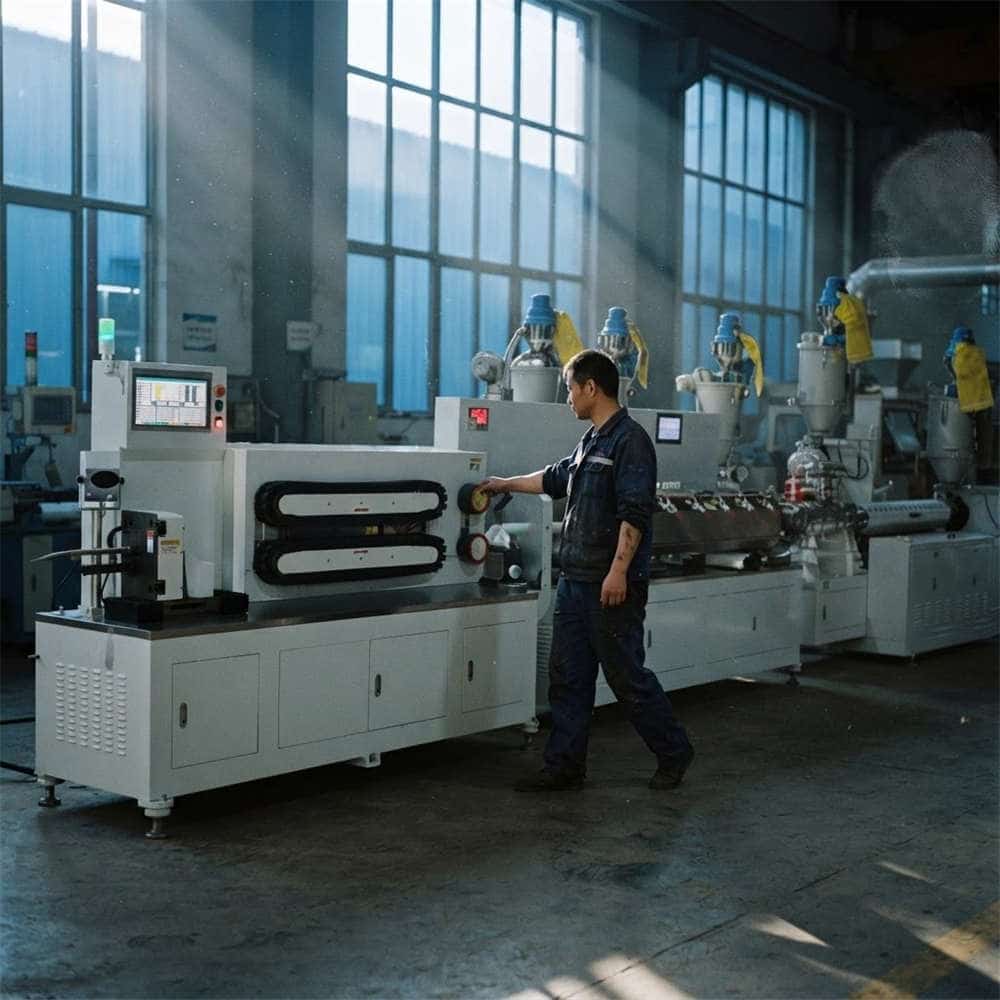
Solving Your Biggest Soft Tube Production Challenges — Starting with the Right Extruder
If you manufacture cosmetic or pharmaceutical soft tubes — or you distribute and source machinery for producers who do — you already know that the extrusion line is where everything either comes together or falls apart.
Inconsistent wall thickness means print registration fails. Poor layer adhesion means barrier performance fails. A poorly calibrated haul-off means your crimping machine rejects tubes all shift. And every one of these problems traces back to the extruder — how it was selected, configured, and set up for your specific application.
This guide cuts through the complexity. It explains exactly how a China plastic extruder works for soft tube production, what each component does, how to match a machine to your materials and compliance requirements, and what separates a line that earns its keep from one that creates constant headaches.

1. The Core Machine Components — and What Each One Actually Does
A plastic extruder for soft tube production is not a single machine — it is a coordinated system of interdependent stations. Weakness in any one station limits the entire line. Here is what each component does, and why it matters specifically for cosmetic and pharmaceutical tube output.
Extruder Screw & Barrel
The screw is a helical metal shaft that rotates inside a heated cylindrical barrel. As resin pellets are fed into one end, the screw pushes them forward through progressively narrower flights — melting, mixing, and building pressure along the way. For multi-layer soft tubes using materials like LDPE (Low-Density Polyethylene — a soft, flexible plastic used in most cosmetic tubes), EVOH (Ethylene Vinyl Alcohol — a barrier resin that blocks oxygen and extends shelf life), or PP (Polypropylene — a stiffer resin used for tube shoulders and caps), screw geometry must be matched to each resin’s melt flow behavior. A barrier screw designed for LDPE will degrade EVOH if used without proper zone separation.
Co-Extrusion Die Head
Co-extrusion is the process of pushing two or more different plastic materials through the same die simultaneously, so they fuse into a single multi-layer tube wall before they cool. The die head is the precision heart of this process — it distributes each layer in the correct thickness and sequence. For a standard 5-layer pharmaceutical tube (typically PE / tie / EVOH / tie / PE), the die head must maintain layer-to-layer concentricity within ±0.05mm. Any deviation at this stage cannot be corrected downstream.
Vacuum Sizing & Cooling Tank
As the molten tube exits the die, it is still soft and shapeless. The vacuum sizing unit is the first dimensional control point: it draws the tube against a precision-machined sizing sleeve using controlled vacuum pressure, establishing the tube’s outer diameter while it is still pliable. The cooling tank that follows — usually a water bath with spray bars — drops the tube temperature rapidly enough to lock in the dimensions before haul-off tension can cause deformation. Inadequate vacuum or inconsistent water temperature at this stage is the most common cause of tube ovality (where circular cross-sections become oval) — a defect that causes immediate problems at the crimping station.
Haul-Off Unit (Puller)
The haul-off unit grips the cooled tube with rubber-tracked belts and pulls it down the line at a precise, constant speed. The relationship between haul-off speed and die output rate is what controls wall thickness: pull faster, and the tube wall thins; pull slower, and it thickens. For pharmaceutical tubes where wall thickness must stay within ±5% of specification, haul-off speed must be held to within fractions of a meter per minute — typically managed by closed-loop encoder feedback from an in-line gauge.
Cutting System
Flying saw cutters or rotary blade systems cut the continuous tube into individual blanks at the specified length. For cosmetic tubes, a clean, perpendicular cut with no burring or deformation is critical — any roughness at the cut edge creates problems during tube heading, shoulder injection, and cap threading. Servo-driven cutters with encoder synchronization deliver cut-length accuracy to ±0.2mm.
Accumulator
When an inline printing or sealing station temporarily pauses the take-up of tube blanks, the accumulator provides a buffer — storing a controlled length of tubing so the extruder can continue running at constant output. Without an accumulator, every downstream pause forces an extruder speed change, which destabilizes melt pressure and causes wall thickness variation in the tubes produced during the transition.
PLC + HMI Control System
PLC (Programmable Logic Controller) is the industrial computer that controls all machine functions — temperature zones, motor speeds, sensor responses. The HMI (Human-Machine Interface) is the touchscreen panel through which operators view and adjust those settings. For a production line running 20+ different tube SKUs, the ability to save complete parameter sets (temperature profiles, haul-off speed, vacuum levels, layer thickness targets) as named recipes — and recall them with a button press — is what keeps changeover time under 30 minutes instead of three hours.
Gravimetric Feeder Systems
A gravimetric feeder measures the actual weight of resin being fed into the extruder per unit of time and adjusts feed rate in real time to hit a target. In standard systems, gravimetric feeders achieve dosing accuracy of ±0.2% — meaning in a 5-layer tube where the EVOH barrier layer must be 8% of total wall thickness, the feeder keeps it between 7.84% and 8.16%. Volumetric feeders, which measure by volume rather than weight, typically deliver only ±1–2% accuracy — and in pharmaceutical barrier tubes, that variance is the difference between a compliant product and a rejected batch.
In-Line Gauging Sensors
Laser-based wall thickness gauges measure the tube wall continuously as it exits the cooling tank — typically at 100–1000 measurements per second. When thickness drifts outside the set tolerance, the gauge sends a correction signal to the haul-off speed controller, closing the loop automatically. This is the difference between discovering a thickness issue in a QC lab six hours after it started, and correcting it within the same minute it begins.
Hygienic Design Features
For pharmaceutical-grade production, all surfaces that contact or are near resin pathways must be smooth, crevice-free, and made from materials that won’t react with the polymers or shed particles. Stainless steel contact surfaces, sealed enclosures around the feed throat, and easily disassembled components for cleaning are not optional extras in pharmaceutical environments — they are baseline design requirements under GMP.

2. How the Extrusion Process Works: From Resin Pellet to Print-Ready Tube
Understanding the process sequence helps you diagnose where problems originate — and ask better questions when evaluating a new machine. Here is the full workflow for a multi-layer co-extrusion soft tube line:
- Resin Feeding: Virgin resin and optional recyclate (rPE) are loaded into individual hoppers for each extruder. Gravimetric feeders meter each material at the target weight-per-hour rate. Moisture-sensitive resins like EVOH are pre-dried in desiccant dryers to below 0.03% moisture — wet EVOH degrades in the barrel and produces bubbles and discoloration in the tube wall.
- Melting and Homogenization: Each extruder melts its assigned resin through a temperature-controlled zone profile. For a typical LDPE soft tube, zone temperatures progress from approximately 150°C at the feed throat to 180–195°C at the die adapter. Precise zone control — validated with external thermometers, not just controller readings — prevents both under-melting (causing gels and unmelted particles) and over-melting (causing thermal degradation, especially in EVOH and barrier resins).
- Co-Extrusion Die Forming Multi-Layer Parison: The individual melt streams from each extruder converge inside the die head. The die distributes each layer around a central mandrel. The parison (the continuous tube of molten plastic emerging from the die, before any cooling or sizing) exits with all layers already fused but still in a molten, formable state.
- Tube Inflation and Vacuum Calibration: The parison is drawn into the vacuum sizing sleeve. Controlled internal air pressure keeps the tube inflated against the sleeve interior while vacuum pulls the outer surface to the sleeve’s precision bore. This dual-pressure approach is what achieves consistent outer diameter and roundness simultaneously.
- Cooling and Stabilization: The sized tube travels through the cooling tank. Water temperature, flow rate, and spray bar positioning determine how quickly the tube reaches dimensional stability. Tube wall temperature must drop below the resin’s Vicat softening point before haul-off tension is applied — otherwise tension will distort the still-soft tube wall.
- Haul-Off and Diameter Control: The haul-off unit pulls the cooled tube at the set speed. In-line laser gauging continuously measures wall thickness. Any detected deviation triggers an automatic haul-off speed correction to bring wall thickness back to target.
- In-Line Printing (If Required): Some lines include an in-line flexographic, offset, or hot-stamp printing station that decorates the tube body before cutting. This eliminates a separate printing operation downstream and improves registration consistency.
- Accumulation and Cutting: The accumulator manages continuous tube flow while the cutter indexes. The servo-driven cutter severs the tube at the target length, producing individual blanks with clean, perpendicular ends.
- Quality Inspection: Vision cameras or human QC checkpoints verify print registration, cut-end quality, and surface appearance. Rejected tubes are diverted before entering the downstream process.
- Output — Ready for Heading, Filling, and Crimping: Tube blanks are ready for the shoulder injection station (where the tube head is formed), then filling, then sealing — completing the soft tube as a finished package. For a full view of that downstream process, Miyoda’s tube heading and shoulder machine range integrates directly with extrusion line output.
3. What You Can Actually Produce: Soft Tube Product Range
The range of soft tubes a well-configured extrusion line can produce is broader than most buyers initially expect. The key variable is configuration — screw design, die head layer count, and material compatibility determine what each line can and cannot run.
| Tube Type | Layer Structure | Primary Application | Key Production Requirement |
|---|---|---|---|
| Monolayer PE Tube | 1-layer LDPE or HDPE | Basic cosmetics (hand cream, shampoo) | Consistent wall, high clarity |
| 3-Layer Barrier Tube | PE / EVOH / PE | Sensitive cosmetics, fragrances | Oxygen barrier, layer adhesion |
| 5-Layer Pharma Tube | PE / tie / EVOH / tie / PE | Pharmaceutical ointments, gels | GMP design, tight gauge control |
| Recyclable Mono-Material Tube | All-PE (MDO-PE or rPE) | Sustainable cosmetic brands | Recyclability certification, clarity |
| High-Gloss Print-Ready Tube | Multi-layer with LDPE outer | Premium cosmetic branding | Surface finish, print adhesion |
| Opaque / Colored Tube | PE with masterbatch outer layer | Sunscreen, body lotion packaging | Color consistency, UV stability |
Industry insight worth noting: the recyclable mono-material tube segment is the fastest-growing category in soft tube production. The global mono-material packaging market is valued at USD 4.9 billion in 2025 and is projected to reach USD 7.8 billion by 2035. Brands responding to EU Green Deal requirements and consumer pressure are actively switching from multi-material laminate structures to all-PE designs — and their machine suppliers need to be ready for it.
4. Critical Terminology Every Buyer, Distributor, and Agent Must Know
When you’re evaluating machines, talking to engineers, or advising customers on specifications, these are the terms that come up in every conversation. Knowing them prevents misunderstandings that lead to wrong machine selections.
Co-Extrusion
The simultaneous extrusion of two or more polymer layers through a single die, fusing them into one tube wall. Enables combining soft PE layers with rigid barrier layers like EVOH in one continuous process. Example: a 5-layer tube with an inner EVOH barrier sandwiched between adhesive tie layers and outer PE layers.
Parison
The continuous, unsupported tube of molten plastic emerging from the die before it is calibrated and cooled. The parison is still fully formable at this point — its final dimensions are set in the vacuum sizing unit, not the die.
Drawdown Ratio (DDR)
The ratio between the die gap area and the final tube wall cross-section area. A high DDR means the tube wall is being stretched significantly, which orients the polymer chains and increases tensile strength — but also increases sensitivity to melt temperature variation.
Melt Fracture
A surface defect where the tube outer surface appears rough, wavy, or shark-skinned. Caused by excessive shear stress at the die lip — usually from too-high output rate, too-low die temperature, or a damaged die land surface. In cosmetic tubes, even mild melt fracture ruins print quality.
Layer Adhesion
The bond strength between adjacent layers in a co-extruded tube wall. Poor adhesion — usually caused by incompatible materials without proper tie resin layers, or incorrect melt temperature — results in delamination that appears as whitening, bubbling, or layer separation under squeeze testing.
Gauge Variation
The deviation in wall thickness around the circumference or along the length of a tube. For ISO 11607-compliant pharmaceutical packaging, gauge variation must stay within ±5% of nominal wall thickness. Even for cosmetic tubes, variation above ±8% causes visible inconsistency in tube shoulder formation.
L/D Ratio
The length-to-diameter ratio of the extruder screw. A screw with L/D 30:1 is 30 times as long as its diameter. Higher L/D provides more melting length and mixing — important for processing EVOH and other engineered resins that need thorough homogenization before the die.
GMP Compliance
Good Manufacturing Practice — the regulatory standard that governs how pharmaceutical products and their packaging are produced. A GMP-compliant extruder includes documented design controls, traceable materials, cleanable surfaces, and electronic production records. Without it, pharmaceutical customers cannot use the machine in a regulated production environment.
IQ / OQ / PQ
Installation Qualification, Operational Qualification, Performance Qualification — the three-stage validation process required by pharmaceutical GMP. IQ confirms the machine was installed correctly. OQ confirms it operates within specified parameters. PQ confirms it consistently produces conforming product under actual production conditions.

5. How to Select the Right China Extruder for Your Application
The most expensive mistake in machinery procurement is buying a machine that almost fits your application. Here are the selection criteria that matter most for soft tube extrusion.
Match screw design to your material set. If you plan to run EVOH barrier resins, the screw configuration for each extruder in your co-ex stack must be appropriate for that specific resin — EVOH runs at lower shear and tighter temperature tolerances than LDPE. A screw designed for LDPE will thermally degrade EVOH, producing yellow discoloration and bubble defects in the barrier layer. Ask suppliers specifically what screw design they provide for each layer material.
Choose die head type based on layer count and clarity requirements. Spiral mandrel dies provide superior melt distribution and produce higher clarity in transparent tubes. Stack dies are more common in lower-cost machines and are acceptable for opaque tubes but show more weld lines in transparent applications. For high-clarity cosmetic tubes, spiral mandrel is the correct choice.
Verify CIP or full disassembly capability for pharmaceutical use. CIP (Clean-In-Place) systems allow the die head and adapter to be flushed with cleaning compound without full disassembly — saving significant downtime during material changeovers. For pharma production, the ability to fully disassemble and validate-clean all product-contact surfaces is a baseline GMP requirement. If a supplier cannot show you how this is done, that is a significant red flag.
Confirm compatibility with your downstream printing and filling lines. The extruder’s PLC must communicate with the printing, heading, and filling stations using compatible protocols — typically EtherNet/IP, Modbus TCP, or PROFINET. A mismatch here means either a custom integration project (expensive and time-consuming) or a line that cannot be synchronized (resulting in accumulator overruns and scrap bursts).
Ask specifically about IQ/OQ documentation packages. If you have pharmaceutical customers, the machine must arrive with IQ/OQ documentation. This includes engineering drawings, material certificates for all product-contact parts, calibration records for all sensors, and a FAT (Factory Acceptance Test) report. Suppliers who have not done this before will not be able to produce it under time pressure after delivery.
For a structured procurement decision framework, Miyoda Packaging Machinery has published a detailed buyer’s guide to plastic tube extrusion machine selection covering technical specs, automation levels, and total cost of ownership — designed specifically for cosmetic and pharmaceutical producers.
6. Common Pain Points — and How the Right Extruder Solves Them
These are the problems production managers and quality teams report most frequently on soft tube extrusion lines — and what actually fixes them.
| Problem Observed | Root Cause | Machine-Level Solution |
|---|---|---|
| Layer delamination under squeeze test | Wrong tie resin or die temperature outside compatibility window | Co-ex die with optimized flow channels; tie layer validated to material pair |
| High scrap rate (>3% of output) | Wall thickness drifting outside spec, undetected until QC | Closed-loop laser gauging with automatic haul-off correction |
| 3+ hour changeovers between SKUs | Manual parameter re-entry, no die quick-release, no purge protocol | Recipe-based HMI, quick-change die adapters, documented purge procedures |
| Pharma customer rejected machine for GMP audit | No IQ/OQ documentation, non-hygienic design | GMP-compliant machine design, stainless contact surfaces, full documentation package |
| Print misregistration after tube cutting | Haul-off speed variation causing tube length inconsistency | Encoder-feedback haul-off with ±0.2mm cut-length accuracy; accumulator buffer |
| Black specks in tube wall | Material degradation in die adapter or screw dead zones | Streamlined die flow paths, regular purge cycles, thermocouple validation |
7. Why China-Built Extruders Are a Smart Investment — When You Choose Correctly
The “China-made” label has evolved significantly in the past decade, particularly in precision packaging machinery. The headline cost difference between a comparable Chinese and European soft tube extrusion line typically ranges from 30–50% — with Chinese lines starting from approximately $60,000–$120,000 for a complete single-layer setup, versus $180,000–$350,000+ for equivalent European configurations.
But the cost difference is only part of the story. What has changed is the level at which Chinese manufacturers now compete on engineering. Leading Chinese extruder suppliers for the cosmetic and pharma tube market now use Siemens or Allen-Bradley PLC platforms, Rexnord or SEW gearboxes, and Moog or Proportional valve hydraulics — the same component brands as European OEMs — combined with locally produced structural components and lower overhead costs.
The practical results for buyers include faster lead times (typically 8–14 weeks versus 20–26 weeks for European lines), stronger customization flexibility for niche applications (airless tube structures, hybrid laminate-extrusion combinations), and responsive technical support — an area where proximity and language matter significantly for Asian markets.
What still varies is documentation capability and compliance experience. Chinese manufacturers with established export business in FDA- and EU-regulated markets will have IQ/OQ templates, CE documentation, and pharma-qualified reference customer lists. Those without this experience will not — and that difference can turn a $90,000 saving on machine price into a $200,000 problem during a pharmaceutical customer’s qualification audit.

8. Integration with Downstream Systems: Building a Complete Line
An extruder that produces perfect tube blanks delivers only part of its value if those blanks then move through a disconnected or inefficient downstream process. The highest-performing soft tube production operations treat the extrusion line and all downstream stations as a single integrated system.
Seamless integration points in a complete soft tube line include:
- In-line or offline tube printing (offset, flexographic, or screen printing) — where the tube OD tolerance from extrusion directly determines print registration consistency. A tube diameter variation of ±0.3mm across a batch causes visible print position drift on high-resolution cosmetic graphics.
- UV curing systems — where cure depth depends on tube wall clarity and surface chemistry, both controlled at the extrusion stage.
- Automatic tube filling and crimping — where tube shoulder concentricity (established at the heading machine) determines seal quality, and tube length consistency (established at the cutter) determines crimp position accuracy.
- Vision inspection and leak testing — where pass/fail criteria are set against the tube specification, and false rejects are reduced when upstream dimensional control is tight.
On the data side, Industry 4.0 integration means connecting the extruder’s PLC data stream to a central MES or SCADA platform. Real-time monitoring of melt pressure, zone temperatures, motor load, and gauge readings gives quality teams the visibility to catch process drift before it creates scrap — and gives management the production data needed for regulatory traceability in pharmaceutical environments.
For a complete view of how extrusion integrates with filling and closing operations, explore Miyoda’s tube filling and closing machine range, which is designed for direct integration with extruded and laminated tube blanks.
9. Watch: Multi-Layer Cosmetic Soft Tube Extrusion Line in Operation
Seeing the process in motion clarifies what the specifications mean in practice. The video below demonstrates a multi-layer PE tube extrusion line producing cosmetic tube blanks — including the co-extrusion die head, vacuum sizing station, cooling tank, haul-off, and cutting system operating in a synchronized sequence.
10. Future-Proofing Your Investment: Sustainability, Automation, and Compliance
The soft tube production landscape is shifting under three simultaneous pressures: sustainability regulations, automation economics, and rising pharmaceutical compliance standards. A machine purchased today needs to be able to respond to all three.
Sustainability: The EU’s Green Deal packaging regulations and major brand commitments to recyclable packaging are accelerating the shift from multi-material laminate tubes to recyclable mono-material structures. Mono-material tube adoption is growing rapidly — and extruders that can process all-PE laminates with MDO-PE (Machine-Direction Oriented PE, a technique that gives PE film the stiffness and clarity normally requiring PET) are already in demand. Ask specifically whether a prospective machine can run these structures before you commit.
Automation: Energy-efficient servo motors with regenerative drives, AI-driven process optimization algorithms that predict thickness drift before sensors detect it, and cloud-based remote monitoring that allows your machine supplier (or Miyoda Packaging Machinery’s technical team) to view live production parameters and troubleshoot without a site visit — these are no longer future features. They are available now and should be part of your procurement evaluation.
Compliance: FDA’s forthcoming updates to 21 CFR Part 211 guidance for pharmaceutical packaging equipment, and the EU’s continued enforcement of GDP and GMP requirements for primary packaging, mean that documentation requirements on machines will increase over the next 5–10 years, not decrease. A machine that cannot generate automated, tamper-evident production records is becoming a liability in regulated markets.
For a deeper look at complete line options and production scalability, the complete tube extrusion production line page on Miyoda’s website covers multi-layer co-extrusion configurations, output rates, and downstream integration options for both cosmetic and pharmaceutical applications.

Glossary of Key Extrusion Terms
- LDPE
- Low-Density Polyethylene. The most common resin for cosmetic soft tubes. Flexible, clear to translucent, excellent sealing characteristics. Melts at 180–200°C in standard tube extrusion.
- EVOH
- Ethylene Vinyl Alcohol. A barrier resin used as a middle layer in multi-layer tubes to block oxygen transmission. Extremely moisture-sensitive — must be dried before processing and kept in a sealed layer away from the tube’s outer and inner surfaces.
- Tie Resin (Adhesive Layer)
- A specialized polymer that bonds incompatible adjacent layers — for example, LDPE and EVOH do not naturally adhere to each other. A tie resin (typically maleic anhydride-grafted polyolefin) is co-extruded as a thin adhesive layer between them.
- MDO-PE
- Machine-Direction Oriented Polyethylene. PE film that has been stretched in one direction to improve stiffness, clarity, and barrier properties — enabling mono-material recyclable tube structures that approximate the performance of multi-layer laminates.
- FAT (Factory Acceptance Test)
- A formal test performed at the machine manufacturer’s facility, before shipment, to verify that the machine meets all agreed specifications. For pharmaceutical customers, FAT is required and the results become part of the IQ documentation package.
- OD Variation
- Variation in tube outer diameter along the length of the extrusion run. Caused by haul-off speed fluctuations, vacuum pressure instability, or melt pressure surging. Must be controlled to below ±0.15mm for tubes used on automatic filling and crimping lines.
Frequently Asked Questions
What types of soft tubes can be produced with a China plastic extruder?
A correctly configured co-extrusion line can produce monolayer PE tubes for basic cosmetics, 3-layer barrier tubes with EVOH for sensitive formulations, 5-layer pharmaceutical-grade tubes with tight gauge control, recyclable mono-material all-PE tubes for sustainable brands, and high-gloss print-ready tubes for premium cosmetic packaging. The determining factor is layer count capability in the die head and material compatibility in the screw configuration — not the country of origin.
Can the same extruder handle both cosmetic and pharmaceutical-grade production?
Yes, provided the machine is designed from the outset for both markets. This means GMP-compliant hygienic surfaces, full IQ/OQ documentation, electronic production records, and validated cleanability of all product-contact components. A machine designed only for cosmetic production cannot be retroactively upgraded to pharmaceutical GMP compliance — the design decisions are made at engineering, not at installation.
How do I ensure consistent layer thickness in multi-layer tube production?
Three systems working together: gravimetric feeders (dosing accuracy to ±0.2%) on each extruder, a precision co-extrusion die head with validated flow channel geometry, and in-line laser gauging with closed-loop feedback to the haul-off speed controller. If any one of these three is absent or poorly calibrated, layer thickness consistency will drift — and in a 5-layer pharmaceutical tube, that means potential barrier layer failure.
What materials are compatible with a China soft tube extruder?
Standard configurations process LDPE, HDPE, LLDPE, PP, EVOH, PVDC, and tie resins. Advanced configurations can also process rPE (recycled polyethylene with up to 30–50% recycled content), bio-based PE, and MDO-PE for mono-material recyclable structures. Each material requires specific screw geometry, temperature profile, and drying conditions — confirm these are addressed in the machine specification before purchase.
How long does installation and commissioning take?
For a single-layer cosmetic tube line with no pharmaceutical documentation requirements, installation and commissioning typically takes 10–14 days on-site. A multi-layer pharmaceutical line with full IQ/OQ validation typically requires 3–5 weeks from machine arrival to production release, including validation protocol execution, deviation investigation, and documentation sign-off.
Can the extruder integrate with existing printing and filling lines?
In almost all cases, yes — provided the PLC platform uses a standard industrial communication protocol. Siemens S7-based PLCs communicate via PROFINET; Allen-Bradley via EtherNet/IP; and most modern Chinese PLCs support Modbus TCP as a minimum. A brief PLC audit by your integrator or the machine supplier before purchase confirms compatibility without guesswork.
What certifications should I require from a China plastic extruder supplier?
At minimum: CE marking (required for import into the EU and many other markets), ISO 9001 quality management system certification for the manufacturer, and material certificates for all product-contact components. For pharmaceutical customers, additionally require: IQ/OQ documentation templates, FDA-compliant design declarations, and reference customer lists from other pharmaceutical packaging producers.
How do I minimize downtime during material or product changeovers?
Three measures have the most impact: recipe-based HMI parameter storage (eliminate manual re-entry of 20+ parameters), quick-release die head adapters (reduce mechanical changeover from 4 hours to under 1), and a documented purge protocol using compatible cleaning compound (prevent material contamination between color or resin changes). A well-prepared changeover on a properly equipped line should be completable in under 30 minutes for same-material, different-color changes.
What is the expected lifespan of a China-built soft tube extruder?
With consistent preventive maintenance — quarterly gearbox oil changes, annual barrel bore measurement, regular thermocouple calibration, and timely replacement of wear components like screw flights and barrel liners — a well-built Chinese extruder has an expected service life of 12–15 years. The machines that fail early are almost always those running without a preventive maintenance program, not those with inherent design flaws.
How can I upgrade my existing extruder for higher output or new materials?
Common upgrade pathways include: screw redesign for new material compatibility (a new screw is significantly cheaper than a new machine), advanced PLC controller retrofit to add recipe storage and data logging, in-line gauging system addition for thickness feedback, and gravimetric feeder installation to replace volumetric systems. For a consultation on what upgrade options apply to your specific machine, contact Miyoda Packaging Machinery’s technical team directly.
Ready to Evaluate Your Next Soft Tube Extrusion Line?
Whether you are planning your first extrusion line, expanding your existing capacity, or sourcing machinery for your clients, the right starting point is a specific technical conversation — not a brochure.
Miyoda Packaging Machinery specializes in complete soft tube production lines for cosmetic and pharmaceutical applications. From tube extrusion machines and co-extrusion die systems through to tube heading, printing, filling, and closing — every station is engineered to work as a coordinated system, not a collection of independent machines.















