Every production line has a moment where a small oversight becomes an expensive problem, and on a cosmetic or pharmaceutical tube packaging line, that moment almost always happens at the sealer. A heating platen that drifted 8°C out of calibration overnight, a pressure roller worn 0.3mm out of spec, a sensor caked in dried adhesive — none of these look dramatic on their own. But each one is the kind of quiet failure that turns into a rejected batch, a line stoppage, or in the worst case, a product integrity complaint that lands on a regulator’s desk.
Tube sealers are mechanically simple compared to a filling line or an extrusion system, which is exactly why maintenance on them gets deprioritized. Yet the sealing station sits at the very last point in the process before a tube leaves the factory. A defect introduced here — a cold-weld seam, a scorched seal shoulder, a leak invisible to the eye but detectable in a vacuum decay test — cannot be corrected downstream. It ships, or it gets scrapped.
This guide walks through the maintenance program that keeps a tube sealer performing at spec: what to check daily, what needs deeper attention weekly and monthly, how to clean the machine without damaging it, how to diagnose the seal defects that show up most often, and how to build the kind of documentation trail that satisfies both your production manager and your next GMP audit. It’s written for the people who actually run these lines — production engineers, maintenance technicians, and plant managers at cosmetic and pharmaceutical manufacturers, as well as the machinery distributors and agents who support them.

Why Tube Sealer Maintenance Matters
A tube sealer creates the final barrier between a filled product and the outside world. That barrier depends on three variables working together: temperature, pressure, and dwell time (the number of seconds the jaws stay in contact with the tube tail, typically between 0.3 and 2.0 seconds depending on material). When any one of those variables drifts even slightly out of its calibrated range, seal quality degrades in a way that is often invisible until a leak test, a customer complaint, or a shelf-life failure exposes it weeks later.
The financial case for preventative maintenance is not abstract. Industry benchmarking on packaging lines consistently shows that facilities running structured maintenance programs achieve Overall Equipment Effectiveness (OEE — a composite score of availability, performance, and quality rate) in the low-to-mid 90% range, while facilities relying on reactive, breakdown-driven maintenance typically settle in the 75–82% range. On a line producing 8,000 tubes per hour, that gap is not a rounding error — it is the difference between roughly 600,000 and 700,000 additional finished tubes per month, without a single dollar of new capital investment.
For pharmaceutical operations specifically, seal integrity is a compliance issue as much as an operational one. A seal failure on a topical ointment tube isn’t just a returned product — it can trigger an investigation, a recall assessment, and a regulatory notification under frameworks like the FDA’s cosmetic manufacturing practice guidelines. Maintenance records become part of the evidence trail that demonstrates your equipment was under control at the time of production.
This guide covers four interlocking disciplines: preventative maintenance schedules that catch small problems before they become downtime, cleaning procedures that protect sealing surfaces without damaging them, troubleshooting logic for the defects that show up most often, and documentation practices that turn maintenance from a scattered set of tasks into an auditable system.
Understanding Your Tube Sealer: Essential Components and Functions
The Core Sealing Mechanism
Every hot-jaw or hot-air tube sealer relies on the same physical sequence, even though the exact mechanism varies by technology. Heating elements bring the sealing surface — either a metal jaw or a stream of directed hot air — to a target temperature that sits within the tube material’s “seal window,” the narrow temperature band where the inner plastic layer softens enough to fuse without scorching or deforming. For a standard LDPE-laminate tube, that window is typically only 40–60°C wide, which is why temperature stability, not just peak temperature, is the specification that actually matters in daily production.
Once the material is softened, a pressure system closes the jaws with a controlled, repeatable force. Too little pressure leaves microscopic gaps in the bond; too much crushes thin-wall tubes or distorts the aesthetic finish that premium cosmetic brands specify in their packaging contracts. The relationship between wall thickness and required pressure is non-linear, which is why a sealer calibrated for a 0.30mm wall tube can produce a visibly different — and weaker — seal on a 0.45mm wall tube without a corresponding pressure adjustment.
Seal quality is not a subjective judgment call; it is measurable against recognized standards. Seal strength peel testing (commonly benchmarked against ASTM F88) and bubble leak testing (per ASTM D3078) define pass/fail thresholds that both cosmetic brands and pharmaceutical quality teams reference in supplier agreements. A sealer that has drifted out of calibration will fail a statistically predictable percentage of production against these thresholds — which is precisely why the maintenance program in this guide exists.
Critical Parts That Require Regular Attention
Four component groups drive the overwhelming majority of sealing problems, and each deserves its own attention rhythm in a maintenance plan.
Heating platens are the highest-wear component on any hot-jaw sealer. Repeated thermal cycling, contact with product residue, and mechanical stress from thousands of daily cycles gradually degrade the surface finish and the accuracy of the embedded thermocouple. A platen with visible pitting or discoloration is already producing inconsistent seals, even if the digital display still reads the correct setpoint.
Pressure rollers and jaw inserts wear unevenly, especially on lines running multiple tube diameters. A roller that has worn 0.2–0.3mm out of round will produce a seal that looks fine on one side of the tube and weak on the other — a defect pattern that is easy to misdiagnose as a temperature problem if the wear pattern isn’t checked directly.
Cooling systems stabilize the seal geometry immediately after the heat-and-pressure cycle. If the cooling airflow becomes uneven — often from dust accumulation in the vents — the seal can re-soften slightly before it fully sets, producing wrinkles or shoulder distortion that only becomes visible under close inspection.
Control panels and sensors are the least visible point of failure but often the most consequential. A thermocouple reading that has drifted 3–5°C from actual jaw-surface temperature will not trigger an alarm; it will simply produce a slow, creeping decline in seal quality that shows up first as a statistical trend in your reject data, long before it becomes an obvious visual defect.
Preventative Maintenance: Your First Line of Defense
A structured maintenance schedule turns unpredictable breakdowns into planned, low-impact maintenance windows. The table below summarizes the cadence; the sections that follow explain the reasoning behind each task.
| Frequência | Core Tasks | Primary Risk If Skipped |
|---|---|---|
| Daily | Visual inspection, temperature/pressure verification, surface cleaning | Residue buildup causing weak or contaminated seals |
| Semanal | Deep-clean heating elements, lubrication, electrical connection checks, sample seal testing | Undetected drift in seal strength across a full week of production |
| Mensal | Full diagnostics, gasket replacement, conveyor/drive inspection, metrics logging | Compounding mechanical wear leading to unplanned breakdowns |
| Quarterly/Annual | Professional calibration, scheduled component replacement, full performance audit | Calibration drift invisible to in-house checks; warranty and compliance gaps |
Lista de verificação de manutenção diária
Before the first tube runs each shift, a short visual and functional check catches the majority of issues before they affect production. This should include:
- A visual inspection of jaw surfaces, tube guides, and conveyor paths for residue, damage, or misalignment from the previous shift.
- Verification that the displayed temperature setpoint matches the validated recipe for the SKU about to run — not just that a number is showing, but that it’s the correct number.
- A quick check of pressure settings against the recipe specification, particularly after any tooling change.
- Cleaning of sealing surfaces to remove any dried adhesive, product film, or dust that accumulated since the last shutdown.
Weekly Maintenance Tasks
On a weekly cycle, maintenance moves from surface-level checks to tasks that require the machine to be powered down and partially disassembled. This includes a deep clean of heating elements to remove baked-on residue that daily wiping doesn’t reach, lubrication of designated points using only the lubricant grade specified in the equipment manual (food-grade or pharmaceutical-grade H1-rated lubricants are typically required to avoid contamination risk), and a physical check of electrical connections and safety interlocks to confirm nothing has loosened from vibration. Running a small batch of sample tubes and checking seal width with digital calipers against the validated specification is the single most useful five-minute task in this entire schedule — it catches drift before it becomes a batch-wide defect.
Monthly Maintenance Schedule
Monthly maintenance is where comprehensive diagnostics happen. This is the point to run full system diagnostics against calibrated reference standards rather than the machine’s own displayed values, replace any gaskets or seals showing early signs of wear, inspect conveyor belts and drive systems for tension and alignment issues, and log performance metrics — seal strength averages, reject rates, cycle times — so that trends become visible over time rather than only in hindsight.
Quarterly and Annual Maintenance
Quarterly and annual maintenance typically require either a professional service visit or calibrated instruments that most in-house teams don’t keep on hand. This is when jaw surface inserts (Teflon tape or ceramic plates) get replaced on a cycle-count basis — commonly every 2–4 million seal cycles — heating elements are assessed against their rated service life of roughly 12,000–20,000 hours, and a full performance audit compares current output against the machine’s original commissioning baseline. This is also the point to update maintenance logs and calibration certificates, which becomes essential documentation if your facility undergoes a GMP audit.
A quick glossary note: PID control (Proportional-Integral-Derivative) is the control-loop algorithm most modern sealers use to hold temperature steady. It continuously measures the gap between actual and target temperature and adjusts heating output to close that gap with minimal overshoot. A sealer with well-tuned PID control should recover to setpoint within half a second after each seal cycle — if recovery is slower, that’s a sign the control loop needs retuning, not just a sign the heater is weak.
Cleaning Procedures: Keeping Sealing Surfaces Pristine
Pre-Cleaning Safety Protocols
Before any cleaning begins, the equipment must be fully powered down — not just paused. Hot-jaw sealing surfaces routinely operate in the 130–190°C range, hot enough to cause a full-thickness burn in under a second of contact, so allowing 15–30 minutes of cooling time before touching any jaw surface is non-negotiable. Standard lockout procedures (following frameworks such as OSHA’s control of hazardous energy guidance) should be applied before any technician’s hands go near the jaw mechanism, and appropriate PPE — heat-resistant gloves at minimum — should be standard issue for this task, not an occasional precaution.
Step-by-Step Cleaning Process
Once the machine is cool and safely isolated, cleaning follows a consistent sequence: remove dried adhesive and product residue with a lint-free cloth and an appropriate solvent (isopropyl alcohol is standard for most cosmetic residues), clean heating platens carefully to avoid scratching the surface finish that gives premium tubes their clean seal aesthetic, decontaminate pressure rollers with attention to any grooves where residue tends to collect, and address stubborn buildup with a non-abrasive scraper rather than metal tools that can permanently damage the jaw surface.
Cleaning Different Material Types
Cosmetic product residue — creams, gels, and lotions — generally responds well to IPA-based cleaning without special handling. Pharmaceutical compounds, particularly those with active ingredients or preservative systems, sometimes require a different solvent to fully remove without leaving a film that could cross-contaminate the next batch. This is where a documented, product-specific cleaning validation matters: what works for a vitamin-C serum tube may leave residue behind on a corticosteroid ointment line, and that residue becomes a genuine cross-contamination risk on the next SKU run.
Post-Cleaning Verification
Cleaning isn’t complete until it’s verified. That means visually inspecting surfaces under good lighting, confirming the equipment responds correctly when powered back on, running a small batch of quality-assurance samples before committing to full production, and logging the cleaning as complete with a timestamp and technician initials — a detail that seems minor until an auditor asks for it.

Troubleshooting Common Sealing Issues
Most sealing defects trace back to one of five root causes, and diagnosing the right one quickly is what separates a five-minute fix from a half-shift shutdown.
| Defeito | Most Likely Cause | Quick Diagnostic | Typical Fix |
|---|---|---|---|
| Weak or inconsistent seal | Temperature or pressure drift | Check jaw-surface temp with a contact thermometer, not just the display | Recalibrate; replace worn jaw inserts |
| Leakage / integrity failure | Contamination on seal zone, wrong dwell time | Inspect tube tail before sealing; review dwell-time setting | Adjust dwell time; clean fill nozzle height |
| Burn marks / discoloration | Temperature too high, dwell too long | Measure actual jaw temperature directly | Reduce temperature in small increments; check thermocouple calibration |
| Mechanical jam / conveyor stop | Debris, misalignment, worn guide | Clear path safely; inspect drive belt tension | Lubricate and realign; replace worn guides |
| Electrical/control fault | Loose connection, sensor drift | Check connections; test sensor against reference | Reset controller; replace faulty sensor |
One diagnostic habit worth building into daily practice: when seal quality drifts mid-run, check whether the temperature deviation is trending steadily in one direction or oscillating back and forth. A steady upward drift with a constant setpoint usually points to thermocouple calibration drift — replace the sensor. A cyclical oscillation usually means the PID gain settings need retuning for the current thermal mass of the machine. Knowing which pattern you’re looking at turns a multi-hour root-cause investigation into a five-minute fix.
For electrical faults specifically, resist the temptation to keep resetting the control panel as a first response. If a fault recurs after a single reset, that’s the signal to stop production and call in a technician rather than cycling the machine repeatedly, which can mask a developing failure until it becomes a complete breakdown.
Extending Equipment Lifespan: Long-Term Care Strategies
Material Selection and Compatibility
Not every tube material behaves the same way under heat and pressure, and mismatching sealing technology to tube construction is one of the most expensive — and most common — errors in tube packaging operations. PBL (plastic barrier laminate) tubes seal reliably with standard hot-jaw or hot-air methods. ABL (aluminum barrier laminate) tubes carry additional thermal mass from the foil layer and typically need slightly longer dwell times to achieve full fusion on the inner layer. Before committing any new tube material to full production, run a small validation batch and check seal strength against your specification — a mismatch discovered after 50,000 tubes are already produced is a far more expensive mistake than one caught in a 200-tube trial.
Operational Best Practices
Running a sealer consistently within its rated speed and load range, rather than pushing it to peak throughput on every shift, extends component life measurably. Following documented startup and shutdown sequences — allowing proper warm-up before production and a controlled cool-down before cleaning — prevents the thermal shock that shortens heating element life. Operator training matters here as much as the hardware itself: a well-trained team that understands why a gentle startup matters will protect the equipment even when nobody’s watching.
Environmental Factors Affecting Performance
Temperature and humidity in the production environment directly affect sealing consistency. Most manufacturers target facility conditions between 18–25°C and 40–60% relative humidity, which keeps both the tube material and the machine’s electronics operating within their designed range. Dust is a quieter enemy — it accumulates in cooling vents and on sensor surfaces, degrading performance gradually rather than causing an obvious failure. Electrical supply stability is worth monitoring too; voltage fluctuations that seem minor to a facility’s general power grid can cause measurable temperature control drift on a precision heating system.
Replacement Parts and Upgrades
Genuine, manufacturer-specified components consistently outperform generic aftermarket substitutes on wear parts like jaw inserts, thermocouples, and gaskets — the tolerances on these parts are tight enough that a slightly-off substitute can introduce the very inconsistency a maintenance program is designed to prevent. When evaluating whether to keep repairing an aging sealer or invest in a refresh, the honest comparison is total cost of ownership over the next 3–5 years, not just the sticker price of a replacement part. A detailed breakdown of this calculation — covering CapEx versus OpEx, energy consumption, and reject-rate cost — is covered in depth in Miyoda’s cosmetic tube sealing machine buyer’s guide, which is a useful reference even for teams not currently shopping for new equipment.

Creating a Maintenance Documentation System
Tracking Maintenance Activities
A maintenance program that isn’t documented is a maintenance program that doesn’t fully exist — at least not in the eyes of a quality auditor. Establishing a maintenance log (digital or paper, though digital systems make trend analysis considerably easier) that records every service date, every procedure performed, and every seal-quality metric checked creates both accountability and a compliance record. For pharmaceutical operations working within a validated quality system, this documentation discipline echoes the principles laid out in ISPE’s GAMP 5 guidance for maintaining computerized and equipment systems in a state of control.
Building a Spare Parts Inventory
Downtime is rarely caused by equipment unreliability alone — it’s far more often caused by not having the right part on the shelf when something fails. Keeping heating element seals, gaskets, pressure rollers, and fuses in stock, stored in a dry, temperature-controlled area, turns a potential multi-day shutdown into a same-shift repair. Any critical wear component with a supplier lead time longer than a few weeks belongs in your own inventory, not on backorder.
Training Your Team on Maintenance
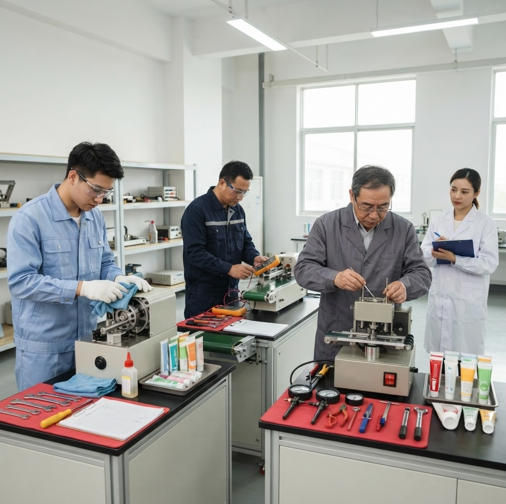
Standard operating procedures only protect a production line if the people running it actually follow them consistently, which means training has to go beyond a one-time orientation. Visual guides and checklists posted at the machine, a certification process that confirms an operator actually understands the procedures rather than just having sat through a session, and periodic refresher training all contribute to a culture where preventative care becomes routine rather than an afterthought squeezed in when time allows.

When to Call Professional Service Technicians
Recognizing Problems Beyond In-House Expertise
Some issues genuinely require a specialist: complex electrical faults that don’t respond to standard resets, calibration work requiring traceable reference instruments your facility doesn’t own, any repair still covered under warranty, or a performance issue that’s affecting multiple SKUs simultaneously rather than one isolated recipe. Attempting an in-house fix on any of these can quietly void a warranty or, worse, mask a deeper mechanical problem until it fails at the worst possible time.
Choosing Qualified Service Providers
When evaluating a service partner, verify actual certifications and hands-on experience with your specific machine model, get clear written terms on response time (particularly the worst-case commitment, not the average), and weigh the cost of a service contract against the cost of the downtime it prevents. A supplier with mature remote diagnostics — the ability to access the machine’s PLC data remotely — can often resolve a meaningful share of issues without a technician ever driving to the plant, which matters a great deal when a line is down at 2 AM.
Emergency Repair Protocols
When a failure does happen, having a documented emergency contact procedure and a pre-identified temporary production plan (running an alternate line, or a slower manual process for a limited period) prevents a bad situation from becoming a chaotic one. Once repairs are complete, a formal post-repair verification — running sample tubes through leak and strength testing before returning to full production — confirms the fix actually solved the underlying problem rather than just addressing the symptom.
Watch: Basic Tube Sealer Maintenance in Practice
For a practical, hands-on look at the shutdown sequence and cleaning routine discussed above, this walkthrough demonstrates the correct power-down order (heat first, allow 3–5 minutes to cool, then fan, then main power) that protects both the operator and the heating elements: Continuous Band Sealer – Basic Maintenance.
Conclusion: Making Maintenance Your Competitive Advantage
None of the individual tasks in this guide are complicated on their own — wiping a jaw surface, logging a temperature reading, replacing a gasket on schedule. What makes them powerful is doing them consistently, as a system, rather than only when something has already gone wrong. The manufacturers who treat maintenance as a scheduled discipline rather than a reactive scramble are the ones who avoid the 2 AM emergency calls, the batch rejections, and the audit findings that come from equipment nobody was quite keeping track of.
The return on this kind of discipline compounds. A machine maintained on schedule doesn’t just avoid breakdowns — it holds tighter seal tolerances, runs closer to its rated speed, and lasts years longer than one running on a break-fix cycle. Teams working with integrated production lines from suppliers like Máquinas de embalagem Miyoda often build these maintenance schedules directly into their commissioning process, so the habit starts on day one rather than getting introduced after the first breakdown.
Building this into your operation doesn’t require a large capital investment — it requires a checklist, a log, and the discipline to use both every single shift. That’s a genuinely achievable competitive advantage, and it starts with the very next cleaning cycle on your line.
Ready to master your tube sealer maintenance?
Download our detailed maintenance checklist and get instant access to our video tutorial series. Join manufacturers who’ve eliminated unexpected downtime and improved production efficiency — get your free resources today and keep your sealing operations running at peak performance.
Perguntas frequentes
1. How often should I perform maintenance on my tube sealer? Daily visual inspections and surface cleaning are essential, a deeper weekly clean is recommended, monthly diagnostics should be conducted against calibrated references, and quarterly professional servicing helps catch drift that in-house checks can’t detect. The exact schedule should flex with your production volume — a line running three shifts needs tighter intervals than one running a single daily shift.
2. What are the signs that my heating elements need replacement? Watch for inconsistent seal quality despite unchanged settings, visible discoloration or pitting on the platen surface, difficulty holding a stable temperature, and a creeping rise in energy consumption. If seals stay weak even after recalibration, the heating element itself — not the control settings — is usually the culprit.
3. Can I use any lubricant on my tube sealer’s moving parts? No. Use only the lubricant grade specified in your equipment manual. Cosmetic and pharmaceutical packaging equipment typically requires food-grade or pharmaceutical-grade (H1-rated) lubricants specifically to eliminate contamination risk if incidental product contact occurs.
4. How do I prevent product residue buildup on my sealing surfaces? Clean daily after every production run, use a cleaning solvent matched to your specific product formulation, keep temperature settings within the validated range (excess heat bakes residue on rather than allowing it to be wiped away), and consider a protective surface coating on jaws for high-residue products.
5. What should I do if my tube sealer produces weak seals on one side? This pattern almost always points to uneven pressure. Check pressure rollers for uneven wear, confirm the heating platens are parallel and properly aligned, clean both sealing surfaces thoroughly, and if the problem persists after cleaning, have the pressure system professionally recalibrated.
6. Is it safe to perform maintenance while the equipment is powered on? No. Power the equipment down completely, allow sufficient cooling time (typically 15–30 minutes for hot-jaw systems), follow lockout procedures on electrical connections, and use the appropriate PPE before any maintenance work begins near the sealing mechanism.
7. How can I improve seal consistency across different tube materials? Run a material compatibility test before committing any new material to full production, adjust temperature and dwell-time settings specifically for each material type rather than reusing a generic recipe, keep detailed records of the optimal settings you land on, and train operators on the material-specific differences that matter for your product line.
8. What’s the typical lifespan of a tube sealer with proper maintenance? With consistent preventative maintenance, well-built tube sealers commonly run 10–15 years or longer, even though individual wear components — jaw inserts, gaskets, thermocouples — may need replacement every 2–4 years. The equipment investment stays sound as long as the maintenance discipline stays consistent.
9. Should I keep spare parts in inventory, and which ones are most critical? Yes. Priority stock items include heating element seals, gaskets, pressure rollers, and fuses. Store them in a dry, temperature-controlled area with a simple organized inventory system — the cost of holding these parts is almost always lower than the cost of the downtime they prevent.
10. How do I know if my tube sealer needs professional calibration? Schedule professional calibration quarterly as a baseline, and immediately if you notice inconsistent seal quality, temperature fluctuations that don’t resolve with in-house checks, pressure inconsistencies, or after any extended shutdown. Professional calibration equipment reaches a level of accuracy manual checks simply can’t match.
11. Can improper maintenance affect the quality of my cosmetic or pharmaceutical products? Yes, significantly. Poor maintenance leads directly to weak seals, contamination risk, and product integrity failures — outcomes that translate into customer complaints, potential regulatory findings, and real damage to brand reputation. Maintenance isn’t a support function here; it’s a quality control component.
12. What environmental conditions best support tube sealer performance? Aim for facility temperatures between 18–25°C (64–77°F) and relative humidity between 40–60%, protect the equipment from dust and vibration, ensure stable, properly grounded electrical supply, and avoid direct sunlight falling on control panels, which can affect sensor accuracy over time.
13. How do I train new operators on proper tube sealer maintenance? Build a clear standard operating procedure, back it up with visual guides or short video tutorials posted at the machine, run hands-on training rather than classroom-only instruction, require a certification step before an operator works unsupervised, and schedule refresher training on a regular cycle to keep habits consistent.
14. What’s the difference between preventative and predictive maintenance? Preventative maintenance follows a fixed calendar — daily, weekly, monthly tasks regardless of current machine condition. Predictive maintenance uses monitoring data (vibration, thermal patterns, cycle counts) to flag when maintenance is actually needed. The most reliable operations combine both: a fixed baseline schedule plus data-driven alerts for anything trending toward failure early.
15. How can I track maintenance activities and ensure compliance with industry standards? Use a digital maintenance management system or a consistently maintained logbook, record every service date and procedure performed, document seal-quality metrics alongside the maintenance record, track spare parts inventory, and schedule periodic internal audits to confirm your records would hold up against pharmaceutical or cosmetic packaging regulatory review.