
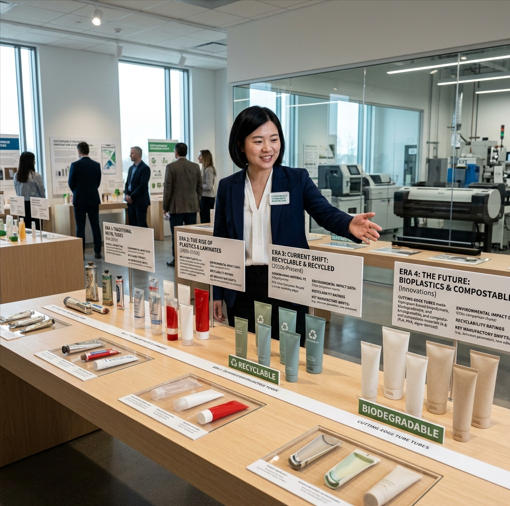
The Hidden Science Behind Every Squeeze
Most people have squeezed thousands of toothpaste tubes in their lifetime without thinking about the engineering behind them. For the manufacturers, distributors, and agents who produce or supply them, that engineering is the entire business.
The global plastic tube packaging market was valued at USD 12.4 billion in 2025 and is projected to reach USD 21.8 billion by 2034, growing at a CAGR of 6.5% (DataIntelo). The tube packaging market more broadly — covering all tube types — reached 55.69 billion units in 2026, growing at 5.17% CAGR to an estimated 71.64 billion units by 2031 (Mordor Intelligence).
Behind every one of those units is a manufacturing process. And that process — specifically the choice between extrusion molding and injection molding — determines your production speed, your material options, your compliance capability, and ultimately your profitability.
This guide is written for clients investing in tube production machinery, and for the distributors and agents who support them. It explains what actually happens inside a modern tube production line, why extrusion dominates the industry, and what the technology choices you make today mean for your business over the next decade.

A modern tube extrusion production line handles everything from raw resin feeding to finished tube sleeve output — in a continuous, high-speed automated flow.
The Evolution of Soft Tube Manufacturing: From Manual to High-Tech
Soft tube manufacturing has gone through three distinct generations in the past 50 years, and each shift was driven by the same pressure: brands demanding more from their packaging, faster and at lower cost.
First generation (1960s–1980s): Aluminum tubes dominated the personal care market. They were formed by impact extrusion of aluminum slugs — a slow, labor-intensive process. They worked, but they could not be heat-sealed, they cracked when folded too many times, and they were expensive to decorate.
Second generation (1980s–2000s): Plastic and laminate tubes replaced aluminum in most cosmetic applications. Early plastic tubes were produced by injection molding — melting plastic pellets into a mold to form a tube body. It worked for short runs and simple shapes, but the process had hard limits on multi-layer capability and cycle time.
Third generation (2000s–present): Extrusion molding displaced injection as the industry standard for high-volume cosmetic and pharmaceutical soft tubes. The shift was not arbitrary. It was driven by three forces: the need for multi-layer barrier structures (impossible to achieve cleanly with injection), the demand for faster output at lower per-unit cost, and increasingly strict regulatory requirements for pharmaceutical-grade tube materials.
Understanding why that shift happened — and why it continues to define the industry — is what separates informed purchasing decisions from expensive mistakes.
Injection Molding: How It Works and Where It Falls Short
Before explaining why extrusion is the industry standard, it is worth understanding what injection molding does and why it became the first widely adopted method for plastic tube production.
How Injection Molding Works
Injection molding for soft tube components follows four steps:
- Melt: Plastic resin pellets are fed into a heated barrel and melted into a viscous liquid
- Inject: The molten plastic is injected at high pressure into a closed metal mold — typically forming the shoulder, nozzle, or cap component
- Cool: The mold is held closed while the plastic solidifies around the mold geometry
- Eject: The mold opens and the finished part is ejected
This process works well for rigid, discrete components: tube shoulders, caps, and closures are still injection-molded today. The problem arises when you try to use injection molding to produce the tube body — the cylindrical sleeve that holds your product.
Why Injection Molding Fails for High-Volume Soft Tube Bodies
| Limitation | Practical Impact |
|---|---|
| One part per mold cycle | Cycle times of 15–45 seconds limit output to 80–240 parts/hour per mold station |
| Runner waste in cold-runner systems | Up to 30–40% of material in each shot is runner material that must be recycled or scrapped |
| Tooling cost | Injection molds cost $10,000–$100,000+; extrusion dies cost $1,000–$15,000 (DFMA Extrusion Cost Guide) |
| Limited multi-layer capability | Creating a co-extruded 5-layer barrier tube via injection is technically complex and commercially impractical |
| Wall thickness consistency | Achieving uniform wall thickness in a thin-walled tube body via injection requires tight mold tolerances and constant process monitoring |
Glossary — Injection Molding: A manufacturing process in which molten plastic is injected under pressure into a closed mold. When the plastic cools and solidifies, the mold opens and the part is ejected. Well-suited for complex, discrete components but limited for continuous tube body production.
For a production line targeting 500,000+ tubes per month — the minimum scale at which most cosmetic and pharmaceutical tube operations become financially viable — injection molding tube body production cannot compete with extrusion on speed, cost, or material flexibility.
Extrusion Molding: The Industry Standard Explained
Extrusion molding is the process of continuously pushing molten plastic through a shaped die to produce a tube of consistent cross-section. Unlike injection molding — which produces one part per cycle — extrusion is a continuous process. The tube does not stop forming between parts.
Here is exactly what happens on a modern cosmetic tube extrusion line:
Step 1: Resin Feeding
Raw material pellets — LDPE, HDPE, MDPE, EVOH, or tie resin layers — are loaded into separate hoppers for each extruder in a co-extrusion setup. Each hopper feeds one layer of the final tube wall. A 5-layer tube (the most common pharmaceutical and premium cosmetic configuration) uses five separate material feeds running simultaneously.
Glossary — Co-extrusion: The simultaneous extrusion of multiple plastic layers through a single die, producing a tube with two or more distinct layers bonded together. Enables barrier, aesthetic, and structural properties to be designed independently into each layer.
Step 2: Melting and Homogenization
Each extruder barrel heats the resin pellets from solid to a controlled melt temperature — typically 160–230°C depending on material type. Screw rotation drives the melt forward while homogenizing it to eliminate cold spots or unmixed material. Temperature zone control in modern extruders maintains melt consistency within ±1°C across the barrel length.
Step 3: Parison Extrusion Through the Die
Glossary — Parison: The continuous hollow tube of molten plastic that exits the extrusion die. Think of it as the raw tube before it is cut, sized, and finished.
The homogenized melt from each extruder is combined in the co-extrusion die head, where all layers merge into a single multi-layer parison. The die geometry determines the tube’s outer diameter and layer thickness distribution. Miyoda Packaging Machinery’s spiral runner die design ensures uniform distribution of each layer with no fusion lines — eliminating the structural weak points that cause burst failures or delamination under squeeze pressure.
Step 4: Vacuum Sizing and Cooling
The hot parison exits the die and passes immediately into a vacuum sizing calibrator — a precisely dimensioned sleeve with vacuum ports that hold the tube’s outer diameter against the calibrator wall as it cools. This step is where OD precision is set.
Wall thickness precision on modern extrusion lines reaches ±0.02 mm — the standard on Miyoda’s tube extrusion machine. That level of consistency means every tube in a production run seats correctly in downstream filling and sealing equipment, with no orientation failures or sealing defects from dimensional variation.
Step 5: Cutting to Length
The continuous tube exiting the cooling section is cut to finished tube length by a servo-driven flying cutter — a blade that moves with the tube at line speed to make a clean, square cut without stopping production. Modern servo-driven cutting systems maintain length tolerance within ±0.5 mm at production speeds up to 10–15 meters per minute.
Step 6: Shoulder Injection and Neck Finishing
The cut tube sleeve is transferred to a tube heading machine, where the open end is heated and a shoulder, nozzle, and threading are injection-molded onto the tube body. This is one of the few steps where injection molding remains essential — the shoulder is a discrete, complex component that must be precisely formed. The tube body and shoulder bond together at this stage, completing the structural tube.
Glossary — Tube Heading Machine: A machine that forms the shoulder, neck, and orifice of a soft tube by injection-molding a plastic shoulder onto one open end of an extruded tube sleeve. The result is a complete tube ready for filling.
Step 7: Real-Time Quality Inspection
Before tubes leave the production line, automated vision systems and dimensional gauges inspect every unit: OD, length, wall thickness at multiple points, surface print quality, and shoulder seating integrity. Out-of-specification units are automatically rejected before they reach the packaging stage.
Step 8: Output Stacking and Downstream Integration
Finished tubes are stacked, oriented for downstream capping and printing, and transferred automatically to subsequent production stations — or packed and prepared for shipment to a tube filling customer.

The co-extrusion die head merges up to 6 material layers simultaneously — each serving a distinct function in the finished tube wall structure.
Why Extrusion Outperforms: 5 Key Advantages for Your Business
Advantage 1: Higher Output Rates
A modern cosmetic tube extrusion line produces tubes at 10–15 meters per minute of continuous tube output. At a standard tube length of 150 mm, that translates to approximately 67–100 tube sleeves per minute, or 4,000–6,000 per hour, from a single extrusion line — before downstream heading and printing.
Injection molding of comparable tube body components achieves approximately 80–240 parts per hour per mold station. For a production target of 5 million tubes per month, the capacity math is straightforward: extrusion requires fewer machines, less floor space, and less energy per unit.
Advantage 2: Lower Material Waste
Extrusion is a continuous process with no runner system. There is no material sprued, gated, or channeled that needs to be removed from the finished product. Scrap on a properly set extrusion line comes primarily from startup and shutdown transitions, and from the rare dimensional reject.
Modern extrusion lines with closed-loop parison control and regrind recycling achieve scrap rates under 3% (E2 Global, ABL vs PBL Guide). Injection molding scrap rates for tube body production regularly run 5–12% when runner waste is included — and can reach 9%+ when real production conditions are tracked against quoted rates (PrintForm Injection Molding Scrap Analysis).
On a 10-million unit annual production run at $0.04 raw material cost per tube, the difference between 3% and 9% scrap is $24,000 per year in material savings — before counting the machine time and labor associated with running and processing the higher scrap volume.
Advantage 3: Multi-Layer Barrier Capability
This is the capability that makes extrusion non-optional for pharmaceutical and premium cosmetic tube production.
A 5-layer co-extruded tube — the standard configuration for oxygen-sensitive pharmaceutical ointments, retinol-based skincare, and active-ingredient cosmetic formulations — has the following architecture:
| Layer | Material | Function |
|---|---|---|
| Outer | LDPE or HDPE | Printability, aesthetics, structural flexibility |
| Tie Layer | Adhesive resin | Bonds PE to EVOH without delamination |
| Core Barrier | EVOH | Oxygen transmission rate (OTR) < 0.1 cc/m²/day |
| Tie Layer | Adhesive resin | Bonds EVOH to inner PE layer |
| Inner | LDPE | Chemical compatibility with product formulation |
The EVOH barrier layer — at just 0.01–0.02 mm thickness — reduces oxygen transmission to levels that protect sensitive pharmaceutical actives for shelf lives of 24–36 months (mPack EVOH Barrier Guide). This performance is only achievable through co-extrusion. It cannot be replicated with injection-molded tube bodies.
Advantage 4: Design Flexibility
Extrusion tooling — the die — costs $1,000–$15,000 versus $10,000–$100,000+ for an injection mold of comparable size. Lower tooling cost means lower barriers to producing custom tube diameters, custom layer configurations, and new neck finishes for specific product requirements.
The practical implication: a tube producer using extrusion can offer their cosmetic brand clients a new tube diameter or layer configuration with a 4–6 week tooling lead time and a manageable tooling investment — rather than a 10–14 week mold development timeline and a $30,000+ commitment before a single tube is produced.
Advantage 5: Lower Maintenance Costs and Fewer Moving Parts
An extrusion line moves material continuously in one direction. The primary moving component is the rotating extruder screw. Compare that to an injection molding press, which cycles between open and closed mold positions under high clamping tonnage — typically 50–500 tons — thousands of times per production shift.
The mechanical wear profile of an extrusion line is significantly simpler. Screw and barrel wear is gradual and predictable. The primary maintenance events on modern extrusion lines are scheduled: screw inspection, thermocouple calibration, die cleaning, and vacuum calibrator maintenance. Most extrusion line suppliers — including the equipment team at Miyoda Packaging Machinery — provide remote diagnostic capability that flags parameter drift before it becomes a production stoppage.
Material Compatibility: Matching Your Process to Your Product
One of the most common specification errors in tube production line procurement is selecting the right process for the wrong material — or the right material in a configuration the machine cannot consistently produce.
Here is a practical compatibility reference:
| Material | Extrusion Compatible? | Notes |
|---|---|---|
| LDPE (Low-Density Polyethylene) | ✅ Yes | Standard cosmetic tube material. Excellent flexibility and printability. |
| HDPE (High-Density Polyethylene) | ✅ Yes | Stiffer wall for products requiring tube shape retention. |
| MDPE (Medium-Density Polyethylene) | ✅ Yes | Balance of flexibility and stiffness. Less common than LDPE/HDPE. |
| EVOH (Ethylene Vinyl Alcohol) | ✅ Yes (co-extrusion) | Barrier layer in 3, 5, or 6-layer configurations. Cannot be extruded alone — requires bonding tie layers. |
| PP (Polypropylene) | ✅ Yes | Higher heat resistance, common in hot-fill applications. Less flexible than PE. |
| PCR (Post-Consumer Recycled Resin) | ✅ Yes | Compatible with twin-screw extruders. Quality depends on PCR resin specification and blend percentage. |
| Bio-based PE | ✅ Yes | Chemically identical to fossil-based PE, compatible with same extrusion parameters. Market valued at USD 345.6M in 2025 (Future Market Insights). |
| Aluminum Laminate (ABL) | ✅ Yes (laminate line) | ABL tube bodies use a laminate sheet welding process, not co-extrusion. Requires a dedicated laminate tube making machine. |
Glossary — ABL (Aluminum Barrier Laminate): A tube material construction using layers of polyethylene laminated around an aluminum foil core. Provides complete light and oxygen barrier. Processed on laminate tube making lines — a distinct machine category from co-extrusion lines.
For clients unsure whether their product formulation requires co-extruded PE/EVOH or full ABL barrier protection, the decision rule is practical: if your formulation is oxygen-sensitive or requires light blocking (common in pharmaceutical ointments and photosensitive cosmetic actives), specify ABL. If recyclability is a commercial requirement and barrier performance is moderate, specify co-extruded PE/EVOH. A tube production machinery supplier with both co-extrusion and laminate tube making capability — such as Miyoda Packaging Machinery — can model the material options against your formulation and volume requirements before you commit to a line configuration.
Quality Control in Tube Production: Ensuring Consistency at Scale
A tube that passes visual inspection but has a wall thickness 0.08 mm below spec will fail under the squeeze pressure of a high-speed filling machine nozzle. That failure does not happen in incoming inspection — it happens mid-production, contaminating the fill nozzle, stopping the line, and generating a non-conformance report that in pharmaceutical production may require batch quarantine.
Modern extrusion lines prevent this with three layers of in-line quality monitoring:
Real-Time Dimensional Gauging
Laser micrometers measure tube OD at multiple cross-section points thousands of times per second as the tube passes through the cooling section. Any deviation beyond tolerance triggers an automatic parison control adjustment — modifying the die gap to correct wall thickness in real time, without stopping production.
This closed-loop control is what makes ±0.02 mm wall thickness precision achievable at 15 meters per minute. Without it, thermal drift, resin viscosity variation, and ambient temperature changes would accumulate into dimensional variation that shows up as production rejects rather than process corrections.
Vision Inspection Systems
Automated camera systems inspect every tube sleeve for:
- Surface defects (streaks, gels, pinholes, contamination)
- Print registration accuracy (critical for multi-color printing on decorated tube stock)
- Shoulder seating integrity (after the heading stage)
Vision inspection at production speed can inspect 100% of output — unlike statistical sampling, which misses defect clusters between sample intervals. Pixargus and similar inline vision platforms (Pixargus Inline QC) detect surface deviations at sub-millimeter scale, at production line speed.
Leak Testing and Seal Integrity Verification
Before tubes leave the production floor, automated leak testing verifies that the tube body/shoulder bond and the orifice seal are intact. Typically performed on a statistical sample basis using vacuum decay or positive pressure hold tests — the same methods used in pharmaceutical packaging validation protocols.
For distributors and agents, the practical value of this QC infrastructure is the answer to the client question: “What is your defect rate?” A modern extrusion line with closed-loop process control and inline vision inspection achieves incoming defect rates at the filling customer of <0.5% — compared to 1–3% for lines without real-time monitoring.

Inline laser gauging and vision inspection catch dimensional and surface defects at production speed — before they reach your filling line.
Sustainability and Waste Reduction: Meeting Market and Regulatory Demands
Sustainability is no longer a brand preference in packaging. For major retail and pharmacy chains, it is a supply qualification requirement. For pharmaceutical companies in EU markets, the EU Packaging and Packaging Waste Regulation (PPWR) is introducing mandatory recycled content and recyclability standards on a fixed timeline.
Extrusion — and specifically modern co-extrusion technology — gives tube producers practical tools to meet these demands without compromising product performance.
Mono-Material PE Tubes: Recyclable Without Barrier Compromise
The traditional obstacle to soft tube recyclability was the mixed-material construction of most barrier tubes. ABL tubes (aluminum + plastic) cannot be sorted or recycled in standard plastic streams. Classic multi-layer PBL tubes with incompatible polymers face the same problem.
Mono-material PE tubes — where the entire tube including cap and shoulder is made from the same polyethylene family — are recyclable in standard PE recycling streams. Modern co-extrusion enables EVOH to be incorporated as an ultra-thin barrier layer within an otherwise mono-PE structure. The EVOH content is low enough (typically 3–5% of total tube weight) that the tube qualifies as recyclable under current EU and UK recycling guidelines (Berlin Packaging Mono-Material Guide).
Post-Consumer Recycled (PCR) Content
Miyoda Packaging Machinery’s tube extrusion lines are fully compatible with 100% PCR resin content processing. Depending on the application and resin specification, PCR content at 25%, 50%, or 100% blend ratios is achievable while maintaining dimensional consistency and barrier performance. This capability positions tube producers to supply cosmetic brands with active recycled content commitments to major retail partners.
Closed-Loop Regrind Systems
Production trim and startup scrap — the short tube sections produced during line startup transitions and format changeovers — are granulated and re-fed into the extruder as regrind material, typically blended at 5–10% with virgin resin. On a 10-million unit annual production operation, this regrind recovery can save 150–300 kg of resin per month that would otherwise be landfilled or sold as low-value scrap.
Lighter Tube Designs
Precision parison control — the ability to tightly control wall thickness throughout the tube circumference — allows wall thickness to be minimized to the structural minimum required. Reducing average wall thickness from 0.45 mm to 0.38 mm on a 35 mm diameter tube reduces resin weight per tube by approximately 12%. At 10 million units annually, that is approximately 18 tonnes of resin per year — a direct reduction in material cost, energy consumption, and carbon footprint per tube.
Choosing the Right Production Line: Key Considerations
The right tube extrusion line for your operation depends on four variables that interact with each other:
1. Volume Requirements
| Annual Volume Target | Recommended Configuration |
|---|---|
| < 1 million units | Semi-automatic extrusion line; manual downstream operations |
| 1–5 million units | Fully automatic single-line with PLC control and inline QC |
| 5–20 million units | High-speed dedicated extrusion line with integrated heading, printing, and QC |
| 20M+ units | Multi-line configuration or dual-speed extrusion system |
2. Barrier Requirements
If your product requires protection against oxygen, moisture, or light — pharmaceutical ointments, vitamin C formulations, photosensitive actives — you need multi-layer co-extrusion capability with EVOH or a dedicated ABL laminate tube line. For standard cosmetic creams and gels without sensitive actives, a single-layer or 3-layer LDPE line is sufficient and lower in capital cost.
3. Tube Diameter and Length Range
Most tube production lines accommodate a defined diameter range. Miyoda’s tube extrusion production line handles tube diameters from 16 mm to 60 mm — covering the full range from single-use pharmaceutical ointment tubes (16 mm) to large-format personal care tubes (50–60 mm). Confirm that the equipment you specify covers your full product range, not just your current SKU mix.
4. Automation Level and Total Cost of Ownership (TCO)
Glossary — TCO (Total Cost of Ownership): The full operational cost of a capital investment over its useful life — including purchase price, installation, training, maintenance, energy, consumables, and productivity losses from downtime. TCO is always more meaningful than purchase price alone.
A semi-automatic line may have 40–50% lower purchase cost than a fully automatic equivalent, but if it requires two additional operators per shift, the labor cost differential pays for the automation upgrade within 18–36 months at typical labor rates in most markets.
The checklist questions to ask any machinery supplier before committing to a line:
- What is the line’s rated output speed, and what is its validated real-world output under production conditions?
- What does a format changeover (tube diameter change) require, and how long does it take?
- What is the annual maintenance cost commitment, and what does the spare parts availability guarantee look like for 10 years?
- What validation documentation (IQ/OQ/PQ) does the supplier provide for pharmaceutical applications?
- What remote diagnostic and support capability is available after installation?
The Miyoda tube production line and machinery portfolio covers the full range from entry-level to high-speed fully automated configurations, with application-level specification guidance available before procurement.
Watch: How Toothpaste Tubes Are Made at Scale
Understanding the full production process becomes much clearer when you can see it running. The documentary below shows inside a modern high-volume toothpaste tube manufacturing facility — covering extrusion, heading, printing, and filling operations at scale.
 Source: YouTube — How millions of toothpaste tubes are made every day. A factory documentary covering the complete production process.
The Future of Soft Tube Manufacturing: What’s Coming Next
The clients who invest in the right production infrastructure today will be positioned to adopt the next generation of capabilities without replacing their core equipment.
IoT-Connected Machine Monitoring
IoT (Internet of Things) sensors embedded in extrusion lines feed real-time process data — melt temperature, line speed, wall thickness readings, motor load, cooling water temperature — to a central dashboard or cloud platform. This connectivity enables production managers to monitor multiple lines from a single screen and identify process drift before it produces defective output.
At the maintenance level, AI predictive maintenance systems can analyze historical sensor patterns and predict component failures hours or days before they cause unplanned downtime — reducing unplanned stoppages by 30–50% (iiot-world.com, AI Predictive Maintenance 2026). For a tube production line generating $15,000 in revenue per operating shift, preventing three unplanned stoppages per month represents $45,000 in annual production value protected.
On-Demand Small-Batch Extrusion
The emergence of indie and specialist cosmetic brands — operating at 50,000–200,000 unit annual volumes — is creating demand for extrusion lines capable of efficient short production runs with fast format changeovers. Quick-change die systems that can swap from 25 mm to 40 mm tube diameter in under 30 minutes (versus 2–4 hours on conventional lines) make small-batch production economically viable for the first time.
Biopolymer and Advanced Material Compatibility
Bio-based PE — chemically identical to conventional polyethylene but derived from sugarcane — is currently commercially available and compatible with existing extrusion equipment without process modification. The bio-based PE skincare tube market was valued at USD 345.6 million in 2025 (Future Market Insights) and growing.
Further ahead, modified extrusion configurations are being validated for PLA (polylactic acid) and other biopolymer materials — enabling fully compostable soft tubes for brands in zero-plastic positioning.
Clients investing in a modern, servo-driven, PLC-controlled extrusion line today are purchasing a platform that can be adapted for these material developments as they reach commercial scale — without replacing the core extrusion infrastructure.
IoT-connected extrusion lines feed real-time process data to a central dashboard — enabling predictive maintenance and remote production monitoring.
The Process You Choose Shapes the Business You Build
Every specification decision in tube production — extrusion vs. injection, EVOH vs. ABL, 3-layer vs. 5-layer, semi-auto vs. fully automatic — compounds over time into your operational cost structure, your product quality profile, your compliance posture, and your ability to serve clients who are growing.
Extrusion molding is the industry standard for soft tube production because it solves the real problems: output at the volumes the market demands, material flexibility that compliance requires, and waste levels that margin targets can support.
The clients and distributors who understand the why behind this technology — not just the spec sheet — are the ones who ask better questions, make fewer procurement mistakes, and build supplier and machinery partnerships that last more than one product cycle.
If you are evaluating tube extrusion production equipment, the Miyoda Packaging Machinery product range spans the full capability spectrum: from tube extrusion machines and laminate tube making lines to tube heading, printing, filling, and sealing equipment — with the application-level specification support that bridges the gap between a factory requirement and a production line that actually delivers it.
Glossary of Key Terms
| Term | Definition |
|---|---|
| Extrusion Molding | A continuous manufacturing process in which molten plastic is pushed through a shaped die to produce a tube or profile of consistent cross-section |
| Injection Molding | A process in which molten plastic is injected into a closed mold under high pressure, producing discrete parts when the plastic cools and solidifies |
| Co-extrusion | Simultaneous extrusion of two or more plastic layers through a single die, producing a single tube wall with multiple distinct material layers |
| Parison | The continuous hollow tube of molten plastic exiting an extrusion die, before it is cooled, cut, and finished |
| EVOH (Ethylene Vinyl Alcohol) | A barrier copolymer used as a thin core layer in multi-layer tubes to prevent oxygen and moisture transmission |
| LDPE (Low-Density Polyethylene) | The most common soft tube material — flexible, chemically compatible with most cosmetic formulations, and readily printable |
| ABL (Aluminum Barrier Laminate) | A tube material structure using polyethylene layers laminated around an aluminum foil core, providing complete light and oxygen barrier |
| PBL (Plastic Barrier Laminate) | A multi-layer all-plastic tube construction, providing barrier properties without aluminum, and recyclable in PE streams |
| Vacuum Sizing Calibrator | A precision-dimensioned sleeve with vacuum ports that holds a hot extruded tube against the calibrator inner wall as it cools, setting the outer diameter |
| Tube Heading Machine | A machine that forms the shoulder, nozzle, and neck threads of a soft tube by injection-molding onto one open end of an extruded tube sleeve |
| TCO (Total Cost of Ownership) | The full operational and financial cost of a capital investment over its working life, including purchase price, installation, labor, maintenance, energy, and downtime |
| PCR (Post-Consumer Recycled Resin) | Plastic resin derived from recycled post-consumer waste. Used at 25–100% blend ratios in extrusion to reduce virgin material use |
| IQ/OQ/PQ | Installation Qualification, Operational Qualification, Process Qualification — the three-phase validation protocol required for pharmaceutical packaging equipment |
| OTR (Oxygen Transmission Rate) | The rate at which oxygen passes through a packaging material. Measured in cc/m²/day at standard conditions. Critical for pharma and sensitive cosmetic formulations |
| Regrind | Production scrap (trim, startup transitions) that is granulated and reintroduced into the extrusion process, typically at 5–10% blend with virgin resin |
Frequently Asked Questions (FAQs)
Why is extrusion molding preferred over injection molding for soft tube body production?
Extrusion is a continuous process that produces tube sleeves at 10–15 meters per minute with no runner waste and no cycle-time bottleneck. Injection molding produces one part per cycle — at 15–45 seconds per cycle, it cannot match extrusion output volumes for high-speed cosmetic or pharmaceutical tube production. Extrusion also enables multi-layer co-extrusion of EVOH barrier structures that are impractical to achieve via injection molding. Tooling cost for extrusion dies is also 80–90% lower than injection molds of comparable size, reducing the barrier to new format development.
Can extrusion molding handle aluminum-plastic laminate (ABL) tubes?
Standard tube co-extrusion lines produce all-plastic multi-layer tubes, not ABL. ABL tube bodies are made on a dedicated laminate tube making machine — a distinct production process that welds pre-manufactured aluminum-laminate sheet into a tube body form. Both machine types are available in the Miyoda Packaging Machinery product range. If your application requires complete light blocking (common in certain pharmaceutical ointments and photosensitive formulations), ABL is the correct specification and requires the correct machine type.
What resin types can be processed on a tube extrusion line?
The most common materials are LDPE, MDPE, and HDPE for tube body layers, with EVOH as a barrier layer in 3, 5, or 6-layer co-extrusion configurations. Adhesive tie resins bond EVOH to polyethylene layers. PCR-blend resins (post-consumer recycled polyethylene) are compatible on twin-screw extruder configurations. Bio-based PE — chemically identical to fossil-based LDPE — processes on standard extrusion equipment without modification. PP is also processable but less common in soft tube applications due to stiffness.
How is wall thickness consistency maintained in high-speed extrusion?
Modern extrusion lines use closed-loop laser micrometer gauging that measures tube OD thousands of times per second at the cooling section exit. Any deviation from the target OD triggers an automatic die gap adjustment — modifying the parison wall thickness in real time. This closed-loop control achieves wall thickness precision of ±0.02 mm at production speed, preventing dimensional drift from thermal variation, resin viscosity changes, or ambient temperature fluctuation.
What output speeds can I expect from a modern cosmetic tube extrusion line?
Production speeds of 10–15 meters per minute are standard on modern co-extrusion lines, translating to approximately 4,000–6,000 tube sleeves per hour depending on tube length. After downstream heading, printing, and finishing, the complete production line output per shift will depend on the speed of the slowest downstream station — typically the heading machine or printing unit. A complete integrated production line from extrusion to finished decorated tube typically achieves 1,500–3,500 finished tubes per hour depending on tube diameter and decoration complexity.
Is extrusion suitable for small-batch or custom cosmetic tube production?
Yes. Modern extrusion lines with PLC recipe storage enable rapid format changeovers — switching tube diameter or layer configuration by loading a stored parameter recipe. Quick-change die systems reduce diameter changeover time from 2–4 hours to under 30 minutes on well-designed lines. The lower tooling cost of extrusion dies (versus injection molds) also makes it commercially viable to develop custom diameter tooling for niche product applications at volumes that would not justify injection mold investment.
How does extrusion support pharmaceutical tube compliance requirements?
Extrusion enables tube production under cleanroom-compatible conditions, with EVOH barrier layers that maintain pharmaceutical active ingredient integrity, and with documented process control (PLC parameter logging) that supports IQ/OQ/PQ validation requirements. Medical-grade LDPE and EVOH resins with USP Class VI compliance are processable on standard extrusion equipment. Miyoda Packaging Machinery provides the IQ/OQ/PQ validation documentation package required for GMP-regulated pharmaceutical tube production environments.
What maintenance does a tube extrusion line require?
Routine maintenance on a properly operated extrusion line covers four areas: (1) Extruder screw and barrel inspection — typically every 2,000–4,000 operating hours to check for wear that causes dimensional drift; (2) Die cleaning — typically quarterly for standard materials, more frequently when processing pigmented or filled compounds that deposit on die surfaces; (3) Thermocouple and heater band calibration — annually, or when temperature zone readings show unexpected variation; (4) Vacuum calibrator maintenance — cleaning of vacuum ports and inspection of calibrator bore for wear. Modern extrusion lines with IoT sensor integration provide early warning of parameter drift, converting reactive maintenance events into planned preventive interventions.
Can I retrofit my existing injection molding equipment to run extrusion tube production?
Extrusion and injection molding are fundamentally different machine architectures — an injection press cannot be converted to run continuous extrusion without replacement of the core machine. However, the downstream equipment in a tube production line — heading machines, printing units, capping machines, and filling lines — is compatible with both tube body manufacturing methods. If you are transitioning from injection-molded tube components to extruded tube sleeves, the downstream equipment investment is preserved; only the tube body production equipment changes.
How does extrusion reduce material waste compared to injection molding?
Extrusion has no runner, gate, or sprue system — there is no material channeled to the part that must be removed and recycled. Scrap on a well-controlled extrusion line consists of startup and shutdown transitions (typically a few minutes at the beginning and end of each production run) and dimensional rejects (typically <0.5% of production on a closed-loop controlled line). When production trim is recycled through a regrind system back into the extruder, net material waste can be reduced to under 1% of total material input. Injection molding lines producing tube body components in cold-runner systems routinely generate 20–40% runner waste by shot weight.
Are modern extrusion lines compatible with sustainable and biodegradable materials?
Yes. Current generation extrusion lines process bio-based PE (identical processing parameters to fossil-based PE), PCR-blend polyethylenes, and various sustainable resin grades without equipment modification. PLA (polylactic acid) and other biopolymers require modified processing parameters — lower barrel temperatures, shorter residence times, additional drying — but can be processed on extrusion lines equipped for the correct temperature profile. As bio-based and compostable tube materials move from pilot scale to commercial volume production, extrusion remains the compatible process platform.
What training is needed to operate a tube extrusion production line?
Operator training for a modern PLC-controlled extrusion line covers five areas: (1) startup and shutdown procedures; (2) process parameter monitoring and adjustment (temperature, line speed, parison control); (3) inline QC system operation and reject interpretation; (4) format changeover procedure; (5) preventive maintenance tasks and record-keeping. Most equipment suppliers provide 3–5 days of on-site commissioning and operator training at installation. Distributors and agents supporting end clients should expect to facilitate this training as part of their post-sale service scope — it is the practical difference between a line that runs at its rated specification and one that underperforms due to operator unfamiliarity with the process.
What validation support should I expect from a tube extrusion machinery supplier?
For pharmaceutical applications, the minimum validation deliverables are IQ (Installation Qualification), OQ (Operational Qualification), and PQ (Process Qualification) documentation packages — verifying that the equipment is installed correctly, operates within its specified parameters, and consistently produces tube output that meets the required dimensional and quality specifications. Suppliers who cannot provide structured IQ/OQ/PQ documentation or who charge separately for documentation that should be part of the pharmaceutical equipment sale are not configured to support regulated pharmaceutical production environments.
How do I choose between a semi-automatic and fully automatic extrusion line?
The decision is a TCO calculation, not a purchase price comparison. Semi-automatic lines typically require 2–3 additional operators per shift for material handling and downstream transfer functions. At $15–25 per operator-hour all-in (wages plus overhead), 3 additional operators over 2 shifts 250 days per year represents $180,000–$300,000 in annual labor cost that the automation investment eliminates. For production volumes above 3 million tubes annually, a fully automatic line almost always delivers lower 5-year TCO than its semi-automatic equivalent, even when the purchase price differential is significant. Below 1 million units annually, semi-automatic lines are typically the more economical choice until volume justifies the capital step-up.















