
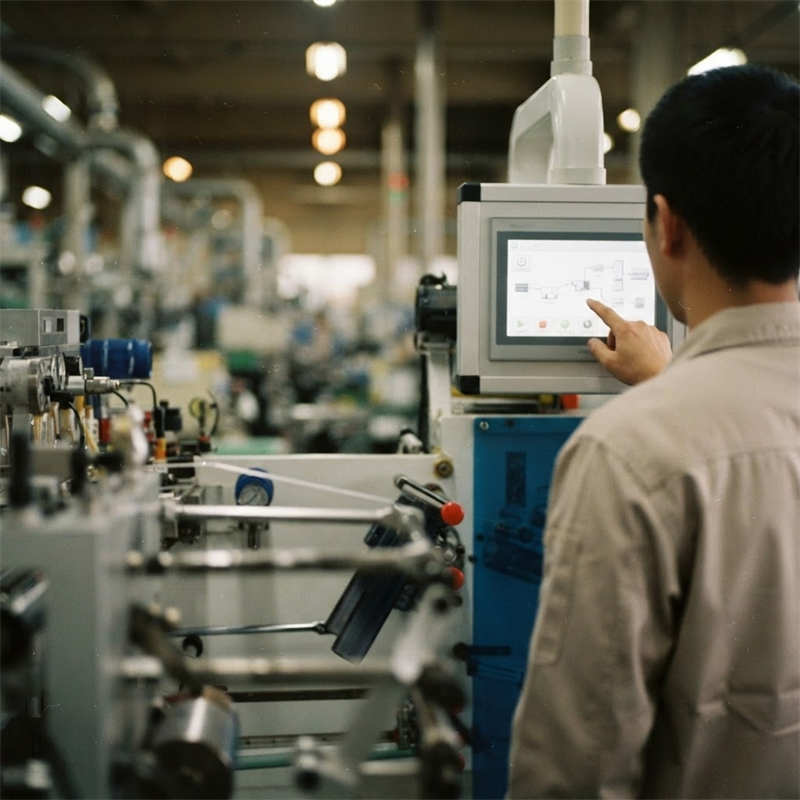
The Decision That Shapes Everything Downstream
A lamination machine is not a commodity purchase. It is the piece of equipment that determines whether your cosmetic or pharmaceutical soft tubes delaminate on a retail shelf, whether your barrier performance holds up across a two-year shelf life, and whether your production line can meet a 30% volume surge without stopping for unplanned maintenance every third week.
The laminated tube market was valued at USD 2.8 billion in 2023 and is growing at a compound annual rate of 5.8%, driven by demand for premium cosmetic packaging, high-barrier pharmaceutical topicals, and sustainability-driven recyclable structures. Behind every tube in that market is a lamination machine selection decision — made by someone with your role, under the same budget pressures and production deadlines you face.
Most purchasing mistakes in lamination machinery are not caused by bad luck or bad suppliers. They are caused by buyers who started the process with the wrong questions: focusing on price before throughput, asking about machine speed before confirming material compatibility, and skipping the compliance documentation review until an audit forces the issue.
This guide gives you the framework to ask the right questions — in the right order — so the machine you purchase solves your actual production challenges rather than creating new ones.
A quick note on terminology: In this guide, soft tubes refers to flexible, squeezable cosmetic and pharmaceutical packaging tubes made from laminated substrates (ABL, PBL) or co-extruded polyethylene structures. Lamination is the process of bonding multiple substrate layers — films, foils, and barrier materials — into a single composite that forms the tube body.
1. Understanding Your Production Needs: Matching Output to Demand
The Number That Drives Every Other Decision
Before you open a single supplier catalogue, you need one precise number: your OEE-adjusted throughput requirement — the real output your production line must deliver, accounting for planned downtime, speed variation, and quality losses.
OEE (فعالية المعدات الإجمالية) is the industry standard metric for realistic machine productivity. It is calculated as:
$$\text{OEE} = \text{Availability} \times \text{Performance} \times \text{Quality}$$
A world-class cosmetic packaging facility achieves around 85% OEE. A realistic target for a mid-size operation running two shifts is 75–82%. Use this to calculate your required machine speed:
$$\text{Required Speed (m/min)} = \frac{\text{Monthly Target (tube bodies)}}{\text{Monthly Production Minutes} \times \text{OEE Factor} \times \text{Tube Bodies per Meter}}$$
A practical scenario: a facility targeting 500,000 tube bodies per month, running 20 eight-hour shifts (9,600 minutes), at 80% OEE, producing approximately 12 tube bodies per metre of substrate:
$$\frac{500{,}000}{9{,}600 \times 0.80 \times 12} = 5.42 \text{ m/min substrate speed}$$
At that volume, a machine rated at 8–10 m/min runs in its efficient operating band. A machine rated at 5.5 m/min runs at its mechanical ceiling — with no margin for speed variation, substrate splices, or minor stoppages.
Planning for Seasonal Demand and Future Growth
Cosmetic tube producers — particularly those supplying sunscreen, holiday gift sets, and seasonal skincare — experience demand swings of 30–50% between peak and off-peak periods. A machine sized to your average demand will be bottleneck during peaks and under-utilised during troughs.
The standard industry practice is to size the machine at 120–130% of your peak monthly requirement — giving you headroom to run the machine comfortably during surges without asking it to perform beyond its rated capability. A machine running at 75–80% of its rated speed is more reliable, produces fewer defects, and requires less frequent maintenance than one running at 95–100%.
Avoiding the Two Common Capacity Mistakes
Over-investment: Buying a 200 m/min machine for a 20 m/min production requirement. The capital cost is unrecoverable through operational savings, and high-speed machines require more specialised maintenance, tighter process control, and faster-qualified operators than lower-speed alternatives.
Under-capacity: Buying to current needs with no growth margin. If your business grows 40% over 24 months — a realistic trajectory for a well-run cosmetic tube operation in a growing market — and your machine cannot accommodate that growth, you face a second capital investment at the worst possible time: during a demand surge, when lead times for new machines are longest.
2. Material Compatibility: Ensuring Quality Across Substrates
Know Your Substrate Before You Specify Your Machine
The three dominant tube substrate constructions in cosmetic and pharmaceutical production are ABL (رقائق الألومنيوم العازلة), PBL (طبقة بلاستيكية عازلة)و PE co-extruded structures. Each makes different mechanical and process demands on the lamination machine.
| Substrate | Barrier Performance | Machine Demand | Primary Application |
|---|---|---|---|
| ABL | Oxygen transmission: near-zero | Precise foil scoring at shoulder; ±2°C temperature control | Pharmaceutical topicals, high-actives cosmetics |
| PBL with EVOH | 80–90% of ABL | Controlled nip temperature; EVOH layer sensitivity to heat | Moisturisers, SPF products, oral care |
| PE Co-extruded (EVOH interlayer) | Good — EVOH interlayer | Extrusion line integration; no separate lamination required | Body lotion, shampoo, general cosmetics |
| Mono-material HDPE | Low–moderate | Validated for recyclable structures | Sustainability-positioned brands |
| Metallised PET | Decorative only | Surface energy management; foil tension compatibility | Premium skincare, luxury gifting |
Glossary: EVOH (Ethylene-Vinyl Alcohol) — A plastic copolymer barrier layer used in PBL and co-extruded tubes. It blocks oxygen and moisture transfer significantly better than standard polyethylene, but its barrier performance decreases in high-humidity environments — a relevant factor for products stored in bathrooms. Unlike aluminium foil, EVOH maintains the tube’s recyclability in plastic waste streams.
Adhesion Performance Across Film Combinations
Bond strength — the force required to peel apart the bonded laminate layers — is the primary quality metric for lamination process performance. The industry minimum for cosmetic tube shoulders is 2.5 N/15mm. Below this threshold, delamination becomes visible as bubbling, whitening, or peeling — first under stress during tube filling, then at retail display, then in the consumer’s hands.
Achieving consistent bond strength across different substrate combinations requires:
- Correct adhesive chemistry matched to the specific film surface energy of each substrate pair
- Corona treatment on low-surface-energy substrates (PE, PP) to raise surface energy before adhesive application, ensuring proper wetting and adhesion initiation
- Validated temperature profiles specific to each laminate construction — particularly critical when processing ABL (aluminium foil softening point varies by gauge) or EVOH-containing substrates
Eco-Friendly and Recyclable Material Compatibility
The European packaging market is moving fast. EU Packaging and Packaging Waste Regulation requirements for recyclability are reshaping which tube structures brands can specify. Machines that have been validated only for standard ABL production will face growing limitations as brand clients require mono-material PE and PCR (Post-Consumer Recycled) content structures.
Before purchasing, confirm with the supplier: “What recyclable or mono-material substrate constructions has this machine processed in a validated production trial, and can you provide bond strength and quality data from those trials?” A supplier who offers “compatible with recyclable substrates” as a specification claim without documented trial data is not giving you useful information.

The substrate you choose determines the machine you need. ABL, PBL, EVOH, and recyclable mono-material structures each make different process demands — confirming compatibility before purchase is non-negotiable.
3. Lamination Techniques: Dry, Extrusion, or Cold — Which Is Right for You?
The Three Core Methods and What They Actually Mean for Your Production
The choice of lamination method is not just a technical specification — it determines your substrate options, your production speed ceiling, your energy costs, and your compliance documentation requirements. Understanding the difference between dry, extrusion, and cold lamination in practical terms is the foundation of every other machine specification decision.
Dry Lamination (Adhesive Lamination)
Dry lamination bonds film layers using a solvent-based or solventless adhesive applied to one substrate surface, which is then dried (or cured) before the two substrates are pressed together at the lamination nip under heat and pressure.
How it works: The adhesive is applied to the first substrate via a gravure roller or slot-die coater, dried in a heated oven zone, and then combined with the second substrate at the nip roller where heat and pressure complete the bond.
Key advantages for cosmetic tube production:
- High bond strength — consistently achieves 3.0–5.0 N/15mm on ABL and complex multi-layer constructions
- Excellent process flexibility — can laminate virtually any film combination with the correct adhesive selection
- Precise adhesive coat weight control — 1.5–4.0 g/m² depending on substrate combination
The main constraint: Solvent-based variants require solvent recovery systems and compliance with VOC (Volatile Organic Compound) emission regulations. Modern solventless dry lamination systems eliminate this issue and are now the dominant technology in new machine installations.
As documented in Sintar’s dry vs. extrusion lamination process comparison, dry lamination is the preferred method for complex, high-performance laminate constructions — including ABL for pharmaceutical applications — because of its superior bond strength and material flexibility.
Extrusion Lamination
Extrusion lamination bonds substrate layers by extruding a thin layer of molten plastic resin (typically PE or PP) directly between them. No separate adhesive is applied — the extruded resin serves as both the bonding agent and a functional layer in the laminate structure.
Key advantages:
- Lower per-unit cost for high-volume commodity tube structures
- No adhesive curing time — the laminate can be processed immediately after bonding
- Excellent moisture barrier from the extruded PE layer itself
- Suitable for ABL inner layer application — bonding the aluminium foil to the inner PE layer
The main constraint: Less bond strength flexibility than adhesive lamination; not suitable for all film surface energy combinations without adhesion promoter application. Higher upfront capital cost for the extrusion system.
Cold Lamination (Pressure-Sensitive)
Cold lamination uses pressure-sensitive adhesive (PSA) — pre-applied to the film — that bonds under pressure alone, without heat. The lamination nip applies mechanical pressure; no heated rollers are required.
Key advantages for specific applications:
- No thermal exposure — critical for heat-sensitive decorative films, metallised structures with vapour-deposited barrier coatings, and delicate foil elements
- Lower energy consumption — no heating zones to maintain
- Fast startup — no warm-up time required
The main constraint: Lower bond strength than dry or extrusion lamination for most cosmetic tube structural requirements. Generally used for decorative overlaminates and speciality finishes rather than primary structural laminate bonding.
Which Method Fits Your Application?
| Criteria | Dry Lamination | Extrusion Lamination | Cold Lamination |
|---|---|---|---|
| Bond strength | High (3–5 N/15mm) | Moderate–high | معتدل |
| Substrate flexibility | ممتاز | جيد | محدود |
| Energy consumption | Medium (oven required) | High (extruder) | منخفضة |
| Cost per unit (volume) | Medium | منخفضة | Medium–high |
| Recyclable material compatibility | ممتاز | جيد | جيد |
| Pharmaceutical ABL applications | ✅ Primary choice | ✅ For inner layer | ⚠️ Not recommended |
| Heat-sensitive decorative films | ⚠️ Careful selection | ⚠️ Not recommended | ✅ Ideal |
For the majority of cosmetic and pharmaceutical tube production applications, dry (solventless adhesive) lamination is the primary choice. Extrusion lamination adds value for high-volume commodity structures or as an integrated step in ABL production. Cold lamination fills a specific niche for decorative and heat-sensitive applications.
4. Precision and Consistency: Achieving Uniform Layer Bonding
Why Precision Is a Revenue Issue, Not Just a Quality Issue
When a lamination process produces inconsistent bond strength — even at levels that pass end-of-line sampling — the defects appear downstream: as delamination bubbles during tube filling, as micro-channels at the shoulder fold under product pressure, or as print registration errors that your retail client’s quality team flags at goods receipt.
Each of these failure modes generates a direct cost: rework labour, material waste, replacement production runs, and — in the worst cases — a production halt while the root cause is investigated. On a high-value ABL substrate running at 15 m/min, one hour of production downtime from a lamination defect investigation represents approximately 900 metres of substrate and 10,800 tube bodies that were not produced — a direct revenue impact of USD 8,000–15,000 depending on the product type.
The root cause of most lamination consistency problems is not the adhesive formulation or the substrate materials. It is web tension variation — and it is correctable with the right machine control architecture.
Closed-Loop Tension Control: The Technical Difference That Matters Most
Web tension is the force applied to the substrate film as it travels through the machine. At any given point in a production run, tension varies with:
- Substrate roll diameter (as the roll depletes, torque must increase to maintain constant tension)
- Machine speed changes during startup, acceleration, or speed adjustment
- Temperature-driven changes in substrate stiffness (PE film becomes slightly more elastic as the lamination oven heats the production environment)
Without closed-loop tension control — a system that continuously measures actual web tension through load cell sensors and automatically adjusts drive motor speed to maintain the setpoint — these variations propagate directly into bond strength variation and surface defects.
With closed-loop control, tension is maintained within ±1–2% of setpoint regardless of roll diameter, speed, or temperature changes. The practical result: bond strength variation across a production run drops from ±15–20% (open-loop systems) to ±3–5% (closed-loop) — well within the specification tolerance for cosmetic and pharmaceutical tube applications.
Inline Adhesive Coat Weight Monitoring
Adhesive coat weight — the mass of adhesive applied per square metre of substrate — directly determines bond strength. Too little: under-bonded areas that delaminate. Too much: adhesive bleed at the tube body weld zone, causing contamination defects and waste.
Modern lamination machines for cosmetic tube production use infrared or X-ray coat weight sensors that measure the adhesive layer in real time across the full substrate width. When the measured weight deviates from setpoint by more than ±5%, the system automatically adjusts the gravure roller speed or slot-die pump rate to correct within the next 2–3 metres of substrate.
As documented by Precision Die Systems, slot-die coating systems reduce material waste by up to 30% compared to traditional gravure systems — from improved coat weight uniformity alone, without any change to the adhesive formulation.
Real-Time Vision Inspection
High-resolution camera systems mounted along the web path detect surface defects — bubbles, tunnelling, delamination initiation, foreign material, and print misregistration — at production speed. When a defect is detected, the system logs the position, flags the affected substrate length for rejection downstream, and (on advanced systems) automatically adjusts the process parameter most likely to have caused the defect.
This closed-loop quality architecture catches defects at the lamination stage — where the material cost is the substrate alone — rather than at the end of the tube production line, where the defective unit has also accumulated filling, sealing, and handling costs.
5. Integration with Your Tube Manufacturing Line
The Lamination Machine Does Not Operate Alone
A lamination machine feeds into a complete tube production sequence: substrate preparation, tube body forming (welding the laminate sheet into a cylinder), shoulder heading, tube filling, tail sealing, and downstream handling. Each of these processes operates at a specific speed, handles specific substrate dimensions, and has specific requirements for the laminate quality it receives.
A lamination machine that cannot match the feed speed of your tube-forming line creates a bottleneck — either the laminator runs faster than the former can consume substrate (requiring a large buffer accumulator), or the former runs faster than the laminator can produce (starving the forming line and creating unplanned stops).
The most common integration mismatch is substrate speed: lamination machines optimised for wide-web roll-to-roll production at 30–80 m/min feeding a tube-forming line that operates at 12–20 m/min. The solution is either a tension-buffering accumulator between the two machines, or a lamination machine with a variable-speed substrate output matched to the forming line’s consumption rate.
PLC Integration and Data Communication
Modern tube production facilities operate as integrated systems. The lamination machine’s operating parameters — substrate speed, tension setpoints, coat weight, temperature readings, defect event logs — must be accessible to the facility’s central PLC (Programmable Logic Controller) or نظام تنفيذ التصنيع (MES) for production monitoring, batch traceability, and compliance reporting.
Confirm that the machine communicates via standard industrial protocols: OPC-UA, Modbus TCP/IP, ، أو PROFINET. A machine with a proprietary closed communication system cannot be integrated into your facility’s data network without a custom gateway — adding both cost and a permanent integration vulnerability.
Footprint and Layout Planning
Full lamination lines — including unwind station, adhesive coating head, drying oven (dry lamination), lamination nip, and rewind station — range from 10 m in length for compact single-stage systems to 25 m+ for high-speed multi-oven configurations. Factor in:
- Clearance zones at both ends for substrate roll loading and finished roll removal (typically 2–3 m each end)
- Utility connections: compressed air supply, electrical supply rating (typically 15–45 kW), solvent extraction if applicable, and cooling water if the nip rollers use water-cooled temperature control
- Operator access paths: safety regulations require unobstructed maintenance access around all moving components
Pre-integration checklist:
- ✅ Confirmed substrate width compatibility (machine maximum width ≥ your widest substrate)
- ✅ Confirmed substrate speed range overlap with downstream tube-forming line
- ✅ Confirmed PLC protocol compatibility
- ✅ Footprint and utility requirements verified against installation location
- ✅ Changeover procedure documented for each substrate and format combination in your product portfolio
- ✅ Buffer accumulator sized if speed mismatch between laminator and forming line

A lamination machine is part of a connected production system — every integration decision, from substrate speed matching to PLC protocol, affects the efficiency of the entire line, not just the machine itself.
6. Regulatory Compliance and Safety Standards
The Compliance Framework for Cosmetic and Pharmaceutical Tube Lamination
Operating in the cosmetic and pharmaceutical packaging space means your lamination process does not exist in a regulatory vacuum. The adhesives you apply, the materials your machine contacts, and the process documentation your facility maintains are all subject to specific standards — some mandatory, some commercially required by brand clients, and some required for market access.
ISO 22716 (Cosmetics GMP) governs Good Manufacturing Practice for cosmetic product manufacturing. For lamination equipment, it requires: surfaces in contact with cosmetic substrates must be cleanable and non-reactive with cosmetic ingredients; equipment must be included in a qualification and maintenance programme; and production parameters must be documented with batch traceability.
اللائحة 21 من قانون اللوائح الفيدرالية (CFR)، الجزء 211، الصادرة عن إدارة الغذاء والدواء (FDA) applies to pharmaceutical packaging in the United States. Any lamination machine producing tube substrates for pharmaceutical topical products must be included in the facility’s equipment validation programme, with IQ/OQ/PQ documentation generated and retained for regulatory inspection.
Glossary: IQ/OQ/PQ — The three-stage validation sequence for pharmaceutical equipment. Installation Qualification (IQ) confirms the machine was installed as specified. Operational Qualification (OQ) confirms it operates correctly across its stated range. Performance Qualification (PQ) confirms it consistently produces output meeting specification under production conditions. All three require documented protocols, execution records, and formal approval. As described by The FDA Group’s guide to IQ/OQ/PQ in FDA-regulated industries, this documentation is the evidence base for regulatory audits.
EU Regulation 1935/2004 and EU 10/2011 require that packaging materials in contact with food or cosmetic products do not transfer substances in quantities that could harm the consumer. For laminated tube inner layers and adhesive formulations, this means the supplier must provide materials compliance certificates referencing these regulations — and the lamination machine must be designed to avoid adventitious contamination from lubricants, mechanical debris, or non-compliant process materials.
Machine Features That Support Compliance
When evaluating lamination machines for regulated production, confirm the following as standard inclusions — not optional extras:
- Cleanroom-compatible design: Smooth, non-porous surfaces on all product-contact areas; no internal recesses where adhesive residue or substrate dust can accumulate between cleaning cycles
- Electronic batch traceability: PLC-based recording of all production parameters (speed, temperature, tension, coat weight, adhesive lot number) linked to batch identifiers and exportable to your QMS or ERP system
- Alarm logging with audit trail: Every parameter excursion — temperature out of range, tension deviation, coat weight deviation — must be recorded with timestamp and operator ID, providing the documentation base for deviation investigations
- CE certification: Mandatory for EU market deployment; confirms conformity with European machinery safety directives
- ISO 9001 certification of the manufacturing facility: evidence that the machine was produced under a quality management system with documented design review, production control, and inspection processes
7. Energy Efficiency and Operational Costs
The Operating Costs You Don’t See at the Quotation Stage
A lamination machine’s purchase price represents roughly 22–28% of its true 5-year cost of ownership. The remaining 72–78% — energy, labour, maintenance, and downtime — accumulates over every production shift, invisible until it appears in the operating P&L.
The 5-year Total Cost of Ownership (TCO) framework:
$$\text{5-Year TCO} = P + E_5 + L_5 + M_5 + D_5 – R$$
Where: P = purchase price, E₅ = 5-year energy cost, L₅ = 5-year operator labour cost, M₅ = 5-year maintenance cost, D₅ = 5-year unplanned downtime cost, R = residual value.
Applied to two comparable machine options at a cosmetic tube facility running two 8-hour shifts, 240 days per year:
| فئة التكلفة | Standard Machine (USD 65,000) | Energy-Optimised Machine (USD 105,000) |
|---|---|---|
| سعر الشراء | USD 65,000 | USD 105,000 |
| 5-year energy (avg. 38 kW vs. 28 kW with VFD + heat recovery) | USD 54,720 | USD 40,320 |
| 5-year operator labour (2 operators vs. 1) | USD 280,000 | USD 140,000 |
| 5-year planned maintenance (6% vs. 4% of purchase/yr) | USD 19,500 | USD 21,000 |
| 5-year unplanned downtime (150 hrs vs. 50 hrs/yr at USD 900/hr) | USD 67,500 | USD 22,500 |
| 5-Year TCO | USD 486,720 | USD 328,820 |
The energy-optimised machine costs USD 40,000 more at purchase and delivers a USD 157,900 lower 5-year TCO. The break-even on the purchase premium occurs in approximately 15 months at this production volume.
Energy Efficiency Features to Specify
- Variable Frequency Drives (VFDs): Reduce main drive motor energy consumption by 15–30% by matching motor speed to actual substrate speed requirements. On a 38 kW machine, a 20% VFD saving represents approximately USD 2,700/year in direct energy savings — USD 13,500 over 5 years.
- Heat recovery in dry lamination oven zones: Exhaust heat from drying ovens can be recirculated for adhesive pre-warming and inlet air preheating, reducing primary heating energy consumption by 8–15%. Several machine manufacturers now offer integrated heat recovery modules as standard on their dry lamination lines.
- Predictive maintenance systems: Condition monitoring sensors — vibration sensors on key bearings, current monitoring on drive motors, temperature monitoring on heat zones — enable maintenance to be performed on condition rather than on a fixed schedule. According to Augury’s analysis of predictive maintenance energy savings, transitioning from scheduled to predictive maintenance reduces hidden energy waste sources by up to 20%, as deteriorating components that are consuming excess energy are identified and replaced before they cause production failures.
- Low-power standby mode: Machines that reduce heating zones to minimum-maintenance temperature and drop drive motors to standby speed during planned breaks recover 10–20% of idle-state energy consumption compared to machines that maintain full operating conditions continuously.
Material Waste as a Hidden Cost Driver
On a high-value ABL substrate at USD 1.50/m², reducing start-up waste from 100 metres per changeover to 40 metres saves USD 90 per changeover. At 20 changeover events per month, that is USD 1,800/month — USD 21,600/year — recovered purely from process optimisation at one machine.
Watch: Full ABL and PBL Laminated Tube Production Line in Operation
Before finalising your machine specification, watch a complete laminated tube production line at operating speed — from substrate unwind and lamination through tube body forming, shoulder heading, and output inspection. Observing the web tension stability across roll changes and the forming precision at the tube body weld zone gives you context that no specification sheet provides:
Click to watch: Full ABL and PBL laminated tube production line — substrate lamination, tube body forming, shoulder heading, and quality inspection for toothpaste, cosmetic, and pharmaceutical tube manufacturing.
8. After-Sales Support and Technical Service Network
The Service Relationship You Are Buying Into
When you purchase a lamination machine, you are not just acquiring a piece of equipment. You are entering a 12–18 year operational relationship with the supplier — because that is how long the machine will be running in your facility. The quality of that relationship determines how quickly you recover from faults, how smoothly you execute format changes, and whether your operators grow in competence or plateau at the machine’s minimum operating requirements.
Most buyers discover the real quality of a supplier’s service capability after the machine is installed and the sales team has moved on. The way to discover it before that moment is to ask very specific questions during the procurement process — and verify the answers against current customers.
The Questions That Reveal the Real Service Capability
What is your written response time commitment for a production-stopping fault? Not a verbal commitment — a document. For remote diagnostics (software, parameter, and control system issues): the standard should be under 4 hours during business hours. For mechanical failures requiring on-site attendance: 72 hours or less for your market territory is the minimum acceptable commitment.
Do you provide remote access diagnostics as standard? On a PLC-controlled machine, the supplier’s engineers should be able to access the machine’s alarm history, current parameter settings, and process trend data via a secure remote connection. This capability resolves the majority of non-mechanical faults without an on-site visit — typically within 1–2 hours for software or parameter issues. A supplier who offers remote diagnostics as an optional paid service is telling you something important about how they think about the ongoing customer relationship.
Where are your spare parts stocked geographically, and what is the emergency delivery time to my facility? The most dangerous single point of failure in any service relationship is a supplier who orders your critical spare parts from the factory after you report a production fault. Ask for the specific regional parts warehouse location and the documented emergency delivery lead time for your top 10 most critical wear items.
What does your operator training programme include? Specifically: Is training conducted at your facility with your production team and your actual substrate materials? Is it structured across multiple days (5 days minimum for a complex lamination line) with documented SOPs delivered in your working language? A factory demonstration on demonstration materials is not operator training — it is a sales activity.
Support for Distributors and Agents: The Account Retention Equation
For distributors representing lamination machinery, the after-sales service quality delivered to clients is the primary determinant of account retention. A client whose machine runs reliably, whose operators are well-trained, and who receives fast, technically competent responses when issues arise becomes a long-term account and a source of referrals. A client who waits three weeks for a critical spare part during a production commitment becomes a competitor’s next customer.
شركة ميودا لآلات التغليف supports distributor and agent partners with technical documentation packages, remote commissioning assistance, and structured training programmes that enable in-territory technical support — reducing dependence on factory-level intervention for routine service events. This is the capability that allows distributors to make service quality a differentiator in their client conversations, rather than a liability they need to manage around.
9. Customization and Flexibility for Diverse Product Lines
The Production Environment Has Changed
Five years ago, a cosmetic tube manufacturer running three SKUs at high volume could justify a single-configuration lamination machine optimised for one substrate and one surface finish. Today, that same manufacturer is more likely running 8–15 SKUs — including standard glossy ABL tubes, matte-finish PBL moisturiser tubes, recyclable mono-material structures for sustainability-committed brands, and short-run premium formats for new product launches.
This fragmentation of the product mix is a permanent structural shift in the cosmetic packaging market. It means that production flexibility — the ability to switch substrates, surface finishes, and format specifications quickly and reliably — is no longer a nice-to-have feature. It is a competitive requirement.
Quick Changeover: What the Numbers Mean
Changeover time — the elapsed time between the last good unit of one product format and the first good unit of the next — directly determines the economics of short-run production. A machine with a 5-hour changeover on a 5,000-unit run is not economically viable. A machine with a 45-minute changeover on the same run is.
Modern lamination machines equipped with stored PLC recipes achieve format changeovers in 35–60 minutes because:
- Temperature setpoints are recalled automatically from the stored recipe — no manual adjustment or re-verification required
- Tension setpoints are loaded automatically for the new substrate specification
- Adhesive coat weight is reset to the validated setpoint for the new laminate construction
- The operator verifies parameter recall and runs a short trial length (typically 10–20 metres) to confirm quality before resuming full production
Without stored recipes, the same changeover involves manually adjusting 12–18 parameters, waiting for temperature zones to stabilise, running a longer trial length, and verifying quality manually — a process that consistently takes 4–6 hours on complex laminate construction changes.
On a production schedule with 15 format changeovers per month, reducing changeover time from 5 hours to 50 minutes recovers 63.5 hours of production time monthly — equivalent to approximately 8 additional production shifts per month.
Modular Design for Future Upgrades
A lamination machine with a modular architecture allows specific capability additions — a corona treatment station, an additional oven zone for faster curing, a second adhesive application head for dual-layer construction, or an upgraded control system — without replacing the machine’s mechanical base. This upgrade path extends the functional service life of the asset by 5–8 years beyond what a fixed-architecture machine can deliver as your product requirements evolve.
Digital Printing Integration
A growing proportion of cosmetic tube clients require variable data printing — serialisation codes, batch numbers, personalised graphics for limited-edition runs — integrated into the tube production process. Modern lamination machines with inline digital print modules can apply variable data directly to the substrate during the lamination pass, eliminating a separate printing step downstream and reducing the risk of print-laminate registration errors.
Confirm whether the machine’s web handling system and tension control architecture support the additional registration precision that inline digital printing requires — typically ±0.2 mm or better across the full substrate width.
For technical specifications on laminate tube making machines configured for both ABL and PBL production — including substrate compatibility data and changeover specifications — Miyoda’s laminate tube making machine product page provides detailed engineering parameters for evaluating against your production requirements.
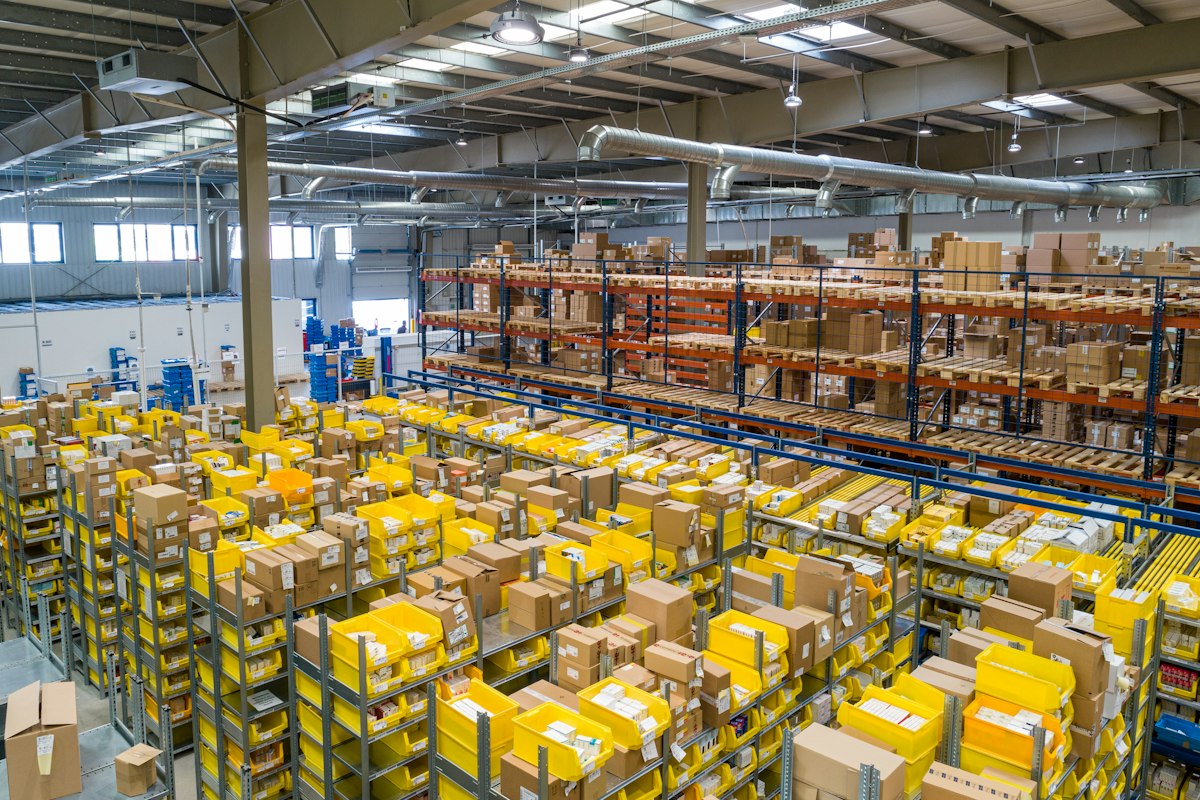
Production flexibility is a revenue capability: the ability to switch between matte PBL moisturiser tubes and glossy ABL toothpaste tubes in under 60 minutes is what allows a contract manufacturer to serve multiple brand clients on the same production line.
10. ROI and Total Cost of Ownership Analysis
The Calculation Most Buyers Skip — and Why They Regret It
The purchase price comparison between machine options is the easiest calculation in the procurement process. It requires no assumptions, no scenario modelling, and no operational data. It is also the calculation that most reliably leads to the wrong decision.
The correct evaluation framework is ROI over a defined payback period — calculated from documented assumptions about your actual production volume, substrate cost, labour model, and defect rate. Here is how to build that calculation:
$$\text{Annual Savings} = \text{Waste Reduction Savings} + \text{Labour Savings} + \text{Energy Savings} + \text{Downtime Cost Reduction}$$
$$\text{Payback Period (months)} = \frac{\text{Premium Over Baseline Machine} \times 12}{\text{Annual Savings}}$$
A worked example for a cosmetic tube producer choosing between a standard machine (USD 65,000) and a premium machine (USD 105,000):
| Savings Category | Annual Value |
|---|---|
| Waste reduction (60 m/changeover saved × 20 changeovers/month × USD 1.50/m × 12) | USD 21,600 |
| Labour reduction (1 operator eliminated from 2-person crew × USD 28,000/yr) | USD 28,000 |
| Energy savings (10 kW avg. reduction × 3,840 hrs/yr × USD 0.12/kWh) | USD 4,608 |
| Downtime reduction (100 hrs/yr saved × USD 900/hr) | USD 90,000 |
| Total Annual Savings | USD 144,208 |
$$\text{Payback Period} = \frac{(USD ; 105{,}000 – USD ; 65{,}000) \times 12}{USD ; 144{,}208} = 3.3 \text{ months}$$
At this production volume, the premium machine pays back its additional investment in under 4 months — and delivers approximately USD 144,000 in annual savings for the remaining 14+ years of its operating life. This is not a marginal case: the lower-cost machine is the more expensive long-term decision by a significant margin.
The Three Savings Drivers That Determine Your ROI
1. Waste reduction is the most underestimated savings category because it requires measuring current waste — which most facilities do not track systematically. Before running your ROI calculation, measure your current lamination waste as a percentage of substrate consumed (start-up waste + defect rejection + splice waste). Even a 20% reduction in this number represents substantial cost savings at commercial substrate prices.
2. Labour savings are the most visible and most politically sensitive line item in the ROI model. A fully automatic lamination machine with closed-loop tension control genuinely requires only one operator in monitoring mode — versus two operators managing tension manually on a conventional machine. Document the current labour model accurately to capture this savings category realistically.
3. Downtime cost reduction is the most volatile category — and often the largest. A single unplanned production stop on a filled-order commitment costs not just the lost production time but also the expediting cost of the recovery run, the potential airfreight cost of a delayed shipment, and the relationship cost with the client whose product was late. Document your current unplanned downtime hours per month and apply a realistic production value per hour to understand this category’s true magnitude.
For a deeper financial analysis of how lamination machine investment drives measurable production improvements, Miyoda’s top 5 benefits of a lamination machine for cosmetic tubes covers the specific performance metrics — including waste reduction rates, yield improvement data, and compliance cost avoidance — that support the ROI case.
Industry Benchmark: Typical Payback Periods
Based on published data and production environment modelling across mid-size to large cosmetic tube operations:
| Production Volume | Machine Investment | Typical Payback Period |
|---|---|---|
| < 200,000 tubes/month | USD 40,000–70,000 | 24–36 months |
| 200,000–500,000 tubes/month | USD 70,000–120,000 | 15–24 months |
| > 500,000 tubes/month | USD 120,000–250,000+ | 12–18 months |
Most cosmetic tube producers operating at commercial production volumes achieve full ROI within 18–36 months — at which point the machine’s remaining 10–12 years of operating life deliver direct margin contribution at the savings rate established in the first 24 months.
A Confident, Profitable Decision Starts Here
Choosing the right lamination machine for your cosmetic soft tube production is not a one-dimensional decision. It is a multi-factor evaluation that connects your production throughput requirements to your substrate strategy, your regulatory environment, your operational cost model, and your growth plans for the next 5–10 years.
The buyers who make this decision well share one characteristic: they invest time in the evaluation before they invest capital in the machine. They run the OEE throughput calculation. They request validated production trials with their actual substrate materials. They check the bond strength data. They read the service SLA. They call the supplier’s reference customers.
The buyers who regret their lamination machine decisions share the opposite characteristic: they started with price, compared specifications as proxies for performance, and skipped the validation steps that would have revealed the gap between a supplier’s marketing materials and their machine’s actual field performance.
This guide has given you the framework to be the first type of buyer. Use it.
For cosmetic and pharmaceutical tube producers evaluating the complete production line — from lamination through tube body forming, filling, and sealing — the engineering team at Miyoda’s cosmetic tube production machine range can provide technical consultations tailored to your specific substrate requirements, production volume, and regulatory environment.

The right machine decision is built from data, validated by production trials, and confirmed by reference customers — not from specification sheets and price comparisons.
مسرد المصطلحات الأساسية
| المصطلح | Definition |
|---|---|
| ABL (رقائق الألومنيوم العازلة) | Multi-layer tube substrate with aluminium foil interlayer providing near-zero oxygen transmission; standard for pharmaceutical and sensitive cosmetic actives |
| PBL (طبقة بلاستيكية عازلة) | Multi-layer tube substrate using EVOH plastic barrier instead of aluminium foil; recyclable in plastic waste streams; 80–90% of ABL barrier performance |
| EVOH | Ethylene-Vinyl Alcohol — high-barrier plastic copolymer layer used in PBL and co-extruded tubes; recyclability advantage over aluminium foil |
| Dry Lamination | Adhesive-based bonding method using solvent-based or solventless adhesive applied, dried, then pressed between substrate layers |
| Extrusion Lamination | Lamination by extruding molten plastic resin directly between substrate layers as the bonding medium |
| Cold Lamination | Pressure-sensitive adhesive bonding without heat; used for heat-sensitive decorative films and speciality finishes |
| Web Tension | Force applied to substrate film travelling through the machine; must be precisely controlled to prevent wrinkles, stretch, and delamination |
| Closed-Loop Control | Automatic control system measuring a parameter in real time and continuously adjusting the process to maintain the target setpoint |
| OEE | Overall Equipment Effectiveness — Availability × Performance × Quality; the standard metric for realistic production line efficiency |
| TCO | Total Cost of Ownership — all costs over the ownership period: purchase + energy + labour + maintenance + downtime − residual value |
| التحقق من الصلاحية (IQ)/التأهيل التشغيلي (OQ)/التأهيل الدائم (PQ) | Installation, Operational, and Performance Qualification — three-stage pharmaceutical equipment validation sequence producing documented evidence of compliant operation |
| ISO 22716 | International GMP standard for cosmetic product manufacturing; governs equipment design, process control, and traceability requirements |
| VFD | Variable Frequency Drive — electronic motor speed control reducing energy consumption 15–30% by matching motor output to actual demand |
| Bond Strength (N/15mm) | Force per 15mm width required to peel apart bonded laminate layers; industry minimum for cosmetic tube shoulders is 2.5 N/15mm |
| علاج فيروس كورونا | Surface treatment applying high-voltage electrical discharge to low-surface-energy substrates (PE, PP) to improve adhesive bonding performance |
| PCR (مواد معاد تدويرها بعد الاستهلاك) | PE material manufactured from recycled post-consumer plastic waste; used in sustainability-positioned tube substrates |
Frequently Asked Questions (FAQs)
Q1: What production capacity should I look for in a lamination machine?
Your required machine speed depends on your OEE-adjusted monthly throughput target — not just your rated production goal. Divide your monthly tube body target by the product of your available production minutes, your OEE factor (typically 0.75–0.85 for a well-run operation), and the number of tube bodies per metre of substrate. Then add 20–30% headroom for growth and speed variation. As a reference, lamination machines for cosmetic tube production range from compact systems at 8–20 m/min substrate speed (suitable for up to 300,000 tubes/month at typical tube dimensions) up to high-speed production lines at 80–200 m/min for large-scale commodity tube manufacturing. Matching your machine to your OEE-adjusted requirement — rather than to your best-case production scenario — prevents both under-capacity bottlenecks and unnecessary capital investment in speed you will not use.
Q2: Can one machine handle both cosmetic and pharmaceutical-grade tubes?
Yes, if the machine is designed with the compliance documentation capability and material compatibility that both categories require. The mechanical hardware can be identical; the difference is in the validation framework. Pharmaceutical production requires IQ/OQ/PQ documentation, electronic batch records with full audit trail, and process parameter monitoring traceable to each production batch. Cosmetic production under ISO 22716 has similar but somewhat less stringent requirements. Confirm specifically that the supplier will support IQ/OQ/PQ protocol development and execution as part of the purchase — not just supply the machine and leave your validation team to develop documentation from scratch.
Q3: Which lamination method is best for recyclable soft tubes?
For recyclable mono-material PE tube structures, solventless dry lamination و extrusion lamination are both well-suited. Solventless dry lamination with PE-compatible adhesive formulations achieves strong bond strength on mono-material PE structures without the VOC emissions associated with solvent-based systems. Extrusion lamination using PE resin as the bonding medium creates a fully mono-material structure with no adhesive chemistry at all — maximising recyclability. Cold lamination is generally not recommended for structural tube lamination. Confirm that the specific adhesive formulation or extrusion resin you plan to use has been evaluated for compatibility with your regional recycling infrastructure — recyclability claims require verification against the collection and sorting systems available in your target market.
Q4: How do I ensure consistent bond strength across different material combinations?
Consistent bond strength across substrate combinations requires three aligned process variables: correct adhesive chemistry for the specific film surface energy combination (consult your adhesive supplier for validated pairings); corona treatment for low-surface-energy substrates such as PE and PP to raise surface energy before adhesive application; and closed-loop coat weight control to maintain adhesive application within ±5% of the validated setpoint across the full web width and throughout the production run. In addition, validate the complete temperature profile — adhesive drying/curing temperature and nip temperature — for each laminate construction separately, not as a global setting. Bond strength variation between substrate combinations is most often a temperature profile issue, not an adhesive or material compatibility issue.
Q5: Is it possible to retrofit my existing tube line with a new lamination machine?
Yes — in most cases, provided the new machine’s mechanical interface and communication protocol are compatible with your existing downstream equipment. The most common retrofit challenges are substrate speed mismatch (requiring a buffer accumulator between the laminator and the forming line), footprint constraints, and utility requirement differences (electrical supply rating, compressed air pressure, solvent extraction if applicable). Request a pre-installation site assessment from the supplier — a review of your existing line specifications, production layout, and utility infrastructure before delivery. This assessment should be part of the standard purchase process, not a paid extra. Suppliers who conduct thorough pre-installation assessments resolve integration issues before the machine arrives; those who skip this step leave you to discover compatibility problems after installation.
Q6: What certifications should the machine have for international markets?
For EU market operation: CE marking (mandatory — confirms conformity with EU Machinery Directive 2006/42/EC and applicable electrical safety directives) and ISO 9001 certification of the manufacturing facility. For production of tubes in contact with cosmetic or food-adjacent products: compliance with EU Regulation 1935/2004 for food contact materials on all product-contact surfaces and adhesive formulations. For pharmaceutical packaging applications: FDA 21 CFR Part 211 compliance capability with IQ/OQ/PQ documentation support. For North American market operation: UL listing (electrical safety) is additionally required in some states. Request copies of current, valid certificates — not application references or expired documents — and verify that the certificate scope covers the specific machine model and configuration you are purchasing.
Q7: How much floor space does a typical lamination line require?
Compact single-stage solventless dry lamination systems start at approximately 10 m in length × 2.5–3.0 m in width — suitable for narrow-web (up to 350 mm) production at moderate speeds. Full production lines including a drying oven (for solvent-based systems), a multi-zone curing section, a winder, and inline quality inspection systems typically require 18–28 m in length. Add 2–3 m clearance at each end for substrate roll loading and finished roll removal, and 1.5–2.0 m aisle clearance on both sides for operator access and maintenance. Provide ceiling height of at least 3.5 m if the unwind station uses large-diameter substrate rolls. Factor utility access points (compressed air, electrical distribution, cooling water, exhaust extraction) into your layout planning before the machine order is placed — retrofitting utility connections around an installed machine is significantly more expensive than planning for them in advance.
Q8: Can the machine handle aluminium-free barrier films?
Yes — modern extrusion lamination and co-extrusion technology supports high-barrier EVOH-containing structures without aluminium foil. Aluminium-free barrier films using EVOH interlayers achieve oxygen transmission rates of 0.5–2.0 cc/m²/day (compared to near-zero for ABL) — sufficient for most cosmetic actives and many pharmaceutical topical applications. Confirm the specific OTR (oxygen transmission rate) specification required by your formulation chemistry, and match it to the substrate structure achievable with the lamination method you are specifying. For formulations containing retinoids, high-concentration vitamin C derivatives, or other highly oxidation-sensitive actives, ABL remains the preferred substrate — the marginal barrier performance advantage of aluminium foil over EVOH is meaningful for these specific applications.
Q9: What training is provided for operators and maintenance staff?
A comprehensive training programme for a new lamination line should include: 5 days minimum of on-site training conducted at your facility with your production team, using your actual substrate materials; documented SOPs for startup, shutdown, parameter verification, changeover, and routine maintenance delivered in your working language; hands-on practice on each changeover procedure in your product portfolio; training on alarm identification and first-response procedures; and maintenance training covering cleaning protocols, wear part inspection and replacement, and calibration verification for sensors and meters. Remote support availability after the on-site training period — for questions that arise during the first production runs without the trainer present — is equally important. A supplier who provides on-site training but no follow-up remote support leaves a capability gap at exactly the moment when new operators are building their confidence.
Q10: How do I reduce adhesive consumption without compromising quality?
The most effective technology for adhesive consumption reduction is a slot-die coating head, which delivers adhesive in a precisely controlled, uniform film across the full substrate width — eliminating the coat weight variation inherent in gravure roller systems. According to Precision Die Systems’ slot-die application data, slot-die systems reduce material waste by up to 30% compared to traditional methods while maintaining the coat weight uniformity required for consistent bond strength. In addition to the coating technology, real-time coat weight sensors with closed-loop feedback to the adhesive pump allow the system to continuously correct coat weight in response to viscosity changes (which occur as the adhesive temperature changes during a production run), substrate surface energy variation, and machine speed changes — maintaining optimal coat weight throughout the run without operator intervention.
Q11: Are spare parts readily available globally?
Reputable lamination machine suppliers maintain regional parts warehouses with a minimum 90-day stock holding of critical consumable items — doctor blades, nip roller surface materials, seals, bearings, and heating elements. Before purchasing, request: the geographical location of the nearest regional parts warehouse, the documented emergency delivery lead time for your top 10 critical wear items to your facility address, and the supplier’s policy on long-term parts availability (a 10-year minimum commitment is the industry standard for reputable suppliers). A supplier whose answer to “where are my spare parts stocked?” is “we order from the factory when you request them” is describing a supply chain that will extend your production downtime whenever a critical component fails.
Q12: What is the typical ROI period for a high-end lamination machine?
ROI period varies primarily with production volume and current baseline efficiency. At commercial cosmetic tube production volumes (200,000–500,000+ tubes per month), most buyers achieve full ROI within 18–36 months when waste reduction, labour optimisation, energy savings, and downtime cost reduction are properly accounted for — not just compared on purchase price. At volumes above 500,000 tubes per month, payback periods below 18 months are achievable with premium machines that significantly reduce per-unit waste and labour intensity. The worked example in Section 10 of this guide shows a payback period of under 4 months at specific production parameters — an extreme case, but illustrative of how dramatically the ROI calculation changes when downtime cost reduction is included at commercial production values. Run the full TCO calculation with your own production data before concluding that a lower purchase price represents a better financial decision.















