
How to Choose a Tube Silk Screen Printing Machine: A Strategic Buyer’s Guide for Cosmetic and Pharmaceutical Tube Producers
A shopper picks up a tube of face cream, looks at it for about three seconds, and decides whether it feels premium. A pharmacist reads the strength and batch code on an ointment tube before handing it to a patient. In both cases, the print on the tube is doing the work.
That makes choosing a tube silk screen printing machine a bigger decision than it looks. You aren’t only buying a printer. You are deciding how stable your line will be, how easily you pass audits, and how your customers’ brands will look on the shelf.
This guide gives you a practical way to evaluate the decision. It is written for cosmetic and pharmaceutical tube producers, and for the distributors and agents who advise them.
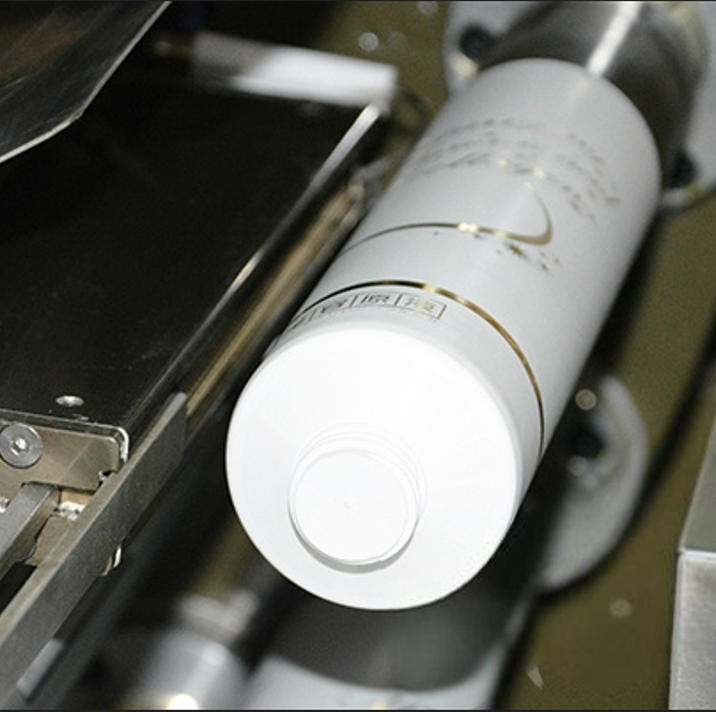
Quick definition: Silk screen printing الطباعة بالشاشة الحريرية pushes ink through a fine mesh stencil onto a surface using a rubber blade called a squeegee. On tubes, the tube turns under the screen while the squeegee moves across it. The method lays down a thick, opaque ink film, often 3–5 times thicker than offset printing. That is why it is widely used for bold logos, white ink on dark tubes, and metallic effects.
I. The High Stakes of Packaging Aesthetics in Pharma and Cosmetics
The Critical Link Between Print Quality and Perceived Product Value
In cosmetics, the tube is often the only “advertising” a brand gets at the point of sale. A logo that is 0.3 mm off-centre, or a white that looks grey on a black tube, quietly tells the shopper “cheap.”
In pharma, the stakes are different but just as high. Printed text carries dosage, warnings, and lot numbers. If it is smudged, fails a rub test, or is unreadable, the problem becomes a compliance issue, not just a cosmetic one.
Industry insight: Brand owners now audit decoration quality as closely as they audit filling. Many premium cosmetic contracts include print specifications such as ΔE colour tolerance, registration limits, and rub resistance in the supply agreement. Tube makers who can’t prove they meet them lose the contract at renewal.
Common Pain Points: Smudging, Misalignment, and Slow Throughput
When we talk with tube producers, the same three problems come up again and again:
- Smudging: Wet ink touches a guide rail, a conveyor, or another tube before it has cured.
- Misalignment: Colours don’t line up, so you see gaps or overlaps in multi-colour logos.
- Slow throughput: The printer runs slower than the extrusion or heading line, and tubes pile up in front of it.
Objective: From “Buying a Machine” to “Optimizing a Production Ecosystem”
A printer that looks great on its own can still fail when it’s placed on a real line. This guide helps you judge the whole system: how the printer works with upstream tube making, curing, downstream capping, your operators, and your supplier’s support.
II. Defining Your Production Scale: Matching Capacity to Market Demand
Analyzing Current vs. Projected Output Requirements
Start with numbers, not brochures. Use a simple formula:
Required hourly output = Annual tubes ÷ (working days × shifts × hours per shift × OEE)
Glossary: OEE (Overall Equipment Effectiveness) OEE is the share of planned time that produces good tubes. It is calculated as Availability × Performance × Quality. For example, 90% × 92% × 98% = 81%. Most printing lines should plan with 75–85%.
Example: You need 6 million tubes a year, running 250 days, 2 shifts of 8 hours, at 80% OEE. 6,000,000 ÷ (250 × 2 × 8 × 0.80) = 1,875 tubes per hour.
A machine rated at 4,000 pcs/h gives you room to grow. A machine rated at 2,000 pcs/h is already near its limit on day one.
| Annual Volume | Realistic Configuration | Typical Buyer |
|---|---|---|
| Under 1 million tubes | Semi-automatic, 1–2 colours | Start-up or boutique cosmetic brand |
| 1–5 million tubes | Fully automatic, 2–4 colours | Contract manufacturer, OTC pharma |
| 5 million+ tubes | Fully automatic, 4–7 colours, inline with tube line | Large pharma, FMCG oral care |
Balancing Batch Size Flexibility with High-Speed Automation
A private-label cosmetic producer may run 15 different designs a week in batches of 5,000–20,000 tubes. A toothpaste plant may run one design for a month. These two businesses need different machines, even if their annual volume is the same.
If you run many short jobs, a fast changeover matters more than top speed. A machine that changes over in 20 minutes instead of 2 hours gives you back about 10 production hours a week if you do six changeovers.
Evaluating the Impact of Machine Speed on Ink Drying and Curing Times
Speed and curing are directly connected. The faster tubes move, the less time each one spends under the curing lamp.
Glossary: UV curing UV curing uses ultraviolet light to harden special inks almost instantly through a chemical reaction. It happens in about a second instead of minutes of drying.
If a supplier quotes 80 tubes per minute but the curing unit is sized for 60, you will get tacky ink, set-off (ink transferring onto the next surface), and failed rub tests at full speed. Always ask: “At what speed does the ink pass a tape adhesion test straight off the line?”
III. The Precision Checklist: Ensuring “Medical-Grade” Print Quality
Registration Accuracy: Preventing Overlap and Gaps in Complex Logos
Glossary: Registration Registration is how accurately each colour lands in its correct position relative to the others. Poor registration causes white gaps between colours or dark lines where they overlap.
Tubes are soft, round, and slightly flexible, which makes them harder to print accurately than flat sheets. Good machines handle this with:
- A servo-driven indexing table, a rotating table driven by precise electric motors that stops each tube in exactly the same spot
- Mandrels (the metal rods that hold the tube from inside) made to tight tolerances
- Registration pins that seat each screen in the same position every time
What to ask for: colour-to-colour accuracy of ±0.1 mm on your own tube, not just on a demo part.
Ink Consistency: Achieving Uniform Density Across Varying Tube Diameters
A 16 mm eye cream tube and a 50 mm hand cream tube curve very differently. If squeegee pressure and angle stay fixed, ink can print thicker on the small tube and thinner on the large one.
Look for squeegee pressure, stroke, and speed that are stored in recipes and recalled for each diameter. That way density stays consistent, measured with a densitometer or a ΔE colour reading, from the first job to the last.
Substrate Compatibility: Ensuring Adhesion on PE, EVA, and Laminated Materials
PE (polyethylene) and EVA (ethylene-vinyl acetate) have low surface energy. Think of it like water beading on a waxed car: ink doesn’t want to stick. Before printing, the surface has to be activated with flame treatment or corona treatment.
| Substrate | Common Use | Pre-Treatment Needed | Watch Out For |
|---|---|---|---|
| PE (LDPE/HDPE) | Most cosmetic tubes | Flame or corona, every tube | Treatment fading if tubes sit for days |
| EVA blend | Soft-touch cosmetic tubes | Flame or corona | Heat sensitivity under curing |
| ABL (aluminium barrier laminate) | Toothpaste, pharma | Usually lighter treatment | Seam area print quality |
| PBL (plastic barrier laminate) | Premium cosmetics | Flame or corona | Different ink grade than ABL |
Industry insight: Untreated PE usually measures about 30–32 dynes/cm (a unit of surface energy). Good ink adhesion generally needs 38–44+ dynes/cm. A US$20 dyne pen test at the start of each shift catches most adhesion failures before they turn into a customer complaint.
IV. Line Integration: Eliminating Bottlenecks in the Workflow
Synchronization with Upstream Tube Feeding and Downstream Capping
The printer sits in the middle of the line. Upstream, sleeves come from a آلة بثق الأنابيب or a laminate tube making machine. Downstream, tubes go to heading and then to a tube capping machine.
For the line to run smoothly:
- Match speeds with a buffer. The printer should run 10–15% faster than the slowest upstream machine so it can catch up after short stops.
- Share signals. “Line full” and “line empty” signals should slow down or pause the stations next to each other automatically.
- Keep orientation. If the next machine needs tubes facing a certain way, the unloader must hold that orientation.
Integration of Automated Curing Systems (UV vs. IR) to Prevent Wet-Ink Handling
| Curing Type | كيف تعمل | Strengths | Limits |
|---|---|---|---|
| Conventional UV (mercury lamp) | High-intensity UV light | Proven, fast, wide ink choice | Heat can soften thin PE tubes |
| UV LED | Narrow-band LED light | 40–50% less energy, low heat, instant on/off | Needs LED-matched inks |
| IR (infrared) | Heat dries the ink | Works with some solvent/water inks | Slower, longer tunnels, risk of tube distortion |
The rule is simple: no person or rail should touch the print until it is fully cured. Curing should happen at the print station or right after it.
Space Optimization and Ergonomic Layout for Operator Efficiency
Check three practical things before you sign off on a layout:
- The operator can reach the screens, ink trays, and HMI (the touchscreen control panel) without climbing or reaching over moving parts.
- There is a clear path for carrying screens to the cleaning area.
- Loading hoppers sit at waist height. A full shift of bending to load tubes leads to fatigue and mistakes.
V. Evaluating Supplier Support: Beyond the Sales Brochure
Assessing the Availability of Local Technical Support and Spare Parts
The real test of a supplier comes on a Friday night when the squeegee drive fails. Ask each supplier:
- Which wear parts do you keep in stock, and how fast can you ship them (same day, 72 hours, or 3 weeks)?
- Do you offer remote diagnostics, so you can log into the PLC and see fault codes?
- How many years do you guarantee spare parts for this model?
At شركة ميودا لآلات التغليف, we keep common wear items ready for same-day dispatch, and we commit to long-term parts availability for each model. A machine you plan to run for 15 years needs parts for 15 years.
Requirements for Comprehensive Operator Training and SOP Documentation
Glossary: SOP (Standard Operating Procedure) A written, step-by-step instruction for a task, such as a screen change. With an SOP, every operator on every shift does the task the same way.
Good training covers machine operation, job setup, screen alignment, ink handling, UV safety, routine cleaning, and troubleshooting. Expect 3–5 days of hands-on training, plus manuals in English and in your operators’ language.
Evaluating the Supplier’s Experience with Pharmaceutical Regulatory Standards
If you supply pharma, your supplier should be familiar with:
- The FDA’s Current Good Manufacturing Practice (CGMP) regulations
- ISO 15378, the GMP standard for primary packaging materials for medicines
- IQ/OQ documentation (explained in Section IX)
Ask for references from pharma customers. A supplier that has only served household-product customers will find it hard to support your audit.
VI. The “Hidden Cost” Analysis: Calculating True ROI
Comparing Initial CAPEX Against Long-Term OPEX
Glossary: CAPEX and OPEX CAPEX (capital expenditure) is what you pay up front for the machine. OPEX (operating expenditure) is what it costs to run every year: energy, ink, screens, squeegees, labour, and maintenance.
Over 10 years, OPEX is usually much larger than CAPEX. Here is an illustrative comparison:
| Cost Item (per year) | Low-Cost Machine | Well-Built Automatic Machine |
|---|---|---|
| Purchase price (spread over 10 years) | $6,000 | $11,000 |
| Scrap at 4% vs. 1.5% (5M tubes, $0.06/tube) | $12,000 | $4,500 |
| Unplanned downtime (60 h vs. 15 h × $300/h) | $18,000 | $4,500 |
| Operators per shift (2 vs. 1, 2 shifts) | $48,000 | $24,000 |
| Curing energy (mercury vs. LED) | $5,500 | $3,000 |
| Total yearly cost | $89,500 | $47,000 |
Figures are illustrative. Plug in your own labour, energy, and tube costs. For a deeper breakdown, see our screen printing machine hidden costs guide.
The Cost of Downtime: How Reliable Components Prevent Revenue Loss
When the printer stops, the whole line stops. If a line produces 3,000 tubes an hour at $0.10 margin each, every hour of downtime costs $300 in lost margin. That is before you count overtime or late-delivery penalties.
Components such as precision cam indexers, branded servo drives, and industrial PLCs cost more at purchase. They also fail far less often over millions of cycles.
Scalability: Assessing the Ease of Upgrading or Adding Modules
Ask whether you can add later:
- Extra colour stations, for example going from 2 to 4 colours
- Hot stamping for metallic effects
- Vision inspection
- An automatic loader or unloader
A modular machine lets you grow as your contracts grow, without replacing the whole printer.
VII. Red Flags: Warning Signs to Avoid Before Signing the Contract
Vague Specifications Regarding “Maximum Speed” vs. “Actual Quality Speed”
“Up to 100 pcs/min” means very little on its own. Ask:
- Is that speed for one colour or four?
- On which tube diameter?
- Does the ink pass an adhesion test at that speed, using a method such as the ASTM D3359 tape test?
If the supplier can’t answer clearly, treat the number as a marketing figure.
Lack of Transparent Case Studies or References from the Cosmetic/Pharma Sector
Ask for at least two references in your own sector, ideally ones you can phone or visit. Real projects should come with numbers: reject rates, changeover times, and uptime. You can see examples in our tube printing case studies.
Over-Promising on Automation Without Demonstrating Seamless Integration
“Fully automatic” should mean tubes go in and come out cured, oriented, and ready for the next station, with no hand handling. Ask for a video or a live demo of the complete loading → treatment → printing → curing → unloading cycle on your own tube size.
| Red Flag | What It Usually Means | What to Ask For Instead |
|---|---|---|
| “Max speed” with no conditions | Speed with no ink, or one colour | Speed at your colour count, with test results |
| No sector references | Little cosmetic/pharma experience | Two contactable references |
| “Plug-and-play integration” | Integration work not scoped | Signal list, layout drawing, FAT plan |
| No written parts list | Spare parts will be slow | Priced wear-parts list with lead times |
VIII. Customization vs. Standardization: Solving Unique Tube Challenges
Handling Specialty Tubes: Tapered, Ultra-Small, or Oversized Diameters
Standard machines cover most work. Specialty tubes need extra attention:
- Ultra-small tubes (13–16 mm) for eye creams and samples need stiff, precise mandrels so they don’t flex under the squeegee.
- Oversized tubes (50–60 mm) for hand creams and body lotions need longer screens and steady support along the full length.
- Oval or tapered tubes need a pre-alignment system that finds the correct orientation before printing.
لدينا tube silk screen printing machine covers diameters from 13 mm to 60 mm, with 1–7 colour stations and pre-alignment for oval shapes.
Specialized Ink Requirements for Pharmaceutical Traceability Codes
Pharma tubes often carry lot numbers, expiry dates, and sometimes 2D codes for serialisation. To support this:
- Use low-migration inks, formulated so ink components don’t migrate into the packed product.
- Use fine-mesh screens for small, sharp text.
- Add inline coding or inspection for variable data, since screen printing itself prints the same image on every tube.
Industry insight: Many pharma tube makers screen-print the fixed design and then add variable codes downstream with inkjet or laser. That keeps the screens unchanged for millions of tubes while still giving you full traceability.
Adapting the Machine for Multi-Color Complex Designs
For complex designs, many producers combine methods: screen printing for opaque white bases and metallic accents, and tube offset printing for fine gradients and photo-style images. Ask your supplier which colours belong on which process for your artwork.
IX. Quality Assurance and Validation Framework
Implementing a Rigorous Acceptance Test Procedure (ATP)
Glossary: FAT and SAT FAT (Factory Acceptance Test) is done at the supplier’s factory before shipping. SAT (Site Acceptance Test) is done in your plant after installation. Both check the machine against agreed numbers.
A strong ATP includes the following steps:
- Run at least 2,000 consecutive tubes on your own tubes and your own artwork.
- Measure registration on 30 samples spread across the run.
- Do a tape adhesion test and a rub test on cured tubes taken straight from the unloader.
- Record the changeover time from one diameter to another.
- Check that saved recipes reproduce the same result after a restart.
Establishing KPIs for Print Reject Rates and Machine Uptime
Glossary: KPI (Key Performance Indicator) A number you track to see whether the machine is performing as promised.
| مؤشرات الأداء الرئيسية (KPI) | Good Target |
|---|---|
| First-pass print yield | 98% or higher |
| Registration tolerance | Within ±0.1 mm |
| Machine uptime | 90% or higher of planned time |
| Changeover time (same colour count) | 15–30 minutes |
| Unplanned stops | 2 or fewer per shift |
Write these targets into the purchase contract.
Validation Protocols for Compliance with Industry Hygiene and Safety Standards
For pharma and premium cosmetics, plan for:
- IQ (Installation Qualification): confirms the machine is installed as designed.
- OQ (Operational Qualification): confirms it runs within the specified limits.
- PQ (Performance Qualification): confirms it consistently produces good tubes in real production.
Cosmetic customers often also expect alignment with ISO 22716 cosmetic GMP. Machines should have CE marking, UV light shielding, emergency stops, and surfaces that are easy to clean.
Watch: Automatic Screen Printing on Cosmetic Tubes
This video shows a full automatic cycle on cosmetic tubes: loading, surface treatment, multi-colour printing, UV curing, and unloading. Watch how each tube sits on its mandrel and how quickly the cured tubes leave the machine.
https://www.youtube.com/watch?v=hJydOxl5OZU
X. Future-Proofing Your Packaging Production
Summary of the Strategic Approach to Machine Selection
To bring it together, judge every machine on four questions:
- Precision: Does it hold ±0.1 mm registration and pass adhesion tests on your tubes?
- Integration: Does it match your line speed and cure fully before tubes are handled?
- Support: Are parts, training, and remote help available when you need them?
- True cost: What does it cost per printed tube over 10 years, not just on the day you buy it?
The Shift from Viewing Equipment as a Cost to Viewing It as a Competitive Advantage
A stable printer lets you bid on contracts other suppliers can’t: tight colour specs, short runs with quick turnaround, and pharma work that requires documented validation. Over time, that pays back far more than the price difference between quotes.
Prioritizing Long-Term Partnership Over the Lowest Bid
The lowest bid often becomes the most expensive machine once scrap, downtime, and extra labour are added up. Before you decide, send us your tube samples and artwork. We will run a print trial and share the measured registration, adhesion, and speed data with you.
To compare how cosmetic and pharma requirements differ, read our guide on screen printing machines for cosmetics vs. pharma packaging. When you’re ready, request a tailored proposal from our engineers.
الأسئلة المتداولة
1. How does the machine handle different tube diameters without requiring manual recalibration?
Modern machines store mandrel position, squeegee pressure, stroke, and print speed as recipes. After you swap the quick-release mandrels and screens, the operator recalls the recipe and the servo axes move to the saved positions. Only small fine-tuning should be needed.
2. What is the average setup time for a new job/design change?
On a well-designed automatic machine, a screen-only change takes about 5–10 minutes. A full job change, including diameter, screens, and parameters, typically takes 15–30 minutes. Older manual machines often need 1–2 hours.
3. How do I ensure the ink adheres permanently to pharmaceutical-grade plastics?
Treat every tube with flame or corona right before printing, check surface energy with dyne pens each shift, use inks matched to your substrate and curing system, and confirm full cure. Verify each batch with a tape adhesion test and a rub test.
4. What is the expected lifespan of the consumables, and how frequently must they be replaced?
Well-maintained screens usually last 50,000–100,000+ impressions. Squeegee blades are typically replaced or re-sharpened every few weeks, depending on ink and volume. UV mercury lamps last around 1,000–2,000 hours, while UV LED modules can last 20,000 hours or more.
5. Does the machine support automatic registration correction during a run?
High-end systems use servo indexing and, optionally, vision cameras to detect and correct position drift. Mid-range machines rely on precise mechanical indexing and registration pins, which hold accuracy well but don’t adjust themselves automatically.
6. How do I integrate this machine into an existing fully automated production line?
Match the printer’s speed to your line with a 10–15% buffer, connect start/stop and “line full” signals between machines, and use conveyors that keep tube orientation. Ask your supplier for a layout drawing and a signal list before ordering.
7. What specific training is provided to operators to minimize human error in printing?
Expect 3–5 days of hands-on training covering operation, screen setup, ink handling, UV safety, cleaning, and troubleshooting, plus written SOPs. Restricting recipe changes to trained setters is the single best way to avoid shift-to-shift variation.
8. How does the curing system prevent the deformation of soft tubes under heat?
UV LED curing produces much less heat than mercury lamps or IR dryers, which protects thin PE walls. Mercury-lamp systems use shutters, cooling air, and correct lamp distance to keep tube temperature safe.
9. What are the power requirements and environmental conditions needed for optimal performance?
Most machines need 3-phase power (often 380 V or 220 V, depending on region), clean dry compressed air, and LPG if flame treatment is used. A stable room temperature (around 20–28 °C) and moderate humidity help keep ink viscosity and adhesion consistent.
10. Can the machine handle high-pigment white inks without clogging the screen?
Yes, if you use the correct mesh count, keep the ink well mixed, and avoid long idle periods with ink sitting in the screen. Covered ink trays and following the ink maker’s viscosity guidelines prevent most clogging.
11. What is the typical lead time from order placement to full operational installation?
Standard configurations usually take about 2–4 months from order to shipment, depending on customization. Installation and commissioning typically take 3–5 days on site, followed by training.
12. How does the supplier handle software updates and technical troubleshooting remotely?
Many suppliers connect to the machine’s PLC through a secure remote link to read fault codes, adjust parameters, and install updates. Confirm response times, such as remote support within 4 hours, in the service agreement.
13. What is the difference in output quality between a semi-automatic and a fully automatic system for my specific volume?
A semi-automatic machine can match print quality on short runs, but it depends on operator skill, so consistency drops over long runs and across shifts. Fully automatic systems usually hold first-pass yields of around 98–99%, compared with roughly 93–95% for manual or semi-automatic operation.
14. How do I verify that the machine meets the safety certifications required for pharma manufacturing?
Ask for the CE declaration, electrical safety documents, UV shielding and interlock details, material certificates for parts near the product zone, and IQ/OQ templates. Check these during the FAT, before the machine ships.















