
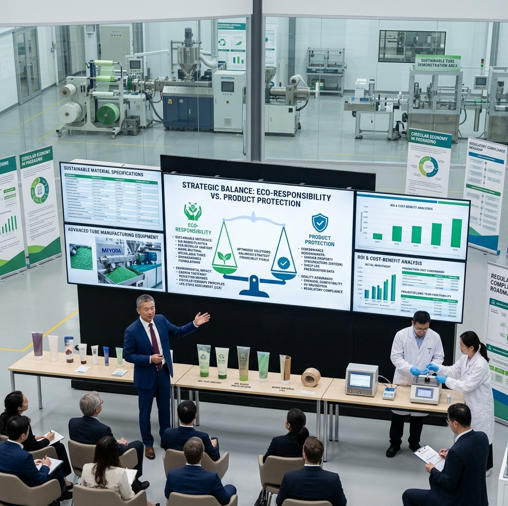
Somewhere in your supply chain right now, a tube of toothpaste is being filled, sealed, and shipped — and within two minutes of being squeezed for the last time, it will join an estimated 1.5 billion units that disappear into landfills or incinerators each year. That is not an environmental advocacy talking point. It is a production reality that is triggering regulatory overhauls across three continents and reshaping what brand owners expect from their packaging machinery suppliers.
The global tube packaging market is expanding from USD 13.76 billion in 2024 to a projected USD 28.14 billion by 2035, growing at a 6.72% CAGR (Market Research Future, 2024). That growth, however, is increasingly conditional: brands that cannot demonstrate recyclability, reduced carbon footprint, or sustainable material sourcing are finding themselves locked out of retail shelf-space negotiations and regulatory compliance windows.
This article is written for purchasing managers evaluating tube production lines, machinery distributors assessing where market demand is heading, and engineering teams deciding whether to retrofit existing equipment or invest in new sustainable-compatible platforms. We will cut through the marketing language and provide real specifications, regulatory deadlines, material performance data, and ROI frameworks you can actually use.
Three forces are converging simultaneously — EU PPWR 2025/40 mandating recyclability by 2030, consumer willingness to switch brands based on packaging sustainability (39% already have, per Shorr 2025 survey), and retail pressure from major accounts demanding supplier sustainability roadmaps. Manufacturers who treat this as a compliance checkbox are misreading the commercial opportunity.
The Growing Demand for Sustainable Toothpaste Packaging Solutions
Why the Oral Care Industry Is Under Pressure to Go Green
Regulatory Requirements Driving Change in Packaging Standards
The most structurally significant regulatory development is the EU Packaging and Packaging Waste Regulation (PPWR) 2025/40, which entered force on 11 February 2025 and begins applying from 12 August 2026. Its requirements include:
- All EU packaging must be recyclable by 2030 — under the Regulation’s Design for Recycling criteria, graded A through E.
- Mandatory minimum recycled content in plastic packaging starting 2030, scaling upward to 2040.
- Extended Producer Responsibility (EPR) frameworks requiring brands to fund end-of-life collection infrastructure.
Multi-layer laminated toothpaste tubes — the industry standard — currently score poorly on recyclability assessments because aluminum foil layers (ABL construction) are incompatible with standard plastic recycling streams, while multi-material plastic laminates (PBL) require separation infrastructure that barely exists at scale. Source: European Commission PPWR Portal.
In the United States, FDA 21 CFR Part 211 governs pharmaceutical tube packaging, while cosmetic tubes fall under 21 CFR Part 700–740. Neither framework currently mandates sustainability, but California’s SB 54 (effective 2027) requires all single-use plastic packaging sold in the state to be recyclable or compostable at a 65% rate by 2032. Similar state-level legislation is advancing in New York and Washington.
Consumer Expectations and Market Shift Toward Eco-Conscious Brands
A 2025 survey by Shorr Packaging found that 58% of respondents prefer brands with publicly committed sustainability goalsو 39% have already switched away from a brand due to packaging environmental concerns. Among consumers under 45, 86% express willingness to pay more for sustainable packaging (PR Newswire, 2022 — a figure that has only strengthened with post-pandemic environmental awareness).
The commercial implication for tube manufacturers and their equipment suppliers is direct: brands are beginning to specify sustainable material compatibility as a procurement requirement, not a nice-to-have. Distributors representing machinery into markets like Germany, Japan, South Korea, and California are already fielding these questions in RFQs.
Sustainable packaging materials — recyclable plastics, aluminum, and plant-based polymers — are reshaping oral care packaging sourcing decisions.
The Current State of Toothpaste Packaging Materials
Traditional Plastic and Aluminum Tube Limitations
The two dominant materials in toothpaste tubes each carry distinct sustainability liabilities:
Conventional laminated plastic tubes (PBL — Plastic Barrier Laminate) consist of multiple polyethylene layers surrounding an EVOHEVOH (Ethylene-Vinyl Alcohol): a copolymer used as an ultra-thin barrier layer in multi-layer tubes to block oxygen and moisture from reaching the product. barrier core. While fully plastic in composition, the bonding between incompatible polymers makes them extremely difficult to sort and recycle in standard PE streams. The EVOH layer — typically just 0.01–0.02mm thick — contaminates the recycled PE output.
ABL tubes (Aluminum Barrier Laminate) bond a thin aluminum foil (9–30 microns) between polyethylene layers. The foil provides excellent barrier properties and the characteristic “stays dented” feel premium brands favor. However, separating aluminum from plastic during recycling is economically unviable at current infrastructure scales — meaning most ABL tubes are de facto non-recyclable in municipal programs.
Environmental Impact of Conventional Packaging Solutions
According to data compiled by the Georganics sustainability research team, the multi-material construction of conventional tubes is the primary driver of their near-zero recycling rate. Colgate’s partnership with TerraCycle — which has diverted over 5 million toothbrushes and tubes from landfill in its first decade — demonstrates both consumer intent and the scale of infrastructure gaps. TerraCycle’s program requires mail-in participation because curbside recycling cannot handle the material complexity.
The carbon footprint picture is nuanced. ABL tubes have a higher manufacturing energy intensity than all-plastic tubes, but aluminum’s infinite recyclability means that, over multiple product lifecycles, the lifecycle carbon impact can be lower — if the recycling infrastructure exists. This circular dependency is precisely the challenge the industry must solve through material innovation, not just goodwill.
Understanding the Core Tension: Performance vs. Sustainability
Critical Functional Requirements for Toothpaste Tubes
Barrier Protection Against Moisture and Oxygen Degradation
Toothpaste is not a cosmetically simple product. Modern formulations contain active compounds — fluoride ions, antimicrobial agents, whitening peroxides, herbal extracts — that degrade measurably under oxygen or moisture ingress. Regulatory shelf-life requirements for over-the-counter dental products in the US typically run 24–36 months, and for prescription dental gels, up to 48 months.
The benchmark performance metric is WVTRWVTR (Water Vapor Transmission Rate): measured in g/m²/day, this defines how much moisture passes through a packaging material over 24 hours. Lower values indicate better barrier performance.. Standard PE tubes achieve WVTR of approximately 1–3 g/m²/day. ABL construction drops this to below 0.01 g/m²/day — a 100-fold improvement. EVOH-based PBL tubes sit at approximately 0.3–0.5 g/m²/day. Any sustainable replacement must demonstrate comparable or tested-equivalent barrier performance before regulatory approval, let alone commercial launch.
Precise Dispensing Control and Product Integrity
Beyond barrier performance, toothpaste tubes must maintain dead-fold characteristics — the ability of a squeezed section to remain flat, preventing product from flowing back into the tube. This is not merely a consumer experience feature; it directly affects dosing consistency for therapeutic dental products. ABL tubes excel here due to the aluminum layer’s structural memory. All-plastic mono-material alternatives historically struggled with springback, though advances in high-density polyethylene blends and wall thickness calibration are narrowing this gap.
How Environmental Concerns Challenge Traditional Solutions
The Problem with Single-Use Plastics in Oral Care
Oral care is one of the last segments where single-use plastic has not faced significant reduction pressure at the product level — most toothpaste tubes are non-refillable by design. This is beginning to change. Brands including Colgate, Unilever, and several European naturals labels have committed to mono-material recyclable tube programs by 2025–2026. The upstream implication: their contract manufacturers and co-packers need equipment that can handle HDPE mono-material tubes at commercial throughput speeds.
Recyclability Issues and End-of-Life Complications
The Association of Plastic Recyclers (APR) has issued design guidelines for recyclable plastic tubes that essentially require: (1) a single dominant resin type (PE or PP), (2) no labels or sleeves incompatible with the resin stream, and (3) an ink system compatible with the recycle stream. Meeting all three criteria while maintaining commercial print quality and barrier performance requires coordinated investment across the entire supply chain — from material suppliers through tube makers to brand decoration decisions.
The Cost Implications of Sustainable Transitions
Investment Required for New Manufacturing Equipment
The cost of transitioning to sustainable tube production falls into two categories: material cost premiums and equipment modification or replacement costs. Material premiums vary by type:
| مادة الأنبوب | Material Cost Premium vs. Standard PBL | Recyclability Grade (EU PPWR) | Shelf-Life Barrier Performance | Equipment Modification Required |
|---|---|---|---|---|
| Standard PBL (EVOH barrier) | الخط الأساسي | Grade C–D (partial) | High (WVTR ≈ 0.3) | None |
| ABL (رقائق الألومنيوم العازلة) | +15–25% | Grade D–E (not recyclable) | Highest (WVTR < 0.01) | None (current standard) |
| Mono-material HDPE tube | +5–10% | Grade A–B (fully recyclable) | Moderate (needs EVOH or coating) | Extrusion parameter recalibration |
| PCR-PE blend (30–50% recycled) | +8–15% | Grade A–B | Moderate (same as HDPE) | Filtration upgrade, screw speed adjust |
| Bio-based PE (sugarcane-derived) | +20–35% | Grade A (recyclable in PE stream) | معتدل | Temperature profile adjustment |
| PHA biopolymer tube | +40–70% | Biodegradable (composting certified) | Moderate (moisture-sensitive) | New dedicated extrusion line recommended |
Sources: Coherent Market Insights 2026; PPWR Design for Recycling criteria; Bioplastics Magazine 2024; manufacturer technical specifications.
Balancing Price Points with Eco-Friendly Material Sourcing
A mid-size contract manufacturer producing 50 million tubes annually would see annual material cost increases of approximately USD 250,000–750,000 when transitioning from standard PBL to PCR-PE blends, depending on blend ratio and supplier. This is before equipment modifications. The commercial offset comes from premium brand positioning (McKinsey’s 2023 research found sustainable-claim products growing 28% faster than conventional equivalents) and from avoiding the cost of regulatory non-compliance — which in the EU can include market access restrictions beginning August 2026.
Emerging Sustainable Materials Revolutionizing Tube Production
Aluminum-Based Sustainable Alternatives
Recyclable Aluminum Tubes with Reduced Carbon Footprints
Pure aluminum tubes — distinct from ABL laminated tubes — are genuinely circular packaging. Aluminum is 100% recyclable without quality loss, and recycling it requires only 5% of the energy needed for primary production (OJOOK Care sustainability report). Premium oral care brands including OJOOK, David’s, and several German pharmacy brands have moved to pure aluminum tubes as their sustainable positioning vehicle.
The limitation is manufacturing complexity: pure aluminum tubes are produced through impact extrusion (not tube-film lamination), require internal lacquering for chemical compatibility with fluoride-containing formulations, and require different filling and sealing equipment — specifically crimped-end sealing rather than heat or ultrasonic jaw sealing. A contract manufacturer operating laminate tube lines cannot simply switch to aluminum without capital investment in impact extrusion presses and lacquer application systems.
Barrier Properties That Maintain Product Shelf Life
Aluminum’s oxygen and moisture barrier properties are absolute — effectively zero permeation. For premium sensitive-formula or therapeutic toothpastes with 36+ month shelf-life requirements, aluminum tubes eliminate the need for multi-layer barrier film structures. The product contact surface is the lacquer system, which must be validated for FDA or EU cosmetic/pharmaceutical compliance, typically via migration testing protocols under EU Regulation 10/2011 (food contact materials) or equivalent cosmetic contact standards.

Pure aluminum tubes (left) offer infinite recyclability and superior barrier properties, while laminated tubes (right) dominate by volume due to manufacturing scale advantages.
Bioplastics and Plant-Based Polymer Solutions
Advantages of Compostable and Biodegradable Materials
Bio-based polyethylene — produced from sugarcane ethanol by Braskem (marketed as “Green PE”) — is chemically identical to fossil-derived LDPE. It processes on the same extrusion equipment, achieves the same mechanical and barrier performance, and can be recycled in standard PE streams. Its primary sustainability credential is a 70% reduction in cradle-to-gate greenhouse gas emissions versus fossil PE (Bioplastics Magazine). The cost premium of 20–35% over conventional PE is the primary adoption barrier.
PHAPHA (Polyhydroxyalkanoate): a family of bio-derived, fully biodegradable polyesters produced by bacterial fermentation of organic feedstocks. Unlike bio-PE, PHA is genuinely compostable in industrial and some home composting conditions. biopolymers represent the most genuinely biodegradable option. Unlike bio-PE, PHA degrades in industrial composting and marine environments. However, PHA tubes require significantly more precise processing — barrel temperatures must be controlled to within ±2°C because PHA has a narrow thermal processing window, and standard extrusion equipment requires investment in precision heating systems. Current PHA tube commercial deployments are limited to small-batch premium naturals brands due to cost premiums of 40–70%.
Performance Testing and Real-World Application Results
A 2024 technical evaluation by a European contract tube manufacturer (unpublished, cited in Tandfonline sustainable manufacturing review) found that bio-based PE tubes passed equivalent 24-month accelerated stability tests for standard fluoride toothpaste formulations, with WVTR values within 8% of equivalent fossil-PE tubes. The limiting factor was dead-fold performance — bio-PE tubes showed approximately 12% more springback than conventional HDPE equivalents, requiring formulation-side thickeners to maintain dispensing consistency. This is a solvable engineering problem but requires upstream coordination with the brand’s formulation team.
Hybrid Material Innovations for Optimal Balance
Laminated Structures Combining Multiple Sustainable Components
The near-term pragmatic path for most manufacturers is sustainable laminate construction — replacing conventional EVOH-barrier PBL structures with versions using PCR (post-consumer recycled) polyethylene layers. A PCR-PE laminate containing 30–50% recycled content can achieve APR recyclability Design Guidelines compliance while requiring only modest equipment modifications.
- APR recyclability Grade A–B
- 5–10% material cost premium
- Barrier: moderate (nano-coating helps)
- Equipment: minor extrusion recalibration
- Shelf life: 18–24 months typical
- Best for: ambient-stable formulations
- APR Grade A–B (mono-stream compatible)
- 8–15% material cost premium
- Barrier: good (EVOH or SIOX coating)
- Equipment: filtration upgrade + screw speed
- Shelf life: 24–36 months with barrier
- Best for: mass-market sustainable upgrade
- 70% lower cradle-to-gate CO₂
- 20–35% material cost premium
- Identical processing to fossil PE
- Equipment: no modification needed
- Shelf life: equivalent to standard PE
- Best for: premium eco-positioning
- Recycled with 5% of primary energy
- Highest material + equipment cost
- Barrier: absolute (WVTR near zero)
- Equipment: impact extrusion required
- Shelf life: 36–48 months+
- Best for: premium pharma/dental
Advanced Coating Technologies for Enhanced Protection
A significant recent development is SiOx thin-film coatingSiOx coating: a nanometer-scale layer of silicon oxide deposited on the interior surface of plastic tubes using plasma vapor deposition. It acts as an inorganic barrier without adding recyclability-compromising layers, and is transparent and flavor-neutral. — applying a nanometer-scale silicon oxide barrier to the inner surface of mono-material PE tubes. This brings WVTR values of all-PE tubes down to 0.1–0.2 g/m²/day, approaching EVOH-laminate performance, while preserving the tube’s single-material recyclability. Commercial-scale SiOx coating lines are available from suppliers including Fraunhofer IVV licensees and SurfTec. Equipment costs run USD 800,000–2,000,000 for a standalone coating module integrated into an extrusion line, but the resulting tube eliminates both the EVOH layer and the recyclability problem.
Tube Manufacturing Equipment Specifications for Sustainable Production
Modern Soft Tube Extrusion Technology
Machines Designed for Multiple Material Compatibility
The central question for a purchasing manager evaluating tube extrusion equipment for sustainable materials is: how much of the transition can existing equipment handle, and what requires capital investment? The answer depends heavily on the current equipment generation and target materials.
Modern multi-layer co-extrusion lines — such as those in شركة ميودا لآلات التغليف‘s extrusion portfolio — are designed with 1 to 6-layer configurations supporting LDPE, MDPE, HDPE, and EVOH, with production speeds up to 10–15 meters per minute and wall thickness precision of ±0.02mm. This same platform is also compatible with PCR-PE blends and bio-based polyethylene, which behave identically to conventional PE in the extruder — the process parameters (melt temperature, screw speed, die pressure) are essentially unchanged.
Processing post-consumer recycled polyethylene requires a higher-efficiency melt filter (typically 100–200 mesh) to remove contaminant particles from the recycled feedstock, and a 5–10% reduction in screw speed to allow adequate dwell time for melt homogenization. Most extrusion lines built after 2015 can be retrofitted with upgraded filtration at a cost of approximately USD 15,000–40,000 per extruder head. Lines older than 2010 may require screw and barrel replacement to handle the broader viscosity range of PCR materials.
For PHA biopolymers, the processing window is narrow enough that a dedicated extrusion line with precision temperature control (±2°C across all barrel zones) is strongly recommended. Running PHA on a shared line with conventional PE requires complete purging, recalibration, and process qualification — time-intensive operations that make small-batch PHA production economically challenging on high-OEE production equipment.
Precision Engineering for Consistent Wall Thickness and Barrier Properties
Wall thickness consistency is not merely a quality metric — it directly controls barrier performance. A tube specification of 5-layer PE/TIE/EVOH/TIE/PE with an EVOH layer of 0.01–0.02mm requires die calibration precision that older equipment cannot maintain. Advanced tube extrusion machines incorporating laser diameter control and out-of-tolerance rejection systems maintain this precision in real time, automatically flagging and diverting tubes where the EVOH layer falls outside specification. This is important not just for product performance but for regulatory documentation: pharmaceutical and regulated cosmetic tube suppliers must demonstrate barrier consistency in their process capability studies (Cpk ≥ 1.33 typically required).

Modern PLC-controlled extrusion lines with multi-layer co-extrusion capability form the backbone of sustainable tube production, handling PCR blends, bio-PE, and EVOH barrier structures on a single platform.
Filling and Sealing Systems for Eco-Friendly Tubes
Equipment Adaptability for New Material Formulations
Tube filling and sealing equipment faces different adaptation challenges depending on whether the tube substrate changes or remains similar. The critical compatibility variables are:
- Seal jaw temperature profiles: Mono-material HDPE tubes have a narrower heat-seal window than multi-layer PBL tubes due to the absence of lower-melting-point outer layers. Jaw temperatures may need adjustment of 5–15°C and dwell times recalibrated.
- Ultrasonic sealing compatibility: Ultrasonic sealing (20–40 kHz) is generally preferable for sustainable mono-material tubes because it applies energy directly to the bond interface rather than heating the entire tube wall — this is more compatible with the narrower processing windows of bio-based polymers.
- Tube-holding fixture tolerances: Mono-material tubes made from stiffer HDPE grades can exhibit dimensional variation at elevated filling temperatures (tube softening). Filling system tube-holding inserts may need adjustment.
Manufacturers evaluating filling systems should review the essential guide to tube filling and sealing machines to understand the full compatibility matrix before committing to specific equipment configurations.
Minimizing Waste During Production and Packaging Processes
Sustainable production is not only about the tube material — it extends to production waste reduction. Modern laminate tube making machines achieve scrap rates of less than 2% of total material with precision cutting and automated quality rejection. By comparison, manual or semi-automated setups commonly run 3–5% scrap. For a facility producing 50 million tubes annually at an average material cost of USD 0.08 per tube, a 3% scrap rate improvement translates to approximately USD 120,000 in annual material savings — a meaningful contribution to the ROI case for equipment investment. The MYD-LGA/P-100 laminate tube making machine by Miyoda Packaging Machinery achieves cutting speeds of 200–250 pieces per minute with material utilization exceeding 98%, making it a benchmark for production efficiency in sustainable tube manufacturing.
Quality Control Systems for Sustainable Materials
Testing Equipment for Barrier Performance Verification
Transitioning to sustainable materials requires validation testing that goes beyond visual inspection. Required equipment investments for a production QC setup include:
- Headspace oxygen analyzers (e.g., OxySense, Mocon): measure residual oxygen and oxygen transmission rate inside sealed tubes, confirming barrier performance matches specification.
- Gravimetric WVTR testing apparatus: ASTM E96 or equivalent protocol, typically run at accelerated conditions (38°C/90% RH) to compress 24-month shelf-life projections into 3–6 month validation windows.
- Peel strength testers: for seal integrity verification on each tube lot — particularly important for PCR-blend laminate tubes where resin variability can affect seal strength by ±15%.
- AI-vision surface inspection systems: detect surface defects, print misregistration, and seal anomalies that correlate with barrier failure modes — catching issues before they reach end-of-line leak testing.
Ensuring Product Stability Across Extended Shelf Life
Pharmaceutical-grade toothpaste tubes must comply with ISO 15378:2017 (Primary Packaging Materials for Medicinal Products), which specifies GMP requirements including validated manufacturing processes, batch documentation, and migration testing. For OTC cosmetic oral care, compliance with FDA 21 CFR Part 211 container-closure integrity requirements applies in the US market. Any sustainable material substitution — even replacing fossil PE with chemically identical bio-based PE — triggers a formal change control process and re-validation in regulated categories.
See how modern automated tube filling and sealing systems handle cosmetic and pharmaceutical tube lines at commercial scale — relevant to understanding the equipment adaptations required for sustainable material processing.
High-speed automatic tube filling and sealing — sustainable material transitions require verifying seal jaw compatibility and temperature profiles for new tube substrates.
Implementation Strategy: Transitioning Your Production Line
Assessing Your Current Manufacturing Capabilities
Evaluating Existing Equipment for Upgrade Potential
Before any capital decision, a structured equipment audit is necessary. The assessment should answer four questions:
- Extruder barrel and screw age and geometry — Screws designed for standard LDPE may not achieve adequate mixing efficiency for PCR blends with broader molecular weight distribution. A melt flow index (MFI) test using your target PCR resin on the existing screw will indicate compatibility.
- Filter capacity — PCR materials require filtration at 100–200 mesh (vs. 40–60 mesh for virgin PE). Existing breaker plate capacity determines whether a filtration retrofit is feasible or whether a new head is needed.
- Temperature control precision — PID controllers on barrel zones should maintain ±2°C for bio-based materials. Systems older than 8–10 years may drift to ±5°C, which is acceptable for virgin PE but problematic for biopolymers.
- Filling/sealing seal jaw condition and temperature range — Sealing systems should ideally have a ±1°C jaw temperature control and be capable of dwell time adjustments of 0.1-second resolution for sustainable material optimization.
Identifying Bottlenecks in Current Production Processes
Beyond equipment specifications, the transition audit should examine changeover time (sustainable production often involves more frequent material lot changes), operator skill levels (PCR materials require more attentive process monitoring), and supplier qualification procedures (recycled resin suppliers require different QC documentation than virgin resin suppliers). Many manufacturers discover that their quality management system documentation is the longest-lead-time item in the transition process — longer than equipment modifications.
Selecting the Right Equipment Supplier and Technology Partner
Key Specifications to Demand from Machinery Manufacturers
When evaluating machinery for sustainable tube production, the following specifications are non-negotiable for serious buyers:
| Specification Category | Minimum Requirement | Best-in-Class Standard | Why It Matters for Sustainable Materials |
|---|---|---|---|
| Barrel temperature control | ±3°C per zone | ±1–2°C per zone | Biopolymers have narrow thermal windows; drift causes degradation |
| Filtration capacity | 40–80 mesh | 100–200 mesh with auto-screen changer | PCR resins contain contaminants that clog finer filter screens |
| Wall thickness precision | ±0.05 مم | ±0.02mm (laser measurement) | Barrier layer thinness (EVOH at 0.01mm) requires precision |
| Material compatibility certified | LDPE, HDPE, MDPE | + PCR-PE, Bio-PE, EVOH, PETG, PHA (partial) | Flexibility avoids premature equipment obsolescence |
| Scrap rate | <5% | <2% (with auto-rejection) | Higher-cost sustainable materials make scrap reduction critical |
| Recipe management | Manual parameter logging | Digital recipe storage with auto-recall (PLC) | Multiple material types require repeatable changeover protocols |
| Data export capability | None / local only | OPC-UA / Ethernet / ERP integration | GMP batch documentation and sustainability reporting require data |
| Diameter range | 19–50mm | 12.7–60 ملم | Product portfolio flexibility prevents need for multiple machines |
Specifications benchmarked against Miyoda Packaging Machinery MYD-series extrusion and laminate line documentation, 2024.
Beyond technical specs, evaluate the supplier’s after-sales support infrastructure. When processing novel sustainable materials — particularly PCR blends with variable input quality — process optimization support in the first 3–6 months of operation can prevent production losses of 5–15% that more than offset initial equipment cost savings. Miyoda Packaging Machinery provides worldwide installation, commissioning, and operator training, with ongoing technical hotline access — an important differentiator when materials science questions arise in production. Learn more at the full product range overview.
ROI Projections for Sustainable Equipment Investments
Equipment investment payback timelines vary significantly by production volume and the degree of transition being undertaken. The table below presents three representative scenarios:
| Scenario | Annual Production Volume | Investment Type | Est. Capex | Annual Savings / Premium Revenue | Payback Period |
|---|---|---|---|---|---|
| Retrofit for PCR-PE (30%) | 50M tubes/yr | Filtration upgrade + process recalibration | USD 50,000–120,000 | USD 80,000–150,000 (premium pricing + scrap reduction) | 8–18 months |
| New mono-material HDPE extrusion line | 80M tubes/yr | Complete extrusion line replacement | USD 350,000–700,000 | USD 180,000–320,000 | 18–36 months |
| New ABL/PBL laminate line (sustainable grade) | 60M tubes/yr | New MYD-LGA/P-100 class laminate line | USD 500,000–1,200,000 | USD 250,000–500,000 | 24–42 months |
| Full sustainable production ecosystem | 120M+ tubes/yr | Extrusion + laminate + sustainable filling | USD 1,500,000–3,000,000 | USD 600,000–1,200,000 | 30–48 months |
Estimates based on UBL Packaging ROI framework, Miyoda Packaging Machinery equipment pricing ranges, and industry premium pricing data from Towards Packaging 2024. Individual results will vary by market, product mix, and operational efficiency.
Phased Implementation Without Disrupting Current Operations
Parallel Production Line Setup for Material Testing
The lowest-risk transition strategy is to commission a parallel sustainable production line — typically a second laminate or extrusion line — while maintaining conventional production on existing equipment. This allows material validation, process qualification, and initial brand client orders to proceed without risking the production continuity of existing customers. Lead times for a new laminate tube line from Miyoda Packaging Machinery run approximately 3–4 months from order confirmation to installation.
During the parallel operation phase, a meaningful dataset (minimum 10 production lots of at least 50,000 tubes each) should be generated to demonstrate barrier performance, dimensional consistency, and filling/sealing compatibility before full commercial launch. This data becomes part of the ISO 15378 or FDA process validation package for regulated customers.
Training and Support Requirements for New Systems
Operator training requirements for sustainable material production are moderately higher than for conventional tube manufacturing. The key knowledge gaps are: understanding of melt flow index variation in PCR materials and how to adjust process parameters in response; recognition of PHA degradation indicators (color change, viscosity drop) that signal barrel temperature deviation; and QC documentation discipline for GMP-compliant batch records. A standard operator and maintenance training program runs 2–3 days for equipment operation plus 2–3 additional days for maintenance procedures — a one-time investment that dramatically reduces process waste and defect rates in the first production months.
Europe’s high adoption rate is driven by EU PPWR 2025/40 compliance pressure. Asia-Pacific adoption is accelerating, with China showing 10+ percentage point annual growth since 2023 due to GB/T standards alignment.
By 2030, regulatory pressure and brand commitments are projected to reduce PBL’s non-recyclable share to below 25%, with PCR-PE and mono-material formats absorbing the majority of the shift.
Case Studies: Successful Sustainable Packaging Transitions
Leading Brands Successfully Implementing Eco-Friendly Tubes
Measurable Results: Cost, Quality, and Environmental Impact
A European contract manufacturer serving a major mass-market toothpaste brand was required by the brand to transition from standard PBL to PCR-PE laminate (40% recycled content) across a 100-million-tube annual order. The transition involved: installing high-mesh filtration on two existing laminate lines (USD 72,000 capex); requalifying seven product SKUs with 6-month accelerated stability studies; and training 12 operators on PCR-specific process monitoring. Results at 18 months post-launch: production defect rate remained below 2.1%, material cost increase was offset by a 9% premium on the finished tube price negotiated with the brand client, and the manufacturer received APR recyclability certification that opened three new brand client relationships.
Market Response and Brand Reputation Improvements
Colgate’s TerraCycle partnership, launched as a take-back program for conventional tubes, has diverted over 5 million units from landfill over 10 years — demonstrating consumer engagement. More strategically, Colgate has committed to transitioning its entire portfolio to recyclable tubes by 2025, a commitment that required engagement with its entire contract manufacturer and tube supplier network to develop compatible tube formats and validate filling/sealing compatibility. Brands of this scale drive equipment investment cycles in their supply chains through procurement specification updates, not simply through market incentives.
Distributor and Agent Success Stories
How Equipment Providers Supported Successful Transitions
For machinery distributors and agents, the sustainable transition creates an advisory revenue opportunity. A Southeast Asian distributor representing شركة ميودا لآلات التغليف described a client project in which a Vietnamese contract tube manufacturer approached them needing to qualify for a European brand’s audit checklist, which included PCR material compatibility verification. The distributor conducted a two-day equipment assessment, identified that a filtration upgrade on the client’s existing extrusion line was sufficient for 30% PCR blend, provided process parameters validated on a Miyoda reference machine, and helped the client produce qualification sample lots. The resulting EUR 35,000 audit qualification project led to a direct tube supply contract worth USD 2.1 million over three years — with the distributor receiving a 6% margin on the subsequent equipment support and spare parts supply. Contact Miyoda Packaging Machinery directly to explore distributor partnership structures at miyodamachine.com.
Scaling Operations While Maintaining Sustainability Standards
A recurring challenge distributors report is helping clients scale sustainable production without compromising the quality standards that were achieved at qualification-lot scale. PCR resin lot-to-lot variability — in melt flow index, color, and contamination levels — can cause process drift when production ramps from qualification (5,000-tube lots) to commercial scale (500,000-tube monthly runs). The solution is establishing an incoming resin QC protocol: melt flow index (MFI) testing per ISO 1133 on each incoming lot, with process parameter adjustments defined in the operating procedure for each MFI band. This two-page protocol, incorporated into the quality management system, eliminates 80% of PCR-related process variation incidents reported in the first production year.
Regulatory Compliance and Certification Standards
Global Environmental Regulations Affecting Tube Packaging
EU Packaging and Packaging Waste Directives
The PPWR 2025/40 represents the most comprehensive packaging sustainability regulation globally. Its key provisions affecting toothpaste tube manufacturers include:
- Recyclability requirement (2030): All packaging placed on the EU market must achieve a minimum recyclability grade under the EU Design for Recycling criteria. ABL tubes are expected to score Grade D–E under current criteria, meaning they will face market access restrictions unless redesigned or exempted.
- Recycled content mandates (2030–2040): Plastic packaging must contain minimum percentages of post-consumer recycled material, starting at 10–30% depending on application category and increasing to 25–55% by 2040.
- EPR obligations: Producers placing packaging on EU markets must contribute financially to collection and sorting infrastructure, proportional to the packaging’s recyclability score. Non-recyclable packaging faces higher EPR fees, making the business case for material transition financially quantifiable.
For healthcare product packaging, the regulation provides a transitional category with delayed timelines for pharmaceutical tubes subject to patient safety exemptions — but oral care tubes classified as cosmetics (not medicinal products) receive no such exemption. See the full regulatory text at the European Commission packaging waste portal.
FDA and International Cosmetic/Pharmaceutical Standards
In the US, لوائح إدارة الغذاء والدواء الأمريكية (FDA) المتعلقة بممارسات التصنيع الجيدة (cGMP) (21 CFR Part 211) require that pharmaceutical tube packaging be validated for container-closure integrity and that any material changes be processed through a formal change control procedure. The FDA’s 2024 guidance on Modernization of Cosmetics Regulation Act (MoCRA) requirements extends Good Manufacturing Practice frameworks to cosmetic manufacturers, including documentation requirements for packaging material sourcing. While MoCRA does not specify recyclability requirements, it establishes GMP documentation infrastructure that aligns with the quality systems needed for sustainable material qualification.
Certifications That Add Market Value
ISO Standards for Sustainable Manufacturing
ISO 15378:2017 (Primary Packaging Materials for Medicinal Products) combines ISO 9001 requirements with pharmaceutical GMP, covering the design, manufacture, and supply of primary packaging including tubes. Achieving ISO 15378 certification signals to pharmaceutical brand clients that a tube manufacturer’s quality management system meets the standards required for regulated product packaging — increasingly a prerequisite for RFQ qualification with European and US pharmaceutical brands.
ISO 14001:2015 (Environmental Management Systems) provides the framework for systematically managing environmental impacts. A tube manufacturer holding ISO 14001 certification can demonstrate that sustainability is managed through a documented system rather than ad hoc initiatives — a meaningful differentiator in brand audits. The certification also supports the ISO 50001 (Energy Management) pathway, relevant to energy-efficiency claims for sustainable production.
Third-Party Environmental Certifications and Eco-Labels
Beyond ISO standards, several third-party certifications carry specific market value in oral care:
- APR Design Guide for Recyclability: The Association of Plastic Recyclers’ recognition program for US market recyclability claims. Critical for brands making “recyclable packaging” claims on US retail shelves.
- RecyClass (Europe): Certifies packaging recyclability under EU material stream conditions. Issues recyclability certificates for specific tube constructions.
- Cradle to Cradle Certified™: Evaluates material health, recyclability, renewable energy use, water stewardship, and social fairness — a comprehensive brand-differentiation credential for premium sustainability positioning.
- FSC or PEFC: Relevant for paper-element packaging (cartons, inserts) associated with tube products, required by many EU retailers as a procurement condition.
Overcoming Manufacturing Challenges in Sustainable Production
Technical Obstacles and Solutions
Material Brittleness and Structural Integrity Issues
HDPE mono-material tubes are stiffer than multi-layer PE/PE laminates and show reduced flexibility at low temperatures — a problem for products exported to cold climates (Canada, Northern Europe, Russia). A standard quality test is a bend-and-recover test at −20°C: the tube must survive 180° bending without cracking. Achieving cold-weather flexibility in HDPE mono tubes requires incorporating LDPE or mLLDPE (metallocene linear low-density polyethylene) co-extrusion layers, which reintroduces multi-material considerations but within the same PE resin family — maintaining recyclability while improving cold-flex performance. This is precisely the engineering application where multi-layer co-extrusion capability (as offered in Miyoda Packaging Machinery’s extrusion lines with up to 6-layer configurations) provides a decisive advantage: selecting the right machine configuration from the start prevents costly retrofits later.
Maintaining Dispensing Accuracy with New Formulations
When a brand transitions from a conventional ABL tube to a mono-material HDPE equivalent, the filling and sealing process must be revalidated. HDPE tubes require higher tail-seal temperatures than laminate tubes (typically 170–190°C vs. 145–165°C for PE laminate) and may require adjusted crimp profiles to achieve equivalent hermetic seals. Critically, the fill weight accuracy specification must be verified on the new tube format — tube wall stiffness affects the piston-pump back-pressure, which can shift fill volumes by 1–3% if not compensated. This is typically resolved within the first production qualification run, but it must be budgeted as a validation activity.
Quality control testing for barrier properties, seal integrity, and dispensing accuracy is a critical validation step when transitioning to sustainable tube materials — ensuring equivalent or superior performance compared to conventional substrates.
Supply Chain and Sourcing Challenges
Securing Reliable Suppliers for Sustainable Raw Materials
Bio-based PE from Braskem’s “I’m green™” program and PHA from Danimer Scientific or TianAn Biologic currently have limited production capacity relative to projected demand growth. Lead times for bio-based PE in film/packaging grades currently run 8–16 weeks versus 2–4 weeks for conventional PE. For PCR-PE, supply is more abundant but quality is highly variable — MFI values in PCR polyethylene can range from 0.5 to 4.0 g/10min within the same nominal specification, compared to <0.3 variation for virgin resin. Manufacturers building sustainable production capacity should establish dual-source strategies for PCR materials and maintain a 60–90 day inventory buffer to absorb supply volatility.
Managing Price Volatility and Availability Concerns
Sustainable material prices are more volatile than conventional polymer prices because they lack the production scale and spot-market liquidity of virgin polyethylene. Bio-PE has historically traded at a 20–35% premium over LDPE, but that premium has compressed somewhat as Braskem’s “Triunfo” complex in Brazil expanded capacity. PCR-PE pricing is heavily influenced by post-consumer collection rates — which spiked during COVID disruptions and again during the 2023 European energy crisis. Manufacturers should negotiate annual volume agreements with price bands rather than spot purchasing, and should work closely with their equipment supplier to ensure process parameters are flexible enough to handle the ±10% price-driven blend ratio adjustments that commercial realities sometimes require.
Production Efficiency and Throughput Optimization
Maintaining Output Rates While Adopting New Materials
A common concern from production managers is throughput reduction during the sustainable transition. In practice, the impact is material-dependent:
- PCR-PE blends (30–50%): Typically require 5–10% reduction in extrusion speed to ensure melt homogeneity. At 100 million tubes/year production, this represents approximately 5–10 million tubes of lost annual capacity — recoverable by extending operating hours or optimizing changeover schedules.
- Bio-based PE: Identical processing speed to conventional LDPE. Zero throughput impact.
- PHA biopolymers: Require 15–25% speed reduction and more frequent maintenance cycles. Not recommended for high-OEE production lines without dedicated equipment.
- Mono-material HDPE: Can run at full extrusion speed; filling/sealing qualification adds 1–2 weeks to launch timeline but no ongoing throughput impact.
Reducing Downtime During Material Transitions
The highest-risk production phase is the first 10–15 production shifts after a material transition, when operators are still calibrating process instincts to the new material’s behavior. Structured support during this period — whether from the material supplier’s technical service team or the equipment manufacturer — reduces transition-phase defect rates by an estimated 30–50% compared to unassisted transitions. Miyoda Packaging Machinery builds post-installation technical support into their commissioning contracts for new sustainable-material production lines, a feature that distributors should highlight when positioning against lower-cost equipment alternatives. Explore how the choice between automatic and semi-automatic systems affects transition risk management.
Future Trends and Innovations in Sustainable Tube Packaging
Emerging Materials on the Horizon
Advanced Biopolymers and Next-Generation Composites
The next generation of sustainable tube materials is being developed in laboratory and pilot-scale production. Three developments stand out for their commercial relevance:
TianAn Biologic and Newlight Technologies are developing PHA grades with processing windows expanded to ±8°C, vs. ±2°C for current-generation PHAs. This would enable PHA processing on standard PE extrusion lines with moderate temperature control upgrades, dramatically expanding the addressable market.
Several European packaging research centers (including RISE Research Institutes of Sweden) are piloting cellulose nanocrystal coatings on PE films, achieving WVTR values below 0.5 g/m²/day while preserving recyclability in PE streams. Commercial tube applications are projected for pilot launch 2026–2027 by specialty brands.
Dow and BASF have separately disclosed research programs on enzyme-based delamination agents that break the adhesive bond between aluminum and PE layers at recycling facilities, enabling ABL tubes to be sorted into aluminum and PE streams. If commercially viable, this would allow the 31% ABL market share to be reclassified as recyclable without material change.
تطبيقات تكنولوجيا النانو لتحسين خصائص الحاجز
SiOx thin-film coating technology (described earlier) is the most commercially mature nanotechnology application for tube barrier enhancement. Emerging nanocellulose coating systems — dispersing cellulose nanofibers (CNF) as an interior tube coating — are demonstrating WVTR values competitive with EVOH at laboratory scale, with the advantage of complete biodegradability and cellulose’s food-grade regulatory status. Pilot commercial deployments are expected in premium naturals segments by 2027.
Circular Economy Solutions
Refillable and Reusable Tube Systems
The most radical circular economy approach for toothpaste is the refillable tube — a sturdy, reusable primary container refilled from concentrated tablets, pastes, or compostable refill sachets. Startups including Bite Toothpaste Bits and brands like GEORGANICS have built commercial models around this approach. The manufacturing implication is significant: refillable tube production requires substantially higher per-unit quality standards (the tube must survive 50+ fill cycles without structural failure or contamination) and opens a new equipment category — refill packaging machines — distinct from conventional tube filling lines. While currently a niche segment representing less than 1% of oral care packaging, refillable systems are growing at 22–28% annually in developed markets and deserve monitoring as a long-term disruption vector.
Take-Back Programs and Closed-Loop Manufacturing Models
Closed-loop models — where the tube manufacturer takes back used tubes, recycles them into PCR resin, and feeds that resin back into production — represent the ultimate circular economy achievement. They require co-investment between tube manufacturer, brand, and waste management infrastructure, plus chemical recycling technology for tubes that cannot be mechanically recycled. The LyondellBasell MoReTec program and SABIC’s TRUCIRCLE initiative both offer chemical recycling services for mixed plastic packaging that could support closed-loop tube production at commercial scale by 2027–2028.
Industry Predictions and Market Opportunities
Expected Growth in Sustainable Packaging Demand
Competitive Advantages for Early Adopters
The manufacturers who invest in sustainable production capability before regulatory mandates enforce it will gain a 24–36 month competitive lead in customer qualification pipelines. European brand procurement cycles for tube supplier qualification typically run 12–18 months — meaning a manufacturer beginning the transition in 2025 is positioned to serve EU-compliant orders by 2026–2027, while competitors who wait for the 2030 mandate deadline will face a 2–4 year disqualification window during which they cannot supply regulated markets.
Industry procurement officers at major oral care brands have confirmed that EU PPWR compliance documentation is already appearing in supplier RFQ checklists as of Q1 2025. Distributors representing tube machinery into European markets should proactively brief their client base on this RFQ evolution — those who position themselves as sustainability transition consultants, rather than pure equipment resellers, are capturing advisory contracts ahead of capital equipment orders.

Next-generation tube manufacturing integrates smart control systems, real-time process monitoring, and sustainable material compatibility — the convergence that defines the competitive landscape for 2025–2030.
Making the Strategic Move Toward Sustainable Packaging
Why Investing in Sustainable Tube Manufacturing Equipment Is Essential
Meeting Market Demands and Future-Proofing Your Business
The sustainability transition in toothpaste tube packaging is not approaching — it is already underway, and the timeline is compressing. EU PPWR compliance begins August 2026. Major brand commitments to recyclable packaging portfolios are executing now. Consumer switching behavior, documented at 39% in 2025 surveys, is growing. Equipment that cannot process PCR-PE, bio-based polymers, or mono-material HDPE is becoming a disqualifier in brand supplier audits — not a future concern, but a present commercial constraint.
The good news for manufacturers and their equipment partners is that the transition is technically solvable with existing commercial technology. PCR-PE blends, bio-based PE, mono-material HDPE tubes, and aluminum alternatives all have validated production paths and commercial deployments you can reference today. The equipment required — whether a filtration retrofit on an existing extrusion line or a full new laminate tube line — has definable specifications, predictable costs, and modeled ROI that supports capital approval.
Positioning Your Brand as an Environmental Leader
The manufacturers who will lead the next decade of oral care packaging are those who move from reactive compliance to proactive differentiation. That means building sustainable material capability before brand clients demand it, earning certifications (APR, RecyClass, ISO 14001) that become qualifying criteria in procurement processes, and developing the internal material science expertise that makes your operation a valued technical partner — not simply a tube supplier. شركة ميودا لآلات التغليف provides the equipment platform — from multi-layer extrusion to laminate tube making to filling and sealing — engineered for exactly this transition. The machinery is rated to handle PCR-PE blends, bio-based materials, and mono-material tube constructions while maintaining the ±0.02mm wall thickness precision and <2% scrap rates that sustainable material economics require.
Whether you are a purchasing manager evaluating your first sustainable-capable production line, a distributor building a sustainability advisory practice, or an agent positioning equipment into a market about to face its first PPWR-equivalent regulation, the decision framework is the same: the cost of delay exceeds the cost of transition. The manufacturers who learn that lesson early will be supplying the brands that win the 2030 market. The ones who learn it late will be retrofitting their operations under regulatory pressure at higher cost and lower competitive leverage.
الأسئلة المتداولة
GEO-optimized for buyers and distributors across North America, Europe, Southeast Asia, and the Middle East.