
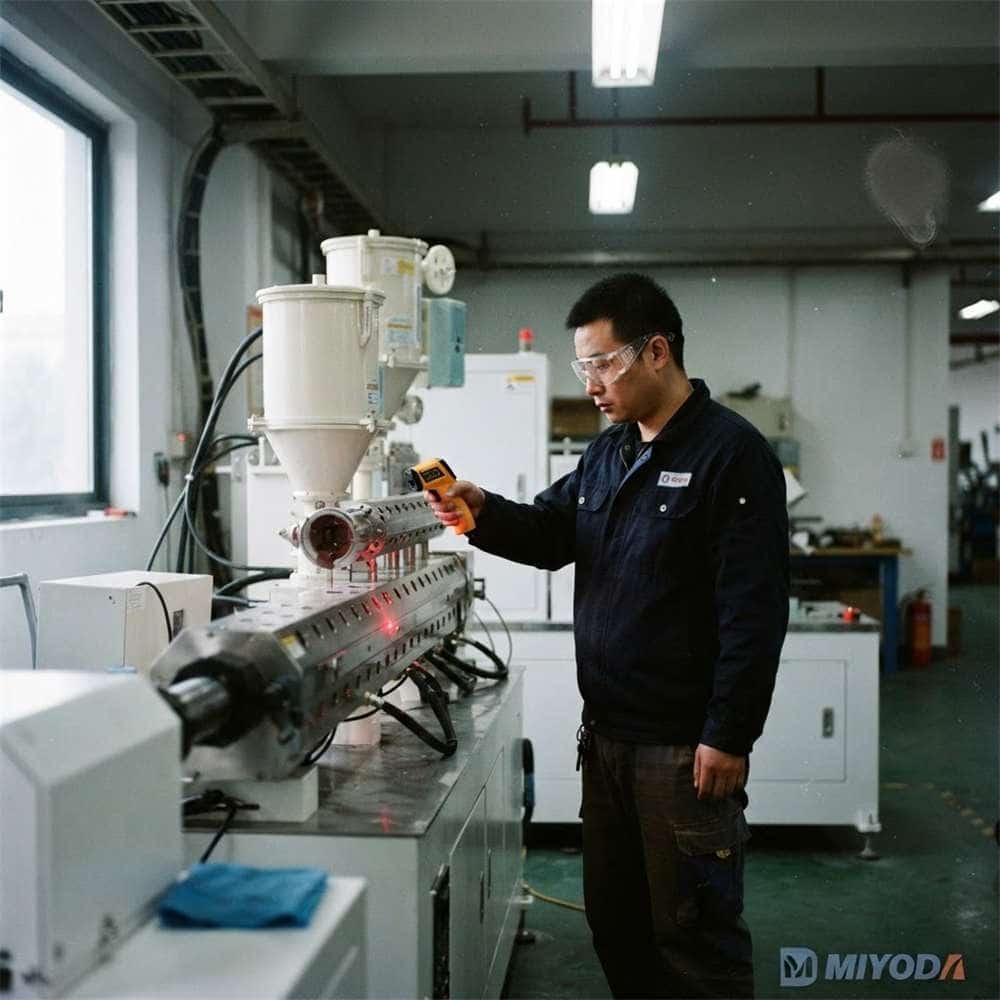
The Decision That Shapes Your Entire Production Future
You’re about to invest six figures in a tube extrusion line. Maybe more. And you’re being asked to make that decision — in many cases — without ever touching the machine, visiting the factory, or knowing the real total cost buried inside a competitive quote. This guide exists to close that gap.
1. Executive Summary: Making the Right Investment for Your Tube Production Line
Here’s a scenario that plays out more often than it should: a cosmetic tube producer in Southeast Asia or Eastern Europe selects a Chinese extruder based on price, saves $30,000 on the upfront purchase, then spends the next 18 months managing a 6-week spare-parts delivery queue, an undertrained floor team, and a vendor who answers support emails in 72 hours — when they answer at all. By year two, the “savings” are gone. In many cases, they’ve run negative.
This isn’t an argument against Chinese suppliers. Some of the most capable tube extrusion equipment in the world ships out of China — and for the right buyer, in the right context, it’s an excellent strategic choice. The problem is that most buyers don’t know how to tell the difference between a good Chinese vendor and a problematic one, or how to model what their choice will actually cost them over five years.
This guide was built for three types of readers:
- Plant managers and production directors evaluating equipment upgrades or new line investments for cosmetic or pharmaceutical tube manufacturing
- Procurement officers responsible for capital equipment decisions who need a structured, defensible framework
- Machinery distributors and agents who need to align their sourcing decisions with what their end-clients actually need — not just what generates the fastest margin
The core pain points driving this decision are real and consistent: rising production costs, supply chain delays that hit new product launches, inconsistent output quality that drives up reject rates and customer complaints, and the chronic frustration of needing customization from vendors whose product lines were designed for standardization. Getting this decision right solves all four. Getting it wrong compounds them.

2. Understanding Your Production Needs: The Foundation of Smart Equipment Sourcing
Before comparing any two suppliers, you need a precise picture of what your process actually requires. Most equipment sourcing mistakes begin at this step — not because buyers don’t care, but because they’re working from incomplete or overly optimistic production specs.
Start with material and structure. Are you producing single-layer PE tubes for body lotion? Three-layer co-extruded tubes for pharmaceutical ointments with an EVOH oxygen barrier? Multi-layer ABL (aluminum barrier laminate) tubes for medicated creams? Each structure requires a different machine configuration, different screw and die geometry, different temperature zone control, and different downstream handling. A machine spec that works perfectly for mono-layer PE sleeves may produce inconsistent wall thickness or layer adhesion failures on a 5-layer co-extruded pharmaceutical tube — sometimes not immediately, but progressively over a production run.
Regulatory compliance shapes your shortlist before price does. If you supply pharmaceutical clients — or plan to — your extrusion equipment must operate within GMP (Good Manufacturing Practice) environments. GMP requires product-contact surfaces to be cleanable without dead zones, production parameters to be logged and traceable, and equipment to be validated through IQ/OQ/PQ protocols before regulated product can run across it. ISO 13485 — the international standard for medical device manufacturing quality management — may also apply if your tubes are used in medical or pharmaceutical packaging. These are not checkbox additions. They are hard constraints that eliminate machines — and vendors — who don’t understand regulated production environments.
Scalability is the most underestimated requirement. The tube diameter range, output speed, and SKU count you need today is almost never what you’ll need in three years. Eco-friendly mono-material tube formats are reshaping product portfolios across both cosmetic and pharmaceutical sectors. Refillable and recyclable tube structures are entering regulatory frameworks in multiple markets. If your machine cannot be upgraded to handle new material grades, tighter wall tolerances, or additional processing steps — without a full rebuild — you’ve locked yourself into a production ceiling at the exact moment the market is moving.
For a technical deep-dive into specifying the right extrusion system for your tube format, the plastic tube extrusion machine selection guide from Miyoda Packaging Machinery covers material compatibility, automation level, and TCO factors specific to cosmetic and pharmaceutical tube production.
3. Lead Time Comparison: Speed to Market vs. Long-Term Planning
Lead time is the hidden variable that collapses more equipment sourcing plans than any other single factor. It looks manageable on paper — until a new product launch moves up three months, your existing line fails during peak season, or a major retail customer adds a new tube SKU with a 16-week delivery commitment.
| Stage | China Supplier | Local / Regional Supplier |
|---|---|---|
| Machine Build / Lead Time | 12–20 weeks | 6–10 weeks |
| Ocean Freight | 4–6 weeks | N/A or 1–2 weeks |
| Customs Clearance | 1–3 weeks (variable) | Minimal or none |
| Installation & Commissioning | 2–4 weeks (travel scheduling) | 1–2 weeks |
| Total Time to Production | 22–35 weeks | 8–14 weeks |
For new product launches — especially in fast-moving cosmetic categories where a seasonal window can be 8–12 weeks wide — a 35-week equipment timeline is not a plan. It’s a missed opportunity. The same applies to capacity expansion: by the time a Chinese machine clears customs, your competitor may have already taken the shelf space you were targeting.
Where Chinese suppliers gain ground is in long-term forward planning. If you’re building a second production site 18 months from now, or planning a capital refresh on a rolling 3-year cycle, the longer lead time becomes manageable — and the cost savings from Chinese sourcing become more defensible. The key is alignment between your order timeline and your production calendar, with a deliberate buffer for the variables that consistently blow past the optimistic scenario: port congestion, component delays, engineering revision rounds.
For pharmaceutical buyers, commissioning and validation add further time. IQ/OQ/PQ validation — confirmation that the machine is installed correctly, operates within specifications, and consistently produces compliant output — can add six to twelve weeks to your timeline post-delivery. Vendors who have pre-prepared validation protocols for your machine type compress this significantly. Vendors who don’t can turn a manageable delay into a regulatory crisis.
4. Total Cost of Ownership: Beyond the Initial Price Tag
The purchase price is the number on the quote. The total cost of ownership is the number that matters. A $90,000 twin-screw extruder can accumulate over $250,000 in costs over 10 years once energy consumption, spare parts, maintenance labor, and unplanned downtime events are fully accounted for. This isn’t a theoretical worst case — industry cost data for plastic extrusion equipment consistently shows this pattern across machine categories.
| Cost Category | China Supplier | Local Supplier | Notes |
|---|---|---|---|
| Purchase Price | Lower by 20–40% | Baseline | Largest apparent savings; often eroded by what follows |
| Freight & Import Duties | $2,000–$8,000+ (sea freight) + 3–10% duty | Minimal or included | Varies significantly by destination country and HS code |
| Installation & Commissioning | $5,000–$18,000 (travel + per diem) | Often bundled or lower cost | Chinese vendor engineer travel from Shanghai adds real cost |
| Spare Parts (Annual) | $4,000–$15,000 + 4–8 week lead time | $3,000–$12,000, 24–72hr delivery | Delivery speed is often the bigger issue than price |
| Unplanned Downtime | $15,000–$60,000/year | $5,000–$20,000/year | Local support cuts resolution time dramatically |
| Training & Operator Errors | Higher — language gap, limited follow-up | Lower — in-language, structured | Operator errors drive scrap rates and wear damage |
| Estimated 5-Year TCO Delta | Chinese machine apparent savings often eliminated or reversed within 3–5 years on high-run lines | ||
The hidden cost that catches the most buyers off guard is unplanned downtime. On a tube production line running at 60 tubes per minute for two shifts, a 48-hour stoppage — caused by a failed sealing jaw with a 6-week part delivery timeline from China — can cost $30,000 to $50,000 in lost output before you factor in customer penalties or rescheduling costs. This scenario is not rare. It’s a predictable consequence of sourcing critical equipment from a vendor without regional spare parts stock.
Local suppliers typically charge more upfront. But that premium often includes bundled commissioning, in-language training, regional spare parts inventory, and a service team that can have someone on your floor within 48 hours. When you model those factors into a five-year cost comparison — rather than comparing purchase prices in isolation — the gap frequently closes, and in many cases reverses.
5. Customization & Technical Flexibility: Matching Your Unique Process
The words “fully customizable” appear in almost every machine vendor’s product description. What they often mean in practice is quite different — particularly among manufacturers whose business model is built on volume production of standardized equipment.

For Chinese manufacturers, customization typically means selecting from predefined module combinations: standard screw diameter options, fixed die configurations, and a set of pre-engineered downstream assemblies. If your product spec falls within those parameters, the process is smooth. If it doesn’t — for example, if you need a 7-layer co-extrusion die for a medical tube with a specialized EVOH barrier layer, or a custom shoulder-forming system for a non-standard tube geometry — the response is often a long silence followed by an extended engineering timeline and a revised (higher) quote.
For local suppliers, collaborative engineering is more commonly embedded in the sales and project management process. Your process engineer can typically have a technical conversation directly with the machine designer — in the same language, in the same time zone — to resolve a specific wall-thickness tolerance challenge, a co-extrusion layer ratio problem, or an integration requirement with your existing capping or filling line. This kind of iterative, back-and-forth development work is difficult to do well across a 7-hour time difference, through a translator, over email.
A practical example: a cosmetic tube producer transitioning from full-plastic PBL (Plastic Barrier Laminate) to aluminum-plastic ABL (Aluminum Barrier Laminate) tubes — to meet a pharmaceutical client’s moisture and oxygen barrier specs — requires not just a different die configuration but adjustments to line speed, tension control, seam sealing temperature profiles, and downstream handling systems. A local supplier with application experience in both tube formats can walk you through that transition. A catalog-based Chinese supplier may not recognize it as a problem until production trials reveal it.
For producers building complete production lines — from extrusion through heading, capping, and filling — the complete tube extrusion production line from Miyoda Packaging Machinery is engineered specifically for the cosmetic and pharmaceutical tube sector, with multi-layer co-extrusion capability and configuration options across a wide range of tube diameters and output speeds.
6. Quality Control & Process Reliability: Ensuring Consistent Output
Quality in tube extrusion isn’t a one-time inspection event — it’s a continuous process variable. Wall thickness uniformity, layer adhesion, tube straightness, surface finish, and print registration all fluctuate throughout a production run as temperature zones drift, material viscosity changes, and mechanical components wear. The question isn’t whether your machine will experience these fluctuations — it’s whether your quality control system will catch them before defective tubes reach your customer.
Chinese suppliers vary enormously on quality control infrastructure. Some have invested seriously in inline gauging systems, laser wall-thickness measurement, and automated reject handling that match European standards. Many have not. The challenge for buyers is that quality control capability is difficult to assess from a product brochure or a factory video. Third-party inspection before shipment — through qualified agencies like SGS Industrial Machinery Inspection or TÜV Rheinland — is essential for verifying that the machine you receive matches the specification you were quoted.
Local suppliers serving regulated markets — EU, US, Japan, Australia — generally operate to higher baseline quality standards because their domestic clients demand it and their local regulatory environment reinforces it. Inline gauging, statistical process control (SPC) integration, and full production parameter logging are more commonly standard on locally sourced machines than on comparable Chinese equipment at the same price point. For pharmaceutical tube applications, where a wall thickness deviation of 0.05mm can affect dosing precision or barrier integrity, this difference has direct product quality implications.
Tighter process tolerances also protect your brand downstream. A cosmetic tube with a non-uniform wall thickness seals inconsistently — resulting in customer complaints about leaking, deformed, or difficult-to-dispense products. In pharmaceutical applications, the consequences are more serious: a batch recall triggered by barrier layer inconsistency is a seven-figure problem that starts with a machine that wasn’t adequately specified or controlled.
▶ Watch: Cosmetic Tube Extrusion — From Molten PE to Finished Sleeve
Seeing the full extrusion process — from raw material feeding through wall-thickness gauging, cutting, and downstream handling — helps you identify the quality control checkpoints that matter most when evaluating vendor specifications.
7. After-Sales Service & Technical Support: Minimizing Downtime
The most important thing you will ever ask a machine vendor is not “what is the output speed?” It’s “what happens when something goes wrong?”
For a tube extrusion line running two shifts, six days a week, an unexpected stoppage has a daily production cost that can reach $12,000 to $25,000 — before customer penalty clauses, rework costs, or the ripple effect on downstream filling and packaging operations. The vendor’s after-sales infrastructure is the single biggest determinant of how long that stoppage lasts.
With Chinese suppliers, the timeline reality looks like this: a critical component fails on a Tuesday evening. You send an email (or WhatsApp message) to your contact. There is a 7–10 hour time zone difference. By the time you receive a diagnostic response, it’s Thursday. The part needs to be sourced. It ships Friday. It clears customs in your country the following Tuesday or Wednesday — if there are no delays. You are back online, optimistically, in 10–14 days. Realistically, 3–4 weeks. If the component requires a custom machined part rather than a stocked spare, add another two weeks.
Local suppliers operate in a structurally different support model. A technician can be on your floor within 48 hours. Remote diagnostics — increasingly enabled by IoT-connected PLCs and HMI systems — can isolate the fault before anyone leaves the office, meaning the technician arrives with the right part and a clear repair plan rather than needing to diagnose on-site first. Stocked regional spare parts mean a critical wear item can arrive overnight. The measurable result: local after-sales support reduces downtime duration by 60–80% compared to waiting on an overseas support response — a figure consistent with what dual sourcing and local service strategies show across manufacturing sectors.

One structural advantage some Chinese manufacturers have developed to counter this gap: establishing local service offices or regional distributor partnerships in major markets. When evaluating Chinese suppliers, ask specifically whether they have a qualified service partner in your country — not a sales agent, but a technically trained, stocked service operation. The answer to that question tells you more than most of what’s in the technical brochure.
8. When Importing from China Makes Strategic Sense
China produces some genuinely excellent tube extrusion equipment — and for the right buyer in the right situation, it is a smart, defensible choice. The problem is that too many buyers assume the conditions for a good Chinese sourcing decision apply to their situation when they don’t. Here’s when they actually do:
- Budget-constrained market entrants who need to establish production capability with limited capital and cannot yet justify the premium of a locally sourced, fully supported machine. In this scenario, a well-vetted Chinese extruder for standardized PE mono-layer tubes can provide adequate performance at an accessible entry point — provided the buyer accepts a higher operational risk profile and plans accordingly.
- Buyers with established, trusted Chinese OEM partnerships — specifically, those who have already purchased from a vendor, visited the factory, validated the quality on previous orders, and have a functioning service relationship in place. Relationship continuity matters enormously in Chinese manufacturing; a known vendor is a fundamentally different risk profile than a new one.
- Standardized, low-customization production runs where the tube format is simple (single-layer, single-diameter, high-volume), the changeover frequency is low, and the machine spec falls cleanly within a proven product line. This is the environment Chinese manufacturers are optimized for — and they can deliver strong results there.
- Long-term capacity planning with staggered delivery schedules — if you’re building out production capacity 18 months ahead of need, with deliberate buffer time for shipping, customs, and commissioning, the lead time disadvantage of Chinese sourcing becomes manageable and the cost advantage becomes real.
Companies like Miyoda Packaging Machinery, based in Shanghai, have spent years engineering for precisely the use cases where Chinese manufacturing excellence meets the technical demands of cosmetic and pharmaceutical tube production — combining local manufacturing cost efficiency with the quality control infrastructure, compliance documentation, and after-sales support model that regulated market buyers require. It’s a model that shows China-sourced doesn’t have to mean low-support.
9. Risk Mitigation: Protecting Your Investment
Whether you source from China or locally, equipment investment carries risk. The difference is in which risks you face and what tools you have to manage them. For Chinese sourcing specifically, the following measures materially reduce your exposure:
Third-party pre-shipment inspection is non-negotiable when purchasing capital equipment from a distant supplier. Agencies like SGS, TÜV Rheinland, and Bureau Veritas operate inspection offices throughout China’s major manufacturing regions. A qualified inspector visiting the factory before the machine ships can verify that the equipment matches your purchase specification, that build quality meets declared standards, and that functional testing under load produces the results the vendor is claiming. The cost — typically $800 to $2,500 for a machinery inspection — is trivial against the risk of receiving a machine that doesn’t perform as specified.
Milestone-based payment and escrow structures protect your capital through the production process. A typical structure might allocate 30% at order confirmation, 40% upon pre-shipment inspection clearance, and 30% upon commissioning sign-off at your facility. Avoid full payment upfront — it removes the vendor’s strongest incentive for post-delivery responsiveness. Ensure your contract specifies performance acceptance criteria with clear, measurable parameters that define what “commissioned and accepted” actually means.
Dual sourcing strategy — maintaining relationships with both a Chinese supplier and a local or regional supplier — provides production redundancy that single-source buyers lack. If your primary line goes down, a secondary sourcing relationship gives you faster access to backup equipment, spare parts, or engineering support. This is particularly relevant for pharmaceutical tube producers where line continuity is tied to customer supply obligations. Dual sourcing in pharmaceutical packaging environments is now considered a risk management baseline by many regulated manufacturers, not an optional premium.
Warranty enforcement and legal jurisdiction deserve explicit attention before you sign. A warranty clause governed by Chinese law, enforceable only through Chinese courts, is practically difficult to act on from a European or American or Southeast Asian base. Negotiate for dispute resolution mechanisms with practical enforceability — international arbitration through ICC or SIAC, for example — and confirm exactly what warranty covers (parts? labor? travel? consequential losses?) and what it excludes.
10. Making the Decision: A Framework for Your Business
After working through the analysis above, you need a way to bring your evaluation together into a structured decision. The matrix below gives you a starting framework — score each supplier from 1 to 10 on each criterion, multiply by the weight, and sum the totals.
| Decision Criterion | Weight | What to Measure |
|---|---|---|
| After-Sales Support Quality | 25% | Response time SLA, regional service presence, spare parts logistics |
| 5-Year Total Cost of Ownership | 20% | Purchase + freight + parts + energy + downtime cost modeled |
| Regulatory Compliance Readiness | 20% | GMP design, IQ/OQ/PQ availability, ISO certification, audit experience |
| Customization & Technical Capability | 15% | Multi-layer capability, engineering collaboration, process flexibility |
| Lead Time & Delivery Reliability | 10% | Total time to production-ready; on-time delivery track record |
| Verified Industry References | 10% | Cosmetic/pharma tube sector clients contactable for verification |
Engage shortlisted vendors early — and ask for evidence, not promises. Request process validation data from comparable installations. Ask for client references in your tube format and output range — and actually call them. Request a factory audit, in-person or virtual, before any commitment. For regulated market buyers, ask the vendor to walk you through a validation dossier for a comparable machine installation. Their fluency (or lack of it) with that process tells you more than any spec sheet.
For distributors and agents, the scoring matrix above needs an additional layer: supplier partnership depth. The best machinery partnerships for distributors are not simply those with the most competitive unit margin — they’re those where the supplier provides training support for your technical team, co-branded marketing materials, a stocked regional spare parts allocation, and a clear escalation path when an end-client has a critical issue. A supplier who treats you as a transaction rather than a channel partner will leave you exposed the moment a client problem requires more than a forwarded email.
For buyers building a complete line — from tube extrusion through to finishing — explore the three-step extrusion tube machine selection guide from Miyoda, which walks through the matching process from production spec to machine configuration in practical terms. For a broader perspective on weighted supplier scoring methodology, Art of Procurement’s supplier selection criteria framework provides a strong cross-industry reference for procurement teams formalizing their evaluation process.

📖 Key Terms: Quick Reference Glossary
- Co-extrusion: A manufacturing process where multiple plastic layers are extruded simultaneously through a single die, creating a multi-layer tube wall. Used in pharmaceutical tubes to achieve specific barrier, structural, and aesthetic properties in a single production pass.
- ABL (Aluminum Barrier Laminate): A multi-layer tube material that includes an aluminum foil layer for superior moisture, oxygen, and light barrier performance. Standard in pharmaceutical and premium cosmetic tube applications.
- PBL (Plastic Barrier Laminate): A multi-layer tube material using plastic films for barrier performance. More flexible and printable than ABL; widely used in cosmetic tubes where metallic appearance is not required.
- EVOH (Ethylene Vinyl Alcohol): A polymer material used as a mid-layer in co-extruded tubes specifically to block oxygen permeation. Critical in pharmaceutical tubes where oxidation-sensitive active ingredients must be protected.
- GMP (Good Manufacturing Practice): Regulatory standards requiring that manufacturing processes, environments, and equipment consistently produce products meeting defined quality specifications. Mandatory for pharmaceutical production; increasingly required for cosmetic applications in regulated markets.
- IQ/OQ/PQ: Installation Qualification / Operational Qualification / Performance Qualification — a three-phase validation protocol that certifies pharmaceutical manufacturing equipment is correctly installed, operates within specifications, and produces compliant output reliably.
- ISO 13485: International standard specifying quality management system requirements for manufacturers of medical devices and related packaging — relevant to pharmaceutical tube production destined for medical or regulated cosmetic applications.
- TCO (Total Cost of Ownership): The full financial cost of operating a machine over its productive life — including purchase price, installation, energy, maintenance, spare parts, and production losses from downtime.
- SPC (Statistical Process Control): A method of using statistical analysis of in-process measurement data (e.g., wall thickness, tube diameter) to detect and correct process drift before defects occur. Standard practice in high-volume pharmaceutical packaging.
- FAT (Factory Acceptance Test): A structured performance test conducted at the machine manufacturer’s facility before shipment, verifying the machine meets agreed specifications under load conditions. A critical risk-reduction step for offshore purchases.
Frequently Asked Questions
These questions come directly from cosmetic and pharmaceutical tube producers and machinery distributors navigating this sourcing decision. The answers are based on real production environments — not sales copy.
1. Is a Chinese plastic extruder reliable for pharmaceutical-grade tube production?
2. How do I verify the quality of a Chinese extruder before purchase?
3. Can Chinese suppliers customize extrusion lines for multi-layer cosmetic tubes?
4. What are the biggest operational risks of buying from China?
5. How much can I realistically save by choosing a Chinese extruder?
6. Are local extruder suppliers too expensive for small to mid-sized producers?
7. How does after-sales service actually affect my production uptime?
8. Can I get spare parts quickly from Chinese suppliers?
9. Do local suppliers offer better integration with downstream equipment?
10. What quality control certifications should I require from any supplier?
11. How do I handle language and communication barriers with Chinese suppliers?
12. Should I visit the Chinese manufacturer’s factory before buying?
13. Are there hybrid solutions — Chinese core machine with local integration?
14. What support should a supplier provide during machine installation?
15. How do I future-proof my extrusion line against changing market demands?
Ready to Make a Smarter Sourcing Decision?
Whether you’re evaluating your first tube extrusion line or replacing an underperforming system, the right conversation starts with your specific production requirements — not a generic quote. Talk to the technical team at Miyoda Packaging Machinery, specialists in cosmetic and pharmaceutical tube production lines with installations across multiple continents.















