
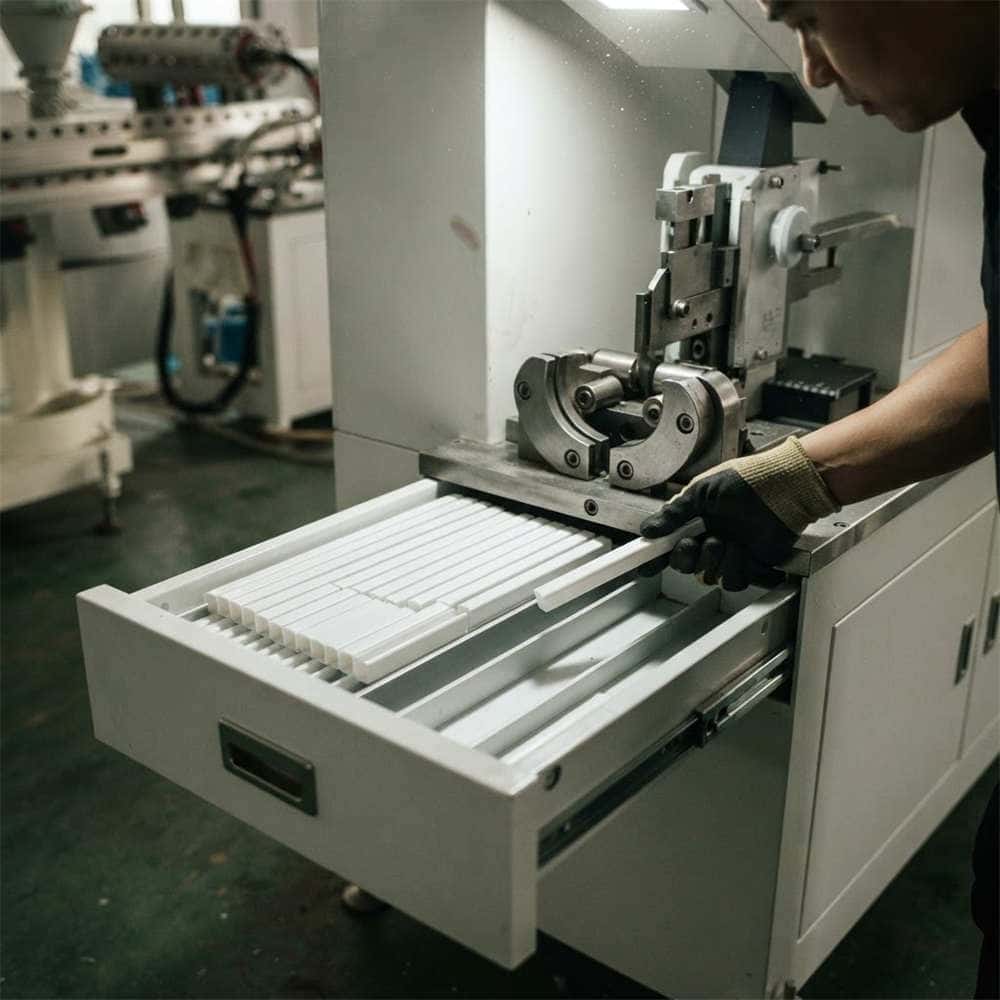
Solving Your Core Production Challenges Before the Machine Purchase
The cosmetic and pharmaceutical soft tube market has a persistent problem: buyers who purchase extruders based on catalog speed ratings and then spend the first 18 months of ownership working around the gaps between what the machine was designed for and what their production line actually needs.
The consequences are familiar: tube wall thickness inconsistency that pushes rejection rates above 2%, thermal degradation of sensitive PE formulations from imprecise temperature control, changeover delays that turn a 4-hour production run into a 7-hour one, and — most costly — compliance gaps that surface during a pharmaceutical audit rather than during the purchase evaluation.
These are not equipment problems at their root. They are specification problems — and they’re preventable. This guide walks you through every stage of a rigorous extruder evaluation: defining what you actually need, matching machine architecture to your tube structure, assessing the engineering details that determine real-world performance, and building a total cost of ownership picture before you commit.

The right extruder specification starts not with a machine catalog, but with a clear map of your production requirements, material constraints, and compliance obligations.
Define Your Production Requirements Before You Look at Machines
The single most effective thing you can do before requesting a single quotation is to write a one-page production requirement document. It sounds simple, and it is — but most buyers skip it and then spend weeks evaluating machines that were never going to fit their production context.
Here are the four dimensions you need to define clearly before any machine conversation begins:
Monthly Volume Target
Are you producing 50,000 tubes per month or 500,000? The extruder that makes sense at 50k units — a compact single-screw system running one shift — is fundamentally different from what you need at 500k, where 24/7 operation, robust thermal management, and predictive maintenance capability become business-critical requirements, not nice-to-haves.
Tube Material and Structure
LDPE for standard cosmetic tubes, HDPE for stiffer body care packaging, PP for high-clarity formats, or multi-layer co-extrusion with EVOH barrier for oxygen-sensitive pharmaceutical formulations — each material requires a different screw geometry, temperature profile, and die head design. Confirm your material specification before comparing machines.
Tube Diameter Range
The industry-standard soft tube diameter range runs from 13mm (eye cream) to 50mm (body lotion), with the most common cosmetic range sitting between 19mm and 35mm. If you’re producing across a wide diameter range, modular die head compatibility becomes a primary evaluation criterion — not just output speed.
Regulatory and Compliance Context
Cosmetic-grade production has different requirements than pharmaceutical-grade. If you’re supplying to pharmaceutical clients, hospital networks, or exporting to US/EU regulated markets, your extruder must support GMP-compatible design, cleanroom installation compatibility, and IQ/OQ validation documentation — requirements that need to be confirmed at the purchase stage, not discovered during an audit 18 months later.
Match Extruder Type to Your Soft Tube Application
Not all extruders handle laminated or barrier tubes effectively — and the choice between machine architectures has real consequences for your output quality and production economics. Here is the practical breakdown for soft tube manufacturers:
| Extruder Type | Best For | Typical Soft Tube Application | Key Advantage |
|---|---|---|---|
| Single-Screw (SSE) | Single-layer PE/LDPE/PP tubes | Standard cosmetic cream, lotion, toothpaste tubes | Simple operation, lower cost, easy maintenance. Output consistency of ±0.02mm wall thickness achievable with barrier screw design. |
| Multi-Layer Co-Extrusion (2–5 layer) | Barrier tubes requiring EVOH, TIE layers | Pharmaceutical ointment tubes, premium cosmetic serums with oxygen-sensitive actives | Enables EVOH barrier as thin as 0.01–0.02mm for maximum protection with minimal material cost. Essential for vitamin C, retinol, and peroxide-containing formulations. |
| Twin-Screw Co-Rotating (TSE) | Compounding, recycled/PCR content processing | Sustainable tubes with 30–100% PCR content; specialty polymer blends | Superior mixing for heterogeneous resin inputs. Maintains consistent melt quality even with variable PCR resin batches. |
The key consideration for most cosmetic soft tube producers is melt homogeneity — the consistency of the polymer melt as it exits the die head and forms the tube wall. Uneven melt distribution creates fusion lines (thin seams in the tube wall), surface defects that show through print, and wall thickness variation that causes dispensing inconsistency when the consumer squeezes the tube.
Modern die heads for soft tube extrusion use a spiral runner design — a geometry where the melt flow path spirals around the mandrel before reaching the die gap. This eliminates the weld lines common in older crosshead die designs and produces a tube wall with uniform mechanical properties in all directions. When evaluating any extruder for cosmetic or pharmaceutical tube production, confirm that the die head uses spiral runner technology, not a simpler spider-leg or crosshead design.

Melt homogeneity at the die head determines tube wall consistency across the entire production run — it’s the difference between print-ready tubes and surface defects that appear after decoration.
Evaluate Screw and Barrel Design for Material Integrity
The screw and barrel are the mechanical heart of the extruder. They determine whether your PE resin melts uniformly, mixes consistently, and arrives at the die head at the correct temperature, pressure, and viscosity to form a dimensionally stable tube. Get this specification wrong and no amount of downstream process adjustment will fully compensate.
Here is what to evaluate:
-
L/D Ratio (Length-to-Diameter) The L/D ratio describes how long the screw is relative to its diameter. For LDPE and MDPE soft tube production, an L/D of 28:1 to 30:1 provides the residence time needed for complete melting and homogeneous mixing before the melt reaches the die. Shorter screws (24:1 or less) leave less time for thermal equilibration, which tends to produce melt temperature variation and wall thickness inconsistency — particularly at higher output speeds.
-
Barrier Screw Design A barrier screw separates the solid-bed channel from the melt channel using a secondary flight, preventing solid polymer particles from passing to the die before fully melting. For soft tube producers running at sustained high output — or processing blended or recycled resins — a barrier screw delivers materially more consistent output than a conventional metering screw. The result: tighter wall thickness tolerance and fewer surface defects.
-
Screw Material: Nitrided vs. Bimetallic Nitrided screws — treated with ion nitriding to a surface hardness of 900–1100 HV — are adequate for standard virgin LDPE processing. However, if you’re processing PCR resins (which contain contaminants and abrasive filler particles), running at 24/7 throughput volumes, or working with filled compounds like colored masterbatch, bimetallic screws are the correct specification. Bimetallic barrels carry 1.5–3.0mm of wear-resistant alloy, extending service life by 3–5x compared to nitrided equivalents — and avoiding the scenario of screw replacement (a 3–5 week lead time event) occurring at peak production demand.
-
Barrel Construction and Wear Resistance The barrel should match the screw specification: a bimetallic barrel pairs with a bimetallic screw. Confirm that the barrel bore is finished to H7 tolerance for the screw clearance — loose tolerance causes melt leakage back along the screw, reducing output consistency and accelerating wear. Ask the supplier for their stated screw-barrel clearance specification in millimeters, not just a material specification.
Precision Heating and Temperature Control Systems
Thermal stability is the specification that separates consistent tube production from the kind of drift-and-correct cycle that keeps operators busy and keeps quality technicians occupied with rejection analysis.
In soft tube extrusion, the polymer melt passes through multiple temperature zones — typically 4 to 6 along the barrel, plus one or two at the die head. Each zone must maintain its setpoint to within ±1°C across a full production shift. A zone that drifts ±5°C produces a corresponding variation in melt viscosity, which translates directly into wall thickness variation at the die — often visible as a repeating pattern of thin and thick sections around the tube circumference.
Here are the three key thermal control specifications to assess:
Multi-Zone PID Control
PID (Proportional-Integral-Derivative) control — the standard closed-loop temperature regulation algorithm — adjusts heater output based on the difference between actual and setpoint temperature, eliminating the overshoot and undershoot cycles of simpler on/off controllers. Confirm that each barrel zone and the die head zone are independently PID-controlled, and that the control system logs temperature history so you can audit thermal consistency during a production run.
Ceramic vs. Induction Heaters
Traditional resistance heater bands are still common on budget extruders. Ceramic heaters offer better thermal uniformity across the barrel surface and are more durable in high-cycle operations. Induction heating systems — found on higher-specification machines — heat the barrel directly through electromagnetic induction, achieving 40–50% faster thermal response and 20–30% lower energy consumption than resistance heaters. For 24/7 soft tube production, the energy and responsiveness advantages of induction heating justify the cost premium.
Closed-Loop Cooling Management
During extended production runs, the barrel temperature can rise above setpoint from the frictional heat generated by the rotating screw — a phenomenon called viscous dissipation. Without active cooling, this forces the control system to cycle the heaters off, creating thermal instability that ripples through melt quality and output consistency. Closed-loop barrel cooling — either air-cooled fans at each zone or water-cooled jacket segments — prevents this drift and maintains genuine ±1°C control throughout a 24-hour production cycle, not just during start-up.
Die Head Temperature Precision
The die head temperature zone is the most critical single thermal point in the extrusion process — it’s where the melt transitions from a flow state to a formed tube shape. For LDPE soft tube production, die head setpoints typically run 170–210°C. Deviation of more than ±2°C at this stage causes surface gloss variation, die swell inconsistency, and dimensional drift that accumulates through a production run. Confirm that the die head zone has its own independent PID controller, not just a shared zone with the last barrel segment.
Advanced Control Systems for Consistent Output
A decade ago, a reliable extruder needed a competent operator at the control panel for every hour of production. Today, the control system embedded in the machine should handle the majority of parameter management automatically — freeing your operator to monitor, rather than continuously adjust.
This shift matters practically: facilities running manual or semi-manual control systems report operator-driven setting adjustments as the leading cause of within-shift output variation. Every manual adjustment is a temporary disturbance to the production equilibrium — and in a 10-hour shift, even a well-trained operator makes dozens of them.

A well-designed HMI interface reduces operator touchpoints per shift — and every reduced touchpoint is a variability source eliminated from your production quality equation.
Here is what modern extruder control systems should deliver for soft tube production:
PLC with HMI Recipe Storage: The PLC (Programmable Logic Controller) should store complete production recipes — screw speed, barrel zone temperatures, die head temperature, line speed, cut length — for every tube format you run. Switching between a 22mm eye cream tube and a 35mm lotion tube should require selecting a recipe name on the touchscreen, not manually re-entering 15 parameters across multiple control panels. Systems with 100–200 recipe storage slots are standard on current-generation machines. If a supplier’s system stores fewer than 50 recipes, ask why.
Real-Time Process Monitoring: Melt pressure at the die head, motor torque load, barrel zone temperatures, and line speed should all be continuously logged and displayable on the HMI. More importantly, the system should generate alarms when any parameter drifts outside a set tolerance band — not just when it has already moved far enough to produce defective output. The difference between an alarm at ±1°C and one at ±5°C is the difference between catching a developing problem and discovering it in the rejection bin.
Industry 4.0 Integration: For facilities running or planning to run connected production lines, confirm that the extruder’s control system supports standard industrial communication protocols — Modbus TCP, EtherCAT, or OPC-UA — for integration with downstream machines (printing, heading, filling) and plant-level SCADA or MES systems. Extrusion PLC control systems built on open communication protocols allow real-time data sharing between upstream extrusion and downstream tube processing, enabling coordinated line speed control and centralized quality data collection — both valuable for reducing scrap at format transitions.
Customization and Integration with Downstream Equipment
An extruder that produces perfect tube sleeves but can’t feed them efficiently into your printing and heading line is a production bottleneck wearing a machine’s clothing. Downstream integration isn’t a bonus feature — it’s a core specification requirement for any tube extrusion line that will operate as part of a complete production system.
Here is what the integration specification needs to cover:
Mandrel Head Compatibility and Tube Diameter Range: The die head mandrel determines the internal diameter of the extruded tube. For soft tube producers covering a range of formats — from 13mm (narrow eye cream) to 50mm (wide body lotion) — confirm that the extruder’s die head system accommodates your full diameter range, either through interchangeable mandrel inserts or adjustable die gap settings. Each mandrel change should be documented with a defined changeover procedure and time estimate.
Inline Thickness Gauging: Ultrasonic or laser-based wall thickness gauging systems mounted between the die head exit and the cooling tank provide closed-loop feedback to the screw speed controller. When wall thickness drifts above tolerance, the system automatically adjusts screw speed — without waiting for an operator to notice and respond. For pharmaceutical tube applications where wall thickness directly affects dose accuracy at the filling stage, inline gauging is not optional.
Vacuum Sizing and Cooling Tank: The vacuum sizing sleeve controls the external diameter of the tube as it exits the die. Confirm that the vacuum level is adjustable and PLC-controlled — pressure variation in the sizing sleeve produces the same kind of diameter inconsistency that thermal variation produces, and needs the same closed-loop management approach.
Communication Interface with Downstream Machines: The extruder’s cut-off system must synchronize with the downstream tube sorter and heading machine. Confirm that the servo-driven cut system has a digital handshake with the downstream conveyor — so the cut cycle and tube transfer are coordinated, not running asynchronously with a mechanical buffer absorbing the timing mismatch.
The complete tube extrusion production line from Miyoda Packaging Machinery is designed as an integrated system — extrusion, precision cutting, tube sorting, and heading running as a coordinated production cell, with a single PLC managing the inter-machine timing and communication rather than treating each machine as an independent unit.
See a Complete Tube Extrusion Line Running at Production Speed
Reading specifications only takes you so far. Before finalizing any extruder evaluation, watch a production line run at sustained output — not a slow-motion clip or a short highlight reel, but a real production sequence that lets you observe tube consistency, cut quality, and the handling transition between stations. The following video shows a fully automated PE tube extrusion production line operating across the complete process sequence:
Watch the tube surface consistency, the cut edge quality, and the transition between extrusion and tube sorting — these three points reveal more about production-ready engineering than any specification sheet.
When watching production videos, focus on three specific things: the surface uniformity of the tube as it exits the die head (look for any gloss variation or surface streaking that indicates melt temperature inconsistency); the cut edge quality (a clean, flat cross-section with no burrs or angel hair indicates a well-calibrated servo cutting system); and the tube handling behavior at the sorting station (tubes that bounce or tangle indicate a conveyor speed mismatch that will generate jams at scale).
Supplier Qualification: What to Ask Before You Buy
A machine purchase in the $80,000–$300,000 range is also the beginning of a 10-year technical relationship with a supplier. The engineering support, spare parts availability, and remote diagnostic capability you’ll have access to after the purchase is determined almost entirely by the supplier you choose — not the machine model.
Here are the qualification questions that extract real, verifiable information:
| Qualification Area | Specific Question to Ask | What a Credible Answer Looks Like |
|---|---|---|
| Application Experience | “Can you provide references from customers producing the same tube format as ours — same material, similar diameter range?” | Provides 2–3 verifiable references in the cosmetic or pharmaceutical sector, with contact names. Offers to facilitate a reference call within 1 week. |
| Validation Support | “Do you provide IQ/OQ documentation for pharmaceutical customers? Can we see a sample protocol?” | Produces a sample IQ/OQ protocol immediately. Confirms whether this is included in the machine price or quoted separately — and at what cost. |
| Spare Parts | “What are the top 10 wear components for this machine? What are your lead times and do you hold regional stock?” | Provides the parts list with part numbers, standard lead times in working days, and confirms whether regional warehouse stock is available for critical wear items. |
| After-Sales Coverage | “What is your committed response time for remote diagnostics and on-site support in our region?” | States specific response time commitments (e.g., remote diagnostics within 4 hours, on-site within 72 hours), with named service contacts in the relevant region. |
| Performance Guarantee | “Will you include a Factory Acceptance Test against our tube specification, with our resin, as a delivery condition?” | Agrees to an FAT with specified performance criteria (wall thickness tolerance, output rate, surface quality standard) confirmed in writing before shipment. |
| PCR Compatibility | “Has this machine been validated for PCR resin processing? What content levels and what screw/filtration configuration do you recommend?” | Provides specific PCR content range the machine has been tested with, recommended filtration specification (screen changer mesh size), and documented output performance at those conditions. |
Total Cost of Ownership: Beyond the Initial Price Tag
The purchase price of a plastic extruder represents, on average, 35–45% of its total 10-year operating cost. The remainder is energy, maintenance, spare parts, downtime, and the labor cost of running and supporting the machine. Buying on price alone means optimizing the smaller fraction of the cost equation while ignoring the larger one.
Here is how to build a realistic TCO comparison for two extruder candidates:
⚡ Energy Cost Delta
Servo-driven extrusion systems consume 20–30% less energy than conventional fixed-speed induction motor drives at equivalent output rates. On a high-volume line running 6,000 hours per year, a 22kW energy saving equates to roughly $15,000–$20,000 per year at typical industrial electricity rates. Over 5 years, that’s a $75,000–$100,000 differential — often larger than the price premium between a servo and conventional drive system.
🔧 Maintenance Cost Projection
Request the supplier’s preventive maintenance schedule: what is serviced, at what interval (in operating hours), and what are the consumable costs? A machine requiring screw inspection every 2,000 hours on a 6,000-hour annual production schedule means 3 inspection events per year. If each event takes 4 hours of technician time plus consumables, that’s a quantifiable annual maintenance budget line — and it’s comparable across candidate machines before purchase.
⏱️ Downtime Risk and MTBF
MTBF (Mean Time Between Failures) for the drive system, heating elements, and screw/barrel assembly should be documented in the technical specification. On a line producing 8 million tubes per year at $0.15 contribution per tube, every unplanned hour of downtime costs approximately $1,000 in lost margin. A machine with 30% lower MTBF than its competitor represents a meaningful financial risk that needs to be factored into the purchase comparison alongside price.
📦 Spare Parts Economics
Ask for pricing on the top 5 wear components: screw tip, barrel liner (if applicable), heater bands, thermocouple sensors, and die head seals. These costs recur annually. A machine with a 20% lower purchase price but heater bands that cost 3× more and arrive on 8-week lead times may have a significantly worse 5-year parts economics picture than its more expensive competitor.

A 5-year TCO calculation typically shifts the ranking of machine candidates significantly from the purchase-price-only comparison — often making a higher-spec machine the more economical choice.
Final Decision Checklist: Ensure a Future-Proof Investment
Before signing a purchase agreement for any soft tube extrusion line, run through this checklist. Each item represents a specification area where a gap discovered after installation will cost more to resolve than it would have to specify correctly at the outset.
- Output Capacity Confirmed: Sustained throughput (not peak rate) at your specific tube diameter, material, and wall thickness specification has been documented by the supplier — either from existing installation data or a factory trial.
- Material Compatibility Validated: The machine has been confirmed as compatible with your specific resin grade (including MFI range), and — if you’re targeting PCR content — the screw design and filtration configuration for your target PCR level have been specified.
- Wall Thickness Tolerance Specified: A maximum wall thickness tolerance (e.g., ±0.02mm) has been agreed and will be tested during Factory Acceptance Testing with your tube specification.
- Temperature Control Confirmed: Multi-zone PID control with ±1°C accuracy, independent die head zone control, and closed-loop barrel cooling are confirmed as standard configuration — not optional upgrades.
- Compliance Documentation Secured: CE certification, material contact surface certificates, and — for pharmaceutical customers — an IQ/OQ documentation package are confirmed as included deliverables, with sample documents reviewed before purchase.
- Downstream Integration Confirmed: Communication protocol compatibility with your printing and heading machines has been confirmed, with a written interface specification provided by the supplier.
- Spare Parts Commitment Obtained: Lead times and pricing for the top 10 wear components are confirmed in writing, with regional stocking arrangements for critical items confirmed where available.
- Service Response Committed: Remote diagnostic response time and on-site support lead time are specified in the purchase agreement, with penalty or escalation terms defined.
- Scalability Path Confirmed: If your volume targets will require capacity expansion within 3–5 years, confirm whether the machine supports modular addition of a second extruder for co-extrusion or output increase — and obtain indicative upgrade costs now.
- Performance Guarantee in Writing: The Factory Acceptance Test criteria — throughput rate, wall thickness tolerance, surface quality standard, energy consumption — are specified in the purchase agreement as delivery conditions, not aspirational targets.
For distributors and agents evaluating extrusion equipment to recommend to your clients, this checklist also serves as a pre-qualification tool — a structured way to verify that the machines you represent meet the specification standards your clients in cosmetic and pharmaceutical tube production will rightfully expect.
Need a Tube Extrusion Machine Matched to Your Specific Production?
Miyoda Packaging Machinery provides application-specific configuration, production trial support, and full technical documentation — for both direct manufacturers and distributors serving cosmetic and pharmaceutical tube producers globally.
View Extrusion Machine Specs Explore Full Production Line Solutions
Frequently Asked Questions
Answers to the questions cosmetic and pharmaceutical tube manufacturers — and their equipment distributors — ask most often when evaluating plastic extruders for soft tube production.
1. What type of extruder is best for producing laminated cosmetic tubes?
For standard single-layer laminated PE cosmetic tubes, a single-screw extruder with a barrier screw design and L/D ratio of 28:1 to 30:1 is the correct starting specification. This configuration delivers consistent melt homogeneity for LDPE and MDPE materials without the complexity or cost of a twin-screw system. If your tubes require an EVOH barrier layer — for oxygen-sensitive actives like vitamin C or retinol — you need a multi-layer co-extrusion system with a minimum of 3 extruders (inner PE, EVOH, outer PE) and a spiral-runner co-extrusion die head. The tube material structure should drive the extruder architecture choice, not the reverse.
2. Can I use the same extruder for both cosmetic and pharmaceutical tubes?
Yes — but only if the machine was specified for pharmaceutical production from the outset, not retrofitted from a cosmetic-only design. The critical requirements for dual-use: all product-contact surfaces must be SUS 316L stainless steel (or documented food/pharma-grade equivalents), the control system must support complete production data logging for traceability, and the supplier must provide an IQ/OQ validation documentation package. A machine designed and certified for cosmetic production only will lack some or all of these features and cannot be easily upgraded to pharmaceutical compliance after purchase.
3. How do I ensure consistent tube wall thickness in high-speed production?
Consistent wall thickness at high output rates requires three things working together: a barrier screw that delivers homogeneous melt to the die, a spiral-runner die head that distributes that melt uniformly around the mandrel, and a closed-loop inline thickness gauging system (ultrasonic or laser-based) that continuously measures the formed tube and feeds correction signals back to the screw speed controller. On a well-engineered system, this closed-loop arrangement maintains wall thickness to ±0.02mm across a production run without operator intervention. Without the closed-loop gauging, you’re relying on periodic manual measurement and operator adjustment — which introduces the variability it’s meant to prevent.
4. What L/D ratio should I look for in a plastic extruder for soft tubes?
For PE-based soft tube production (LDPE, MDPE, or HDPE), an L/D ratio of 28:1 to 30:1 is the recommended specification. This provides sufficient screw length to achieve complete melting and thorough mixing of the polymer before it reaches the die head, which is particularly important for colored compounds and masterbatch blends where color consistency depends on thorough distributive mixing. Shorter L/D ratios (24:1 or less) can work for simple natural-color LDPE at lower output speeds, but tend to produce melt temperature and color variation at sustained high throughput.
5. Is co-extrusion necessary for my cosmetic tube line?
Only if your tube structure requires it. Standard cosmetic tubes — face creams, body lotions, shampoo conditioners, toothpaste — are typically produced in single-layer PE and don’t require co-extrusion. Co-extrusion becomes necessary when your tube needs an EVOH barrier layer (for oxygen-sensitive formulations), a white opaque inner layer with a colored outer layer for aesthetic reasons, or an ABL-equivalent barrier structure without aluminum. If your current product range is standard PE cosmetic tubes, a well-specified single-screw system is the right starting point — with modular expansion to co-extrusion if your product mix develops to require it.
6. How important is screw material in extruder longevity?
Screw material is one of the two specifications with the most direct impact on extruder service life — the other being barrel material. For virgin LDPE processing without fillers, a nitrided screw (ion-nitrided to 900–1100 HV surface hardness) is adequate. Once you introduce PCR content, masterbatch with abrasive pigments, or filled compounds, nitrided screws wear at an accelerating rate. Bimetallic barrel and screw systems carry 1.5–3.0mm of wear-resistant alloy on the working surface and extend service life by 3–5× compared to nitrided equivalents. Given that a screw replacement typically takes 3–5 weeks in lead time plus 2 days of installation and re-validation, specifying bimetallic from the outset is a straightforward TCO decision for any facility running at significant volume.
7. Can I integrate the extruder with my existing tube printing and sealing machines?
Yes — provided the extruder’s control system supports the communication protocol your downstream machines use. The most common industrial communication standards for production line integration are Modbus TCP, EtherCAT, and OPC-UA. Confirm your downstream machine’s protocol with its manufacturer before purchasing the extruder, and specify that the extruder’s PLC must include a compatible communication interface. Without this, coordination between extrusion output rate and downstream machine speed requires manual adjustment — which introduces changeover-related scrap and limits your ability to run the line at optimized efficiency.
8. What control system features are essential for minimizing operator errors?
The four features that most directly reduce operator-driven variability: (1) recipe storage with named presets for every tube format you produce — so format changes are a selection event, not a re-entry event; (2) parameter alarm logging with defined tolerance bands, so deviations are caught automatically rather than noticed manually; (3) user access level controls, so operators can monitor and acknowledge alarms but cannot inadvertently change temperature setpoints or screw speed parameters that require engineering authorization; and (4) remote diagnostic capability, so your supplier’s engineers can review live process data and guide corrective action without requiring an on-site visit for every fault event.
9. How do I verify a supplier’s machine meets pharma packaging standards?
Start with documentation requests before any factory visit. Ask for: the machine’s CE Declaration of Conformity; material certificates for all product-contact components confirming grade (316L stainless steel for pharma applications); a sample IQ/OQ qualification protocol showing the test procedures and acceptance criteria that will be used for your installation; and any existing FDA inspection records or audit reports from pharmaceutical clients using the same machine model. Verbal assurances of compliance are not sufficient — FDA equipment compliance standards are documentation-based, and your qualification evidence must be documentation-based to match.
10. What maintenance is required to keep the extruder running efficiently?
Request the supplier’s complete preventive maintenance schedule before purchase. For a well-maintained single-screw extruder on a soft tube line, typical intervals are: visual inspection of heater bands and thermocouple connections (every 250 operating hours), screw and barrel clearance measurement (every 1,000–2,000 operating hours depending on resin abrasivity), gearbox oil change (every 2,500 hours), and full screw pull and inspection (every 5,000 hours or annually, whichever comes first). A supplier who cannot provide specific PM intervals with specific tasks — not just “regular maintenance as required” — is telling you something important about the engineering depth behind their machine support.
11. Do Chinese extruder manufacturers offer after-sales support overseas?
The top-tier Chinese extruder manufacturers — those specifically serving the cosmetic and pharmaceutical packaging market rather than the general industrial plastics sector — provide remote diagnostic support as a standard service, with on-site engineering capability for major markets either through direct staff or certified local service partners. The key qualification question is specificity: “What is your committed response time for remote support in our region, and who specifically is our assigned technical contact?” A supplier who can answer that with a name, a phone number, and a contractual commitment is a different partner than one who assures you that support is “available worldwide.”
12. How long does it take to commission a new extrusion line?
For a standard single-screw soft tube extrusion line, plan for 4–8 weeks from machine arrival to production-ready status: installation and mechanical commissioning (1 week), electrical and PLC commissioning (3–5 days), trial runs with production materials and parameter optimization (1–2 weeks), operator training (3–5 days), and Factory Acceptance Testing against production criteria (2–3 days). Add 2–4 weeks if IQ/OQ pharmaceutical qualification documentation is required. These timelines should be contractually agreed with the supplier before purchase — not estimated informally — so installation and production start planning can be done with accuracy.
13. Can the extruder handle recycled or post-consumer resin (PCR) content?
Yes — with the correct screw and filtration configuration. PCR resin typically contains varying levels of contamination (paper fibers, adhesive residues, degraded polymer chains) that must be filtered before the melt reaches the die. A screen changer (a device that holds filter screens across the melt flow path and allows spent screens to be replaced without stopping production) is essential for PCR processing above 30% content. The screw design should be bimetallic to handle the abrasive contamination in PCR without accelerated wear. Ask the supplier to confirm what PCR content levels they have validated in production — not just “it can handle PCR” — and what filtration configuration they recommend at your target content level.
14. What safety features should I expect in a modern extruder?
Current-generation extruders for cosmetic and pharmaceutical production should include as standard: emergency stop buttons at multiple operator positions around the machine; die head overpressure protection (a pressure relief valve or automatic screw stop triggered if melt pressure exceeds the die head’s rated maximum — a critical safety feature given the temperatures and pressures involved); barrel and die head guard interlocks that prevent access during operation; overload protection on the main drive motor; and CE or UL-certified electrical panel construction. For pharmaceutical facilities, confirm also that the electrical panel design meets your facility’s area classification requirements if applicable.
15. How do I scale up production without replacing the extruder?
The most cost-effective scaling path for soft tube extrusion is modular line expansion rather than machine replacement. Confirm at the time of purchase whether the extruder platform supports: addition of a second extruder for co-extrusion capability (so you can add EVOH barrier production to an existing PE-only line); output rate increase through screw speed upgrade or higher-torque gearbox replacement; and addition of a parallel cut-and-sort station to increase the number of tubes processed per meter of extruded sleeve. Suppliers who design for modular expansion — and who can quote upgrade paths with specific configurations and costs at the time of initial purchase — are making a long-term commitment to your production scalability, not just your initial order.
Ready to Specify the Right Extruder for Your Soft Tube Line?
The Miyoda Packaging Machinery tube extrusion platform is configured to specification — not shipped from a standard catalog. Share your tube format, material, volume target, and compliance requirements, and our engineering team will respond with a specific machine configuration recommendation and application data from comparable installations.
View Full Machine Specifications Read the Lamination Machine Guide















