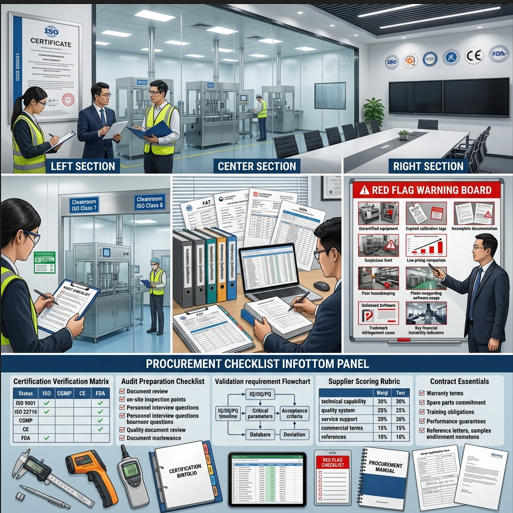
This guide applies to any B2B organization procuring cosmetic filling machines — whether you are a cosmetic brand managing your own production, a contract manufacturer qualifying new equipment suppliers, or a pharmaceutical company sourcing equipment for topical product lines. The evaluation framework is technology-agnostic: it applies equally to servo-driven piston fillers, pneumatic systems, peristaltic pump fillers, and multi-head rotary filling platforms.
Understanding CGMP and ISO Standards

Core CGMP Principles for Cosmetic Manufacturing Equipment
CGMP stands for Current Good Manufacturing Practice — the “current” is deliberate, meaning the standard evolves with technology and regulatory updates. In the context of cosmetic filling machines, CGMP (governed primarily by FDA Guidance for Industry on Cosmetic Good Manufacturing Practices) defines minimum requirements for equipment design, construction, and maintenance to prevent contamination, ensure fill accuracy, and support product traceability.
The four CGMP principles most directly applicable to filling equipment are:
Equipment Design
All product-contact surfaces must be smooth, non-reactive, and cleanable. Crevices, dead legs, and porous materials create contamination reservoirs that cleaning cannot eliminate. CGMP requires that equipment be “of appropriate design and adequate size, and suitably located to facilitate operations.”
Calibration and Control
Filling machines that determine product quantity must be calibrated to a documented standard. Fill weight accuracy targets (e.g., ±0.5% of nominal weight) must be validated and monitored in production. Instruments used for calibration must themselves be traceable to national or international measurement standards.
Documentation
Batch production records, equipment qualification records, calibration logs, and maintenance histories must be maintained and retrievable during an inspection. A supplier who cannot provide maintenance logs for their own manufacturing equipment is signalling the documentation culture your production records will inherit.
Preventive Maintenance
CGMP requires documented preventive maintenance (PM) schedules and records. For filling machines, this covers seal replacement intervals, piston wear checks, nozzle inspection frequency, and lubrication schedules — all of which directly affect fill accuracy and contamination risk.
Relevant ISO Norms and How to Interpret Certifications
ISO 9001:2015 is the baseline quality management system standard for manufacturing organizations globally. It specifies requirements for a QMS that demonstrates the ability to consistently provide products and services that meet customer and regulatory requirements. For filling machine manufacturers, ISO 9001 certification means a third-party auditor has verified that the company’s quality processes — from design through manufacturing to after-sales — are documented, implemented, and subject to continuous improvement.
However, ISO 9001 certification is not a product quality guarantee — it is a process quality guarantee. The certificate confirms the system exists; it does not confirm that every machine produced meets your specific accuracy and contamination requirements. Additional product-specific certifications (CE, FDA compliance declarations, ISO 22716 for cosmetics GMP) provide the product-level assurance that ISO 9001 alone does not.
| Norma / Certificación | Ámbito de aplicación | Who Requires It | What It Confirms | Verification Method |
|---|---|---|---|---|
| ISO 9001:2015 | Quality Management System | Most global B2B buyers | Documented processes, continual improvement, customer focus | IAF CertSearch online database |
| CE Marking | EU Machinery Directive 2006/42/EC | EU market supply required | Machine meets EU safety, health, environment requirements | Request Declaration of Conformity; check Notified Body number |
| ISO 22716:2007 | Cosmetics GMP | Cosmetic brand customers | GMP-compatible equipment design and documentation | Request GMP compliance declaration and audit report |
| FDA cGMP (21 CFR) | US FDA Good Manufacturing Practice | US market supply | Equipment suitable for FDA-regulated production | Request equipment qualification documentation (IQ/OQ/PQ templates) |
| ATEX / IECEx | Explosive atmosphere safety | Flammable solvent filling lines | Intrinsically safe design for Zone 1/2 environments | Request ATEX certificate and zone classification documentation |
| ISO/IEC 17025 | Testing and calibration lab competence | Regulated and precision applications | Traceable calibration of instruments and test equipment | Request calibration certificates with lab accreditation number |
Mapping Certifications Relevant to Filling Machines
FDA, CE, UL, and Other Region-Specific Certifications
The certification requirement for a filling machine depends on three factors: where the machine will be deployed, what product it will fill, and what regulatory framework governs the end product. The matrix below maps common deployment scenarios to the minimum certifications a credible supplier should hold:
📊 Figure 1 — Certification Priority by Deployment Region (Importance Score 1–10, Cosmetic Filling Equipment)
Based on regulatory requirement frequency across cosmetic and pharmaceutical filling equipment audits. Higher = more critical to have.
Source: Compiled from audit requirements of cosmetic and pharmaceutical equipment procurement teams across EU, US, and APAC markets.
How to Verify Current vs. Outdated Certifications
An expired ISO certificate is one of the most common supplier due diligence failures — and one of the easiest to detect. The certificate must show: the specific standard version (e.g., ISO 9001:2015, not 9001:2008), the certifying body’s name, a unique certificate number, the scope of certification (which products/processes are covered), and a valid expiry date.
- Check IAF CertSearch: En International Accreditation Forum’s CertSearch database lets you search by company name or certificate number to verify ISO certification status in real time. A certificate that does not appear in this database — or appears with a status of “suspended” — is a disqualifying red flag.
- Verify the Certifying Body’s Accreditation: ISO certificates issued by non-accredited bodies (sometimes called “vanity certifications”) carry no regulatory weight. Confirm the certifying body is accredited by a member of the International Accreditation Forum (IAF). Accredited bodies in China include CNCA (China National Accreditation Service); in Europe, UKAS (UK), DAkkS (Germany), COFRAC (France).
- Match Scope to Your Procurement: An ISO certificate with scope “design and manufacture of agricultural machinery” does not cover cosmetic filling equipment. Request a copy of the certificate and read the scope statement in full. Any gap between the certificate scope and the equipment you are purchasing is a qualification risk.
- Request CE Declaration of Conformity (DoC): For CE-marked machines, the manufacturer must provide a written DoC listing the specific EU directives and harmonized standards the machine complies with, signed by an authorized person. For high-risk machinery, the DoC also references the Notified Body that conducted the conformity assessment — verify this body’s status at the EU NANDO database.
- Confirm Calibration Certificate Traceability: Request calibration certificates for the manufacturer’s test equipment (fill weight scales, pressure gauges, flow measurement systems). Each certificate should reference the standard used, the laboratory’s ISO/IEC 17025 accreditation number, and the measurement uncertainty. Certificates without stated uncertainty — or without reference to a national metrology standard — are not compliant with ISO 17025 requirements.
Quality Management System (QMS) Documentation Review

Key QMS Documents to Request
A mature QMS at a filling machine manufacturer will have a defined document hierarchy. The table below lists the documents your procurement or QA team should request, what each one tells you, and what a weak response looks like:
| Document | What It Tells You | Strong Response | Weak / Red Flag Response |
|---|---|---|---|
| Quality Manual | Overall QMS scope, policy, organizational structure | Issued with revision date <2 years ago; maps processes to ISO 9001 clauses | Single-page generic document; no revision history; scope doesn’t include manufacturing |
| Quality Policy Statement | Leadership commitment to quality objectives | Specific, signed by management, with measurable quality objectives | Boilerplate text copied from ISO template; no management signature |
| Standard Operating Procedures (SOPs) | How specific processes are executed and controlled | Numbered, version-controlled SOPs for machining tolerances, assembly, test, and cleaning | “We follow best practices” — verbal response with no written procedures |
| Calibration Records | State of measurement equipment traceability | ISO/IEC 17025-traceable certificates for all test instruments; calibration due dates current | Generic certificates without accreditation numbers; any instrument overdue for calibration |
| Non-Conformance Reports (NCRs) | How defects are identified and resolved | Numbered log with root cause, disposition, and closure date for each NCR | “We rarely have non-conformances” — no documented NCR system |
| CAPA Records | Systematic defect prevention and correction | Closed CAPAs with effectiveness checks; CAPA backlog <30 days average close time | No formal CAPA system; only verbal corrective actions; no effectiveness verification |
| Internal Audit Reports | Self-assessment rigor of QMS | Annual internal audits; findings documented; corrective actions closed | No internal audit program; last audit was more than 2 years ago |
| Customer Complaint Log | Post-market quality performance | Numbered log with complaint category, resolution, and CAPA link | “We don’t get complaints” without data — no formal complaint handling system |
How to Assess Document Control and Traceability
Document control — the system that manages creation, approval, distribution, and revision of controlled documents — is a leading indicator of QMS maturity. Ask the supplier to demonstrate their document control system with a live example: pull up a specific SOP (e.g., “Final Inspection Procedure for Filling Machines”) and show its revision history, approvals, and distribution list.
🥧 Figure 2 — QMS Documentation Compliance Rate Among Equipment Suppliers: Field Audit Data
Based on compiled supplier qualification audit data across cosmetic and pharmaceutical equipment categories (n = 85 audits, 2022–2025).
- 42% — Fully compliant (all key docs current, traceable, auditable)
- 26% — Partially compliant (most docs available; gaps in CAPA or calibration)
- 16% — Minor gaps (incomplete revision control or traceability)
- 16% — Major gaps (no formal QMS; certificates only; no procedures)
Source: Compiled from published supplier audit reports in cosmetic and pharmaceutical equipment categories. Figures are indicative.
Supplier Qualification and Audit Process
Criteria for Selecting Manufacturers and Subcontractors
Supplier qualification in the context of filling machine procurement is not a one-time event — it is an ongoing risk-management process. The USP General Chapter <1083> and ICH Q10 frameworks define a tiered qualification approach: suppliers are classified by the criticality of what they supply, and qualification rigor scales accordingly.
For filling machines used in cosmetic or pharmaceutical production, the qualification criteria should address five dimensions:
Technical Capability
Does the manufacturer have demonstrable experience producing filling machines for your specific product type (cream, gel, ointment, liquid)? Request reference sites in your product category — not just general filling experience — and contact references directly.
Manufacturing Infrastructure
Does the facility have precision machining, surface treatment, and assembly capabilities appropriate for GMP-grade equipment? A manufacturer outsourcing >50% of critical components to unqualified subcontractors introduces supply chain risk that their ISO certificate does not cover.
Documentation and Compliance
Can the manufacturer supply IQ/OQ/PQ protocol templates, CE Declaration of Conformity, material compliance certificates for product-contact components, and maintenance documentation — all as standard deliverables, not as paid extras?
After-Sales Capability
Where are spare parts stocked? What is the committed lead time for critical wear items (seals, pistons, nozzles)? Is remote diagnostic support available? A 12-month warranty is standard — what does the warranty specifically cover, and what exclusions apply?
Financial Stability
A supplier that discontinues operations mid-contract leaves you with an unsupported machine, unavailable spare parts, and no escalation path for warranty claims. Request trading history, references from buyers who have owned machines for 5+ years, and confirm the organization is not heavily dependent on a single customer.
The same qualification discipline applies to precision measurement instruments integrated within production lines. Companies like Jade Ant Instruments — an ISO-certified flow meter manufacturer supplying industrial process measurement solutions — demonstrate how documentation maturity (traceable calibration certificates, ISO-compliant QMS, technical support infrastructure) translates directly into the supplier qualification score that procurement teams should apply to all critical equipment suppliers, including filling machines.
On-Site Audits vs. Remote Assessments and Their Limitations
The COVID-19 pandemic accelerated remote supplier assessment — video audits, document reviews via shared portals, and virtual factory tours. While remote assessments are a practical first-screening tool, they have documented limitations for filling machine suppliers that procurement teams must understand:
| Audit Type | What It Can Assess | What It Cannot Assess | Recommended Use |
|---|---|---|---|
| Document Review (Remote) | Certificate validity, QMS documentation completeness, procedure existence | Actual implementation, facility conditions, operator behavior | Pre-qualification screening; always required before on-site |
| Video / Virtual Tour (Remote) | Facility layout, general cleanliness, major equipment visibility | Machining tolerances, material traceability, calibration equipment condition | First-contact assessment; not a substitute for on-site |
| On-Site Audit (Scheduled) | Full QMS implementation, production practices, calibration records, subcontractor management | Performance under non-standard conditions; staff behavior when not audited | Required before first purchase order for critical equipment |
| Unannounced On-Site Audit | True operating conditions, actual documentation practices, real non-conformance rate | Requires supplier agreement; may not be feasible for international suppliers | For long-term, high-value supplier relationships; re-qualification |
| FAT (Prueba de aceptación en fábrica) | Machine performance at speed with buyer’s product; fill weight accuracy; documentation completeness | Long-term reliability; software stability over months of operation | Mandatory before shipment of any filling machine; minimum 4-hour continuous run |
Quality Control and Calibration Practices

Incoming Materials Testing, In-Process Checks, and Final Inspection
A filling machine manufacturer with a mature quality control program operates three distinct inspection gates — and each gate should produce documented records that you can request during supplier qualification:
Incoming Materials Testing
Before any component enters manufacturing, it should be inspected against a drawing or specification. At minimum: dimensional inspection for machined components, material test reports (MTRs) for stainless steel and food-contact elastomers, and certificate of conformance from the component supplier. Ask what percentage of incoming components are inspected (100% vs. AQL sampling) and what AQL level is used.
In-Process Checks
During assembly, critical parameters must be verified — torque values for fasteners, alignment of fill heads, leak testing of fluid pathways, and electrical continuity checks. These should be recorded on a traveler or job card that stays with the machine through production and is archived after delivery. A supplier who cannot show you a sample traveler is operating without production-stage quality evidence.
Final Inspection and FAT
Before shipment, the completed machine must be run at rated speed and the fill weight accuracy verified against the specification. For a filling machine claiming ±0.5% accuracy, the final inspection should demonstrate Cpk ≥ 1.33 across at least 30 consecutive fills at each fill volume in the machine’s range. The FAT report is a contractual document — request it as a standard deliverable in your purchase order.
Calibration Regimes, Standards Referenced, and Traceability
The calibration infrastructure at a filling machine manufacturer tells you more about their measurement credibility than any specification sheet. Ask specifically: which instruments are used to verify fill weight accuracy during final testing, what is the calibration interval for these instruments, and what standard are they calibrated against?
For flow and volume measurement instruments used in filling machine testing — scales, flow meters, pressure gauges — the calibration standard should reference NIST-traceable or equivalent national metrology institute standards (ISO/IEC 17025). A calibration certificate that does not state the measurement uncertainty and the reference standard used is not compliant with ISO 17025 requirements — and any accuracy claim based on that calibration is unverifiable.
📊 Figure 3 — Calibration Documentation Compliance: Common Gaps Found in Supplier Audits
Percentage of audited filling machine manufacturers showing each gap (n = 85 audits, 2022–2025).
Source: Compiled from published pharmaceutical and cosmetic equipment supplier qualification audit reports.
Change Control and CAPA Procedures
How Changes Are Proposed, Approved, and Implemented
Change Control is the formal process by which a manufacturer manages any modification to a product, process, material, or document — ensuring that changes are evaluated for their potential impact on quality before they are implemented, not after.
For filling machine manufacturers, this matters directly to you: if your supplier changes the piston seal material from EPDM to NBR on a machine model you have already qualified, and they do so without notifying you or providing a change impact assessment, you may discover the incompatibility only after product contamination or fill accuracy failure occurs in your own production.
A robust supplier change control process should answer these questions — request documented examples of each:
- How does a change request originate — and who can initiate one?
- What impact assessment is performed before the change is approved (dimensional, material compatibility, regulatory)?
- Who has authority to approve changes to product-contact materials or critical parameters?
- How are customers notified of changes that affect previously delivered or qualified equipment?
- Is there a minimum notification period before customer-affecting changes are implemented?
Effectiveness Checks and Closure Documentation
CAPA — Corrective and Preventive Action — is the structured process for investigating the root cause of non-conformances and implementing systematic fixes that prevent recurrence. The difference between a strong and weak CAPA system comes down to one question: does the system verify that the action actually worked?
Weak CAPA programs close records after the corrective action is implemented, without verifying effectiveness. Strong programs require an effectiveness check — typically a defined review period (30–90 days) during which data is collected to confirm the root cause has been eliminated. Request a sample closed CAPA from your supplier and look for: root cause analysis method (5-Why or Fishbone), specific action owner and due date, effectiveness criteria defined before closure, and evidence of effectiveness check data.
Validation and Commissioning of Equipment
Installation Qualification (IQ), Operational Qualification (OQ), Performance Qualification (PQ)
Equipment qualification is the formal, documented process of demonstrating that a filling machine is installed correctly, operates within its specified parameters, and consistently produces output that meets defined requirements. The three-stage protocol — IQ, OQ, PQ — is required by FDA 21 CFR 211.63 for pharmaceutical production and is best practice for regulated cosmetic production:
| Escenario | Definición | What is Tested | Duración habitual | Who is Responsible |
|---|---|---|---|---|
| IQ — Installation Qualification | Confirms the equipment is installed as designed and per specifications | Utility connections, physical dimensions, component identification, drawing verification | 1–3 days | Engineering / Maintenance (supplier may assist) |
| OQ — Operational Qualification | Confirms the equipment operates within specified parameters across its operating range | Fill volume accuracy at min/mid/max; cycle speed; alarm function; PLC program integrity | 3–7 days | Engineering / QA (with supplier technical support) |
| PQ — Performance Qualification | Confirms consistent performance under actual production conditions over time | Fill weight Cpk over 3 consecutive batches; defect rate; OEE measurement; product contamination testing | 2–4 weeks (3 batch minimum) | QA / Production |
Suppliers who provide IQ/OQ/PQ protocol templates as standard deliverables with the machine (not as paid consultancy services) signal genuine regulated-market experience. The templates should be specific to the machine model — not generic placeholders requiring your team to write the actual test procedures from scratch.
For flow measurement instruments integrated within filling lines — including flow meters monitoring product dosing, CIP chemical dosing, or utility flows — the same qualification framework applies. Jade Ant Instruments‘ calibration documentation for electromagnetic flow meters, for instance, includes traceable calibration certificates and installation verification checklists — the equivalent of IQ-stage documentation for the flow measurement component of a production line.
Routine Performance Validation and Revalidation Triggers
Initial qualification is not a one-time event. Revalidation is triggered by any of the following conditions — ensure your supplier’s documentation package includes guidance on when requalification is required:
📋 Revalidation Trigger Checklist
Post-Market Surveillance and Maintenance
Service Agreements, Preventive Maintenance Schedules, and Spares Policy
The quality of a supplier’s post-delivery support is often more consequential than their machine’s specification — because filling line downtime is not a supplier problem, it is your production problem. At $260,000/hour average unplanned downtime cost in manufacturing (2026 data), a single overnight machine failure that cannot be resolved because a $45 seal is not in stock costs more than the annual maintenance contract for most filling machines.
Evaluate post-market support on these five dimensions before committing to a supplier:
Preventive Maintenance Schedule
Request a detailed PM schedule with task, frequency, estimated time, and required parts for each interval. A supplier who cannot provide this during the sales process will not provide adequate technical support after delivery. PM schedules should distinguish between operator-level tasks (daily, weekly) and service-technician tasks (quarterly, annual).
Spare Parts Policy
Ask: where are critical spare parts stocked, and what is the guaranteed lead time? A supplier whose critical seal kits require 8-week manufacturing lead time from China while your production line sits idle has transferred their supply chain risk entirely to you. Request a 3-year spare parts forecast with part numbers and unit pricing — suppliers who cannot provide this cannot support you.
Remote Diagnostics
Modern PLC-controlled filling machines support remote access for fault diagnosis — a capability that can reduce average fault resolution time from 3–5 days (waiting for a technician) to 4–8 hours (remote session). Confirm whether the supplier offers remote diagnostic support, what the response time commitment is, and whether it requires a separate service agreement.
Warranty Scope and Exclusions
A 12-month warranty is standard and legally expected. The critical question is what it excludes: wear items (seals, nozzles), damage from incorrect cleaning agents, and failures caused by the buyer’s product formulation are common exclusions. Read the warranty document before signing — not the warranty summary in the sales brochure.
Handling Field Incidents, Recalls, and Corrective Actions
Ask every filling machine supplier candidate this question: “What is your process when a delivered machine produces a quality incident at a customer site?” The response reveals the entire post-market surveillance (PMS) culture. A mature supplier will describe: a formal incident reporting system, root cause investigation protocol, determination of whether other delivered machines are affected (field safety corrective action), and customer notification procedures.
A supplier who responds with “that hasn’t happened to us” — without being able to show a PMS procedure — has not built the infrastructure to detect or respond to incidents systematically. The absence of field incidents in their history is more likely to reflect absent monitoring than absent problems.
▶ Watch: How to Audit Your Equipment Suppliers — Quality Systems Evaluation
Video: A practical guide to auditing manufacturing suppliers for quality systems compliance — covering preparation, on-site assessment techniques, critical findings, and supplier scoring. Directly applicable to filling machine supplier evaluation.
Risk Management in Supplier Selection
Risk Assessment Frameworks (Risk Scores, Severity, Likelihood)
Risk-based supplier qualification means applying more scrutiny to suppliers whose failure would cause greater harm — and proportionally less scrutiny to lower-risk components. The risk score for a filling machine supplier is calculated from two dimensions: severity (how bad is the worst-case failure if this supplier’s equipment fails?) and likelihood (how probable is that failure, given what you know about their quality systems?).
| Risk Factor | Severity Score (1–5) | Likelihood Score (1–5) | Risk Score (S × L) | Action Required |
|---|---|---|---|---|
| No traceable calibration on fill weight instruments | 5 (product contamination, recall) | 4 (common gap) | 20 — Critical | Disqualify or require remediation before purchase |
| No change control procedure for materials | 5 (undisclosed material substitution) | 3 (moderate frequency) | 15 — High | Require written change notification clause in contract |
| ISO certificate expired or scope mismatch | 3 (compliance gap, audit finding) | 3 (moderate frequency) | 9 — Medium | Require certificate renewal before purchase order |
| No spare parts stock; 8+ week lead times | 4 (production shutdown) | 2 (less common) | 8 — Medium | Require stocking commitment or hold safety stock |
| No IQ/OQ/PQ templates provided | 3 (validation delay) | 3 (moderate) | 9 — Medium | Include as contractual deliverable; budget own protocol writing |
| No reference sites in your product category | 3 (unproven performance risk) | 2 | 6 — Low-Medium | Require pilot FAT with your product before full order |
Contingency Planning for Supplier Disruption
Single-source dependency on a filling machine supplier is a business continuity risk that procurement teams systematically underestimate. The following contingency questions should be answered — and documented — before any filling machine purchase:
- If this supplier ceases operations, is there a second-source machine compatible with our production line and product specification?
- Are the critical spare parts (seals, pistons, nozzle bodies) specific to this manufacturer, or are they industry-standard components available from multiple sources?
- Does our service agreement include access to the machine’s source code and PLC program? If the supplier is unavailable, can another integrator service the machine?
- What is the minimum stock of critical consumables we should hold on-site to maintain 90-day production continuity without supplier replenishment?
Practical Evaluation Checklist and Red Flags

A Concise Downloadable Checklist for Quick Supplier Screening
✅ Filling Machine Manufacturer Quality System Evaluation Checklist
Common Warning Signs During Due Diligence and How to Respond
| Red Flag | What It Signals | Recommended Response |
|---|---|---|
| 🚩 ISO certificate not found on IAF CertSearch | Certificate may be fraudulent, expired, or issued by non-accredited body | Disqualify until certificate is verified through accredited body directly |
| 🚩 CE DoC does not list specific harmonized standards | Self-declaration without actual conformity assessment; CE claim may not be defensible | Request full DoC; verify Notified Body status in EU NANDO database |
| 🚩 “We rarely have non-conformances” — no NCR log provided | Non-conformances are not tracked; problems are likely handled informally without root cause | Require NCR log as condition of qualification; unverifiable claim is a red flag |
| 🚩 Calibration certificates without uncertainty statement | Calibration not compliant with ISO 17025; accuracy claims based on unverified measurements | Require ISO 17025-accredited calibration before accepting fill accuracy specifications |
| 🚩 IQ/OQ/PQ templates are “available for purchase” as a service | Limited regulated-market experience; templates likely generic | Budget for your team to write protocols; consider this a qualification risk factor |
| 🚩 No change control notification obligation to customers | Material substitution risk (as in the $1.2M recall case study) | Insert contractual change notification clause before signing purchase order |
| 🚩 Spare parts lead time >6 weeks for critical wear items | Production shutdown risk if machine fails and parts are unavailable | Negotiate consignment stock held at their warehouse; or hold own safety stock |
| 🚩 No reference sites in your specific product category | Unproven machine performance on your product type and viscosity range | Require FAT with your actual product before purchase order commitment |
| 🚩 FAT proposed as “visual inspection” — no performance data | No documented evidence that machine meets accuracy specification before shipment | Require minimum 4-hour production run with fill weight Cpk measurement as acceptance criterion |
Conclusion: Integrating Quality Evaluation into Procurement Decisions
Evaluating a filling machine manufacturer’s quality systems is not a compliance exercise that sits outside the commercial decision — it is the commercial decision. The manufacturer with the most impressive brochure and the lowest unit price, but without traceable calibration, a functioning CAPA system, or a viable change control procedure, will cost you more in the third year of ownership than the premium supplier cost in year one.
The critical steps are not complex — but they require discipline to execute consistently:
- Verify all certifications through independent databases before issuing RFQs
- Request QMS documentation as a pre-qualification step, not post-award
- Conduct at least one on-site audit before the first significant purchase order
- Mandate FAT with your actual product and defined acceptance criteria in the purchase contract
- Include change control notification obligations and spare parts commitments as contractual terms
The most effective procurement teams treat supplier quality evaluation as a recurring program, not a one-time gate. Annual performance reviews against fill weight data, complaint trends, and response time metrics create the supplier accountability that drives continuous improvement — and gives you early warning before a quality issue reaches your production line.
Key Technical Glossary
Need Precision Measurement Instruments for Your Production Line?
Every filling line, CIP system, and utility circuit requires accurately calibrated flow measurement. Jade Ant Instruments supplies ISO-certified electromagnetic, vortex, turbine, and ultrasonic flow meters — with factory calibration certificates, full technical documentation, and engineering support included as standard.
Explore Jade Ant Instruments →Preguntas frecuentes
What certifications are most important for cosmetic filling machines?
The three most important certifications for cosmetic filling machines are: (1) ISO 9001:2015 — confirms the manufacturer’s quality management system is documented, audited, and subject to continual improvement. Verify on the IAF CertSearch database; a certificate not appearing there may be fraudulent or expired. (2) CE Marking — legally mandatory for machines deployed in the EU/EEA; requires a Declaration of Conformity under the EU Machinery Directive 2006/42/EC. For high-risk machinery, a Notified Body must be involved in the conformity assessment. (3) ISO 22716 GMP Compatibility — for cosmetic-grade production, the machine should be designed and documented to support ISO 22716:2007 Good Manufacturing Practices for Cosmetics. This means GMP-compatible product-contact surface design (316L SS, food-grade elastomers), documented cleaning procedures, and calibration traceability. For pharmaceutical-grade topical product lines, add FDA 21 CFR compliance documentation and IQ/OQ/PQ protocol template delivery as required certifications beyond the ISO/CE baseline.
How often should a supplier’s QA documentation be reviewed?
For critical equipment suppliers — those supplying filling machines directly involved in product quality — QA documentation should be reviewed at three intervals: (1) Pre-qualification: Before the first purchase order, a full QMS documentation review covering quality manual, SOPs, CAPA records, calibration certificates, and certification validity. (2) Annual re-qualification: Each year, request updated certification status (ISO, CE), confirm calibration certificate currency, and review any major CAPA records or customer complaint data from the past 12 months. If the supplier has had a significant quality incident, require a formal corrective action report. (3) Event-triggered review: Any time the supplier notifies you of a change (material substitution, process change, ownership change) or when a machine performance issue occurs in your own production, conduct an immediate targeted documentation review specific to the affected parameter. Annual re-qualification is a minimum baseline; pharmaceutical contract manufacturers typically require semi-annual reviews for critical equipment suppliers.
What are practical red flags during supplier audits for filling machine manufacturers?
The nine most impactful red flags during filling machine supplier audits are: (1) ISO certificate not verifiable on IAF CertSearch — potential fraud; (2) Calibration certificates without stated measurement uncertainty — non-ISO 17025 compliant; (3) No CAPA system or only verbal corrective actions — non-conformances not systematically resolved; (4) Change control procedure does not require customer notification for material substitutions — direct recall risk; (5) FAT proposed as “visual inspection” without fill weight Cpk measurement — accuracy specification unverified; (6) Spare parts for critical items have >8-week lead times with no stocking commitment — production shutdown risk; (7) IQ/OQ/PQ templates are “available for purchase” rather than standard deliverables — limited regulated-market experience; (8) “We rarely have non-conformances” with no NCR log to demonstrate it — absent detection system; (9) Product-contact surfaces are 304 stainless rather than 316L — corrosion and contamination risk with acidic or saline formulations. Any single one of items 1, 3, 4, or 5 is sufficient to disqualify a supplier pending formal remediation.
What is the difference between IQ, OQ, and PQ for filling machine qualification?
IQ, OQ, and PQ are the three sequential stages of equipment qualification required by FDA 21 CFR 211.63 for pharmaceutical production and best practice for GMP cosmetic lines. IQ (Calificación de instalación) confirms that the machine is installed exactly as designed: correct utility connections (power, air, water), physical dimensions and location per facility layout, and all components identified and documented. Duration: 1–3 days. OQ (Calificación operativa) confirms that the machine operates within its specified parameters across its full operating range: fill volume accuracy at minimum, mid-range, and maximum fill; cycle speed at rated throughput; alarm functions tested; PLC program integrity verified. Duration: 3–7 days. PQ (Calificación de rendimiento) confirms that the machine consistently produces compliant output under actual production conditions over time: fill weight Cpk ≥ 1.33 over three consecutive batches with your actual product; defect rate below acceptance threshold; no contamination of product by machine materials. Duration: 2–4 weeks. All three stages must be completed in sequence; PQ cannot begin before OQ is passed and closed.
How do I verify that a filling machine manufacturer’s ISO certificate is genuine and current?
Follow this four-step verification process: (1) IAF CertSearch: Visit iafcertsearch.org and search by company name or certificate number. If the certificate does not appear, request the certifying body’s name and accreditation number and contact them directly. (2) Verify the certifying body’s accreditation: Confirm the certifying body (e.g., BSI, SGS, Bureau Veritas) is accredited by an IAF member national accreditation body. For China-based suppliers, the relevant body is CNAS (China National Accreditation Service for Conformity Assessment). (3) Check the certificate scope: The certificate scope statement must include the specific manufacturing activities you are qualifying — “design and manufacture of liquid filling and packaging machinery” is appropriate; “office services” or “import/export trading” is not. (4) Confirm the standard version: A valid certificate should reference ISO 9001:2015, not earlier versions (2008 or older). The 2015 version became mandatory in 2018; any supplier still holding a 2008 certificate has either not updated their QMS or the certificate is outdated.
What documents should I request from a filling machine manufacturer before qualifying them?
Request the following documents before issuing a purchase order: (1) ISO 9001:2015 certificate — with scope statement; (2) CE Declaration of Conformity — listing specific EU directives and harmonized standards; (3) Quality Manual — with revision history; (4) Sample SOP for final inspection/test — version-controlled, with approval signatures; (5) Sample closed CAPA — demonstrating root cause analysis and effectiveness check; (6) Change control procedure — confirming customer notification requirement; (7) Calibration register — listing all test instruments with calibration due dates; (8) Sample calibration certificate — for a fill weight scale or reference flow meter (must reference ISO 17025 accreditation and state measurement uncertainty); (9) Material compliance certificates for 316L SS and elastomers used in product-contact components; (10) FAT protocol template — with defined acceptance criteria including fill weight Cpk; (11) IQ/OQ/PQ protocol templates; (12) Preventive maintenance schedule; (13) Spare parts list with committed lead times. Suppliers who refuse to provide any of these before purchase order are signalling the documentation maturity you can expect after delivery.
What is CAPA and why does it matter when evaluating filling machine suppliers?
CAPA — Corrective and Preventive Action — is the systematic process by which a manufacturer investigates the root cause of quality non-conformances and implements fixes that prevent recurrence. In filling machine procurement, CAPA matters because it is the leading indicator of whether a supplier’s quality problems stay problems or get solved. A supplier who has a functioning CAPA system with documented root cause analysis, defined action owners, due dates, and effectiveness checks is demonstrably different from one who fixes problems ad-hoc and has no mechanism to verify whether the fix worked. When reviewing a supplier’s CAPA records, look for: (1) Is there a numbered, logged CAPA for every significant non-conformance? (2) Is root cause identified using a structured method (5-Why, Fishbone/Ishikawa) rather than simple symptom correction? (3) Is there a defined effectiveness check — specific criteria and timeframe — before the CAPA is closed? (4) What is the average time from CAPA open to closure? More than 60 days average indicates a backlog. (5) Are CAPAs linked back to the original NCR and any related customer complaints? A CAPA system where any of these elements is missing is a warning that quality problems at this supplier will not be systematically resolved.
What should a Factory Acceptance Test (FAT) protocol include for a cosmetic filling machine?
A compliant FAT for a cosmetic filling machine should include: (1) Duration: Minimum 4-hour continuous run at rated speed — shorter runs do not capture thermal stabilization effects on fill accuracy; (2) Fill volume range test: Fill weight Cpk measurement at minimum, mid-range, and maximum fill volumes — not just at one set point; (3) Acceptance criteria: Defined pass/fail thresholds — typically fill weight Cpk ≥ 1.33 across all tested volumes, cycle time within ±5% of rated speed; (4) Alarm function verification: Every operator-safety and product-quality alarm tested and documented; (5) Changeover test: One complete volume changeover timed and documented (if the machine supports multiple fill volumes); (6) Documentation completeness review: Confirm all required documentation (manuals, IQ/OQ/PQ templates, spare parts list, CE DoC, calibration certificates) is physically present and matches the delivered machine serial number; (7) Product contact surfaces inspection: Visual and dimensional verification of nozzle, manifold, and piston assembly against drawings; (8) Signed acceptance report: Documenting pass/fail result for each criterion, signed by both the supplier and buyer’s representative. Do not accept a verbal FAT or a “visual inspection” — the acceptance report is a legal document and a prerequisite for safe shipment.
How should cosmetic manufacturers handle supplier change notifications for filling machines?
The most effective approach is to address change notification obligations contractually — before the purchase order is signed — rather than relying on a supplier’s goodwill or internal procedure. The contract (or a supplementary Quality Agreement, which is standard practice in pharmaceutical procurement) should specify: (1) The categories of changes requiring advance notification to the customer — at minimum: any change to product-contact materials, machined tolerances on critical components, PLC software version, and qualified fill volume range; (2) The minimum notification period — typically 30–90 days advance notice for planned changes, immediate notification for unplanned changes (component discontinuation, regulatory-required changes); (3) The format of the change notification — a written Change Request Document specifying the nature of the change, impact assessment, and effective date; (4) The customer’s right to evaluate the impact of the change before accepting it — including the right to require a re-qualification run if the change affects validated parameters. Without these obligations in writing, the supplier’s internal change control procedure — however well designed — does not protect you from undisclosed material substitutions like the $1.2M recall case described in this guide.
What role does calibration traceability play in filling machine quality systems?
Calibration traceability is the unbroken chain of comparisons connecting a manufacturer’s test instruments — the scales, pressure gauges, and flow meters used to verify filling machine performance — back to a national or international measurement standard (NIST in the USA, PTB in Germany, NIM in China). Without this chain, no accuracy claim can be independently verified. In practice, this means: every test instrument at the manufacturer’s facility must carry a current calibration certificate from an ISO/IEC 17025-accredited laboratory, the certificate must state the measurement uncertainty (not just “Pass”), and the calibrating laboratory must itself be traceable to a national metrology institute. The direct implication for filling machine procurement: if the manufacturer’s fill weight scale — the instrument that verified the ±0.5% fill accuracy claim in the specification sheet — was calibrated against a non-accredited reference or carries an expired certificate, then the ±0.5% accuracy specification is an unverified claim. This is why requesting calibration certificates (not just the certificate list) and verifying the certifying laboratory’s ISO 17025 accreditation is a non-negotiable step in any filling machine supplier qualification.