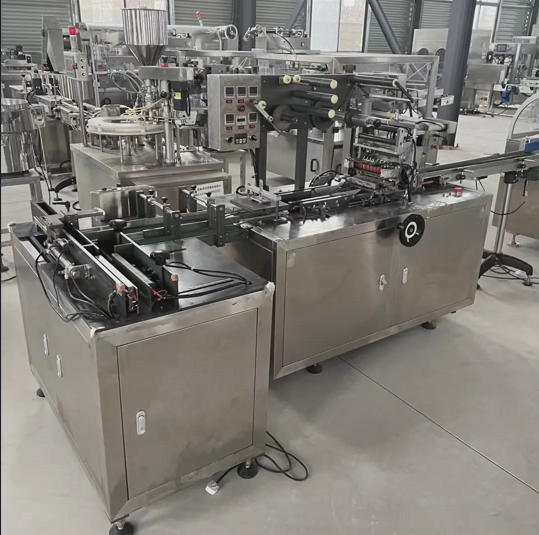
The Benefits of Investing in a High-Quality Filling Liquid Machine
The tube packaging market is growing fast — valued at USD 13.43 billion in 2025 and projected to reach USD 21.9 billion by 2033 at a CAGR of 6.2% (Grand View Research). For cosmetic and pharmaceutical tube producers, that growth is both an opportunity and a pressure test. Orders are rising. Regulatory scrutiny is tightening. And somewhere in the middle, production lines are expected to deliver flawless output, every shift.
Yet walk into most mid-tier production facilities and you will find the same hidden drains: tubes that consistently run 2–3 grams over target weight, sealing jaws that drift out of temperature alignment, and batch record systems held together by spreadsheets and memory. These are not equipment problems alone — they are the compounding result of under-investing in the machine at the center of the operation.
A high-quality filling liquid machine (also called a tube filling and sealing machine — equipment that dispenses a measured volume of product into a tube, seals the tail, and codes the batch, all in a continuous automated cycle) is not simply a faster version of manual or semi-automatic filling. It is an engineered system that changes the economics of your entire production line. This guide breaks down the real operational advantages — with data, production scenarios, and honest trade-offs — so you can make a capital decision based on what actually matters to your business.

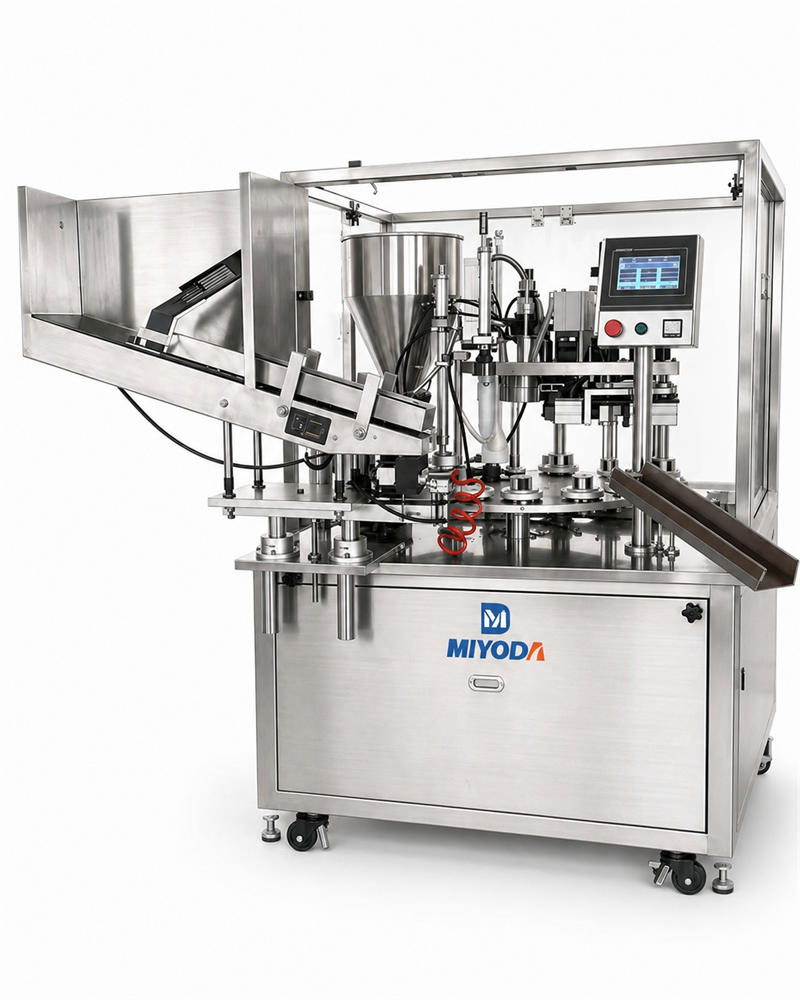
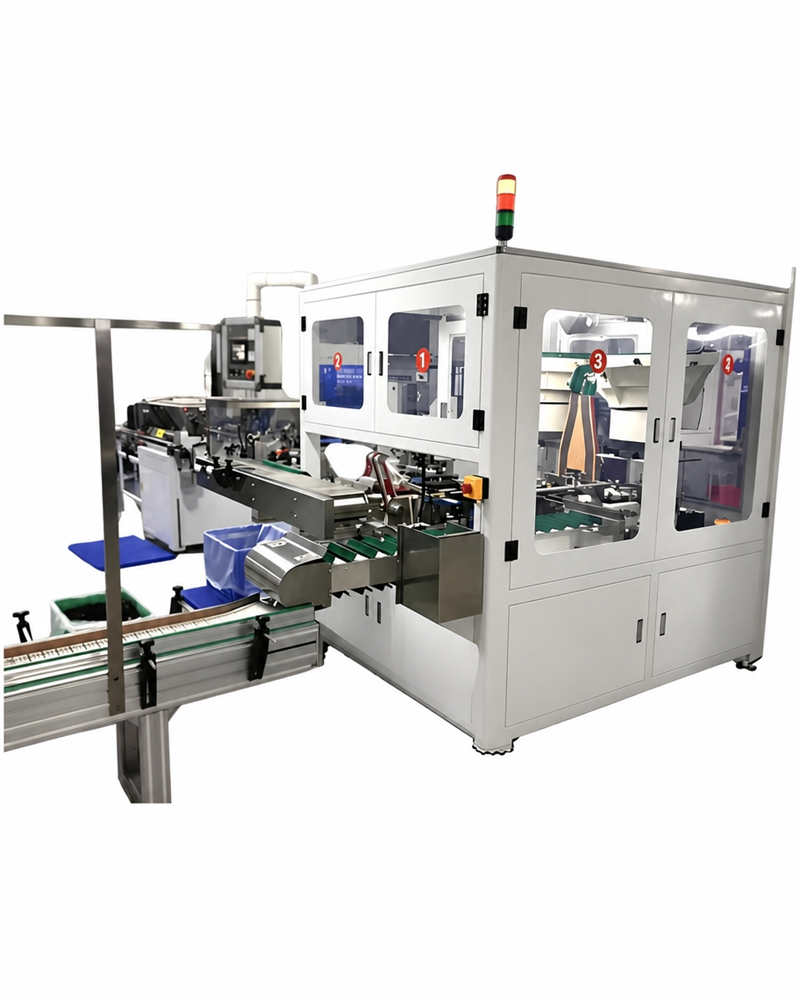
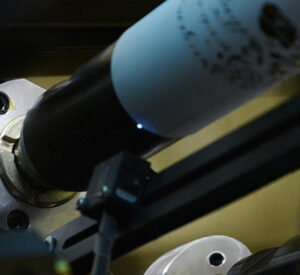
A fully automatic tube filling machine in operation — servo-driven piston dosing, hot-air sealing jaw, and integrated batch coding running at 80+ tubes per minute. Source: Miyoda Packaging Machinery
1. Maximized Production Efficiency and Throughput
Why Output Speed Is a Revenue Lever, Not Just a Specification
A trained operator on a mid-range semi-automatic filler sustains 25–30 tubes per minute in real production — roughly 12,000 tubes per 8-hour shift. A single-head fully automatic machine running at 80 tubes per minute (TPM) at 90% OEE delivers 38,400 tubes per shift. A dual-head system at 120 TPM reaches 57,600 per shift.
That difference — approximately 26,000 additional tubes per shift — is not a minor efficiency gain. At a retail value of USD 3.50 per cosmetic tube, the automatic line’s incremental daily output represents roughly USD 91,000 in additional production capacity per shift, before margin is applied.
Glossary — OEE (Overall Equipment Effectiveness): OEE = Availability × Performance Rate × Quality Rate. World-class tube filling lines achieve OEE of 85–92%. Fully automatic lines typically run at 85–90%; semi-automatic lines at 70–80%. Always size machine capacity to OEE-adjusted output, not the nameplate speed listed in supplier brochures.
Intelligent Automation Protects Uptime
Modern high-quality filling machines incorporate servo-driven indexing, PLC-controlled alarm monitoring, and predictive maintenance data outputs via OPC-UA protocols. These features protect production continuity in measurable ways. A cosmetic manufacturer in Germany documented USD 28,000 in rush-order surcharges in a single quarter because their semi-automatic line was running at full capacity with no output buffer during a peak retail period. Adding 25–30% production headroom through a correctly specified automatic machine is margin protection, not over-engineering.
Real production speed benchmarks across machine types:
| Tipo de máquina | Sustained Real TPM | Tubes per 8-hr Shift | Ideal Annual Volume |
|---|---|---|---|
| Semi-Automatic (entry) | 10–20 | 4,800–9,600 | <2M/year |
| Semi-Automatic (mid-range) | 20–40 | 9,600–19,200 | 2–5M/year |
| Automatic (single-head) | 60–100 | 28,800–48,000 | 5–15M/year |
| Automatic (dual-head) | 100–150 | 48,000–72,000 | 15–30M/year |
| Automatic (high-speed) | 150–200+ | 72,000–96,000+ | >30M/year |
24/7 Operation Without Proportional Labor Increase
High-volume automatic filling lines are engineered for multi-shift, continuous operation. A single technician can monitor multiple lines simultaneously — something structurally impossible with semi-automatic equipment that requires one operator per machine per shift. For producers running 3-shift, 6-day schedules, the labor model of a fully automatic line removes the most volatile variable in per-unit cost: operator headcount.
2. Unmatched Filling Accuracy and Consistency
The Real Cost of Fill Weight Drift
Filling accuracy is where the financial case for high-quality equipment becomes impossible to ignore. Consider a manufacturer filling 100 g cosmetic cream tubes at a typical semi-automatic accuracy of ±2–3%. At a product cost of USD 18/kg and 10 million tubes per year, a systematic 3 g overfill gives away:
$$\text{Annual Product Giveaway Cost} = 10{,}000{,}000 \times 0.003 , \text{kg} \times $18/\text{kg} = $540{,}000$$
A precision servo-driven filling machine achieves ±0.3–0.5% fill weight accuracy — tightening that overfill to 0.3–0.5 g and reducing annual giveaway cost to approximately USD 54,000–90,000. The difference — USD 450,000 to USD 486,000 per year — represents recovered margin from a single specification upgrade.
Glossary — Cpk (Process Capability Index): Cpk measures how consistently your fill weight stays within specification limits relative to natural process variation. A Cpk of 1.0 means 0.27% of fills fall outside specification. A Cpk of 1.67 reduces that to 0.006%. Pharmaceutical buyers typically require Cpk ≥ 1.33. High-quality automatic filling machines routinely achieve Cpk of 1.5–2.0; semi-automatic lines typically produce Cpk of 0.9–1.2.
Underfilling: A Compliance and Brand Problem
Underfilling carries its own costs. In the EU, pharmaceutical tube products must meet fill volume accuracy within 3% of declared volume. Major cosmetic retailers — including several European pharmacy chains — require supplier Cpk data as part of qualification audits. Tubes consistently reading below declared weight fail retailer checks and expose the manufacturer to formal audit findings, corrective action requirements, and ultimately contract termination.
For luxury cosmetic brands where a 50 ml face serum retails at USD 120+, a consistently light fill is not just a compliance risk — it erodes the consumer trust that supports premium pricing.
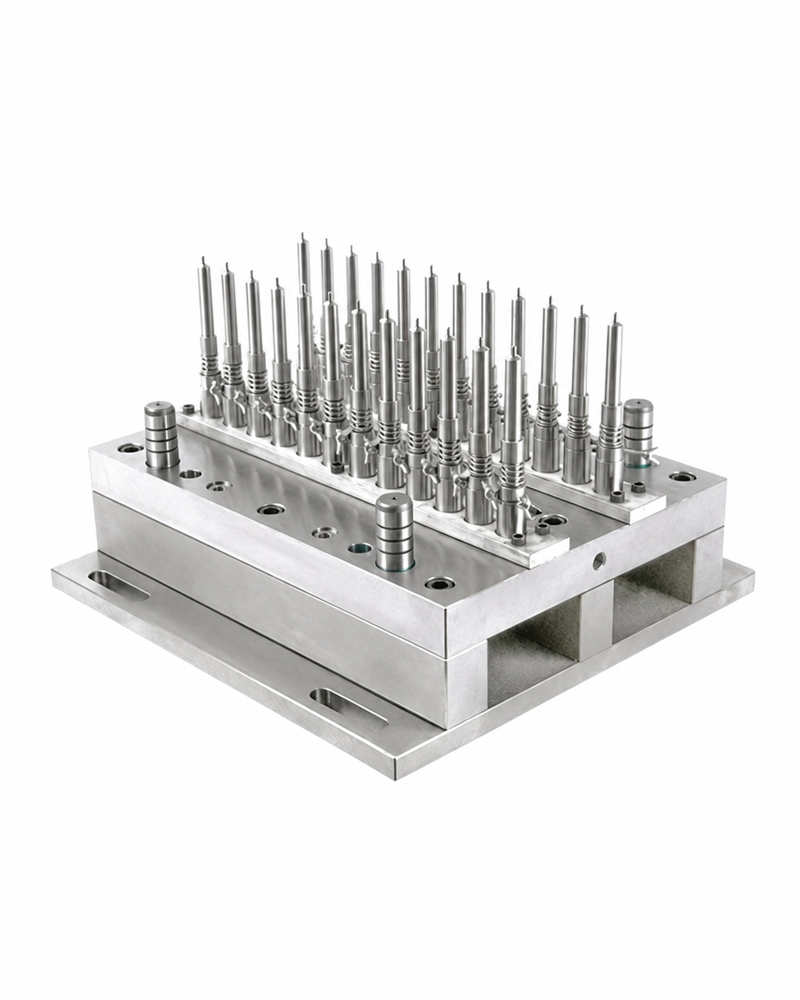
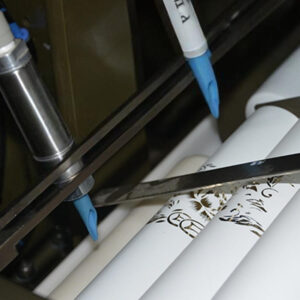
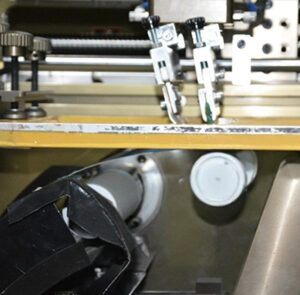
 Servo-driven piston dosing head with electronic fill weight monitoring — the technology behind ±0.3–0.5% fill accuracy on modern automatic tube filling lines. Source: Miyoda Packaging Machinery
3. Reduced Product Waste and Operational Costs
Where Waste Is Actually Being Generated
Most production managers track finished-product waste at end-of-line inspection. The more expensive waste happens upstream: product trapped in dead-leg nozzle assemblies during changeover, product spillage from imprecise cut-off, and material lost to fill-head purging during startup sequences.
Advanced filling machines address each of these through engineering design:
- Drip-free anti-drip nozzles with precision cut-off eliminate post-fill nozzle drip — a seemingly minor issue that on a 200 g tube at 80 TPM accumulates to approximately 4.8 kg of wasted product per 8-hour shift.
- Closed-loop fill head architecture minimizes product exposure between fills, reducing oxidation-related product loss in sensitive formulations.
- Automated CIP (Clean-in-Place) circuits reduce changeover purge waste by 50–70% compared to manual disassembly cleaning — while simultaneously shortening changeover time.
Glossary — CIP (Clean-in-Place): An automated chemical flushing system that cleans product-contact surfaces without disassembling the machine. Reduces cleaning time from 2–3 hours (manual teardown) to 30–45 minutes of documented automated cycling — and eliminates cross-contamination risk between product runs.
Comparing Waste Rates: Manual vs. Automated Systems
| Filling Method | Fill Accuracy | Waste Rate | Drip/Leak Incidents |
|---|---|---|---|
| Manual / Semi-Automatic | ±2%–5% | 2%–5% of output | Frequent |
| High-Quality Automatic | ±0.3%–0.5% | 0.3%–1% of output | Minimal (anti-drip systems) |
Source: LIENM Filling Machine Waste Reduction Data
At 10 million tubes per year, reducing waste rate from 3% to 0.5% recovers 250,000 units of output — the equivalent of adding 6–7 production days per year without running a single additional shift.
Lower Long-Term Operating Costs Despite Higher Initial Investment
A USD 25,000 semi-automatic machine producing 2 million tubes per year with USD 45,000 in annual operating costs yields a 10-year TCO (Total Cost of Ownership) of approximately USD 475,000, at a per-unit cost of USD 0.024. A USD 80,000 automatic machine producing 8 million tubes per year with USD 38,000 in annual operating costs yields a 10-year TCO of approximately USD 460,000, at a per-unit cost of USD 0.006 — 75% lower per unit despite the higher purchase price.
4. Enhanced Product Quality and Brand Integrity
Consistency Is the Product
In cosmetics, the experience of using the product begins when the consumer picks up the tube. A tube that fills inconsistently — sometimes full, sometimes not — creates visible variation in tube hardness and feel. A seam that is slightly misaligned or incompletely fused is not just aesthetically substandard; it is a quality signal that communicates manufacturing carelessness regardless of what is inside.
High-quality filling machines eliminate these variations through system engineering. Servo-driven fill heads maintain the same piston stroke ±0.1 mm across 500,000 consecutive fills. Hot-air sealing stations hold jaw temperature within ±2°C of setpoint — compared to ±10–15°C drift common on older semi-automatic units — producing seals with consistent appearance, width, and structural integrity.
Air Entrapment, Oxidation, and Contamination Prevention
For sensitive cosmetic and pharmaceutical formulations, the filling process itself is a contamination risk. Products containing vitamin C, retinol, or peptides can oxidize during filling if air is incorporated into the product stream during nozzle changes or startup sequences.
High-quality machines address this through:
- Bottom-up nozzle filling that displaces air from the tube before product contact begins
- Nitrogen blanketing options that purge the fill zone with inert gas for oxygen-sensitive formulations
- 316L stainless steel product-contact surfaces with electropolished Ra ≤ 0.8 μm finish that eliminates bacterial harborage points
A South Korean skincare brand documented a 40% reduction in oxidative degradation complaints after switching from standard semi-automatic filling to a closed-system automatic line with nitrogen blanketing on their vitamin C serum production.
Premium Positioning Requires Consistent Execution
Luxury cosmetic buyers — and pharmaceutical distributors — perform incoming quality audits on tube fill weight, seal integrity, and visual appearance. A single shipment with visible seal variation or fill weight variance outside specification can trigger a formal Corrective Action and Preventive Action (CAPA) request. Three CAPA events within a rolling audit period can result in delisting from the supplier panel. The cost of that delisting far exceeds any savings from running lower-quality equipment.
5. Regulatory Compliance and Traceability
Compliance Is Not a Feature — It Is the Foundation
For pharmaceutical tube filling, FDA 21 CFR, parte 211 mandates that equipment must be constructed from materials that do not contaminate product, have documented cleaning SOPs, and generate batch records for every production run. Non-compliance results in Warning Letters, product seizure, and facility shutdown — consequences that have materialized for manufacturers who failed to document GMP compliance during expansion into pharmaceutical contracts.
For cosmetic brands selling in the EU, ISO 22716:2007 requires equipment qualification documentation and documented production records — requirements increasingly audited by major retail buyers as part of their supplier qualification programs, not just regulatory bodies.
IQ/OQ/PQ Validation: What It Means and What It Costs
Glossary — IQ/OQ/PQ:
- IQ (Installation Qualification): Documents that the machine was installed per design specifications with correct utilities.
- OQ (Operational Qualification): Verifies the machine performs within specification at minimum, target, and maximum operating settings.
- PQ (Performance Qualification): Demonstrates consistent production of compliant product across three consecutive batches at production conditions.
A realistic IQ/OQ/PQ timeline for pharmaceutical equipment qualification runs 8–16 weeks from machine delivery, with total costs of USD 20,000–100,000 depending on equipment complexity. Suppliers who provide IQ/OQ/PQ template protocols as standard scope — not as a paid add-on — signal genuine experience in regulated market supply. This is a supplier selection criterion.
A contract pharmaceutical manufacturer in Brazil learned this the hard way: their domestically purchased filling machine had been running correctly for four years, but when a European distributor requested the machine qualification file before approving a supply contract, it did not exist. Remediation took seven months and approximately USD 38,000 in consulting work before the first EU-bound shipment cleared.
Electronic Batch Records and Audit-Ready Documentation
Modern pharmaceutical-grade filling machines generate electronic batch records automatically — linking each production run to machine settings, fill weights, sealing temperatures, operator IDs, and raw material lots. Pharmaceutical regulations require minimum 5-year data retention. For cosmetic producers supplying major retail chains, providing batch traceability on request has become a standard supplier qualification expectation.
Suppliers offering machines with 21 CFR Part 11-compliant electronic records eliminate the manual data entry bottleneck that creates errors, slows audits, and exposes manufacturers to compliance findings.
6. Flexibility Across Product Lines and Tube Formats
One Machine, Many Products — If Specified Correctly
A production line that cannot adapt to changing product portfolios is a liability, not an asset. The cosmetic industry’s new-product velocity has increased dramatically: boutique brands launch 15–30 new SKUs per year; contract manufacturers serve dozens of clients simultaneously with different tube formats, fill volumes, and materials.
High-quality filling machines designed for format flexibility can handle:
- Tube diameters from 13–60 mm — covering pencil-tip applicators through large body lotion tubes
- Tube materials: LDPE/HDPE plastic, ABL (Aluminum Barrier Laminate), PBL (Plastic Barrier Laminate), and all-aluminum crimp-seal tubes
- Fill volumes from 5 ml to 400 ml within the same machine platform
- Product viscosities from 5 cP (serums, toners) to 500,000+ cP (thick ointments) — managed through pump type selection and fill pressure settings
Glossary — Viscosity: A measure of a fluid’s resistance to flow. Water is approximately 1 cP. Toothpaste runs 100,000–200,000 cP at rest, dropping to 20,000–40,000 cP under shear stress during filling. The pump type (piston, gear, rotary lobe) must be matched to product viscosity at fill temperature.
Quick Changeover: The Metric That Determines Real Flexibility
Nominal machine flexibility is only valuable if changeover is fast enough to make it practical. On an older semi-automatic machine, switching between a 30 mm and a 40 mm diameter tube can require 45–70 minutes of manual adjustment. On a servo-driven machine with stored HMI recipe parameters and color-coded quick-release tooling, the same diameter change completes in 25–45 minutes — and a fill volume adjustment on the same tube takes less than 2 minutes via touchscreen recipe recall.
A European contract cosmetics manufacturer running 24 cream and gel SKUs weekly reported that installing a servo-driven machine with digital recipe management reduced total weekly changeover time from 6.2 hours to 1.8 hours — recovering 228 additional production hours per year without adding headcount.
| Changeover Type | Semi-Automatic | High-Quality Automatic |
|---|---|---|
| Fill volume only (same tube) | 5–10 min | 1–2 min (HMI recipe recall) |
| Tube length change (same diameter) | 10–20 min | 10–20 min |
| Tube diameter change | 45–70 min | 25–45 min (quick-release tooling) |
| Full format + product change | 60–90 min | 45–75 min (with auto CIP) |
{% youtube Dh-hpAiL1S0 %}
Watch: High-Speed Automatic 2-Head Tube Filling & Sealing Machine — observe the continuous rotary cycle, servo-driven indexing, automatic tube orientation, hot-air sealing station, and batch code embossing running at production speed. This demonstrates the throughput and consistency levels that cosmetic and pharmaceutical brands depend on at 5M+ annual volume.
7. Durability and Lower Total Cost of Ownership
Why the Purchase Price Is Only 30–40% of the Story
The single most reliable path to the worst financial outcome in tube filling equipment is optimizing for purchase price. A USD 12,000 entry-level semi-automatic filler with a 3-month spare parts lead time from the manufacturer is not a USD 12,000 machine. Its first unplanned breakdown — statistically occurring within 18 months of heavy production use — can cost USD 15,000–40,000 in lost production, rush orders, and expedited repair service.
Total Cost of Ownership (TCO) over a 10-year service life typically breaks down as:
| TCO Component | Realistic Range |
|---|---|
| Machine purchase price | 30–40% of 10-yr TCO |
| Labor (operators, maintenance technicians) | 35–45% of 10-yr TCO |
| Maintenance, wear parts, spare parts | 10–20% of 10-yr TCO |
| Downtime-related losses | 5–15% of 10-yr TCO |
| Installation, training, validation | 5–10% of 10-yr TCO |
Source: Canadian Packaging — The True Cost of Filling Equipment
Food-Grade Stainless Steel: The Engineering That Enables 10+ Years of Service
High-quality filling machines are constructed with 316L stainless steel (not the lower-grade 304 SS used in budget equipment) for all product-contact surfaces. 316L provides superior corrosion resistance against chloride-containing formulations, acidic product ingredients (pH < 5), and aggressive CIP cleaning chemicals. The difference in surface longevity is not theoretical: facilities running abrasive cosmetic pastes (zinc oxide sunscreens, exfoliating creams) on 304 SS components report measurable surface pitting within 18–24 months; 316L components in the same environment run 8–12 years before requiring surface reconditioning.
With proper preventive maintenance — including quarterly seal inspections, servo drive diagnostics every 6 months, and annual jaw face replacement — high-quality industrial tube filling machines routinely achieve 10+ years of productive service life with consistent fill weight accuracy.
Wear Parts and Maintenance Planning
Critical wear components and realistic replacement intervals on a high-quality filling machine:
- Piston pump seals and O-rings: every 3–6 months (abrasive products) to 12 months (standard cosmetic creams)
- Sealing jaw heating elements: annually
- Nozzle check valves: every 6–12 months
- Conveyor belts: every 2–3 years
Ask every supplier to provide a 3-year spare parts forecast with unit pricing at time of quotation — not a generic “maintenance recommendation.” Suppliers who cannot provide this data will likely support you poorly when you need the parts.

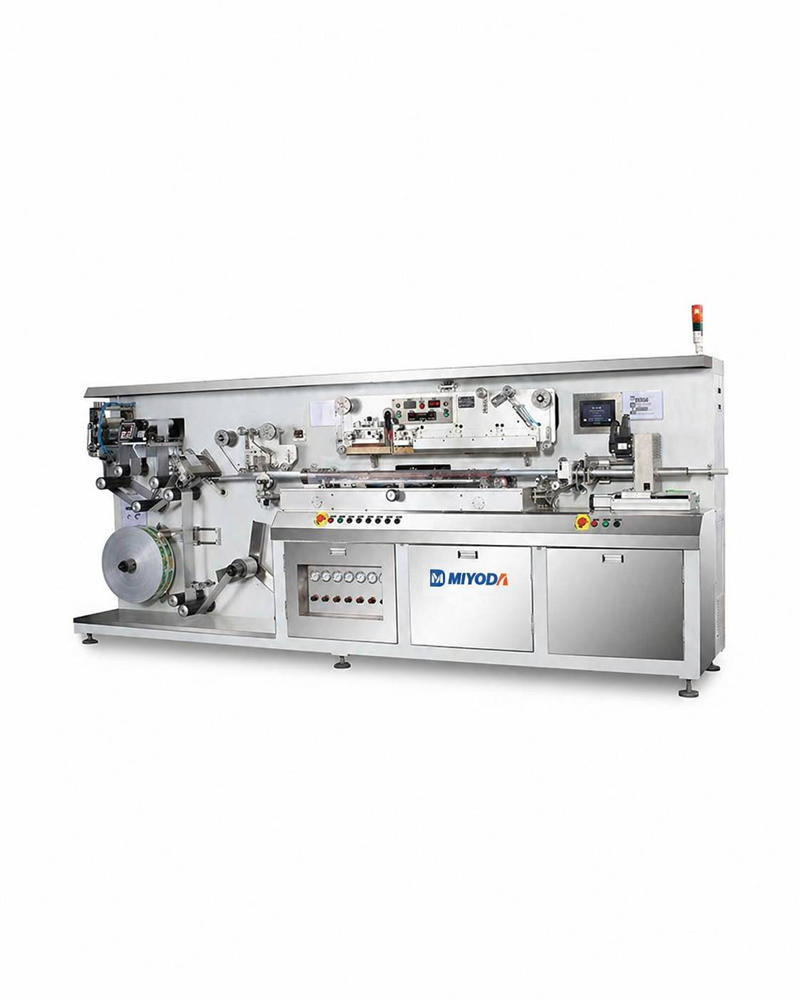
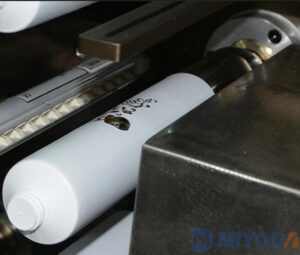
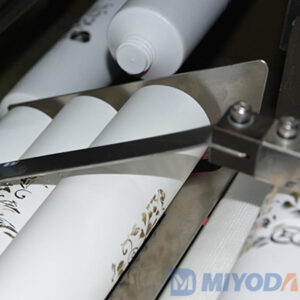
316L stainless steel nozzle assembly with anti-drip valve — the component that determines both filling accuracy and product hygiene in cosmetic tube production. Source: Miyoda Packaging Machinery
8. Seamless Integration with Existing Production Lines
A Filling Machine Is One Station in a System
The filling machine does not operate in isolation. In a complete cosmetic or pharmaceutical tube production line, it sits between the tube in-feed system and the downstream sealing, labeling, batch coding, and cartoning stations. A machine that cannot communicate with adjacent systems through standard industrial protocols creates manual staging bottlenecks that erase throughput gains from the filling stage itself.
High-quality filling machines designed for production line integration offer:
- Standard conveyor interface heights (typically 900–950 mm) compatible with downstream labeling and cartoning equipment
- PLC handshake signals (I/O, Ethernet, OPC-UA) for upstream/downstream system synchronization
- Modular mechanical design that allows adding additional fill heads, vision inspection cameras, or checkweighers without replacing the base machine
OPC-UA Integration: The Industry Standard That Matters
OPC-UA (Open Platform Communications Unified Architecture) is the industrial standard for machine data exchange — allowing fill weight data, alarm histories, and production counts to flow directly into your ERP or MES system. It is increasingly specified as a mandatory requirement by major cosmetic and pharmaceutical brand buyers (including multinational CPG companies) in their supplier qualification criteria, ensuring production data is traceable without manual entry.
A leading contract manufacturer in Southeast Asia reduced average weekly changeover time from 6.2 hours to 1.8 hours after implementing servo-driven jaw adjustment with HMI recipe management — recovering 228 additional production hours per year without additional headcount.
Modular Architecture and Retrofitting
The most commercially valuable integration feature is modularity. When commissioning a filling line, confirm whether additional fill heads can be added to the same base machine versus requiring a parallel second machine. For a brand projecting volume growth from 8 million to 18 million tubes in four years, adding a second fill head to an existing machine at approximately USD 35,000 is materially different from purchasing a second complete machine at USD 120,000.
Miyoda Packaging Machinery designs their tube filling and closing platforms with modular architecture — enabling production line upgrades including additional fill heads, integrated vision inspection, and automated tube in-feed systems without complete machine replacement. Their tube filling and closing machine portfolio is engineered specifically for cosmetic and pharmaceutical production environments where integration with existing manufacturing infrastructure is a baseline requirement.
9. Regulatory-Driven ROI: How Compliance Protects Revenue
The Hidden Revenue Impact of Non-Compliance
Regulatory non-compliance in tube filling operations does not manifest as a fine — it manifests as blocked contracts. A Southeast Asian cosmetic producer committed to a USD 35,000 semi-automatic tube filler in early 2024 based on lowest quoted price. Eighteen months later, a European distributor’s audit flagged the absence of electronic batch records, blocking a USD 1.2 million annual contract. The machine itself was performing adequately. The compliance infrastructure it could not support was the failure point.
A filling machine with built-in GMP compliance features does not eliminate regulatory work — but it removes the most common sources of audit findings: inconsistent batch documentation, fill weight records that cannot be reconstructed after the fact, and cleaning records that exist only as handwritten logs.
ROI Calculation: A Realistic Example
For a pharmaceutical contract manufacturer producing 8 million tubes per year, upgrading from two semi-automatic lines (4 operators per shift) to one fully automatic line (1 operator per shift) at a blended labor rate of USD 22/hour across 2 shifts, 250 operating days:
$$\text{Annual Labor Savings} = 3 \text{ operators} \times $22/\text{hr} \times 16 \text{ hrs/day} \times 250 \text{ days} = $264{,}000$$
$$\text{Annual Waste Recovery} = 0.025 \times 8{,}000{,}000 \text{ tubes} \times $0.10/\text{tube} = $20{,}000$$
$$\text{Total Investment (machine + installation + validation)} = $120{,}000$$
$$\text{Payback Period} = \frac{$120{,}000}{$264{,}000 + $20{,}000} \approx 5.1 \text{ months}$$
At that production volume, the automatic machine pays for itself in under 6 months — and then generates its full capital value in labor and waste savings every subsequent year of its 10+ year service life.
10. Support, Service, and Partnership for Long-Term Success
What “After-Sales Support” Actually Means in Practice
When a filling machine sealing jaw fails during a production run of 40,000 pharmaceutical ointment tubes, the relevant metric is not when a technician can “probably” be available — it is the contractual response time guarantee and the nearest stocked spare parts depot. Ask every supplier two questions before signing a purchase order:
- What is your committed response time for critical production stoppages?
- Where is your nearest regional service center, and which critical spare parts are stocked within 48-hour shipping distance?
Suppliers who provide generic “we will support you” language without specific commitments will demonstrate that generality when you most need specificity.
Remote Diagnostics and Predictive Maintenance
Modern filling machines with IIoT (Industrial Internet of Things) connectivity allow supplier technical teams to access PLC diagnostic data remotely — diagnosing fill weight drift, servo alarm codes, and temperature calibration issues without dispatching an on-site engineer. Predictive maintenance algorithms analyzing motor current profiles and vibration signatures can flag component failures 15–20 minutes before they cause production stoppages, reducing unplanned downtime by 25–40% compared to fixed-interval replacement schedules.
Operator Training: The Investment That Protects Your Machine Investment
A pharmaceutical production facility in Thailand lost 11 days of production in one quarter when their sole qualified filling machine operator was absent due to illness. Their machine was functional; their documented operator pool was not. Cross-training a minimum of two operators per machine — with their qualification documented in your training records — is a production continuity requirement, not an optional investment.
Structured operator training timelines for tube filling equipment:
- Semi-automatic operation: 1–3 days to reach competent sustained production rate
- Fully automatic line operation: 2–4 weeks to reach independent operation, including PLC alarm diagnosis, HMI recipe management, servo drive parameters, and changeover sequencing
Suppliers who provide on-site commissioning training with qualification documentation and video-based remote support programs eliminate a critical dependency on locally available specialist technicians — a significant operational advantage for facilities in markets where automation expertise is scarce.
Choosing a Partner, Not Just a Supplier
Miyoda Packaging Machinery specializes exclusively in automated tube production lines for cosmetics and pharmaceuticals. Their engineering team works with producers globally — matching machine specification to tube format, output target, compliance requirements, and floor layout — and has documented client cases showing operational efficiency improvements of 30% or greater following transition from semi-automatic to fully automated production lines.
For producers evaluating their first fully automatic filling investment, their 2026 Tube Filling Machine Buyer’s Guide provides scenario-by-scenario TCO analysis across production volumes, tube materials, and regulatory jurisdictions. Buyers who need to compare automation levels before committing will find the automatic vs. semi-automatic comparison guide directly applicable to their evaluation process.

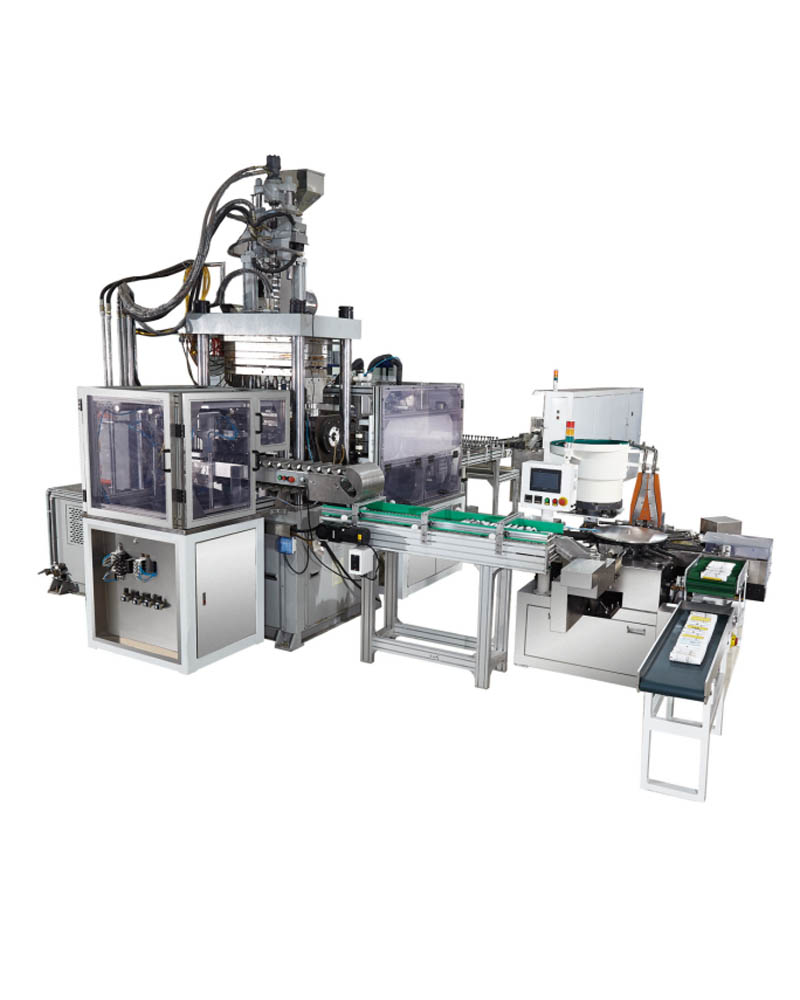
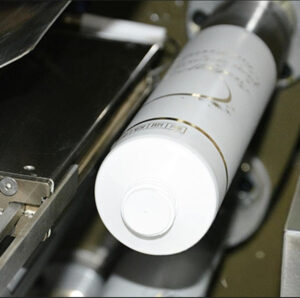
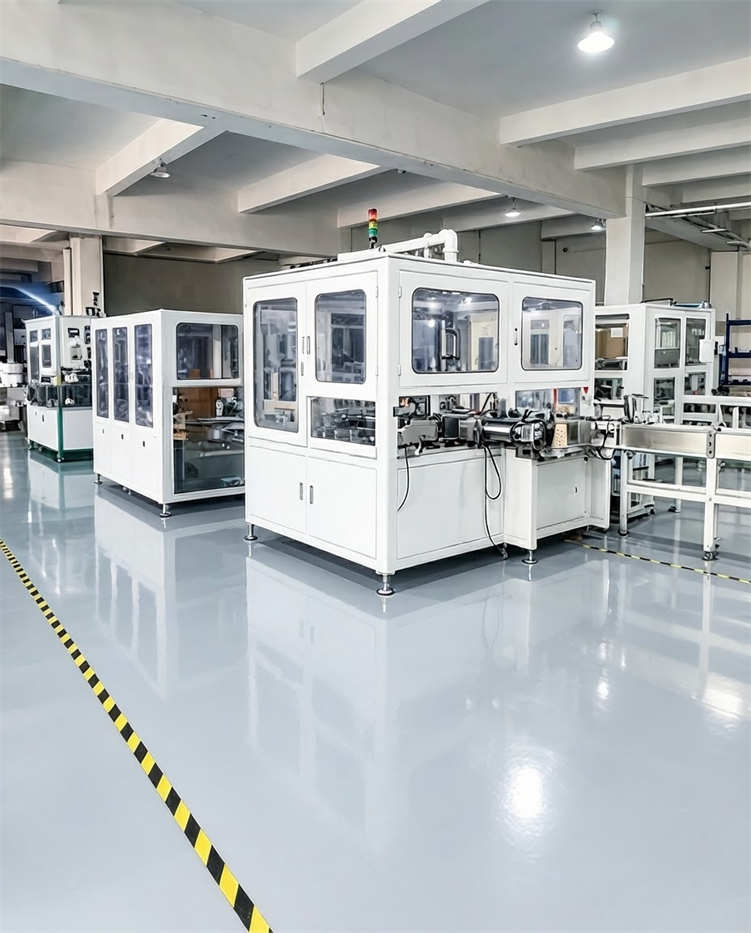
Real-time fill weight monitoring on a touchscreen HMI — the interface between operator oversight and servo-driven precision on a modern automatic tube filling line. Source: Miyoda Packaging Machinery
What a High-Quality Filling Machine Actually Delivers
Every section of this guide traces back to the same economic logic: the premium cost of a well-engineered filling liquid machine is recovered — typically within 6–36 months depending on production volume — and then generates compounding returns through reduced labor, reduced waste, fewer compliance events, and the ability to win contracts that lower-specified equipment cannot satisfy.
The tube filling machine market is projected to grow from USD 2.1 billion in 2025 to USD 3.1 billion by 2035 at a CAGR of 3.9% (Future Market Insights). The brands and contract manufacturers who invest in precision filling infrastructure now will hold the audit-ready documentation, the fill weight Cpk data, and the production capacity headroom to take that market growth — while competitors are still managing fill weight drift with spreadsheets.
Preguntas frecuentes (FAQ)
How does a high-quality filling machine improve production accuracy?
High-quality tube filling machines use servo-driven piston pumps with electronic fill weight monitoring to maintain fill accuracy within ±0.3–0.5% of target volume. This is achieved through closed-loop feedback between the checkweigher and the servo motor controlling piston stroke — automatically correcting drift in real time without operator adjustment. In practice, this means a Cpk of 1.5–2.0 compared to 0.9–1.2 on semi-automatic equipment — the difference between a 0.006% and 0.27% defect rate at scale.
Can the machine handle both cosmetic and pharmaceutical-grade products?
Yes — machines designed with 316L stainless steel product-contact surfaces, CIP circuits, and GMP-compliant sanitary design are suitable for both categories. The key operational difference is documentation: pharmaceutical production requires IQ/OQ/PQ qualification, electronic batch records compliant with FDA 21 CFR Part 11, and more stringent cleaning validation protocols. Many facilities run cosmetic and pharmaceutical products on the same machine with robust cross-contamination prevention SOPs and formal change control documentation.
What types of products can be filled using this machine?
High-quality tube filling machines handle the full viscosity range encountered in cosmetic and pharmaceutical production: free-flowing serums and toners (5–50 cP), standard lotions and cleansers (500–2,000 cP), creams and moisturizers (5,000–20,000 cP), thick ointments and pastes (50,000–200,000 cP), and dense pharmaceutical creams and toothpaste (100,000–500,000+ cP). Pump type — piston, gear, or rotary lobe — is matched to product viscosity at fill temperature, determined during the machine specification process.
Is the machine suitable for different tube materials like aluminum, laminate, and plastic?
Yes. Tube material determines the sealing method required: LDPE and ABL laminate tubes use hot-air sealing; PBL laminate tubes typically use ultrasonic sealing; aluminum tubes use mechanical crimping. Modern high-quality filling machines can be configured with interchangeable sealing stations — or designed with a primary sealing method plus tooling sets for secondary formats. Confirm tube material compatibility with the supplier at specification stage and request a witnessed Factory Acceptance Test with your actual tube substrate before accepting delivery.
How long does installation and setup typically take?
Standard setup for an automatic tube filling machine takes 4–12 weeks from machine delivery to first commercial production run, depending on configuration complexity and facility readiness. High-speed multi-head systems with custom tooling and vision inspection can extend to 14–16 weeks. For pharmaceutical-grade validation, add 8–16 weeks for IQ/OQ/PQ execution after installation. The full timeline from purchase order to first validated pharmaceutical batch is realistically 28–40 weeks — plan product launch dates accordingly.
Do you offer validation documentation (IQ/OQ/PQ) for pharmaceutical clients?
Full IQ/OQ/PQ validation packages — including protocol templates, test execution support, and documentation review — are available for pharmaceutical clients. These should be confirmed as included scope at the time of purchase, not negotiated as an add-on after delivery. Budget USD 20,000–100,000 for complete pharmaceutical qualification depending on machine complexity and the extent of customer-side engineering support involved.
Can the machine be integrated with existing sealing and labeling systems?
Yes. High-quality filling machines use standard industrial interfaces — including OPC-UA data protocols, Ethernet PLC handshake, and compatible conveyor transfer heights — allowing integration with upstream tube in-feed systems and downstream labeling, cartoning, and batch coding equipment. Confirm interface specifications with both the filling machine supplier and downstream equipment suppliers during system design, not during installation.
What maintenance is required, and how often?
A practical preventive maintenance schedule for a high-quality automatic filling machine includes: daily cleaning of product-contact surfaces and nozzle tips; weekly lubrication of indexing table bearings and inspection of sealing jaw faces; monthly fill weight calibration verification; quarterly piston seal inspection; and 6-monthly servo drive diagnostics and vision system calibration. Critical wear parts — nozzle check valves, piston seals, sealing jaw heating elements — should be stocked on-site per the supplier’s 3-year spare parts forecast. Automated maintenance alerts in modern machines notify operators of upcoming service intervals.
Is operator training provided after purchase?
Yes. Reputable suppliers provide on-site commissioning training covering machine startup, recipe management, in-process quality sampling, changeover procedures, cleaning protocols, and basic alarm diagnosis. For fully automatic lines, structured training covering PLC alarm diagnosis, servo drive parameters, and changeover sequencing takes 2–4 weeks to reach independent operation competence. Confirm training scope, duration, and qualification documentation in the purchase agreement — not after delivery.
How does the machine reduce product waste during filling?
Waste reduction is achieved through four engineering features: drip-free anti-drip nozzles with precision cut-off that eliminate post-fill nozzle drip; closed-loop fill weight monitoring that corrects dosing drift before off-weight tubes accumulate; automated CIP circuits that reduce changeover purge waste by 50–70%; and servo-controlled product pressure management that maintains consistent fill speed across the run, preventing air entrapment and associated rework. Combined, these features reduce waste from the 2–5% typical of manual filling to 0.3–1% of output.
Can I switch between different tube sizes quickly?
Yes, with stored HMI recipes and quick-release modular tooling. Fill volume adjustments on the same tube format take 1–2 minutes via touchscreen recipe recall. Tube diameter changes with quick-release tooling sets complete in 25–45 minutes on well-designed automatic systems — compared to 45–90 minutes on older mechanical-adjustment designs. Full format and product changes including CIP cleaning typically run 60–90 minutes total.
What is the expected lifespan of the machine?
With proper preventive maintenance, high-quality filling machines constructed from 316L stainless steel with wear-resistant valve components achieve 10+ years of productive service life. Budget equipment using 304 SS and standard-grade seals may require major mechanical overhaul within 4–6 years of heavy production use. The 10-year TCO comparison consistently favors high-quality equipment: lower per-unit cost, fewer unplanned stoppages, and longer intervals between capital replacement.
Are spare parts readily available for quick replacement?
This is the most underestimated procurement risk in filling machine purchasing. Specify contractually which spare parts the supplier will maintain in regional inventory and what the committed lead time is for critical components. A supplier whose nearest warehouse is 8 weeks away for critical nozzle assemblies is a production continuity risk that no warranty coverage resolves. Ask for a 3-year spare parts forecast with unit pricing at quotation stage and confirm regional stocking commitments before signing the purchase agreement.
How does this machine help meet regulatory requirements?
GMP-compliant filling machines support regulatory requirements through design features rather than procedural workarounds: 316L stainless steel product-contact surfaces meet FDA 21 CFR and EU GMP material standards; automated electronic batch records satisfy data integrity requirements under FDA 21 CFR Part 11; CIP circuits support cleaning validation under EU GMP Annex 15; and fill weight Cpk data provides the process capability evidence required in pharmaceutical batch release and supplier qualification audits.
Glosario de términos clave
| Término | Definición |
|---|---|
| Cpk | Process Capability Index — measures how consistently fill weight stays within specification limits. Pharma standard: Cpk ≥ 1.33. |
| OEE | Overall Equipment Effectiveness = Availability × Performance × Quality. World-class: 85–92%. |
| CIP | Clean-in-Place — automated chemical flushing of product surfaces without machine disassembly. |
| 316L SS | Food/pharma-grade stainless steel with superior corrosion resistance; standard for pharmaceutical-grade filling equipment. |
| IQ/OQ/PQ | Installation, Operational, and Performance Qualification — the three-stage validation protocol required for pharmaceutical equipment. |
| OPC-UA | Open Platform Communications Unified Architecture — industrial standard for machine data exchange with ERP/MES systems. |
| ABL | Aluminum Barrier Laminate — multi-layer tube combining plastic squeezability with near-zero oxygen transmission barrier. |
| PBL | Plastic Barrier Laminate — multi-layer tube using EVOH polymer barrier; fully recyclable alternative to ABL. |
| Coste total de propiedad (TCO) | Total Cost of Ownership — complete cost over equipment lifespan including purchase, labor, maintenance, downtime, and validation. |
| FAT | Factory Acceptance Test — a formal production trial at the vendor’s facility before machine shipment, confirming it meets agreed specification. |
| cGMP | Current Good Manufacturing Practice — FDA and WHO regulatory standards for pharmaceutical manufacturing environments and equipment. |
| LOTO | Lockout/Tagout — safety procedure for de-energizing equipment before maintenance to prevent accidental startup. |