
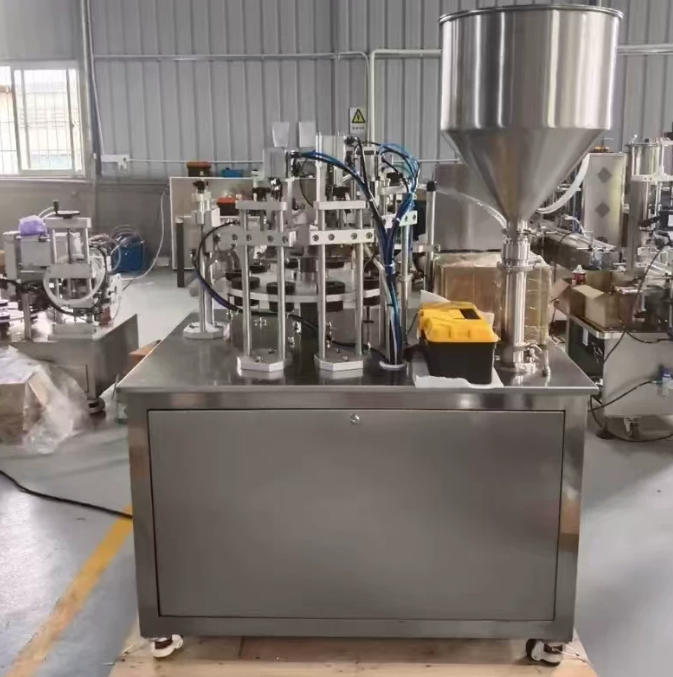

The gap between a production line that runs and one that performs is often measured in the features you didn’t ask for when you bought the machine.
The Real Cost of Running a Line That’s “Good Enough”
Every soft tube manufacturer knows this situation. The line is running. Output is meeting daily targets — most days. Quality holds — mostly. Downtime is manageable — usually.
But “mostly” and “usually” are doing a lot of work in that sentence. They’re hiding the real cost of a production operation that’s running below its potential.
Consider what “mostly meeting quality targets” actually means across 10 million tubes per year at a 1.8% defect rate: 180,000 defective tubes. At $0.12 material cost per tube, that’s $21,600 in scrapped material annually — before counting the labor cost to inspect, sort, and document each rejection, or the risk that some of those defective tubes reached retail.
Consider what “manageable downtime” means when the average manufacturing plant experiences 15 hours of unplanned downtime per week. On a line capable of 80 tubes per minute, 15 hours per week of unplanned stops represents 72,000 tubes of lost weekly output. At a $0.15 contribution margin per tube, that’s $10,800 per week in foregone margin — $561,600 per year — classified on no income statement as “lost opportunity” because it’s invisible. It never existed, so it’s never counted.
This guide is for the manufacturers, distributors, and agents who are done accepting these losses as fixed costs of doing business. It’s a practical, numbers-backed walkthrough of the five most common soft tube production pain points — and exactly how the right machine configuration solves each one.
Pain Point #1: Inefficient Production Slows Down Market Entry
 Slow production cycles don’t just limit output — they delay your ability to respond to new orders, seasonal demand spikes, and product launches that require fast scale-up.
The Time-to-Market Problem
Speed to market is not an abstract business goal. It’s a competitive advantage with a measurable dollar value. When a cosmetic brand launches a new product range and needs 500,000 tubes in eight weeks, the manufacturer who can commit to that schedule wins the contract. The manufacturer whose production cycle is running at 65% of its rated capacity — through a combination of manual feeding, slow changeovers, and intermittent stoppages — cannot.
Manual processes are the primary bottleneck in most underperforming tube production lines. Manual tube loading — typically performed by one to two operators per shift — introduces irregular feeding intervals that cause micro-stoppages downstream every time a loader falls behind or misfeeds an orientation. Manual parameter adjustments for speed, temperature, and pressure run on operator instinct rather than calibrated data. Manual end-of-line inspection adds a time buffer between production and shipment readiness that compounds across large batches.
The result is a cycle time — the total time from raw tube stock to finished, inspected, packaged tube — that runs 30–50% longer than the machine’s mechanical capability suggests it should.
What Optimized Automation Changes
A tube production line configured with automatic loading, servo-driven motion control, and recipe-based setup eliminates these manual bottlenecks at their source.
Clients who transition from semi-manual to fully automated soft tube production lines consistently report 30–50% faster effective cycle times — not because the machine runs faster at peak speed, but because it runs at a consistent, sustainable speed without the micro-stoppages, setup variations, and human fatigue factors that drag actual throughput below theoretical throughput.
Miyoda Packaging Machinery’s tube production efficiency guide documents documented output gains of 15–30% achievable at existing machines simply by systematically addressing the process variables that limit sustained speed — before any capital upgrade is considered.
💡 Glossary:
- Cycle time: The total elapsed time from the start of one tube’s production to the start of the next. Reducing cycle time increases throughput for the same number of operating hours.
- OEE (eficacia global de los equipos): A metric that multiplies Availability × Performance × Quality to give a single number representing how productively a machine is being used. Industry average for packaging lines is approximately 65%; world class is 85%.
Pain Point #2: Material Waste Is Quietly Destroying Your Margins
The Waste You’ve Stopped Noticing
Material waste in soft tube production is usually not dramatic. It’s not a machine that dumps an entire batch into the scrap bin. It’s 0.4g of extra laminate trimmed on every tube because the cutter isn’t holding tolerance. It’s $0.006 of adhesive over-applied at the shoulder joint on every cycle because the dispensing system drifts under heat. It’s the tube body that’s 1.5mm longer than specified and gets discarded at the sealing station.
Each of these is trivial. Together, across millions of production cycles, they are not.
For a production line running 15 million tubes per year, a systematic over-trim of 1.5mm of laminate per tube at a material cost of $0.004/mm represents:
This number is invisible in most operations because it has always been there. No one line item in the P&L says “laminate over-trim.” It’s embedded in the material cost per unit, accepted as a known inefficiency, and passed on to customers through pricing — making every quote slightly less competitive than it needs to be.
Closed-Loop Control: The Engineering Response
Closed-loop control systems — where sensors continuously measure the output of each process step and feed that data back to the machine’s control system to correct deviations in real time — are the primary engineering tool for eliminating systematic material waste.
In a tube trimming application, a closed-loop cutter with a laser measurement sensor verifies cut length on every tube and adjusts the blade travel position by the required correction within the next cycle. The system doesn’t wait for an operator to notice drift and adjust manually. It self-corrects, continuously, within ±0.1mm of target.
In a filling application, a closed-loop piston filler with load cell feedback measures actual fill weight per cycle and adjusts piston stroke length to compensate for viscosity variations across a batch. Rather than setting a conservative over-fill to ensure minimum volume compliance, the system maintains precise target volume — typically ±0.5% — eliminating the systematic over-fill that accounts for the majority of filling material waste.
Clients operating precision-controlled soft tube production lines report 15–20% reduction in material waste within the first three months of operation — consistent with data from Fuluke’s precision tube filling analysis across cosmetic and pharmaceutical tube applications.
Pain Point #3: Inconsistent Quality Risks Your Brand Reputation
What One Defective Tube Costs
The direct cost of a single rejected tube at end-of-line is measurable: material cost, plus a fraction of the labor cost to inspect and sort it. On a $0.15 tube, perhaps $0.18 total when overhead is included.
The cost of a defective tube that reaches retail is not measurable in the same way. It’s a customer complaint. It’s a return. It’s a social media post with a photo of a leaking tube in someone’s cosmetics bag. For pharmaceutical products, it’s a potential recall event with regulatory reporting obligations and remediation costs that can reach six figures.
The asymmetry is significant: a tube that’s caught at the end-of-line costs $0.18. A tube that reaches the consumer and fails costs somewhere between $50 (direct complaint handling cost) and catastrophically more in brand damage and regulatory consequence.
This asymmetry is the business case for built-in quality assurance that operates at line speed — not statistical end-of-line sampling.
Built-In Quality Systems: What They Look Like in Practice
Modern soft tube production machines integrate quality verification at every stage where a defect can originate:
Seal integrity: Inline pressure decay testing — where each sealed tube is briefly pressurized and monitored for pressure drop — tests 100% of tubes for micro-leaks at production speed. No statistical sampling. No escaped defects from within-batch variation.
Fill volume: Load cell or flow meter feedback on every fill cycle confirms that each tube received the specified volume within tolerance. Fill-weight data is logged per tube for pharmaceutical batch records.
Seal alignment and print registration: Vision systems — cameras mounted on the production line that capture an image of each tube and compare it against a reference template — verify seal alignment, print position, cap orientation, and surface defects at line speed. Tubes outside tolerance are automatically diverted to a rejection bin, with each rejection time-stamped and catalogued.
Sealing temperature uniformity: Thermal monitoring of seal jaw temperature verifies that each seal is formed at the correct temperature — preventing the cold seals that look acceptable visually but fail under minimal pressure.
For a real-world view of what happens when these systems are absent, Miyoda Packaging Machinery’s tube filling production line failure case studies documents the direct and indirect costs of the most common seal and quality failures across cosmetic and pharmaceutical tube operations — including the production and financial impact of failures that reached retail before detection.
💡 Perspectiva del sector: iFactory’s seal integrity inspection analysis confirms that AI vision-based inline inspection systems achieve defect detection rates above 99.2% — compared to 87% for manual visual inspection. That 12.2 percentage point difference represents the defects that currently escape your line and reach your customer.
Pain Point #4: High Downtime and Maintenance Disrupt Output

Predictive maintenance — identifying developing faults before they cause failures — converts reactive downtime emergencies into planned maintenance events that don’t disrupt production schedules.
The True Cost of Unplanned Downtime
The average manufacturing facility experiences 15 hours of unplanned downtime per week, according to TWI Institute’s manufacturing downtime research. High-performing packaging facilities hold unplanned downtime below 5% of available production time; average facilities experience 10% or more.
On a soft tube production line running 80 tubes per minute, the difference between 5% and 10% unplanned downtime at a $0.15 contribution margin per tube across a 16-hour production day is:
\$5{,}760 \times 250 \text{ working days} = \$1{,}440{,}000 \text{ per year}}
That’s not a typo. The gap between average and high-performing downtime rates on a single production line at this volume is worth over a million dollars annually in contribution margin — and it’s primarily driven by machine design, maintenance practice, and support infrastructure, not by operator behavior.
Modular Design and Predictive Maintenance
The two engineering approaches that most reliably improve production uptime are modular machine design y predictive maintenance capability.
Diseño modular means that the machine’s functional stations — filling, sealing, trimming, inspection — are built as independent modules that can be removed, serviced, and replaced without disassembling adjacent stations. A seal jaw failure on a modular machine requires replacing one station module: 15–20 minutes. The same failure on a non-modular machine, where the seal station is integrated with the conveying system and the trimmer, can require 4–6 hours of disassembly, repair, and reassembly.
Predictive maintenance capability uses sensors — vibration, temperature, current draw — on critical mechanical components to generate trend data over time. When a bearing’s vibration signature begins trending upward over two weeks, the control system flags a predictive maintenance alert. The bearing is replaced during a scheduled maintenance window, not after it fails catastrophically during a production run.
Oxmaint’s manufacturing downtime reduction research confirms that structured predictive maintenance programs reduce unplanned downtime by 30–50% compared to reactive maintenance — translating directly to the kind of 90%+ uptime rates that distinguish consistently profitable tube manufacturing operations.
Quick-change tooling — standardized mounting interfaces for seal jaws, cutting blades, and forming mandrels — reduces the mechanical changeover component of planned maintenance from 90 minutes to under 20 minutes, recovering additional production time from every scheduled maintenance event.
Pain Point #5: Scalability Challenges Limit Growth
The Equipment That Makes You Say No
Every growing tube manufacturer reaches the same inflection point. A major cosmetic brand calls with an order for 2 million units — 40% above your current monthly capacity. On the existing line, you have two options: decline the order or run seven-day weeks for two months to fill it, burning out your team and accumulating deferred maintenance that will cost you dearly six months later.
Neither option is acceptable. And neither would exist if the production line had been specified with scalability as a design requirement rather than an afterthought.
The equipment that limits scalability is usually not failing. It’s running. It’s just running at a fixed ceiling — a specific tube size range, a specific material type, a specific output speed — that was adequate when it was purchased and has become the constraint that limits every new commercial conversation.
What Flexible Machine Architecture Enables
A soft tube production machine designed for multi-format flexibility handles PE extruded tubes, aluminum-plastic laminate (ABL) tubes, and plastic-plastic laminate (PBL) tubes on the same platform — with the format switch managed through tooling changes and HMI recipe selection rather than machine replacement.
Diameter range flexibility — supporting tube bodies from Φ13mm (mascara tubes) through Φ60mm (large-format body lotion tubes) on the same machine with tooling changes — means that winning a new brand contract with different tube specifications doesn’t require a capital investment. It requires a tooling order and a recipe setup.
Production speed scalability — machines configurable from 40 to 180 tubes per minute depending on tube format and fill complexity — means that as volume grows, the machine can be configured for higher sustained throughput rather than requiring replacement.
The business impact: A mid-sized cosmetic tube manufacturer working with Miyoda Packaging Machinery scaled output from 2 million to 5 million tubes per month without adding production headcount, by reconfiguring an existing flexible-format line and adding a second machine module — rather than installing an entirely new production line from scratch. The capital cost of the expansion was 35% of a greenfield line installation; the timeline was 11 weeks from order to full production, versus 20–24 weeks for a new line.
For a detailed breakdown of production line scalability options and format flexibility in soft tube manufacturing, the complete tube extrusion production line guide at Miyoda covers the configuration options available for different output volumes and tube material requirements.
Total Cost of Ownership: The Calculation That Changes the Conversation
Most machine purchase decisions are made primarily on purchase price. That’s understandable — purchase price is visible, immediate, and easy to compare across suppliers. It’s also the least important number in the actual financial assessment of a machine investment.
Total Cost of Ownership (TCO) is the complete financial impact of a machine over its operating life: purchase price, installation and commissioning, training, energy, consumables, maintenance parts and labor, downtime costs, and end-of-life replacement. This is the number that determines whether a machine investment creates or destroys value.
Consider a simplified 5-year TCO comparison between a legacy line and a modern configured soft tube production machine:
| Categoría de costes | Legacy Machine (5 Years) | Modern Machine (5 Years) |
|---|---|---|
| Precio de compra | $0 (already owned) | $95,000 |
| Energy (30% reduction on modern) | $200,000 | $140,000 |
| Labor (automation reduces headcount) | $360,000 | $216,000 |
| Material waste (15–20% reduction) | $108,000 | $86,400 |
| Maintenance and downtime losses | $280,000 | $140,000 |
| 5-Year Total | $948,000 | $677,400 |
| 5-Year Saving | — | $270,600 |
The modern machine costs $95,000 more to acquire. Over five years, it saves $270,600 in operating costs — a net value creation of $175,600, or roughly 185% return on the purchase premium, before accounting for revenue gains from higher throughput and better quality retention.
This is the conversation that moves a machine purchase from “cost center” to “investment decision” — and it’s the framing that every distributor and agent should be equipped to have with their end clients.
Alpha Packaging’s TCO framework for packaging equipment provides a structured methodology for building this analysis with client-specific cost inputs.
Integration and Support: Making the Transition Manageable
One of the most common reasons manufacturers delay a machinery upgrade is not the capital cost — it’s the fear of disruption. The installation period. The retraining of operators who have been running the current line for five years. The first weeks of production on the new machine while the team finds its rhythm.
These concerns are legitimate, and a supplier who dismisses them is not taking your production reality seriously.
A genuine implementation support program for a soft tube production machine includes:
Factory Acceptance Testing (FAT): Before the machine leaves the manufacturer’s facility, it is run at full production speed with the client’s specified tube formats and materials, against agreed performance criteria — throughput rate, seal integrity pass rate, material waste rate, OEE. The client or their representative is present. The machine is not shipped until it meets the agreed criteria.
On-site commissioning: Installation and commissioning at your facility, conducted by certified technicians who configure the machine for your specific production environment, run the first production batches with your team, and don’t leave until the line is performing to specification.
Operator and maintenance training: Structured, hands-on training programs for both production operators and maintenance technicians — covering daily operation, parameter adjustment, routine maintenance, fault diagnosis, and safe shutdown procedures — conducted in your facility with your team, using your language and your production context.
24/7 remote diagnostics: Machines with secure IoT connectivity allow the supplier’s engineering team to view live machine data, review fault logs, and in most cases resolve operational issues remotely within hours of a fault event. For global distributors and agents operating across multiple time zones, this is the support infrastructure that makes a supplier partnership commercially viable.
For distributors and agents evaluating Miyoda Packaging Machinery as a supply partner, the Miyoda about page outlines the company’s global service infrastructure, technical support commitments, and partnership framework for regional representatives.
Watch: Soft Tube Production in Action — Full Line Automation
Before any specification or investment decision, it helps to see the complete production process running. This video shows a fully automated soft tube production line — from automatic loading through filling, sealing, trimming, and quality inspection:
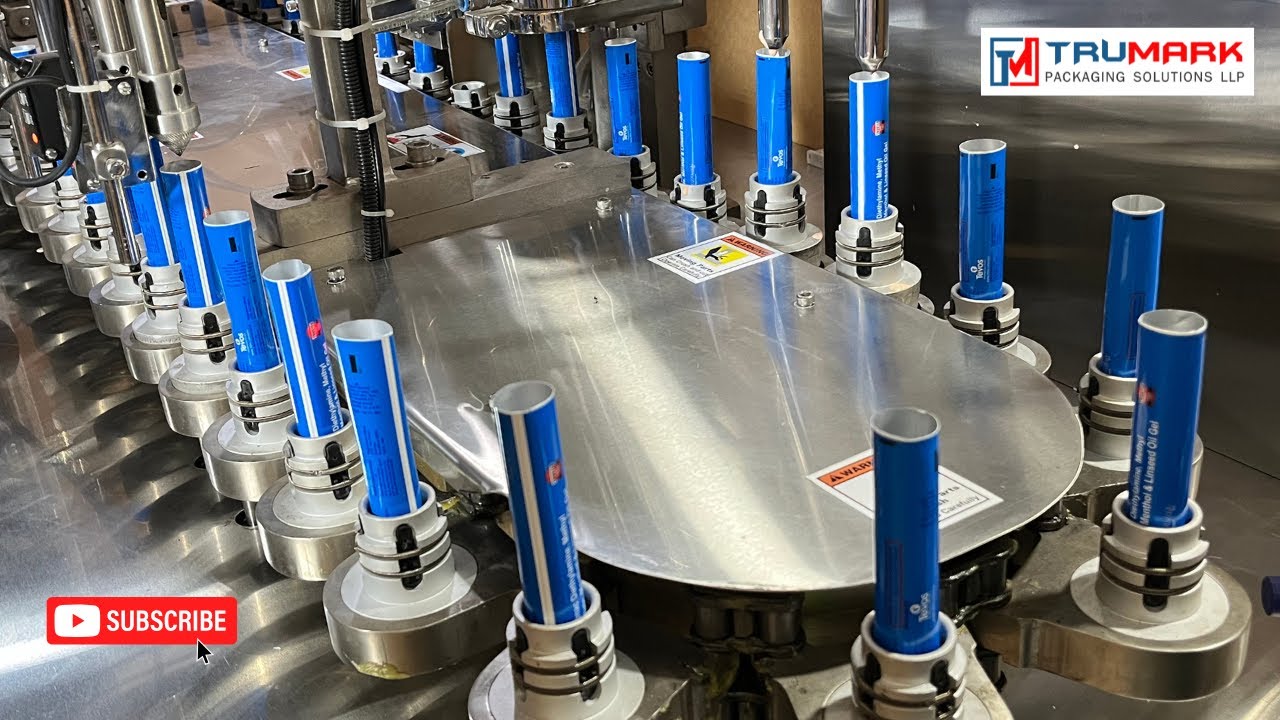 ▶ Watch: Automatic Tube Filling and Sealing Machine — High-Speed Production Line for Cosmetic and Pharmaceutical Packaging
Pay attention to the loading station flow, the seal formation consistency, and the rejection handling — these are the visible indicators of a line that’s been engineered for sustained production rather than demonstration performance.
Why Specialists Outperform Generalists in Tube Machinery
There’s a meaningful difference between a machinery supplier who makes packaging equipment and one who specializes in soft tube production for cosmetic and pharmaceutical markets.
A generalist supplier can provide a machine that fills and seals tubes. A specialist supplier understands that a toothpaste tube runs at different filling viscosity parameters than a vitamin E cream, that pharmaceutical tube production requires batch record documentation that cosmetic tube production does not, that a BIPV-grade laminate tube requires different sealing temperature profiles than a standard PE tube, and that a contract manufacturer running 14 different tube SKUs for 8 cosmetic brands needs quick changeover capability as a primary specification requirement — not an optional add-on.
This domain depth is reflected in specific engineering decisions:
- Filling systems designed for the viscosity range of real cosmetic and pharmaceutical formulations (50 cP to 500,000+ cP) rather than the idealized low-viscosity test fluids used in generic equipment demonstrations
- Seal jaw geometries validated against the specific laminate structures and tube wall thicknesses common in cosmetic and pharmaceutical tube packaging
- GMP-compatible machine surfaces — 316L stainless steel product-contact parts, IP65 enclosures on electrical components, cleanable cavities with no dead zones — rather than food-grade surfaces retrofitted to a pharmaceutical specification
For compliance-sensitive applications, machines designed to meet ISO 22716 GMP guidelines for cosmetics manufacturing y FDA 21 CFR Part 211 equipment requirements from the ground up — rather than adaptations of general-purpose equipment — reduce the qualification burden during regulatory audits and the risk of compliance findings that require costly machine modifications post-installation.
Client Results: What “Optimized Production” Looks Like in Practice
Numbers in a brochure are predictions. Results from operating production lines are evidence. Here is what clients report after optimizing their soft tube production with purpose-built, specification-matched machinery:
| Performance Metric | Before Optimization | After Optimization | Improvement |
|---|---|---|---|
| Effective throughput rate | 52 tubes/min (sustained) | 78 tubes/min (sustained) | +50% |
| Material waste rate | 3.2% | 1.4% | –56% |
| Seal defect rejection rate | 2.1% | 0.4% | –81% |
| Changeover time (per format switch) | 88 minutes | 27 minutes | –69% |
| Unplanned downtime | 11% of production time | 4.2% of production time | –62% |
| Energy cost per 1,000 tubes | $1.84 | $1.21 | –34% |
These improvements compound. A 50% throughput gain combined with an 81% reduction in defect rejection and a 62% reduction in unplanned downtime doesn’t produce a 193% performance improvement — it produces a production operation that looks fundamentally different from the one that entered the optimization process.
Your Next Step
If any of the pain points in this guide sound familiar — slow throughput, material waste, inconsistent quality, high downtime, or equipment that limits rather than enables growth — the right next step is a structured production audit.
Not a sales call. An audit: a systematic review of your current production line performance against the benchmarks in this guide, with specific identification of the gaps and the machine features or process changes that would close them.
Miyoda Packaging Machinery offers production consultations for manufacturers, distributors, and agents evaluating soft tube production equipment. The conversation starts with your numbers, not our brochure.
- 📧 Email: info@miyodamachine.com
- 💬 WhatsApp: +86 13774214471
- 🌐 Website: www.miyodamachine.com
For a deeper technical evaluation before that conversation, the soft tube production machine buyer’s guide for pharmaceutical and cosmetic manufacturers provides the complete specification framework — from fill system selection through compliance documentation requirements.
Preguntas frecuentes (FAQ)
1. How much can I realistically reduce my production waste after installing a modern soft tube machine?
Most clients see a 15–20% reduction in total material waste within the first three months of operating a closed-loop precision machine, according to data from cosmetic and pharmaceutical tube production facilities. The waste reduction comes from three sources: precise fill volume control (eliminating systematic over-fill), accurate trimming within ±0.1mm tolerance (eliminating over-cut laminate), and reduced tube rejection rates (fewer tubes scrapped for quality failures). The exact savings depend on current waste levels — clients with higher baseline waste rates typically see larger absolute savings. A production audit that measures your current waste rate against optimized-line benchmarks provides an accurate site-specific estimate before any investment decision.
2. Can your machines handle different tube materials like laminated aluminum, PE, and eco-friendly composites?
Yes — modern soft tube production platforms are engineered for multi-material flexibility. Polyethylene (PE) extruded tubes, aluminum-plastic laminate (ABL) tubes, plastic-plastic laminate (PBL) tubes, and emerging mono-material recyclable HDPE tubes all run on the same machine platform with tooling and recipe changes managed through the HMI system. The key specification to confirm with your supplier is the seal jaw temperature range — ABL tubes typically require higher sealing temperatures (160–180°C) than PE tubes (130–150°C), and the machine’s heating system must cover the full range for the materials you run. Bio-based and recycled-content materials may have different melt behavior and require process parameter adjustment — confirm this compatibility with sample production testing before committing to a full production run.
3. What is the average return on investment (ROI) for soft tube production machines?
Clients typically achieve full ROI within 18–24 months through combined savings in labor, materials, energy, and downtime reduction — with higher-volume operations (above 5 million tubes per month) often achieving full payback in 12–15 months. The ROI timeline is driven by the cost differential between current operations and optimized operations: a client with high current waste and downtime rates achieves faster payback than one whose current operations are already partially optimized. The most accurate way to calculate expected ROI for your specific operation is to run a TCO comparison using your actual current cost data — energy, labor, material waste, maintenance, and downtime loss — against the projected costs of the new configuration. Contact Miyoda’s technical team to request a structured ROI analysis for your production volume and tube format mix.
4. How long does installation and commissioning take?
Standard installation and commissioning for a single soft tube production machine typically takes 5–7 working days for an adequately prepared site: day 1–2 for mechanical installation and utilities connection, day 3 for electrical commissioning and control system startup, and day 4–7 for production trials, parameter optimization with your specific tube materials, and operator training. Sites that require civil preparation work (foundations, utilities upgrades, ventilation modifications) add 2–4 weeks of preparation before machine installation begins. Complex multi-machine line installations take longer — typically 10–15 working days. Your machine supplier should provide a detailed installation schedule and site preparation checklist well in advance of machine delivery, not on arrival day.
5. Do you offer remote diagnostics and technical support?
Yes — all modern production machines from qualified suppliers include IoT-enabled remote monitoring as a standard feature, not an optional add-on. This means the machine’s PLC and sensor network continuously logs operational data that can be accessed by the supplier’s engineering team via a secure encrypted connection when a fault event occurs. In practice, the majority of operational faults — parameter drift, sensor calibration issues, software configuration errors — can be diagnosed and resolved remotely within 1–4 hours of the fault report. Physical component failures that require on-site intervention are identified and diagnosed remotely, allowing the service engineer to arrive with the correct replacement part rather than diagnosing on arrival. For global operations and distributors serving clients across multiple time zones, this capability is the foundation of a viable service model.
6. Can the machine be integrated into an existing production line?
Yes, with a compatibility assessment conducted before purchase. The integration requirements are: physical compatibility (conveying height, transfer speed, tube format alignment with upstream extrusion or downstream filling equipment) and data compatibility (communication protocol compatibility with any existing SCADA or MES platforms you’re running). Machines with OPC-UA output — the industrial standard for machine-to-machine communication — connect to most current manufacturing data platforms without custom programming. For older existing equipment without network interfaces, physical signal handshaking (start/stop triggers, jam signals) provides basic operational integration without digital data sharing. Provide your existing line equipment specifications to your machine supplier at the evaluation stage — a qualified supplier will map the interface requirements and flag any incompatibilities before the purchase order is placed.
7. What kind of training do you provide for operators and maintenance staff?
Training programs for soft tube production machine operators and maintenance technicians should include two phases: factory training (conducted at the supplier’s facility before machine shipment, covering machine operation, HMI navigation, routine maintenance procedures, and fault diagnosis — typically 3–5 days) and on-site commissioning training (conducted at your facility during machine installation, using your materials, your product recipes, and your team — typically 2–4 days). The on-site phase is more valuable than factory training alone because it trains your team on real production conditions rather than demonstration conditions. Beyond initial training, leading suppliers provide digital training libraries — video guides, maintenance manuals, and troubleshooting decision trees accessible from the HMI or a dedicated online portal — and refresher training availability for new operators joining an established team.
8. Are your machines compliant with pharmaceutical and cosmetic industry standards?
Machines designed specifically for pharmaceutical and cosmetic tube production should meet: ISO 22716 (Good Manufacturing Practice for cosmetics — governing equipment design, cleanability, and process documentation), FDA 21 CFR Part 211 (US pharmaceutical GMP requirements for equipment), EU GMP Annex 15 (European pharmaceutical equipment qualification requirements), and CE marking (European machinery directive). Compliance is not a statement — it’s a documentation package. Request the machine’s declaration of conformity, material certificates for all product-contact surfaces (confirming compliant grades of stainless steel and elastomers), and an IQ/OQ protocol package. A supplier who responds to these requests with verbal assurance rather than documentation is not meeting the evidentiary standard required for pharmaceutical market access.
9. How do your machines reduce energy consumption compared to older models?
Modern soft tube production machines with servo-electric drives consume 30–40% less energy than equivalent machines using fixed-speed induction motors and conventional hydraulic systems, according to independent packaging machinery energy studies. The reduction comes from demand-responsive power delivery: servo motors draw current in proportion to the load they’re driving at each moment, rather than running at full power continuously. In a production cycle where 60–75% of the cycle time is in the cooling or dwell phase (low or zero power demand), this demand-responsive operation eliminates the wasted energy that conventional fixed-speed systems consume continuously. Intelligent heating zone management — PID controllers that modulate heating element output to maintain setpoint temperature rather than cycling full power on and off — contributes an additional 15–20% reduction in heating system energy. Combined, these improvements are meaningful enough to generate significant payback within the TCO framework over a 5-year operating period.
10. What is the production capacity range of your soft tube machines?
Soft tube production machine platforms from specialist manufacturers support output rates from 40 tubes per minute (suitable for small-batch or high-complexity specialty formats) through 180 tubes per minute (for high-volume cosmetic tube production with simple formats and minimal changeover). The actual sustainable throughput for your specific tube format depends on tube diameter, fill viscosity, seal method, and quality inspection requirements. As a practical reference: a standard 35mm diameter cosmetic cream tube with piston filling and hot-air sealing typically achieves 60–80 tubes per minute sustained on a single-head automatic machine; a 25mm pharmaceutical ointment tube with pressure decay leak testing typically achieves 45–65 tubes per minute. Multi-head configurations — two filling heads operating simultaneously on a single conveying system — can approximately double single-head throughput for formats where filling is the rate-limiting step.
11. Do you support customization for unique tube shapes or special closures?
Yes — custom tooling and application engineering support are available for non-standard tube formats including oval-cross-section tubes, flat-oval tubes, very large diameter tubes (above Φ60mm), and specialty closure formats (flip-top caps, airless dispensers, metered-dose closures). Custom tooling design and manufacture typically adds 4–8 weeks to the delivery timeline and is priced separately from the base machine. For specialty applications, request a feasibility review with the supplier’s application engineering team before confirming the specification — some specialty formats require machine platform modifications rather than tooling changes alone, which affects both timeline and cost.
12. What after-sales services do you provide?
A comprehensive after-sales service package for a soft tube production machine should include: a preventive maintenance plan (scheduled visits or remote-guided procedures at defined intervals to inspect and service critical components before failure), spare parts availability with committed lead times for both standard consumables and long-lead components, software and firmware updates (releasing performance improvements and bug fixes throughout the machine’s operating life), and dedicated technical support access with defined response time commitments. Lifetime technical support — access to the original engineering team’s knowledge about your specific machine configuration throughout its operating life — is a differentiator that matters significantly when you need machine troubleshooting support 8 years after installation and the person who knows the machine is still available.
13. Can distributors or agents get exclusive territory rights?
Territorial partnership arrangements — where a qualified distributor or agent holds exclusive or preferential rights to represent the machine supplier within a defined geographic territory — are available from suppliers whose business model is built around a partner channel. Qualified partnerships typically include: technical training (enabling the distributor to provide first-level technical support and conduct machine demonstrations independently), marketing support (product literature, digital assets, and co-marketing programs), sales support (pricing authority, lead registration, and co-selling with the manufacturer’s sales team), and defined performance expectations (minimum annual purchase volume or activity targets). Contact Miyoda Packaging Machinery directly at info@miyodamachine.com to discuss territorial partnership availability for your market.
14. How do your machines ensure consistent seal integrity across different batches?
Consistent seal integrity requires consistent control of three variables: seal jaw temperature, sealing pressure, and dwell time (the duration of seal jaw contact with the tube). Modern seal systems use: PID-controlled heating elements that hold jaw temperature within ±1°C of setpoint throughout the production shift, servo-driven jaw closure that delivers repeatable sealing pressure within ±2% cycle-to-cycle, and programmable dwell time that adjusts automatically when production speed changes. In combination, these controls ensure that every tube — whether it’s the first tube of a shift or the 50,000th — receives a seal formed under identical thermal and mechanical conditions. Batch-level seal quality verification is provided by inline pressure decay testing (100% tubes tested) and logged against the batch record for traceability.
15. Is there a trial or demo option before purchasing?
Yes — qualified suppliers offer live machine demonstrations at their manufacturing facility, where potential buyers can observe the machine running their specific tube formats and materials, review live performance data including throughput rate, fill accuracy, and rejection rate, and assess operator ergonomics and HMI usability firsthand. For clients who cannot travel, virtual demonstrations — live video tours of the machine running at the factory, with real-time data sharing of production parameters — provide meaningful evaluation capability without travel. Sample production runs, where a defined quantity of your actual tube materials is processed at the factory and the finished samples returned for quality evaluation, are available from suppliers with sufficient production flexibility. All of these options should be offered as standard qualification support, not charged separately — a supplier who charges for a pre-purchase demonstration is structuring the relationship incorrectly from the start.















