

Injection Moulding Machine Products: A Guide for Cosmetic and Pharmaceutical Tube Producers
1. Solving Your Production Challenges with Precision Injection Moulding
If you make soft tubes for creams, gels, ointments or toothpaste, you already know the tube body is only half the job. The shoulder, the neck, the orifice and the cap decide whether a tube seals properly, runs cleanly on a filling line and gets through a pharmacy audit.
Demand keeps rising. The global cosmetic tube packaging market was valued at about USD 4.2 billion in 2025, and Future Market Insights projects it to reach USD 8.4 billion by 2035. Pharmaceutical tubes add even more volume on top of that. Buyers also want tighter tolerances, faster delivery and more compliance paperwork than they did five years ago.
This guide skips the jargon. It explains what injection moulding machine products actually are, which type suits your output, and how to judge total cost. It also covers how to pick a supplier that keeps your line running long after installation day. We wrote it for tube manufacturers and for the distributors and agents who sell to them.

An automatic line forming soft tube shoulders. Most leak, capping and filling problems start at this station.
2. Injection Moulding Machine Products: Defined for Your Industry
Quick definition: In soft tube packaging, injection moulding machine products means the whole system used to make precise plastic tube parts. That system has four pieces: the machine, the mould, the automation around it, and the control software. The parts it makes are tube heads (shoulders, necks and nozzles), caps and closures.
A lot of buyers picture “an injection moulding machine” as a single box. On a working tube line it’s really four pieces that have to be matched to each other:
| System Element | What It Does | Why It Matters for Tubes |
|---|---|---|
| Machine (injection + clamping unit) | Melts the plastic and pushes it into the mould under pressure | Decides how repeatable each shot is, how much energy you use and how clean it runs |
| Mould (the steel tool) | Gives the part its exact shape | Controls orifice size, thread shape and how the shoulder looks |
| Automation (robots, conveyors, vision) | Moves, checks and transfers parts | Takes manual handling out of the process and cuts contamination risk |
| Controls (PLC, HMI, data logging) | Runs and records every cycle | Makes recipe changes, traceability and batch records possible |
A PLC (programmable logic controller) is the industrial computer that runs the machine. An HMI (human-machine interface) is the touchscreen your operator uses.
These machines are not general-purpose. A good tube-head system is built around small shot weights (often only a few grams), fast cycles and very tight dimensions. In soft tube production the shoulder is usually injected straight onto the open end of the tube sleeve. That creates the shoulder and the bond in one step. This is the job a tube heading and shoulder machine is built for.
Typical parts these systems make for your market include:
- Tamper-evident caps. These have a break-off band that shows the tube has been opened. Many OTC drug and premium skincare buyers expect them.
- Child-resistant closures. These are push-and-turn or squeeze-and-turn caps for medicated products that need to stay out of small hands.
- Luer-lock bases and nozzles. A Luer lock is a standard twist-lock connection used on medical devices. It lets a tube attach securely to an applicator or cannula in pharmaceutical and veterinary use.
- Flip-top, disc-top and long-nozzle shoulders. These are used for serums, eye creams, dental gels and ointments where the dose has to be precise.
Injection moulding lets you mould oval shoulders, embossed logos and built-in closures in a single cycle.
3. Why Injection Moulding Is Non-Negotiable for Soft Tube Packaging
Your finance team will ask why the tube head needs its own precision equipment. The answer comes down to three things: accuracy, material integrity and sealing.
Dimensional accuracy. Well-maintained injection tooling holds shoulder and orifice sizes to about ±0.05 mm. That matters because a filling-line mandrel is usually sized to within about 0.15 mm of the shoulder spec. If shoulder diameter drifts by 0.3 mm across a run, you get feed jams, off-centre seals and stoppages on a line you never touched. A mandrel is the metal holder that carries the tube through filling.
Material integrity. Injection moulding makes one solid shoulder with no glue line. When the shoulder is injected onto the sleeve, you remove the joint that causes a large share of leak complaints.
Hermetic sealing. A hermetic seal is airtight. It protects oxygen-sensitive ingredients like retinol and vitamin C, and it keeps microbes out of sterile ointments. Thread accuracy and a proper shoulder-to-sleeve bond are what keep that seal tight through the product’s shelf life.
How the alternatives compare
| Process | Good At | Weak Point for Tube Heads |
|---|---|---|
| Extrusion | Continuous tube bodies (sleeves) at high speed | Can’t form 3D shoulders, threads or closures |
| Blow moulding | Hollow bottles and containers | Poor control of wall thickness on small, detailed parts, and no fine threads |
| Compression heading | Low tooling cost for simple round shoulders | More flash (excess plastic) and more variation, and it’s harder to automate fully |
| Injection moulding | Complex, repeatable, precise heads and caps | Higher tooling cost up front |
In practice, most tube plants use both processes. Extrusion makes the body and injection makes the head. Miyoda’s comparison of injection and extrusion for tube making goes through the cost crossover in detail.
The ROI story your stakeholders want
Here’s what to show them. When producers move from semi-automatic compression heading to automatic injection shoulder moulding, shoulder scrap often falls from around 6–8% to under 2%. Hot runner moulds (moulds that keep plastic molten in the feed channels, so no solid runner scrap is made) take waste down further.
For pharmaceutical buyers, consistent and documented dimensions help with 21 CFR Part 211 Subpart G packaging and labeling controls, which includes the US rule on tamper-evident packaging. It also helps customers who run ISO 13485 quality management systems for medical devices.
Industry insight: Many “filling problems” are really heading problems. When a filling line keeps stopping for tube loading faults, check shoulder diameter data first. Fixing the heading station often fixes the filler without spending anything on filling equipment.
4. Core Machine Types—Explained for Your Production Needs
Picking the wrong drive type is one of the most common reasons for rework and poor energy numbers. Here’s a plain comparison.
| Machine Type | How It Works | Strengths | Best Fit |
|---|---|---|---|
| Hydraulic | Oil pressure drives clamping and injection | High clamping force, sturdy, lower purchase price | Large moulds, heavy tube bases, long runs of one SKU |
| All-electric | Servo motors drive every movement | Very repeatable, 40–60% less energy than fixed-pump hydraulics, no oil | Pharma closures, cleanrooms, premium cosmetic heads |
| Hybrid (servo-hydraulic) | A servo pump runs hydraulics only when needed | Balances power and precision, 30–45% energy savings | Mid-volume cosmetic tube plants |
| Multi-cavity and stack moulds | More parts per cycle, or two mould faces stacked | More output with the same floor space | Scaling up without a new building |
Clamping force (measured in tonnes) is what holds the mould shut during injection. If it’s too low, plastic escapes at the seam and forms flash.
Hydraulic machines
These are built for force and durability. If you run large multi-cavity cap moulds or thick tube bases for long single-SKU campaigns, a hydraulic press gives you the most clamping force for the money. The downside is that a fixed-speed pump draws power even while the part is cooling, and cooling is 60–80% of every cycle.
All-electric machines
Servo drives repeat shot weight to within about ±0.05 g. Older hydraulic presses often vary by 0.3–0.5 g. Removing hydraulic oil from the machine also removes a contamination risk, and cleanroom validation teams notice that right away. This is the default choice for pharmaceutical-grade closures.
Hybrid machines
Hybrids suit cosmetic producers running 2–8 million heads a year across a changing mix of SKUs. You get servo-level efficiency during the cycle while keeping hydraulic power for bigger tools.
Multi-cavity and stack moulds
A 4-cavity shoulder mould at 8 seconds per cycle makes about 1,800 parts an hour. Moving to 8 cavities on a suitable press roughly doubles that without taking another square metre of floor. Keep in mind that each cavity needs balanced filling, or one cavity will keep producing short shots.
Mould cavities are machined to about ±0.01–0.02 mm. The mould sets the ceiling on part quality before the machine does.
For a step-by-step sizing method, see this guide on matching a shoulder machine to your real output.
Sizing rule of thumb: Aim for a machine that runs at 65–80% of rated capacity at today’s volume. That leaves room for the next contract without pushing the machine at full stress every shift.
5. How Global Businesses Use These Systems to Win Markets
The scenarios below are illustrative. They’re drawn from common project patterns and show how different regions are making their equipment choices.
European cosmetic brands and their tube suppliers. EU buyers increasingly ask suppliers for energy use per 1,000 units as part of their ESG audits. Suppliers running all-electric heading machines can pull that number straight from the machine. Mono-material HDPE and bio-based PE are also spreading under the EU Packaging and Packaging Waste Regulation. Those resins need tight barrel temperature control, ideally within ±2°C per zone.
Emerging markets in Southeast Asia and the Middle East. Producers here often grow in stages. They start with one hybrid machine and a 4-cavity mould, then add cavities or a second press as private-label and pharma contracts arrive. Hybrids keep upfront cost reasonable while still meeting the dimensional specs that multinational brand owners send.
Distributors and agents. Machines that handle 16–60 mm tube diameters with quick mould changes are easier to sell across a varied region. The same model can serve a toothpaste maker, a dermatology lab and a hotel amenity producer. That means fewer SKUs to stock and train on.
Industry insight: Direct-to-consumer beauty brands order more SKUs in smaller batches. A plant that can change moulds in 25 minutes can take a 30,000-unit order profitably. A plant that needs 3 hours per change has to turn that order down.
6. Integration with Tube Assembly Lines: The Full Value Chain
A fast heading machine that can’t talk to the rest of the line just moves the bottleneck somewhere else. The chain typically runs like this:
- Tube body. Sleeves are made on a cosmetic tube extrusion machine or on a laminate welding line.
- Head forming. The shoulder and neck are injection moulded onto the sleeve.
- Decoration. This covers offset printing, screen printing, hot stamping and labeling, often done on multi-decoration tube finishing equipment.
- Capping. An automatic tube capping machine puts on caps with controlled torque.
- Filling and sealing. This is done at the customer’s plant or in-house on a tube filling and closing machine.
What “automation-ready” really means
Ask for these specific features:
- Robotic pick-and-place. A robot arm unloads parts and moves them onward. It usually replaces 1–2 operators per shift and keeps hands off pharmaceutical parts.
- Vision inspection. Cameras check orifice size, flash and short shots at full line speed and reject bad parts automatically.
- Standard data interfaces. EUROMAP 77 is the OPC UA standard for sending data from an injection machine to an MES (the software that tracks production in real time). If a machine supports it, it can join your plant’s data system without custom code.
- Matched conveyor heights. Typical working heights are 900–950 mm. It sounds minor, but conveyor height mismatches are the most common integration problem found during installation.
Changeover: where flexibility pays off
Quick mould change systems combined with HMI recipe recall cut changeovers from 2–3 hours to under 30 minutes. At a loaded machine rate of USD 120 an hour, saving 2.5 hours on each change is worth about USD 300 per changeover. A plant doing eight changes a week gets back roughly USD 120,000 of machine time a year.
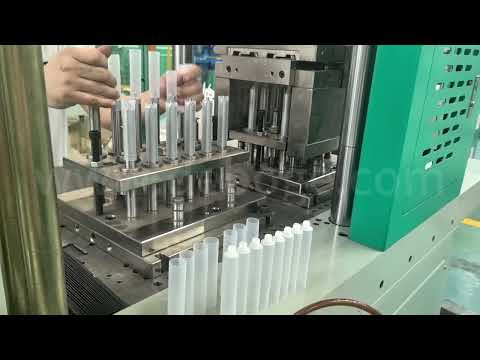
Video: Injection moulding of a cosmetic tube head and shoulder. Watch the mould opening speed and how cleanly parts eject. Those two details tell you whether a machine will hold up over a long run.
7. Compliance & Certification: Your Path to Market Access
A batch rejected at a pharma customer’s incoming inspection costs a lot more than the parts. It can cost you the account. The right machine lowers that risk in three ways.
Hygienic design. Look for stainless steel or hard-coated panels (painted surfaces chip), sealed lubrication points kept away from the product zone, and smooth surfaces that are easy to wipe down. Pharmaceutical component moulding usually happens in rooms classified under ISO 14644-1 cleanroom standards, typically ISO Class 7 or 8.
Full traceability. The machine should log mould ID, recipe, injection pressure range, cycle count and operator for every batch. For US drug customers, electronic records should meet 21 CFR Part 11 rules on data integrity and audit trails.
Validation support. Pharma buyers qualify equipment in three stages:
| Stage | Full Name | What It Proves |
|---|---|---|
| IQ | Installation Qualification | The machine was installed to its design specs |
| OQ | Operational Qualification | It performs within spec across its full operating range |
| PQ | Performance Qualification | It makes compliant parts across three consecutive production batches |
A supplier that provides IQ/OQ/PQ templates can cut weeks off your validation schedule. Cosmetic producers get a similar benefit: many large retailers now require ISO 22716 cosmetic GMP certification from their packaging suppliers.
Dimensional checks, seal strength tests and batch record review in a GMP lab. Good machine data makes this step quicker.
8. Cost of Ownership: Beyond the Initial Price Tag
Total cost of ownership (TCO) is everything a machine costs you over its working life: the purchase price plus energy, maintenance, downtime, scrap and labor.
A cheaper machine that uses 35% more power and scraps 5% more parts will cost you more within a few years. Here’s a simplified example for a producer making 8 million shoulders a year:
| Cost Driver | Older Semi-Auto / Hydraulic Setup | Modern Servo Injection Shoulder Machine | Typical Annual Difference |
|---|---|---|---|
| Resin waste (runners, flash, setup) | ~4.5% of material | <1.5% of material | ~USD 18,000 |
| Scrap rate | 6–8% | 1.5–2% | USD 22,000–32,000 |
| Operators at heading station | 3–4 per shift | 1–2 per shift | USD 36,000–54,000 |
| Energy | Baseline | Up to 40% lower or more | USD 7,000–12,000 |
Figures are indicative. Your numbers will depend on local wages, resin prices and electricity tariffs.
The energy math, simplified
A fixed-pump hydraulic machine averaging 22 kW, compared with a servo-electric one averaging 10 kW, over 4,000 hours a year at USD 0.12/kWh, saves about USD 5,760 a year. Over five years that’s roughly USD 28,800. That’s often enough to cover the price premium of the electric machine by itself.
Downtime is the hidden killer
For a mid-sized tube plant, an hour of unplanned downtime often costs USD 8,000–15,000 once you count lost output and knock-on effects downstream. Design details make a real difference here. An ejector pin you can reach in 15 minutes versus one buried behind hydraulic lines can be the gap between a short pause and a lost shift. So can a spare part that ships from regional stock rather than from overseas.
For a worked example of payback periods, see how an automatic shoulder injection upgrade streamlines tube production.
9. Choosing the Right Partner: Machines Are Only Part of the Solution
A common story goes like this. The machine looks great at the factory acceptance test, the commissioning engineer flies home, and six weeks later a thermocouple fails and nobody answers for three days. For a continuous tube line, that’s a supply crisis.
Before you sign, get these commitments in writing:
- Response time. A live remote session within 24 hours of a critical stoppage. “Next business day” isn’t good enough.
- Spare parts. Written lead times for the top five wear parts (nozzle tip, screw tip/check ring, heater bands, ejector pins, thermocouples), plus a starter kit covering 12–18 months.
- Training. Operator and maintenance training carried out on your site, with your resin and your moulds, not only at the supplier’s factory.
- Process help. An engineer who can tune cooling times and cavity balance, not just someone who fixes breakdowns.
This is how Miyoda Packaging Machinery works with tube producers. Before any order, customers send drawings or sample tubes, and Miyoda runs trial production with sample validation in about 7–15 days. After delivery, the team handles installation and training at home and overseas. Every machine comes with a 12-month warranty, remote support and a spare-parts guarantee. You can read more about the team behind Miyoda’s tube production lines.
A shoulder injection machine set up for cosmetic tube production. Service access and mould change ergonomics are designed in, not added later.
For distributors and agents
Beyond price, a good manufacturing partner should give you:
- Margin room. Clear pricing tiers so you can quote competitively and still profit.
- Marketing support. Sample tubes, videos, spec sheets and case data you can show your customers.
- Technical support. Training for your service engineers, so the first call from a customer is answered in their own time zone.
- A full product range. Offering heading machines alongside a laminate tube production line and extrusion lines lets you quote a whole plant, not one machine.
10. Next Steps: How to Select the Right System for Your Output Goals
Too many options can stall a decision. Work through these four questions in order.
Step 1: Volume
| Annual Volume | Suggested Setup |
|---|---|
| Under 500,000 | Semi-automatic machine, 1–2 cavities |
| 500,000–2 million | Fully automatic hybrid or electric machine, 4 cavities |
| 2–8 million | Fully automatic with robot handling and vision inspection |
| Over 8 million | Multiple machines or a fully integrated line |
Step 2: Material
- PE (LDPE/HDPE): The most common shoulder material. It’s flexible and chemically inert.
- PP: Handles more heat and suits some aggressive formulas.
- COPE and other specialty or medical-grade resins: Check melt temperature range and screw design with your supplier before you order.
Step 3: Regulatory needs
For cosmetics-only production, check ISO 22716 readiness. For pharma or medical, you’ll need cleanroom-compatible design, IQ/OQ/PQ support and electronic batch records.
Step 4: Automation level
Decide now whether you want robots, vision systems and MES connection from day one or later. Even if you add them later, buy a machine with the interfaces already built in.
Our offer: Send Miyoda your tube drawings, target output and resin type. The engineering team will do a machine suitability review, run samples on your specs and invite you to a factory acceptance test or live demo before you commit. Contact Miyoda’s tube machinery team to start.
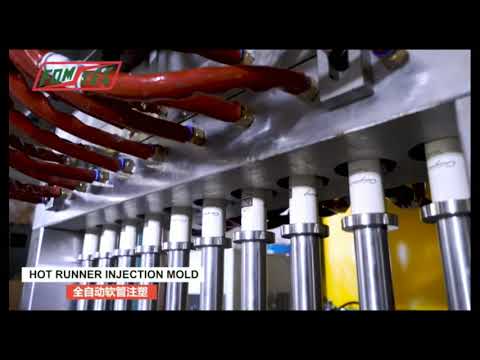
Video: Neck and shoulder forming on a vertical tube injection machine.
Glossary of Key Terms
| Term | Plain-English Meaning | Example |
|---|---|---|
| Tube shoulder / head | The cone-shaped top of the tube, including the neck and orifice | The threaded end your cap screws onto |
| Clamping force | The force that holds the mould shut during injection | A 4-cavity shoulder mould might need 60–120 tonnes |
| Flash | Thin excess plastic at the mould seam | A sharp fin on the nozzle tip that fails a visual check |
| Hot runner | A heated channel that keeps plastic molten between shots | Cuts about 1 g of scrap per shot on a 4-cavity tool |
| Cycle time | Time to make one shot | 8 seconds per shot with 4 cavities is about 1,800 parts per hour |
| OEE | Availability × Performance × Quality | 90% × 95% × 97% = 83% OEE |
| Cpk | How consistently a process stays within spec | Pharma buyers usually want Cpk ≥ 1.33 |
| IQ/OQ/PQ | The three-step equipment validation used in pharma | Needed before commercial pharma batches |
| Quick mould change (QMC) | A clamp system that lets you swap moulds in minutes | Moves from 3-hour changes to under 30 minutes |
| MES | Software that tracks production in real time | Shows live OEE and batch data on the plant manager’s dashboard |
Frequently Asked Questions
1. What type of injection moulding machine is best for producing cosmetic tube heads?
For premium cosmetic shoulders and closures, all-electric machines are usually the best choice. They repeat shot weight very tightly, run clean without hydraulic oil and use the least energy. Hybrids are a good value option for mid-volume plants with a mixed product range.
2. Can one machine produce both tube caps and bases?
Yes, if the machine has the right clamping force range, shot size and mould interface. You change the mould and recall the right recipe. Plants with high volumes still tend to keep dedicated machines for caps and for shoulders so both run at full speed. Miyoda can help you choose between a multi-purpose and a dedicated setup based on your SKU mix.
3. How do I ensure my machine meets FDA or EU medical device standards?
Choose hygienic machine construction, full batch data logging, and a supplier that provides IQ/OQ/PQ templates plus material certificates for any parts that touch the product. The machine supports compliance, but your quality system (ISO 13485 or GMP) is what makes you compliant.
4. What is the typical cycle time for producing a tube closure?
Most tube closures and shoulders run at about 5–15 seconds per shot. The exact time depends on wall thickness, cooling channel design and machine type. Plan your capacity on sustained speed, which is usually 65–80% of the maximum on the nameplate.
5. Can the machine integrate with my existing tube filling line?
Usually yes. Check conveyor heights, digital I/O signals and data protocols (OPC UA/EUROMAP 77) at the specification stage. Problems found during installation cost far more to fix.
6. How much floor space do I need for a tube component injection line?
A compact all-electric machine can fit in about 4 m × 2 m. Add room for mould storage, a temperature controller and robot or conveyor access. Miyoda provides layout planning with every quote.
7. What materials can these machines process for soft tubes?
LDPE, HDPE, PP, COPE and medical-grade resins are all common. Recycled and bio-based PE also work well if barrel temperature control is tight (about ±2°C per zone) and the purge procedure is well planned.
8. Do you offer automation for demoulding and inspection?
Yes. Robot arms, conveyors and vision inspection systems are available as add-ons and can be integrated into the machine’s control system.
9. What maintenance is required to keep the machine running optimally?
Daily checks take 15–20 minutes (mould surfaces, nozzle, cooling water). Add weekly lubrication, monthly temperature calibration and quarterly screw, barrel and cooling channel checks. Preventive maintenance plans keep this on schedule.
10. How long does installation and training take?
On-site installation and training for a single machine usually takes a few days, covering both operators and maintenance staff. Full pharma validation (IQ/OQ/PQ) takes longer and depends on your quality team’s schedule.
11. Can I switch between different tube designs quickly?
Yes. With quick mould change systems and stored recipes, changeovers can take under 30 minutes. Without them, expect 2–4 hours.
12. Do you support global spare parts delivery?
Yes. Miyoda offers a spare-parts guarantee and remote support for customers worldwide. Ask for written lead times on critical wear parts and a starter kit in your purchase agreement.
13. What is the lifespan of an injection moulding machine in tube production?
A well-maintained industrial machine typically runs 10–15 years in 24/7 tube production. Screw tips, ejector pins and seals get replaced on a schedule along the way.
14. Are your machines suitable for small-batch, high-mix production?
Yes. Programmable recipes, quick-change moulds and modular tooling let you run short batches profitably. This is the key requirement for contract manufacturers serving direct-to-consumer brands.
15. How do I calculate ROI when upgrading from hydraulic to electric?
Add up the yearly savings from energy, scrap and labor, then divide the price difference by that total. That gives you the payback period in years. Many mid-volume producers see payback in 12–24 months. Miyoda can run a TCO analysis using your real data.
This guide is meant to help you build a faster, cleaner and more profitable tube operation, whether you’re scaling up output or adding tube machinery to your distribution range. The right injection moulding setup supports everything else on the line. Send us your tube specs and we can start with the problem that’s costing you the most today.














