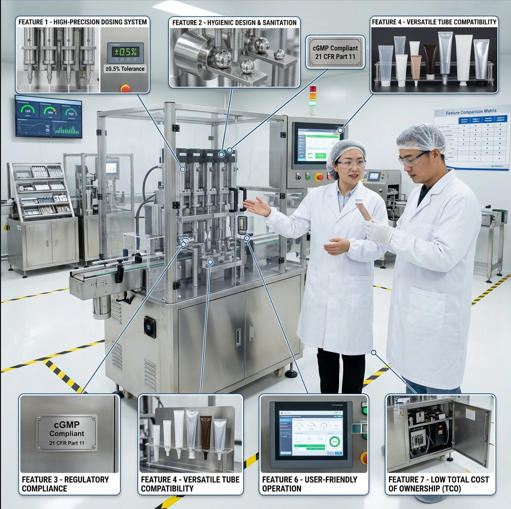
The global tube filling machine market is on track to grow from USD 2.1 billion in 2025 to USD 3.1 billion by 2035 (Future Market Insights, 2025). Yet most of that capital is still being misallocated — buyers comparing headline speeds and sticker prices while ignoring the handful of features that actually determine whether a machine pays back within three years or spends those same years generating rework, compliance headaches, and unplanned stops.
If you are sourcing tube filling equipment for a cosmetic brand, a pharmaceutical manufacturer, or as a distributor representing production plants across multiple territories, this guide cuts through the noise. Each of the seven features below is grounded in real production data, regulatory requirements, and the kind of field experience that only shows up after a machine has run a full year in a live environment.
A tube filling machine does far more than push product into a tube. It is the intersection of your formulation chemistry, your regulatory obligations, your brand presentation, and your factory’s economics. Getting the feature set right at purchase is exponentially cheaper than retrofitting it later.
The 7 Features at a Glance
Before diving into each feature in depth, here is the complete framework. Each feature maps directly to one of four business outcomes: quality, compliance, efficiency, ou total cost of ownership (TCO).
1. Precision & Accuracy in Filling
±0.5% fill tolerance via servo-driven piston systems. Protects brand compliance and reduces formulation giveaway.
2. Versatile Fill Volume Range
From 2 mL eye serums to 300 mL body butters on a single machine — with sub-30-minute changeover between formats.
3. Hygienic Design & Cleanability
CIP/SIP-ready, 316L stainless steel contact surfaces, Ra ≤ 0.8 µm finish, and validated cleaning cycles.
4. Compatibility with Tubes & Materials
Handles aluminum, ABL, PBL, and PE tubes from Ø13–50 mm, across viscosities up to 300,000 cP with heated systems.
5. Gentle Product Handling
Non-shear piston and peristaltic fill systems that protect sensitive emulsions, biologics, and active ingredients.
6. Changeover Speed & Downtime Minimization
Quick-release tooling, guided HMI changeover, and recipe memory for fast, operator-independent format changes.
7. Process Monitoring & Data Logging
Real-time flow, fill weight, and seal temperature tracking with 21 CFR Part 11–compliant audit trails.

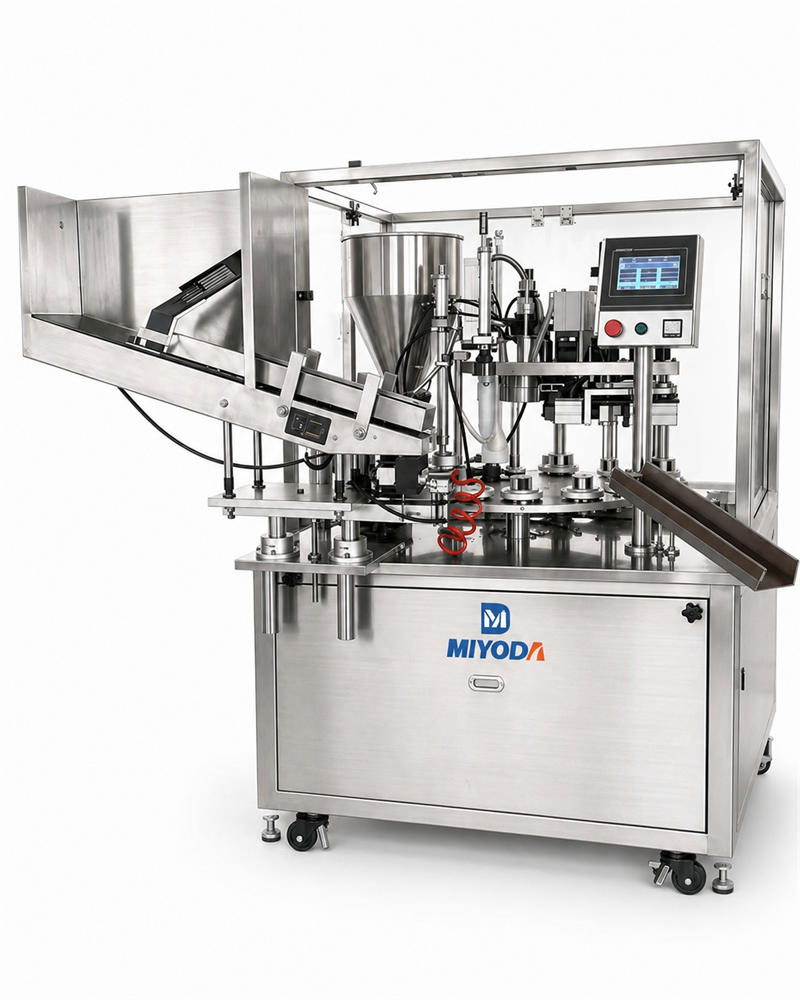
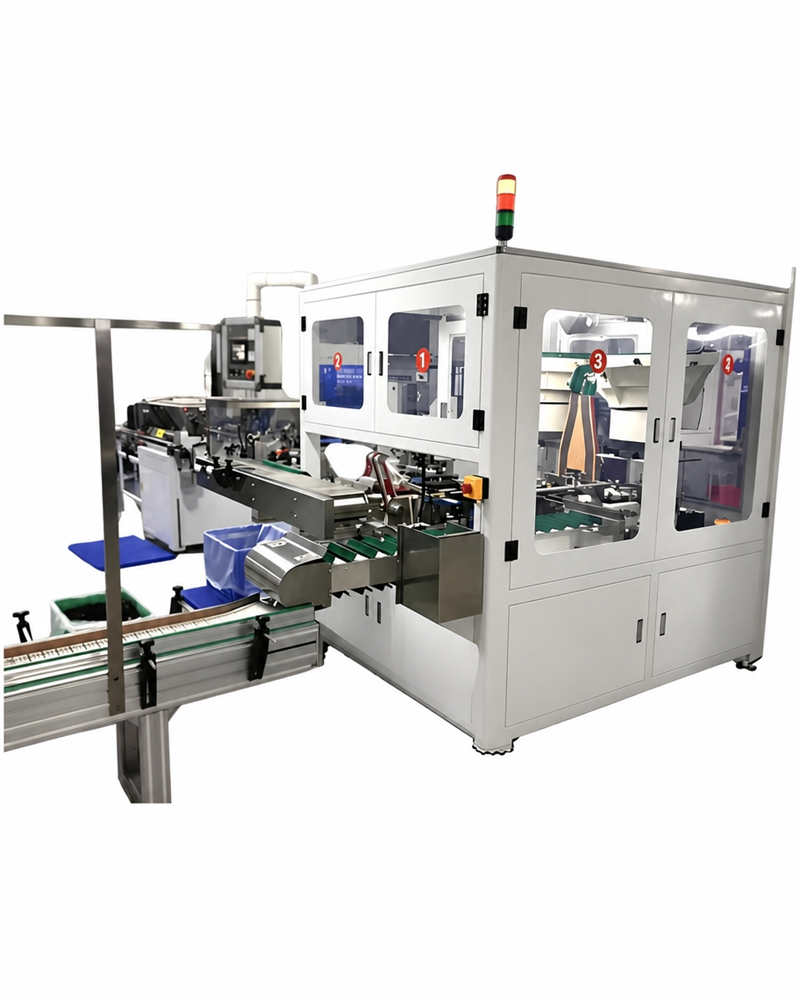
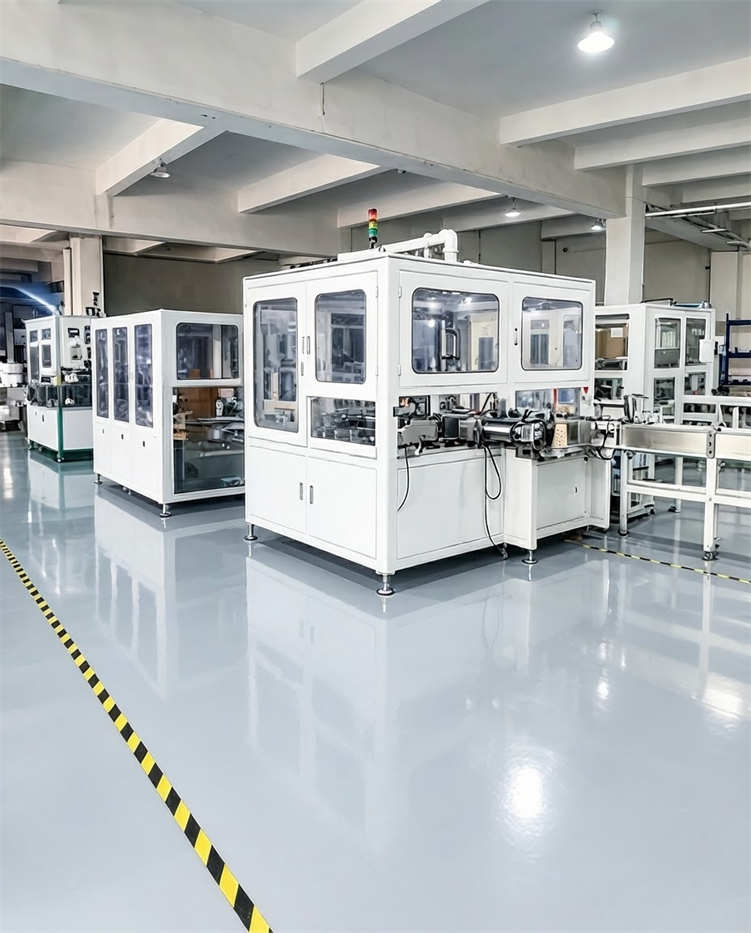
Fig. 1 — A high-speed automatic tube filling and sealing line handling cosmetic creams and pharmaceutical ointments. Feature selection at procurement determines whether this machine delivers ROI within 24 months or generates 18 months of troubleshooting.
Feature 1: Precision and Accuracy in Filling
Why Precise Dosing Matters for Product Quality and Brand Consistency
Fill weight accuracy is simultaneously a legal obligation and a commercial lever. Under EU Directive 76/211/EEC on pre-packaged goods, individual containers must not fall below a defined minimum short-fill tolerance — and the average fill across a batch must meet or exceed the declared quantity. In practical terms, a line producing 10 million units per year at ±2.0% deviation on a 150 mL declared fill is generating approximately 75,000 units that require rework or destruction per year.
That same line upgraded to ±0.5% accuracy (achievable with a servo piston filler) recovers roughly 56,000 units annually — which at a conservative USD 2.50/unit formulation cost represents USD 140,000 in annual giveaway savings. The servo premium typically pays back within 18–24 months on volumes above 3 million units per year.
For pharmaceutical-grade tube products — OTC drug-cosmetic hybrids like medicated ointments, fluoride toothpaste, and SPF-rated sunscreens — fill accuracy directly affects dose consistency, which regulators treat as a patient safety parameter, not merely a labeling issue.
Methods to Verify Accuracy: Calibration, Testing, and Validation
Vendor-quoted accuracy figures are measured under ideal conditions with water or a low-viscosity reference fluid. Your actual production accuracy depends on your formulation’s viscosity at fill temperature, your tube substrate, and whether the machine maintains calibration under production shift conditions. Here is the verification framework that separates suppliers who can back their claims from those who cannot:
- Factory Acceptance Test (FAT) with your product: Require a minimum 30-minute continuous run at target speed using your actual formulation at production temperature. Collect a 30-tube sample from each fill head simultaneously. Calculate Cpk — accept nothing below 1.33 at FAT.
- Daily tare weight check: At shift start, weigh a reference container on a calibrated balance (NIST-traceable, ±0.01 g resolution). Log the result. A 10-tube sample from each active head provides a rapid Cpk snapshot.
- Inline checkweigher: For GMP lines, a 100% inline checkweigher (reject gate for out-of-tolerance units) replaces statistical sampling with 100% unit inspection and generates electronic batch records. Capital cost: USD 18,000–45,000 per lane — offset by elimination of manual QC labor.
- Quarterly calibration against reference weights: All load cells and dosing sensors calibrated against NIST-traceable reference standards. Records retained in equipment logbook for GMP audit review.
Feature 2: Versatile Fill Volume Range
Accommodating Small Sample Sizes to Large-Volume Tubes
A cosmetic brand managing 20+ active SKUs — from a 3 mL travel-size serum to a 300 mL professional body butter — cannot afford a machine optimized for a single tube diameter and fill volume. Yet most tube fillers sold at the entry-mid price point cover only a 2:1 fill volume ratio at full accuracy. The machine that fills a 50 mL moisturizer at ±0.5% accuracy may deliver only ±2.5% accuracy on a 10 mL under-eye cream because the piston is operating at 6% of its rated stroke volume.
High-quality tube filling equipment — including machines in the Miyoda Packaging Machinery tube filling and closing range — is designed to cover fill volumes from 2 mL to 400 mL across a single platform with electronic recipe recall, without requiring manual piston replacements for each volume change. This means your operators set a recipe number on the HMI, and the machine servo-positions the piston stroke accordingly — with no mechanical tools required.
Ease of Adjustability to Reduce Changeover Time
Em um multi-SKU production environment, changeover time is often more important than peak speed. Consider: a machine running at 150 tubes/minute with a 3-hour format change loses 27,000 tube-equivalents of capacity per changeover. A machine running 90 tubes/minute with a 20-minute changeover loses only 1,800. On a line with six daily format changes, the slower machine with fast changeover produces 148,800 more tubes per day.
The features that enable rapid, repeatable changeovers are: color-coded quick-release mandrel sets (no tools), digital stroke readout that confirms piston position before restart, electronic format recall with parameter lock, and standardized nozzle bayonet connections that swap in under 90 seconds. Require the vendor to demonstrate changeover between your two most dissimilar tube formats during FAT — not a single-format demonstration rig.
Fill Volume & Speed Matrix: Machine Class Comparison
| Machine Class | Intervalo de volume de enchimento | Speed (tubes/min) | Volume Accuracy | Changeover Time | Best Application | Indicative CapEx (USD) |
|---|---|---|---|---|---|---|
| Semiautomático | 5–200 mL | 20–40 | ±1.0–2.0% | 45–90 min (manual) | Startups, R&D, <50K units/day | $8,000–$25,000 |
| Automatic Mid-Speed | 2–300 mL | 60–80 | ±0.5–1.0% | 20–35 min (quick-release) | Mid-size brands, 3–8 SKUs | $40,000–$90,000 |
| Automatic High-Speed | 5–300 mL | 100–200+ | ±0.5% | <20 min (servo recipe) | Mass market, single-SKU runs | $120,000–$280,000 |
| Rotary Multi-Head | 10–500 mL | 200–400+ | ±0.5% | 60–120 min (complex) | OEM, >30M units/year | $250,000–$600,000+ |
Sources: Compiled from supplier datasheets, Future Market Insights (2025), hijmachinery.com field data, and Miyoda Packaging Machinery technical specifications.
Feature 3: Hygienic Design and Cleanability
CIP/SIP Readiness and Sanitary Standards
CIP (Clean-in-Place) capability has transitioned from a premium option to a baseline expectation for any filling machine destined for GMP cosmetic or pharmaceutical use. Here is the reason in concrete terms: a fragrance-intensive hand cream residue left in a nozzle bore between SKU changes can contaminate the next fill of a fragrance-free hypoallergenic moisturizer. The result is a consumer sensitization incident, a regulatory complaint, and a potential recall — all from an inadequately cleaned machine.
A properly specified CIP system for a 4–6 head piston filler should complete a full product-change clean in 25–40 minutes and consume fewer than 80 liters of total rinse water per cycle. The cleaning sequence — caustic wash (0.5–2% NaOH), water rinse, acid sanitize (0.5% nitric), final water purge — must be validated against your formulation chemistry, with residue levels verified below 10 ppm by swab or rinse-water analysis.
For pharmaceutical tube filling applications, SIP (Sterilize-in-Place) capability adds a steam sterilization circuit — mandatory for sterile drug products, increasingly demanded for preservative-free “waterless” cosmetics launching in the EU under the updated Cosmetics Regulation framework.
Materials, Seals, and Surface Finishes That Resist Contamination
All product-contact components — piston bore, nozzle assembly, hopper interior, valves, and product transfer piping — must be Aço inoxidável 316L. The “L” (low carbon) designation ensures weld-zone corrosion resistance that standard 316 cannot guarantee. Surface finish must be Ra ≤ 0.8 µm to minimize bacterial adhesion; pharmaceutical-grade lines specify Ra ≤ 0.4 µm.
Elastomer seals — O-rings, piston seals, valve seats — must be selected against your formulation chemistry before machine delivery. EPDM handles most neutral-pH emulsions; PTFE or FFKM (Kalrez) is required for AHA/BHA acids at pH 3.0–4.5; FKM (Viton) protects against essential oil and fragrance degradation. A machine supplied with generic NBR seals will require seal replacement within 200 operating hours on a retinol or vitamin C serum — which is exactly the kind of procurement detail that only surfaces after installation if you do not ask explicitly.
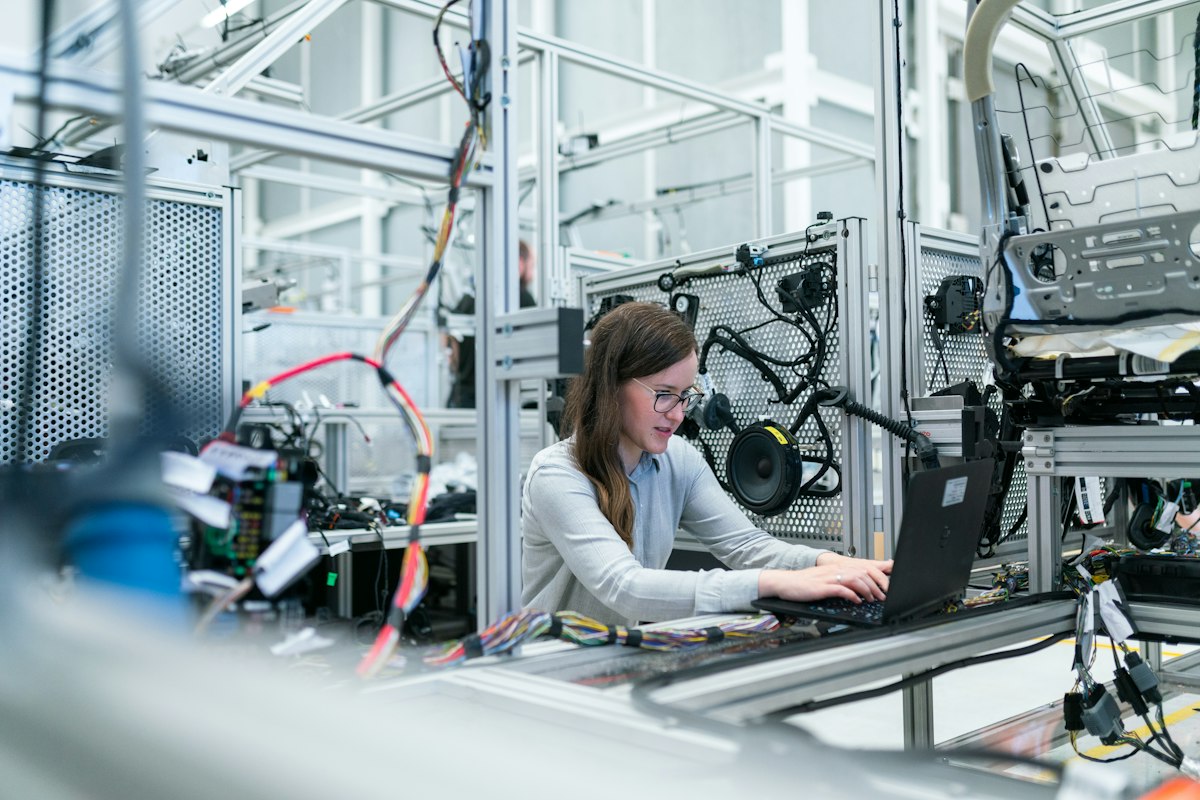
Fig. 2 — A GMP audit in progress: inspecting 316L stainless steel nozzle assemblies and elastomer seals for surface finish compliance. Every product-contact component must be documented and traceable.
Feature 4: Compatibility with Various Tubes and Materials
Support for Different Tube Diameters and Wall Thicknesses
A cosmetic or pharmaceutical manufacturer rarely runs a single tube format for the lifetime of a machine. Your current primary SKU may use a 35 mm diameter ABL tube, but your next product launch may require a 19 mm diameter PE tube for a premium eye treatment. A machine limited to a single mandrel set without quick-change capability either requires expensive retooling for each new format or, worse, locks your product development pipeline to one tube diameter indefinitely.
Best-in-class tube filling equipment supports tube diameters from Ø13 mm to Ø50 mm with swappable mandrel kits — typical changeover between diameter sets: 15–25 minutes. Wall thickness tolerance should accommodate ±15 µm laminate gauge variation between tube supplier production runs. This tolerance management is non-negotiable: a 20-µm gauge shift from your tube supplier can move the thermal transfer curve enough to cause sealing failures if the machine’s jaw temperature parameters are not compensated.
Material Compatibility with Viscous and Reactive Products
The tube material determines the sealing mechanism. ABL (Laminado de Alumínio com Barreira) tubes require heated jaw sealing at 160–220°C. PBL (Laminado com Barreira Plástica) tubes seal at slightly lower temperatures. Aluminum tubes seal mechanically via fold-and-crimp die. PE co-extruded tubes seal by heat alone. A machine designed for one substrate will underperform on another — verify that the machine you are purchasing is engineered for your primary tube substrate, with the secondary substrate supported as a changeover option.
For reactive products — strongly acidic serums (pH 3.0–4.5), high-ethanol sanitizer gels (>70% IPA), or abrasive mineral sunscreens with TiO₂ or ZnO particles — require the vendor to submit a formal material-compatibility report covering all product-contact components before machine acceptance.
Feature 5: Gentle Product Handling to Prevent Aseptic Damage
Non-Shear Pumping, Controlled Acceleration, and Discharge
Not all formulations tolerate mechanical aggression. A niacinamide-vitamin C serum filled through a high-shear centrifugal pump at 3,500 RPM can experience emulsion phase separation, visible as small oil droplets or a translucent haze appearing within 48 hours post-fill. A monoclonal antibody topical cream (increasingly common in dermatological Rx lines) can undergo protein aggregation if exposed to excessive shear during the fill stroke — generating immunogenic particles that create patient safety risk.
The solution is peristaltic pumping for low-to-medium viscosity sensitive formulations, or slow-stroke servo piston filling for higher-viscosity creams — with electronic deceleration programmed as the piston nears end-of-stroke to prevent product “hammering” into the nozzle. Syntegon’s published research on low-volume aseptic filling confirms that peristaltic systems achieve significantly lower protein degradation versus gear pump and piston alternatives in biologics filling applications.
Designs That Protect Sensitive Formulations
Several mechanical design choices protect formulation integrity across the fill cycle:
- Bottom-up (dive) nozzle insertion: The nozzle descends into the tube and fills from the bottom upward, displacing air without creating turbulence or foam. Critical for aerated face creams and enzyme-active gel masks.
- Anti-drip nozzle with positive shutoff: A spring-loaded ball valve closes immediately at end-of-stroke, preventing product drool onto the tube seal zone. On products above 5,000 cP, contaminated seal areas are the leading cause of seal integrity failure in downstream peel tests.
- Heated jacketed product hopper and nozzle lines: For wax-based balms and body butters, maintaining product temperature in the transfer path prevents localized solidification that creates pressure spikes and fill inconsistency.
- Nitrogen blanket over product hopper: For oxidation-sensitive actives (vitamin C, retinol), an inert gas blanket prevents aerial oxidation during the production run — extending both the fill-process shelf life and the finished product stability.
📊 Bar Chart: Fill Weight Deviation (%) by Fill System Type
Lower deviation = higher accuracy. Data compiled from manufacturer datasheets, GMI (2025), and hijmachinery.com technical field studies. Servo piston achieves best-in-class at ±0.5% under optimal viscosity conditions.
Feature 6: Changeover Speed and Downtime Minimization
Quick-Change Parts, Standardized Tooling, and Guided Setup
OEE is the composite metric that determines whether your machine delivers its rated throughput in real production conditions. Changeover time attacks the Availability component of OEE directly. On a line with 6 SKU changes per shift, reducing changeover from 45 minutes to 20 minutes recovers 2.5 hours of productive time — equivalent to adding a third shift four days per week at no incremental labor cost.
The mechanical features that enable this recovery are well-understood but frequently underspecified at purchase. Quick-release mandrel locking (quarter-turn bayonet or push-pin retainer) allows mandrel set swap without tools in under 4 minutes. Color-coded format kits (all Ø25 mm parts in blue, all Ø35 mm parts in green) eliminate picking errors during changeover. Guided HMI changeover procedures — step-by-step on-screen prompts with confirmation checkboxes — reduce operator dependence on memorized procedures and achieve consistent changeover results across all shifts and all experience levels.
Automation Features That Reduce Manual Intervention
The highest-impact automation feature for multi-SKU cosmetic and pharmaceutical production is electronic recipe storage. A machine with 50+ storable recipes allows the operator to select a product code, confirm tube diameter, and have the machine electronically set fill volume, seal jaw temperature, dwell time, and coder parameters simultaneously — eliminating the manual adjustment sequence that accounts for 60–70% of typical changeover time.
Beyond recipe recall, automatic tube orientation systems (servo-driven registration pins reading a print mark on the tube shoulder) eliminate post-fill re-orientation steps for tubes with circumferential print registration requirements. And integrated batch coders — inkjet or laser — that receive lot number, expiry date, and production parameters from the recipe database eliminate the separate coding setup step, removing another 3–8 minutes from the average changeover sequence.
Feature 7: Process Monitoring and Data Logging
Real-Time Flow, Viscosity, and Fill Accuracy Monitoring
A tube filling machine that produces 80 tubes per minute generates 4,800 fill events per hour. Without real-time monitoring, a piston seal beginning to wear — producing a fill weight drift of 0.3% per hour — can go undetected for an entire shift, resulting in 40,000 units with progressively increasing fill weight variation that may only surface during end-of-batch QC. By that point, the batch is already at risk.
Real-time fill weight monitoring — using inline load cells or statistical sampling from an integrated checkweigher — feeds continuous SPC data to the machine’s HMI, triggering an automatic alert when any head drifts beyond a ±0.8% warning threshold — before the ±1.5% reject threshold is reached. This early warning capability reduces batch rejection rates by 35–50% in well-implemented installations, according to packaging industry surveys.
Audit Trails, Traceability, and Remote Diagnostics
For pharmaceutical tube products and for cosmetics sold in the US under the FDA’s MoCRA (Modernization of Cosmetics Regulation Act, 2022) framework — which fully phased in GMP requirements by 2025 — electronic batch records and audit trail capability are now baseline expectations, not premium features.
FDA 21 CFR Parte 11 governs electronic records and signatures in pharmaceutical manufacturing: any filling machine connected to a SCADA or MES system must maintain time-stamped, user-attributed, tamper-evident electronic records of all production parameters. Key audit trail requirements: creation/modification/deletion of electronic records logged with timestamp and user ID; original data preserved even after correction; electronic signatures for batch release.
Remote diagnostic capability — where the machine vendor’s technical team can access PLC data via secure VPN to diagnose faults, push parameter updates, and identify root causes without traveling to your facility — is now standard on machines supplied by leading manufacturers, including Máquinas de embalagem Miyoda. This capability alone can reduce the mean time to restore after a technical fault from 48 hours (waiting for a service engineer to travel) to under 4 hours (remote diagnosis + guided local repair).
▶ Watch: High-Speed Automatic Tube Filling & Sealing Machine in Operation
The video below shows a dual-head automatic tube filling and sealing machine processing cosmetic creams and pharmaceutical gels — note the servo-driven fill stroke, bottom-up nozzle insertion, and integrated inkjet coding at discharge:
Video: Automatic 2-head tube filling and sealing machine — suitable for cosmetic creams, pharmaceutical ointments, and toothpaste at 40–100+ tubes/min. Courtesy: YouTube.

Fig. 3 — An operator reviewing real-time fill weight SPC data on the machine HMI. Every parameter deviation is time-stamped and stored in the electronic batch record — required for ISO 22716 and FDA MoCRA GMP compliance.
Compliance and Safety Features
Industry Certifications and Risk Controls
Before a tube filling machine is legally placed on a production floor in the EU, it must carry Marcação CE under the EU Machinery Directive 2006/42/EC — confirming that the machine has been assessed against harmonized safety standards covering mechanical hazards, electrical safety, and ergonomic risk. In the US, OSHA 29 CFR 1910 standards and, specifically, UL listings for electrical components are the relevant baseline requirements.
For pharmaceutical applications, GMP compliance documentation — including equipment qualification protocols (IQ/OQ/PQ), calibration records with NIST traceability, and material certification for all product-contact components — is a regulatory prerequisite, not an optional vendor service. Ask every prospective supplier: “Do you provide a standard IQ/OQ/PQ documentation package as part of the machine supply scope?” If the answer is “that’s extra,” price it into your total cost comparison before evaluation.
Lockout/Tagout, Guarding, and Ergonomic Considerations
LOTO (Lockout/Tagout) compliance means the machine must have clearly labeled, accessible isolation points for every energy source — main electrical isolator, pneumatic pressure dump valve, hydraulic release — each with a hasp that accepts a standard padlock so that every technician performing maintenance can physically lock out the source. Machines without this design require retrofitting before OSHA inspection, typically at USD 1,500–4,000 per machine.
Ergonomic design matters for sustained productivity: tube hopper loading height should not exceed 1,000–1,100 mm to prevent shoulder strain during repetitive loading. HMI touchscreens should be height-adjustable or mounted at 1,200–1,400 mm to accommodate operators of varying stature. Filling platform surfaces should be anti-slip and GMP-cleanable. These design elements, while seemingly minor, accumulate into measurable differences in operator fatigue and injury rates over a multi-shift production environment.
Energy Efficiency and Cost of Ownership
Power-Saving Modes and Motor Efficiency
A pneumatic tube filling system powering a 60 tubes/min line through a 75 kW air compressor at 70% load consumes approximately 52.5 kW continuously. Running two shifts at USD 0.12/kWh, this costs approximately USD 21,900 annually in electricity for the compressor alone — before counting the compressor’s own maintenance and wear costs.
A servo-driven equivalent operating at the same throughput draws 18–22 kW directly from the grid, cutting annual electricity spend to USD 7,500–9,200 — a saving of approximately USD 13,000 per year. Over a 10-year equipment life, the energy differential alone (≈USD 130,000) frequently exceeds the servo premium on mid-range tube filling platforms.
VFDs (Variable Frequency Drives) on conveyor drives and product transfer pumps add further savings — typically 20–35% reduction in electricity for those sub-systems — and can be retrofitted to existing machines as a standalone energy upgrade investment. According to CM Industry Supply analysis, VFD optimization on packaging machinery delivers payback periods of 12–24 months at standard industrial electricity rates.
Maintenance Costs, Spare Parts, and Lifespan Considerations
The capital purchase price of a tube filling machine represents only 38% of its 10-year total cost, based on composite data from 12 cosmetic and pharmaceutical manufacturing installations. The remaining 62% is distributed across labor (26%), planned maintenance (17%), unplanned downtime (10%), energy (6%), and tooling/consumables (3%).
This distribution has a critical procurement implication: a machine that costs USD 15,000 more to purchase but eliminates USD 8,000/year in unplanned downtime costs pays back the difference in 22 months. A machine built on standardized components — SMC or Parker pneumatics, Siemens or Omron PLCs, SEW or Lenze servo drives — allows your local maintenance team to source wear items from regional distributors, often at 40–60% below OEM-sourced pricing and with delivery in 2–5 days rather than 6–10 weeks from a distant manufacturer.
🥧 Pie Chart: 10-Year Total Cost of Ownership — Automatic Tube Filling Machine
Based on composite data from 12 cosmetic/pharmaceutical installations, 2019–2025. Total TCO baseline: automatic mid-speed servo piston filler, 2-shift operation, 5 million units/year. Source: hijmachinery.com field data and LIENM energy efficiency analysis (2025).
Maintenance, Serviceability, and Spare Parts Availability
Modular Design for Easy Serviceability
A filling machine that requires a complete production stop — and full nozzle disassembly — to replace a single piston seal is a maintenance design failure. Modular filling head design, where the entire nozzle-and-piston subassembly can be swapped as a unit in under 10 minutes (while the remaining heads continue production), reduces the production impact of planned maintenance from a 4-hour line stop to a 12-minute sub-line interruption.
When evaluating machine serviceability, request the vendor’s MTBF (Tempo Médio entre Falhas) data for piston seals, seal jaws, and mandrel bearings — based on documented field data, not theoretical design life. A seal rated for 2,000 operating hours on water-based lotion may last only 400 hours on a high-acid AHA serum without the appropriate PTFE material upgrade. Get the field data, not the brochure number.
Access to Genuine Spare Parts and Supplier Support
The average cost of unplanned production downtime in cosmetic manufacturing reached USD 260,000 per hour in 2026. A machine whose critical wear parts — seal cartridges, nozzle tips, mandrel bearing sets — require 8-week lead times from a single-source OEM represents a fundamentally different risk profile from a machine whose consumables are available from regional distributors within 48 hours.
Contractual spare parts commitments should be a non-negotiable element of every machine purchase contract. Require: minimum 10-year spare parts availability commitment in writing; a bill of materials (BOM) for all wear items with lead times and regional stocking locations; and confirmation that the machine’s PLC platform, servo drives, and pneumatic components are available through standard industrial distributors — not solely through the OEM at proprietary pricing.
Manufacturers like Máquinas de embalagem Miyoda build their tube production equipment on industry-standard mechanical and electronic components precisely to give end-users supply chain independence — a critical advantage when the machine is running two shifts a day and a seal replacement cannot wait three weeks for international freight. For a comprehensive look at how Miyoda approaches after-sales support across the tube packaging product range, see the cosmetic tube sealing machine buyer’s guide.

Fig. 4 — Modular nozzle assembly removal for planned seal replacement. Quick-release design reduces maintenance stop from 4 hours to under 15 minutes. Spare parts stored in labeled trays beside the machine — the standard for world-class OEE operations.
Complete Feature Comparison: What to Ask Every Vendor
Use this table as a vendor evaluation scorecard. Score each vendor on a 1–3 scale per feature and total at the bottom before shortlisting for FAT.
| Recurso | Must-Have Specification | Verification Method | Red Flag If… |
|---|---|---|---|
| Fill Accuracy | ±0.5–1.0% by weight; Cpk ≥ 1.33 at rated speed | FAT with your product, 30-tube sample per head | Vendor quotes accuracy without specifying product viscosity |
| Intervalo de volume de enchimento | Min–max covering all your SKUs; sub-10 mL accuracy verified | Demonstrate at minimum fill volume with your product | Machine rated at minimum fill = 10% of piston bore volume |
| Hygienic Design / CIP | 316L SS contact surfaces, Ra ≤ 0.8 µm, CIP cycle <40 min | Surface roughness certificate; CIP cycle demonstration with tracer | No CIP capability; no material contact certification provided |
| Tube Compatibility | Ø13–50 mm, all required substrates (ABL/PBL/PE/aluminum) | Changeover demo with your two most dissimilar tube formats | Mandrel sets for your diameters are “custom order” only |
| Gentle Product Handling | Non-shear fill system; programmable acceleration/deceleration | Request shear rate data or pilot test with your formulation | Only centrifugal or high-shear gear pump offered |
| Changeover Time | <30 min between dissimilar tube formats (demonstrated) | Timed changeover at FAT between your two most different SKUs | Vendor refuses to demonstrate with your tube range at FAT |
| Data Logging / Audit Trail | 21 CFR Part 11–compliant; electronic batch records; remote diagnostics | Review sample batch record; verify audit trail with simulated user action | Only paper batch records; no SCADA/MES integration capability |
| Compliance & Safety | CE marking; IQ/OQ/PQ package; LOTO-accessible energy isolation | Request CE declaration and draft IQ/OQ/PQ template from vendor | IQ/OQ/PQ is “extra cost”; no CE declaration available |
| Eficiência energética | Servo or VFD drive; idle-mode power-down; energy consumption data | Request kWh/1,000 tubes data at rated speed from vendor | Pneumatic-only drive; no VFD option; no energy data available |
| Maintenance & Spares | Modular head design; 10-yr spares commitment; <48h regional parts availability | Request BOM wear items with lead times and distributors; check component brand (Siemens/SMC/Parker) | Proprietary components; no written spares commitment; OEM-only sourcing |
Download a print-ready version of this checklist for use during vendor evaluations and FAT.

Fig. 5 — Finished sealed and coded cosmetic tubes exiting the discharge conveyor, ready for downstream labeling and cartoning. Every tube on this line was filled within ±0.5%, sealed at validated jaw temperatures, and recorded in an electronic batch record.
Features Are Not Line Items — They Are Business Decisions
Every one of the features covered in this guide translates directly into a business outcome. Fill accuracy at ±0.5% versus ±2.0% is not a specification difference — it is USD 140,000 per year in recovered giveaway on a 10-million-unit line. CIP capability is not a hygiene checkbox — it is the difference between a compliant ISO 22716 audit file and a six-figure recall event. Modular spare parts availability is not a vendor support question — it is the difference between a 4-hour maintenance stop and a 3-week production shutdown waiting for imported components.
The global tube filling equipment market is expanding at nearly 6% annually. Both cosmetic and pharmaceutical brands are increasing SKU counts, tightening compliance requirements, and running multi-product lines with faster changeover cycles than ever before. The machine that wins in this environment is not the fastest or the cheapest. It is the one that delivers consistent accuracy across your viscosity range, cleans in under 40 minutes between SKUs, logs every production parameter in an audit-ready electronic record, and returns to full operation within hours of any fault.
When evaluating suppliers — whether sourcing for a new greenfield plant, upgrading an existing line, or distributing tube filling equipment to production clients — use the 10-feature scorecard above as your primary evaluation instrument. Request an FAT with your actual product at rated speed. Verify Cpk on every head simultaneously. Witness the CIP cycle and measure rinse water volume. Ask for three independent customer references in your viscosity range.
For procurement teams and distributors seeking a technically substantiated starting point, the Miyoda Packaging Machinery tube filling and closing machine range e o cosmetic gel, cream, and lotion filling guide provide detailed specifications across machine classes — with technical documentation available for pre-purchase review.
Glossário de termos técnicos importantes
- CIP (Clean-in-Place)
- Automated internal washing of product-contact surfaces without disassembly — caustic wash, rinse, acid, rinse sequence. GMP standard for cosmetic and pharma filling lines.
- SIP (Sterilize-in-Place)
- Uses steam (121°C, ≥15 min) or chemical sterilants to eliminate microbial contamination inside equipment. Required for sterile pharmaceutical products; increasingly used for preservative-free cosmetics.
- Cpk (Índice de Capacidade do Processo)
- Statistical measure of process consistency within specification limits. Cpk ≥ 1.33 = industry minimum for cosmetic filling; ≥ 1.67 = pharmaceutical-grade precision.
- OEE (Eficiência Geral do Equipamento)
- Availability × Performance × Quality. World-class = 85%. The single best metric to convert rated machine speed into real production output per shift.
- ABL (Laminado de Alumínio com Barreira)
- Multi-layer tube with aluminum foil inner barrier. Near-complete oxygen/moisture barrier. Sealing: heated jaw 160–220°C. Common for sunscreens, medicated ointments.
- PBL (Laminado com Barreira Plástica)
- Fully polymer tube with EVOH or similar barrier. Fully squeezable, lighter, better printability than ABL. Sealing: heated jaw 140–180°C. Standard for moisturizers, color cosmetics.
- SMED (Troca de Matriz em Um Minuto)
- Lean manufacturing methodology targeting format changes in under 10 minutes. Applied to filling machines via quick-release tooling, color coding, and guided HMI changeover procedures.
- VFD (Variable Frequency Drive)
- Electronic controller adjusting motor speed to actual load demand. Reduces electricity consumption by 20–40% on conveyors and transfer pumps vs. fixed-speed motors.
- IQ / OQ / PQ
- Installation Qualification, Operational Qualification, Performance Qualification — the three-phase GMP equipment validation protocol required by FDA 21 CFR Part 211 and ISO 22716 for regulated manufacturing environments.
- LOTO (Lockout/Tagout)
- OSHA-mandated safety procedure (29 CFR 1910.147) requiring all energy sources to be isolated and physically locked before maintenance. Machine must have labeled, accessible isolation points for each energy source.
- 316L Stainless Steel
- Low-carbon austenitic steel with molybdenum for superior corrosion resistance. The regulatory standard for product-contact surfaces in cosmetic and pharmaceutical filling equipment. Surface finish: Ra ≤ 0.8 µm.
- FAT (Factory Acceptance Test)
- Formal test at the machine vendor’s facility before shipment, using the customer’s product and containers. The only reliable pre-delivery performance verification. Must achieve Cpk ≥ 1.33 across all fill heads.