
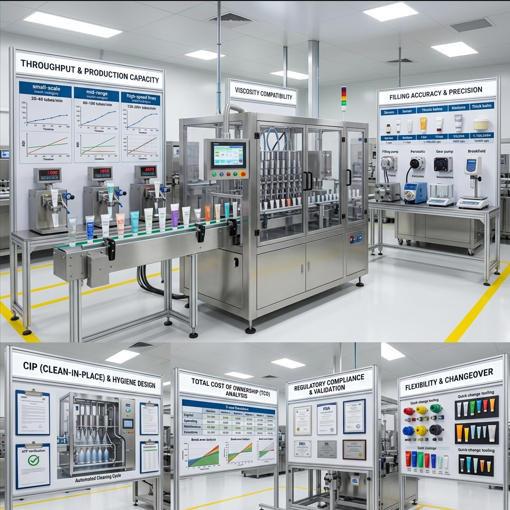
The tube filling machine market is projected to grow from USD 2.1 billion in 2025 to USD 3.1 billion by 2035, driven by rising demand for cosmetic and pharmaceutical packaging in emerging markets and accelerating product premiumisation globally (Future Market Insights, 2025). That growth means more machines on the market, more suppliers making competing claims — and more ways for a buyer to make a costly specification error.
The consequence of choosing the wrong tube filling machine is not just a poor purchase — it is a multi-year operational problem. A machine mismatched to product viscosity produces fill-weight variation that fails OEE targets from day one. A machine without CIP/SIP capability creates cleaning validation gaps that surface during your first regulatory audit. A machine without quick-change tooling quietly destroys throughput on multi-SKU production schedules.
This guide was written for procurement managers, production engineers, and distributors who are evaluating tube filling equipment for cosmetic or pharmaceutical packaging lines. Every section follows a structured framework — from defining your output targets and product requirements through to vendor evaluation and total cost of ownership modelling — so you can make a specification decision that holds up across the asset’s full service life.
You will find detailed comparison tables, real-world data benchmarks, and specific questions to ask every supplier before committing to a purchase. Brands like Máquinas de embalagem Miyoda, who engineer complete integrated tube production lines, are referenced where their specific capabilities align with buyer requirements discussed in the guide.

Production Goals and Throughput Targets
Defining Your Required Output (Tubes Per Minute)
Before evaluating any machine specification, you must calculate how many tubes per minute your line actually needs to produce — not how fast the fastest machine can run. The calculation starts with your annual volume target, factors in your planned operating schedule, and applies a realistic OEE assumption to derive gross machine speed.
Consider a mid-size cosmetic manufacturer targeting 12 million tubes per year of a sunscreen cream. Running two 8-hour shifts, five days per week, across 50 working weeks gives 4,000 operating hours per year. At 85% OEE, net available production time is 3,400 hours — meaning the line needs to fill 12,000,000 ÷ 3,400 hours ÷ 60 minutes = approximately 59 tubes per minute gross machine speed. Buying a 40-tube-per-minute machine because it is cheaper creates a structural output shortfall from week one that no process improvement closes without capital reinvestment.
Equipment specifications in machine datasheets represent peak throughput under ideal laboratory conditions — single tube format, pre-warmed machine, optimal ambient temperature. Real production throughput is always lower. A reliable rule of thumb for tube filling equipment procurement: never specify a machine at more than 80% of its rated maximum speed. The remaining 20% covers product changeover acceleration time, minor speed variations from viscosity batch-to-batch differences, and future volume growth over the asset’s 10–15 year service life. If you need 60 tubes per minute, specify a machine rated for at least 75.
Scanning for Future Scalability
The machine you specify today will be running your production line in 2030 and potentially beyond. Volume projections that looked conservative at purchase frequently become operational constraints within three years for growing brands. When evaluating tube filling equipment, confirm two scalability criteria with every supplier: first, whether the machine architecture supports adding filling heads or increasing seal station capacity without full replacement; second, whether the control system supports integration with upstream tube feeders and downstream inspection or cartoning equipment that you may add as volumes grow.
Suppliers like Miyoda Packaging Machinery’s tube filling and closing machine range are designed as part of an integrated production line platform — meaning filling capacity, heading, capping, and downstream processing are engineered to scale together rather than requiring ad-hoc integration of independently sourced machines.
| Machine Class | Speed Range (tubes/min) | Annual Capacity @ 85% OEE (2-shift) | Typical CapEx Range (USD) | Operators Required | Melhor ajuste |
|---|---|---|---|---|---|
| Manual / Benchtop | 5 – 15 | < 500,000 units/yr | $3,000 – $12,000 | 2 – 3 | R&D labs, clinical trial batches, artisan cosmetics |
| Semiautomático | 20 – 40 | 500K – 2M units/yr | $8,000 – $35,000 | 2 | Startup brands, multi-SKU boutique runs, pilot production |
| Fully Automatic (Mid-Speed) | 60 – 100 | 2M – 10M units/yr | $40,000 – $90,000 | 1 + QC | Established cosmetic manufacturers, 3–6 SKUs, pharma topicals |
| Fully Automatic (High-Speed) | 120 – 300 | 10M – 50M+ units/yr | $120,000 – $300,000+ | 1 supervisory | Mass-market brands, contract manufacturers, toothpaste, pharma |
Fontes: Future Market Insights; Miyoda Packaging Machinery — Automatic vs. Semi-Automatic Guide; LIENM industry analysis 2025. CapEx ranges are indicative and vary by configuration.
Tube Compatibility and Product Attributes
Tube Sizes and Materials
A tube filling machine must be mechanically compatible with every tube format in your production portfolio — not just your current launch SKU. The three primary tube material categories each require different sealing technology, mandrel geometry, and surface handling:
ABL (Aluminium Barrier Laminate) tubes provide the highest oxygen and moisture barrier performance, making them the standard substrate for pharmaceutical topicals (ointments, antifungals, corticosteroids) and active-ingredient cosmetics like vitamin C serums and retinol creams. They seal thermally on their outer plastic layers using hot-jaw or hot-air methods, but the aluminium layer adds thermal mass that requires precise calibration of dwell time and jaw temperature. Tube diameters typically range from Ø13 mm to Ø50 mm; confirm your specific range with the supplier before quotation.
PBL (Plastic Barrier Laminate) tubes — all-plastic multi-layer constructions using EVOH or nylon barrier layers — represent approximately 42% of cosmetic tube market share globally. They are more recyclable than ABL, preferred by sustainability-conscious brands, and compatible with ultrasonic sealing in addition to hot-jaw methods. PBL tubes are the standard substrate for hand creams, body lotions, sunscreens, and most OTC personal care products.
Pure aluminium tubes close mechanically through fold-and-crimp dies rather than thermal sealing. They are standard for pharmaceutical ointments, medicated gels, and pigment products where complete product evacuation and oxidation barrier performance are paramount. The internal lacquer chemistry must be validated against your formulation’s pH and solvent chemistry — an incompatible lacquer can corrode within months, introducing heavy-metal contamination.
Product Viscosity and Additives
Viscosity is the single most important product parameter for filling technology selection, yet it is routinely under-specified in procurement briefs. A machine specified for body lotion at 3,000 cP cannot fill a heavy zinc-oxide sunscreen at 150,000 cP — the piston stalls, fill weights drift outside specification, and nozzle drip contamination of tube tails makes seal quality unrepeatable.
Products with suspended particles (exfoliating scrubs, toothpaste with abrasive silica, clay masks with mineral particles) require hardened 316L stainless steel nozzle tips and PTFE-lined cylinders to prevent premature wear. Specify the maximum particle size and particle loading (% w/w) in your product brief — this determines nozzle orifice clearance and cylinder liner material requirements.
| Product Type | Viscosity Range (cP) | Recommended Fill Technology | Heating Required | Fill Accuracy (±%) | Material do tubo |
|---|---|---|---|---|---|
| Body lotion / serum | 500 – 5,000 | Standard piston or peristaltic pump | No | ±0.5% | PBL, PE |
| Hand cream / moisturiser | 5,000 – 30,000 | Heavy-duty servo piston | Optional (>10,000 cP) | ±0.5–0.8% | PBL, ABL |
| Sunscreen / SPF cream | 20,000 – 200,000 | Servo piston + heated tank & nozzle | Yes (tank 35–50°C) | ±1.0–1.5% | ABL, PBL |
| Toothpaste / dental gel | 80,000 – 250,000 | Heated servo piston or twin-screw pump | Yes (tank 40–55°C) | ±1.0–1.5% | ABL, plastic laminate |
| Pharmaceutical ointment / gel | 10,000 – 300,000 | Servo piston with jacketed cylinder | Yes (product-specific) | ±0.5–1.5% | ABL, aluminium |
| Clay mask / exfoliant scrub | 50,000 – 150,000 | Heated piston + hardened nozzle, PTFE liner | Yes | ±1.0–2.0% | PBL, ABL |
Fontes: HIJ Machinery — Cosmetic Tube Filling Machine Guide; KP Filling Machine — High-Viscosity Engineering Guide; industry field data 2024–2025.

Filling Technology Options
Gravity vs. Piston vs. Volumetric
Gravity filling uses the product’s own weight to flow from a holding tank through a nozzle into the tube, controlled by an open/close valve. It is the simplest and lowest-cost technology — but it is entirely unsuitable for tube filling applications. Tubes are collapsible: they do not maintain an open cavity during filling, so product cannot flow in under gravity alone. Gravity filling is limited to rigid containers (bottles, jars) and should not appear in any tube filling machine specification.
Piston filling — specifically the servo-driven piston — is the dominant technology for cosmetic and pharmaceutical tube filling at all viscosity levels above 5,000 cP. A servo motor drives a piston through a calibrated cylinder, drawing product on the return stroke and dispensing it on the forward stroke with volumetric precision. The servo motor’s encoder provides real-time position feedback, enabling fill accuracy of ±0.5% at rated viscosity range — the industry benchmark for cosmetic and pharmaceutical operations. At viscosities above 80,000 cP, jacketed cylinder heating maintains product flowability throughout the fill cycle.
Volumetric gear pump filling uses a gear pump to meter a precise volume of product per revolution, operating effectively at viscosities from 500 cP to approximately 50,000 cP. Gear pumps are well-suited to thin-to-medium viscosity cosmetics (lotions, gel serums, hair colour creams) but begin to show accuracy degradation above 50,000 cP due to internal slip at elevated back-pressure. They also introduce greater shear force than piston fillers — a factor that matters for shear-sensitive formulations containing emulsion systems or thickeners that break down under mechanical stress.
Jet/Valve Considerations
The filling nozzle is the product’s last contact point before entering the tube, and nozzle design directly affects both fill accuracy and tube-tail cleanliness. A contaminated tube tail — product drips on the sealing area — is the primary cause of seal delamination failures in production. Two nozzle features prevent this: anti-drip valve mechanisms that use spring-loaded or servo-actuated shut-off to terminate product flow without trailing drips, and nozzle dive-and-retract sequences where the nozzle enters the tube before filling begins and retracts upward as the tube fills from the bottom — keeping the tube tail clean throughout the fill cycle.
For pharmaceutical products subject to GMP audits, nozzle materials must carry material certificates confirming 316L stainless steel or FDA-compliant polymer construction, with documented chemical compatibility against your formulation chemistry. Miyoda’s buyer guide on choosing cosmetic tube filling machines covers the nozzle specification parameters that should be confirmed before supplier shortlisting.
Chart 1 — Fill Accuracy by Filling Technology (% of Target Fill Weight, Lower = Better)
Note: Bar widths proportionally scaled. Lower deviation = better accuracy. Source: Compiled from manufacturer specifications and HIJ Machinery field data 2024–2025.
Accuracy, Reproducibility, and QA
Tolerances and Calibration
Fill accuracy is not just a quality specification — it is a direct cost variable. Consider a cosmetic manufacturer filling 10 million units per year of a 100 ml premium serum at a material cost of USD 0.042 per millilitre. A fill system operating at ±1.5% mean overfill (to ensure no tube falls below nominal fill weight) delivers 1.5 ml excess per tube — costing USD 0.063 per unit, or USD 630,000 per year in unnecessary product give-away. A servo piston system achieving ±0.5% mean overfill reduces give-away to 0.5 ml per tube — recovering USD 420,000 per year in material cost alone, without any change to formulation, pricing, or volume. That figure exceeds the CapEx cost difference between a pneumatic piston and a servo piston machine in most mid-speed configurations.
Cpk ≥ 1.33 on fill weight is the minimum process capability standard for pharmaceutical tube filling under cGMP. For cosmetic brand operations subject to ISO 22716 audits, Cpk ≥ 1.00 is a practical minimum; best-in-class operations target Cpk ≥ 1.67. Always request the supplier’s Cpk data from a reference customer running the same machine model and a comparable formulation viscosity — factory test data on water-like test fluid has no predictive value for actual production performance.
Calibration protocols should include daily zero-check at line start, weekly in-process Cpk run-chart review, and quarterly calibration verification of fill-weight instruments against NIST-traceable calibration standards.
Inline Inspection Options
Inline inspection — 100% automated quality checking on every tube before discharge — is increasingly a standard specification for cosmetic and pharmaceutical tube filling lines, not a premium option. Three inspection modalities are applicable at tube filling line speeds:
Checkweigher: a precision weighing station that checks every filled tube within 20–50 ms, comparing the measured weight against the recipe specification and automatically rejecting tubes outside tolerance. Checkweigher data feeds the process control loop — a statistical drift above the tolerance band triggers an automatic adjustment to the fill piston stroke before defects accumulate. Modern inline checkweighers achieve accuracy of ±0.1 g at speeds up to 200 tubes per minute.
Seal integrity vision system: a camera-based system that inspects the tube tail seal geometry — width, symmetry, surface quality, and fold depth — after the sealing station. Systems operating at production speed identify seal defects that would cause leakage or degraded barrier performance in distribution without requiring destructive testing. See vision solutions in a tube filling line for a working demonstration of this technology in production.
Date/batch code verification: an OCR (optical character recognition) system that reads the applied inkjet or laser code on each tube and rejects any tube where the code is missing, illegible, or mismatched to the active production batch record. For pharmaceutical operations under 21 CFR Part 211 or EU GMP batch traceability requirements, this is a compliance necessity rather than an optional quality upgrade.
Watch a fully automatic tube filling and sealing machine in operation — observe the tube indexing, precision volumetric fill cycle, tail sealing, and discharge sequence that defines the quality parameters discussed in this guide.
Speed Versus Accuracy Trade-offs
Synchronisation with Downstream Lines
Higher machine speed does not automatically translate into higher line output. A tube filling machine running at 120 tubes per minute feeding a capping station rated for 80 tubes per minute creates a downstream bottleneck that limits the entire line to 80 tubes per minute — while simultaneously creating tube accumulation, handling contact points, and tube-body marking defects in the buffer zone. Line speed synchronisation is a system design problem, not a single-machine specification problem.
Before finalising filling machine speed specifications, map the rated speed of every downstream station: sealing (if separate), tail coding, inline inspection, tube orientation, cap application, carton loading. The filling machine’s output speed must be matched to the system’s true bottleneck — not specified in isolation as the fastest machine available in the budget range.
Speed-accuracy interaction is a real technical constraint, not a marketing claim. At higher fill rates, the product’s inertia during nozzle retraction creates momentary overshoot in fill volume — an effect that is negligible at 40 tubes per minute and measurable at 150 tubes per minute for products above 30,000 cP. Servo-driven fill systems compensate for this dynamically through closed-loop control; pneumatic piston systems operating at rated speed approach their accuracy limits on higher-viscosity formulations. This is why the speed rating in machine datasheets is always accompanied by a viscosity range — accuracy at the stated speed is only valid within that viscosity window.
Changeover Ease and Sanitation
Quick-Change Tooling
Changeover time is the hidden throughput variable that rarely appears in a machine’s headline specification — but consistently accounts for the largest gap between rated and actual daily output on multi-SKU production lines. A facility running six product SKUs per shift with 40-minute changeovers between each format loses 240 minutes — 50% of an 8-hour shift — to non-productive changeover. At 80 tubes per minute, that represents 19,200 tubes of lost capacity per shift.
The engineering features that enable fast changeover are specific and verifiable: tool-free mandrel and nozzle cassettes with keyed alignment that eliminate recalibration after every format swap; colour-coded format components by tube diameter that assemble in one correct orientation and prevent operator error; servo-driven HMI recipe recall that automatically sets all fill volume, seal temperature, and dwell time parameters to the stored profile for the incoming SKU; and guided changeover workflows on the HMI screen that walk the operator through each step with confirmation prompts. Well-designed lines using SMED principles consistently achieve 15–20 minute changeovers between standard tube formats — a 60–70% reduction versus legacy 45–60 minute changeovers.
At 80 tubes/minute and six changeovers per shift: legacy 45-min changeover = 270 min lost = 21,600 tubes/shift. SMED-enabled 15-min changeover = 90 min lost = 7,200 tubes/shift. The difference: 14,400 tubes per shift. At 250 production days per year (two shifts), that is 7.2 million additional tubes per year — from changeover engineering alone, with no additional capital expenditure on machine speed.
CIP/SIP Compatibility
CIP/SIP capability determines whether your filling machine can be validated for cGMP cosmetic or pharmaceutical production — and whether it will survive regulatory audit scrutiny. For ISO 22716-governed cosmetic manufacturing, cleaning validation requires documented evidence that residual product contamination on product-contact surfaces falls below 10 ppm after the cleaning cycle. For pharmaceutical operations under FDA 21 CFR Part 211 or EU GMP, this threshold is typically tighter and must be validated with analytical method verification.
CIP-capable tube filling machines are designed with fully drainable product-contact circuits — no dead legs where product can pool and be incompletely cleaned — and product-contact surfaces finished to Ra ≤ 0.8 µm (surface roughness) to prevent microbial adhesion and facilitate chemical cleaning agent penetration. The cleaning cycle typically runs 0.5% sodium hydroxide wash followed by water rinse and optional 70% IPA sanitisation, with turbulent flow velocity ≥ 1.5 m/s through all circuits to achieve effective mechanical cleaning action. Always confirm with your supplier that CIP validation data is available for your specific cleaning agents and that cleaning procedure documentation is included in the machine delivery package.

Cleaning and Sanitation Complexity
Cleanability Design
Cleanability is a design criterion, not an afterthought, and it should be evaluated during equipment selection — not after the machine is installed and your first GMP audit is scheduled. A cleanable machine design includes: minimal horizontal surfaces that accumulate product residue and particulates; no blind cavities requiring tool disassembly for cleaning access; product-contact materials (316L SS, PTFE, PEEK) that withstand IPA, 70% ethanol, and quaternary ammonium disinfectant cycles without surface degradation; and fully welded product-contact joints with electropolished Ra ≤ 0.8 µm finish to prevent biofilm formation.
The cleaning complexity multiplier — how much labour time and cleaning agent volume is required per batch changeover — varies dramatically between machine designs. A poorly designed machine may require two to three hours of disassembly, manual scrubbing, reassembly, and re-verification between each product changeover. A well-designed CIP-capable machine completes an automated cleaning cycle in 30–45 minutes with minimal operator intervention. For facilities running five or more product changeovers per week, this difference compounds into hundreds of labour hours per year and a measurable impact on both operating cost and cleaning validation scope.
For pharmaceutical contract manufacturers handling multiple active ingredients across shared equipment, dedicated CIP system design for cosmetic filling lines is a prerequisite for demonstrating adequate cross-contamination control under EU GMP Chapter 5 and FDA 21 CFR Part 211.68.
Maintenance and Reliability
Spare Parts Availability
Spare parts availability is the single greatest source of unplanned downtime on packaging lines — not machine reliability, but the inability to restore a failed machine within the production schedule. A 2025 analysis of packaging line downtime events found that 62% of unplanned downtime exceeding four hours was caused by spare part procurement delay rather than diagnostic failure or repair time. The machine was diagnosed correctly within 30 minutes; the part took four days to arrive.
Before any purchase commitment, request a Recommended Spare Parts List (RSL) with supplier-confirmed lead times for every item. Apply this rule: any critical-path component with a supplier lead time exceeding 72 hours must be stocked in your own on-site inventory from day one. For tube filling machines, the critical-path components that most frequently cause extended downtime are: filling cylinder seals, nozzle shut-off valve springs, heat-seal jaw heating elements, thermocouple sensors, and servo drive encoder cables. These five component categories should have confirmed dual-source supply routes — not sole-source manufacture by a sub-supplier in a single geographic location.
Suppliers like Máquinas de embalagem Miyoda maintain regional parts inventories and offer documented 10-year spare parts availability commitments — a meaningful differentiator for buyers making 10–15 year asset investment decisions in a market where some suppliers cease component supply within three to five years of equipment manufacture.
Remote Diagnostics
Industry 4.0-enabled tube filling machines — those with Ethernet-connected PLCs, OPC-UA data interfaces, and cloud-connected condition monitoring — offer a qualitatively different maintenance model compared to legacy machines with isolated control systems. Remote diagnostics capability means a supplier’s service engineer can access machine PLC data, review alarm logs, and adjust process parameters from any location — resolving 40–60% of production issues without a technician visit and reducing mean time to repair from days to hours for the majority of fault categories.
Predictive maintenance using vibration analysis on servo drive bearings, thermal monitoring of heating cartridges, and fill-weight trend analysis on checkweigher data enables planned maintenance interventions before failures occur. A 2024 study on packaging line predictive maintenance deployment found OEE improvements of 19% and unplanned downtime reductions of 47% after implementation (Oxmaint, 2024). When evaluating remote diagnostics capability, confirm whether the machine’s data interface supports your facility’s IT security policy — VPN-gated remote access with audit-logged sessions is standard for pharmaceutical-grade environments.
Chart 2 — 5-Year Total Cost of Ownership Distribution: Automatic Servo-Driven Tube Filling Machine (Mid-Speed, 5M Units/Year)
- Capital / Depreciation — 38%
- Maintenance & Spare Parts — 27%
- Labour — 21%
- Energy Consumption — 9%
- Downtime & Rejects — 5%
Source: Compiled from BWPackaging TCO analysis frameworks, KP Filling Machine field data, and industry benchmarks 2024–2025. Figures indicative for mid-speed servo-driven automatic line at 5M units/year.
Footprint, Power, and Utility Needs
Electrical, Air, and Water Requirements
Utility requirements are a facility compatibility check that should be confirmed before issuing a purchase order — not after the machine arrives on-site. A mid-speed automatic tube filling machine typically requires: three-phase electrical supply at 380–415 V, 50 Hz (or 460 V, 60 Hz for North America), with installed power of 3–8 kW depending on heating requirements; compressed air at 0.5–0.7 MPa (5–7 bar) with a flow rate of 200–600 NL/min (the specific requirement varies significantly between pneumatic-dominant and servo-dominant machine architectures); and cooling water for seal jaw cooling circuits at approximately 2–5 L/min at ≤20°C inlet temperature, where applicable.
Energy consumption is a meaningful long-term operating cost that is frequently underweighted at purchase. Servo-driven filling systems use energy only when the servo motor is active — during the fill stroke — consuming approximately 0.8–1.5 kW average versus 4–6 kW continuous for pneumatic piston systems whose air compressors run continuously regardless of machine cycle state. Variable frequency drives (VFDs) on conveyor and drive motors can reduce energy consumption by 30–50% compared to fixed-speed motors, with payback periods of 12–24 months at typical industrial electricity rates. At USD 0.12/kWh and 6,000 operating hours per year, a 3 kW energy saving from servo versus pneumatic architecture translates to USD 2,160 per year per machine — material at scale.
Physical footprint defines where the machine can be installed and how much floor space is consumed versus productive capacity delivered. Compact integrated fill-and-seal units from suppliers like Miyoda’s tube filling and closing machine platform eliminate inter-machine conveyor sections and buffer zones — reducing both footprint and the handling contact points where tube-body scuffing and decoration damage accumulate between stations.

Total Cost of Ownership and Vendor Support
Purchase Cost vs. Operating Costs
The purchase price of a tube filling machine is the most visible number in any procurement evaluation — and consistently the least useful single metric for making a sound investment decision. A USD 35,000 pneumatic piston machine and a USD 90,000 servo piston machine filling the same product at the same speed will have dramatically different 5-year operating cost profiles, driven by fill accuracy (product give-away), reject rate (material waste and labour rework), energy consumption, maintenance frequency, and downtime incidence.
At 5 million units per year of a 100 ml cosmetic product with a material value of USD 0.042/ml, the give-away cost differential between ±1.5% (pneumatic) and ±0.5% (servo) fill accuracy is approximately USD 420,000 over five years — more than six times the CapEx difference between the two machines. Add the energy saving (USD 10,000–15,000 over five years for servo versus pneumatic), lower reject rates, and reduced maintenance frequency, and the servo machine’s 5-year TCO is consistently lower despite its higher purchase price at any annual volume above approximately 2 million units per year.
| Categoria de custo | Semi-Automatic ($25K CapEx) | Mid-Speed Automatic ($75K CapEx) | High-Speed Servo ($180K CapEx) |
|---|---|---|---|
| Capital (5-yr depreciation) | $25,000 | $75,000 | $180,000 |
| Labour (5 years) | $312,000 | $104,000 | $52,000 |
| Product give-away (±1.5%) | $315,000 | $210,000 | $105,000 |
| Energy (5 years) | $18,000 | $14,400 | $7,200 |
| Maintenance & spare parts | $28,000 | $42,000 | $38,000 |
| Downtime & reject cost | $48,000 | $21,000 | $9,000 |
| 5-Year Total TCO | $746,000 | $466,400 | $391,200 |
| TCO per 1,000 tubes | $29.84 | $18.66 | $15.65 |
Note: Labour cost at USD 20/hr (2-shift operation). Give-away at mean overfill × material cost. Indicative figures — actual costs vary by region, formulation value, and SKU mix. Sources: KP Filling Machine TCO analysis; LIENM price analysis 2025.
Service and Training
After-sales support quality is a determinant of machine performance that cannot be assessed from a datasheet — it only becomes visible after the purchase order is signed. The three vendor support variables with the greatest impact on operating outcomes are: response time commitment (the worst-case guarantee, not average — your production peak periods are precisely when you need rapid response and precisely when supplier service teams are most stretched); training scope and depth (is operator and maintenance technician training included in the purchase price, delivered at your site, and documented in a format that supports your GMP training records?); and remote diagnostics capability (can the supplier’s engineers access your machine’s PLC remotely with a VPN-secured, audit-logged session to reduce MTTR from days to hours?).
Request a formal Service Level Agreement (SLA) with defined response time commitments — 4-hour remote response and 24–48 hour on-site response is the appropriate standard for production-critical packaging equipment. Suppliers who decline to commit to SLA terms in writing are implicitly communicating that their service capacity does not support these standards. When evaluating vendor support criteria for tube packaging equipment, use a structured scorecard that includes SLA terms, training content, regional spare parts availability, and remote diagnostics capability alongside machine technical specifications.
Chart 3 — 5-Year TCO per 1,000 Tubes (USD) by Machine Class at 5M Units/Year
Lower cost per 1,000 tubes = better long-term value. Source: Compiled from KP Filling Machine and LIENM industry data 2025. Higher CapEx machines consistently outperform on TCO at volumes ≥ 2M units/year.
A Structured Decision Framework Before You Request Quotations
Use this six-step framework as your pre-RFQ checklist. Every supplier receives the same inputs, enabling like-for-like evaluation rather than a comparison of incompatible quotations:
Define Annual Volume & OEE
Calculate required gross machine speed. Apply 85% OEE. Add 20% growth buffer. Never specify at rated maximum speed.
Profile All Products
Measure viscosity at fill temperature for every formulation. Specify particle size and loading for abrasive products. Confirm tube materials for full portfolio.
Map Compliance Requirements
Confirm if IQ/OQ/PQ, 21 CFR Part 11, ISO 22716, or CE marking is required. This eliminates non-compliant machine classes before evaluation.
Issue Identical RFQs
Send the same technical specification to 3–5 suppliers. Request Cpk data, reference customers, RSL with lead times, and SLA terms.
Conduct FAT with Your Materials
Bring your actual tubes and a viscosity-matched surrogate. Run 200 tubes at target speed. Perform ASTM F88 seal strength and checkweigh testing on output.
Build 5-Year TCO Model
Include labour, energy, give-away, maintenance, downtime, and spare parts. CapEx is never the right single metric for a 10-year asset decision.
Prioritise Based on Your Specific Production Needs
The right tube filling machine is not the fastest machine available within your budget. It is the machine that fills your specific product portfolio, at your required throughput, to your quality specification, within your compliance framework — at the lowest five-year total cost of ownership. That level of fit only emerges from the structured approach outlined in this guide: viscosity profiling before quoting, OEE-adjusted throughput calculation, compliance mapping before shortlisting, and FAT with your actual materials before signing.
Three decisions above all others determine whether your machine purchase delivers its projected return: specifying filling technology to match your product viscosity range (not your existing equipment); sizing throughput to your three-year volume projection with a 20% growth margin; and treating the vendor’s SLA commitment, spare parts availability, and training depth as primary selection criteria rather than afterthoughts. These factors have larger impact on five-year operating cost than the headline machine price in virtually every case above 2 million units per year.
Request vendor evaluations and factory acceptance tests — not demonstrations. Any supplier confident in their machine’s real-world performance will welcome a 200-tube FAT run at your production speed using your formulation. Any supplier who declines is communicating something important about the gap between their datasheet and their production reality.
Use the structured decision framework in this guide, build your 5-year TCO model, and approach every supplier conversation with the same technical specification brief. The machine that wins that evaluation is the machine you should buy — regardless of which name is on the front panel.

Glossário de termos-chave
Perguntas frequentes
ROI on a tube filling line upgrade depends primarily on the gap between your current and upgraded fill accuracy, throughput improvement, and labour reduction. A realistic mid-size scenario: a cosmetic manufacturer producing 5 million units per year upgrades from a semi-automatic line (±1.5% fill accuracy, 2 operators) to a mid-speed automatic (±0.5% accuracy, 1 operator). The give-away reduction alone saves approximately USD 84,000 per year in material cost on a 100 ml product at USD 0.042/ml material value. Labour reduction adds USD 42,000 per year. Combined annual savings of USD 126,000 against a net CapEx of USD 50,000 (after trading in the semi-auto) gives a payback period of under 5 months and a 5-year ROI exceeding 1,100%. Higher-value pharmaceutical formulations produce proportionally faster payback — a 1% fill accuracy improvement on a USD 2.00/ml API solution saves USD 1,000 per 1,000 tubes, transforming the financial case for servo piston investment even on relatively low-volume pharmaceutical lines.
The primary data point is a viscosity measurement of your product at fill temperature — not ambient temperature — measured using a Brookfield or Anton Paar viscometer with the appropriate spindle geometry for your product type. Products between 500–30,000 cP are generally handled well by standard or heavy-duty servo piston fillers without additional heating. Products between 30,000–100,000 cP typically require jacketed cylinder heating (maintaining the product at 35–50°C to reduce apparent viscosity) and a heated nozzle assembly to prevent product setting in the nozzle bore between fill cycles. Products above 100,000 cP — dense toothpastes, heavy pharmaceutical ointments, clay masks — require either a twin-screw pump system or a high-force heated piston with reinforced cylinder seals rated for sustained operation above 5 bar back-pressure. For abrasive products (silica-loaded toothpaste, mineral clay masks), additionally specify hardened 316L stainless nozzle tips and PTFE cylinder liners — standard 304 SS wears at accelerating rates above a particle loading of approximately 8% w/w.
The three most common changeover failures are: missing format components that were not pre-staged (causing the operator to pause mid-changeover to locate parts); process parameter settings not loaded from the recipe system before production restart (causing the first batch of tubes to be filled at the previous SKU’s parameters until an operator notices the weight deviation); and post-changeover leak testing skipped under schedule pressure (allowing seal defects from a cold machine to reach downstream inspection or — worse — customer distribution). Avoid these by implementing three controls: a pre-staged format kit system where all components for the next SKU are kitted and verified as complete before the current SKU finishes; mandatory HMI recipe confirmation as a required step in the changeover procedure with a machine interlock that prevents production restart until the recipe is confirmed; and a mandatory warm-up seal verification run of minimum 10 tubes before production batches are accepted into finished goods inventory. Document changeover procedures with timed trials, publish the target changeover time as a KPI visible to operators, and review any changeover exceeding the target in the daily production meeting as an escalation item.
For pharmaceutical GMP and ISO 22716-audited cosmetic operations, the minimum documentation package from a supplier must include: CE Declaration of Conformity (EU) or equivalent safety certification for your target market; IQ/OQ/PQ protocol templates specific to the machine model with blank acceptance criteria tables ready for your specifications; calibration certificates for all measurement instruments (thermocouples, pressure transducers, fill-weight scales) traceable to national measurement standards (NIST, PTB, or equivalent); material certificates for all product-contact components confirming FDA/EU compliance (316L SS, PTFE, PEEK); 21 CFR Part 11 compliance declaration if electronic batch records and audit trail functionality are specified; User Requirement Specification (URS) template for customisation to your process parameters; and a full Recommended Spare Parts List (RSL) with manufacturer part numbers and confirmed lead times. Suppliers who cannot provide this documentation package at quotation stage are not positioned to support a regulated operation regardless of machine price or throughput claims.
ABL (Aluminium Barrier Laminate) contains an aluminium foil layer between plastic films, providing the highest oxygen and moisture barrier performance of any flexible tube substrate — essential for pharmaceutical formulations and cosmetics with active ingredients that oxidise (vitamin C, retinol, benzoyl peroxide). PBL (Plastic Barrier Laminate) achieves barrier performance through EVOH or nylon polymer barrier layers without aluminium — lighter, more recyclable, fully squeezable, and increasingly preferred by sustainability-focused cosmetic brands. Machine selection implications: both ABL and PBL seal thermally using hot-jaw or hot-air methods, so a machine specified for PBL can generally handle ABL with parameter adjustment. However, ABL’s aluminium layer adds thermal mass requiring 10–15% higher jaw temperature or 15–20% longer dwell time than equivalent PBL tubes to achieve the same inner-layer fusion temperature — so the machine’s validated operating window must extend to cover both substrates if you run both. Confirm this with the supplier during FAT by testing seal strength (ASTM F88) on both ABL and PBL tubes at your specified parameters before purchase commitment.
Compressed air consumption on a tube filling machine is driven by three categories of pneumatic consumers: actuators (cylinder-operated tube clamps, nozzle valves, conveyor diverters), control air (pneumatic logic circuits, proportional valves), and purge air (air-wipe nozzles that clean tube tails before sealing). A mid-speed automatic machine with predominantly servo-driven architecture typically consumes 200–300 NL/min at 6 bar during steady-state production, with peak demand during simultaneous multi-actuator cycles approximately 30–40% higher than average. A pneumatic-dominant machine of equivalent speed may consume 400–600 NL/min continuously. Request the supplier’s air flow specification at rated production speed with a breakdown by consumer category — this allows you to verify compatibility with your facility’s compressed air system capacity and filter-regulator-lubricator (FRL) sizing requirements. Air quality requirement is typically ISO 8573-1 Class 2.2.2 (oil ≤ 0.1 mg/m³, dew point ≤ -20°C, particles ≤ 1 µm) for machines with pneumatic control circuits serving product-contact areas.
Yes, provided the machine is specified for dual use from the outset — attempting to qualify a cosmetic-specified machine for pharmaceutical use post-purchase typically requires significant documentation retrofit and often hardware modifications. A dual-use machine requires: 316L stainless steel product-contact surfaces with Ra ≤ 0.8 µm finish (standard on pharmaceutical-grade, optional on cosmetic-grade equipment); CIP/SIP capability with cleaning validation data; 21 CFR Parte 11-compliant electronic batch records and audit trail if any pharmaceutical products are FDA-regulated; and IQ/OQ/PQ protocols validated for both cosmetic (ISO 22716) and pharmaceutical (cGMP) operating conditions. Many contract packaging organisations operate dual-use lines successfully, but they specify dual-use capability explicitly in their initial RFQ and confirm it in FAT before purchase rather than attempting compliance upgrades post-installation.
A properly conducted FAT for a tube filling machine should include: a minimum 30-minute continuous run at your specified production speed using your own tubes (or exact dimensional equivalents) and a formulation surrogate with your product’s viscosity; fill weight verification on a minimum 50-tube sample using a calibrated checkweigher, with Cpk calculation on the results; seal strength testing (ASTM F88 peel test) on a 20-tube sample from the FAT run; visual inspection of 100% of FAT output against your visual defect criteria; a simulated format changeover timed against your specified changeover target; and a demonstration of all safety interlock functions with your quality team present. Your own production operators — not the supplier’s demonstration technician — should run the machine for at least 15 minutes of the FAT. Ergonomic issues, HMI usability problems, and operator-confidence gaps are invisible in a supplier-led demonstration and immediately apparent when your team is at the controls. Any non-conformance identified at FAT becomes a tracked punch-list item with a supplier-committed resolution date before the machine is released for shipment.
A realistic IQ/OQ/PQ timeline for a pharmaceutical tube filling machine is 8–16 weeks from machine installation, depending on protocol complexity, number of tube formats to qualify, and regulatory submission requirements. IQ (Installation Qualification) typically takes 1–2 weeks — verifying utilities, documentation, and safety device function against the approved IQ protocol. OQ (Operational Qualification) typically takes 3–6 weeks — running calibrated parameter range studies across your full operating window and documenting results against acceptance criteria. PQ (Performance Qualification) requires a minimum of three consecutive conforming production batches at commercial scale, typically adding 3–8 weeks depending on batch size and release testing timelines. Suppliers who provide pre-formatted IQ/OQ/PQ protocol templates specific to their machine model reduce protocol authorship time by 4–6 weeks and eliminate the most common source of qualification delays — protocol writing errors and approval cycles on documents authored from scratch. FAT completion before shipment, with documented evidence of performance at target parameters, typically saves an additional 2–4 weeks of OQ execution time at the installation site.