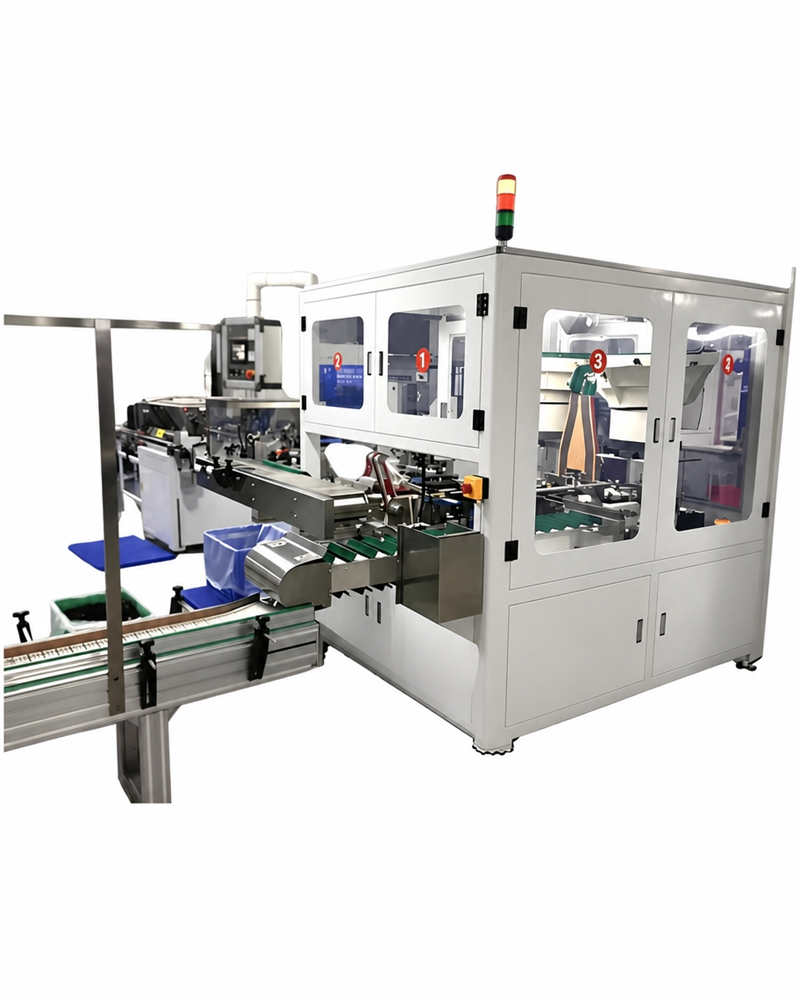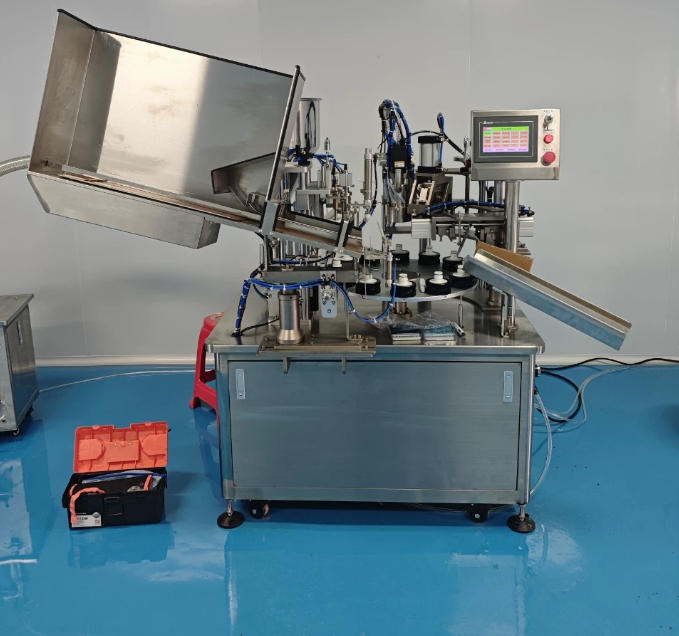
Choosing the Right Tube Packaging Machine Can Make or Break Your Cosmetic Production — Here’s What Actually Matters
Your tube filling line is not just a piece of equipment. It is the center of your production economics, your regulatory compliance, and ultimately your ability to grow. Get it right, and it runs quietly in the background while your margins improve. Get it wrong, and every production shift becomes a negotiation between speed, quality, and risk.
This guide was written for one audience: cosmetic and pharmaceutical brands, distributors, and packaging machinery buyers who are making a real equipment decision — not browsing brochures. Every figure in this article comes from production data, industry compliance frameworks, and documented buyer experiences. No filler, no generalities.

Why Tube Packaging Machine Selection Impacts Your Bottom Line
A cosmetic producer in Southeast Asia committed to a USD 35,000 semi-automatic tube filler in early 2024 — selected primarily on lowest quoted price. Eighteen months later, they were running four machines in parallel with six operators per shift just to meet a single retail account’s volume. Every margin advantage the low purchase price had promised had been consumed by labor costs.
Then a European distributor flagged the absence of electronic batch records during a supplier qualification audit — blocking a USD 1.2 million annual contract from proceeding.
That outcome is not rare. It is, however, entirely avoidable — if you know what to evaluate before signing a purchase order.
The global tube packaging market was valued at USD 13.43 billion in 2025 and is projected to grow at a CAGR of 6.2% through 2033. Cosmetic tube packaging specifically is on track to reach USD 7.8 billion by 2034. As volume demand grows and regulatory scrutiny intensifies across the US, EU, and regulated Asian markets, the tube filling machine at the center of your production line becomes a strategic capital decision — not a procurement checkbox.
Common Mistakes Cosmetic Manufacturers Make When Buying Equipment
The most expensive equipment decisions tend to share the same failure pattern. Buyers optimize for purchase price while underestimating total cost of ownership. They size capacity to today’s volume without building in growth headroom. They skip material compatibility testing and discover the problem only after the machine is commissioned. They overlook regulatory documentation requirements until an audit stops production.
This guide addresses each of those failure modes with specific, actionable criteria.
1. Production Capacity and Speed: Matching Your Output Demands
Understanding Your Real Production Needs
Why “faster is better” thinking costs manufacturers money
A machine running at 25% of rated capacity for the first two years of operation has significant capital sitting idle. For a startup cosmetic brand projecting 3 million tubes in year one and 6 million in year three, a mid-range semi-automatic machine is frequently the correct year-one decision — with a documented transition plan to automation at the volume threshold where labor costs exceed the automatic machine’s capital premium.
Conversely, a brand that buys exactly to current volume with no headroom faces a harder problem. When a major retail chain listing doubled one brand’s required volume from 2 million to 5.5 million tubes per year in eighteen months, their machine could not meet the new demand even running two full shifts. Emergency outsourcing to a contract filler cost USD 0.08 per tube above their standard margin. On 3.5 million incremental units, that was USD 280,000 in avoidable cost.
How to calculate the right throughput for your product line
Key Term: TPM (Tubes Per Minute) — the standard production rate metric across the tube filling industry. Nameplate TPM is measured under ideal conditions; real sustained production runs at 60–85% of nameplate speed after startup sequences, minor stops, quality checks, and changeovers.
Use this formula to calculate your actual minimum machine requirement:
$$\text{Required TPM} = \frac{\text{Annual Volume}}{(\text{Operating Days} \times \text{Shifts/Day} \times \text{Hours/Shift} \times 60) \times \text{OEE}}$$
Key Term: OEE (Overall Equipment Effectiveness) — the combined measure of machine availability, performance efficiency, and quality rate. World-class tube filling lines achieve OEE of 85–92%. Semi-automatic lines typically run 70–80%. Always size machine capacity using OEE-adjusted output, not nameplate speed.
Example: A brand producing 12 million tubes per year across 250 operating days, 2 shifts of 8 hours, at 80% OEE:
$$\text{Required TPM} = \frac{12,000,000}{(250 \times 2 \times 8 \times 60) \times 0.80} = \approx 63 \text{ TPM minimum}$$
That brand needs a machine rated at approximately 63 TPM minimum — not the 150 TPM machine a sales representative might recommend to “leave room for growth.”
The hidden costs of oversizing or undersizing capacity
| Sizing Error | Immediate Cost | Long-Term Cost |
|---|---|---|
| Undersized | Rush order surcharges, overtime labor | Premature replacement at 15–25% residual value |
| Oversized | Idle capital, high depreciation per unit | Low utilization rate, difficult ROI justification |
| Correctly Sized | Efficient capital deployment | Predictable payback, room for planned growth |
Speed Specifications That Actually Matter
What tubes-per-minute numbers really mean for your operation
Production speed affects more than output volume — it affects fill accuracy, seal quality, and product consistency. At 200 TPM, a fill weight drift that moves the process mean by just 2 grams produces 4,800 out-of-tolerance tubes before an end-of-line inspection catches it. Faster machines require proportionally tighter process control to maintain quality at speed.
| Machine Type | Sustained Real TPM | Tubes Per 8-hr Shift | Ideal Annual Volume |
|---|---|---|---|
| Semi-Automatic (entry) | 10–20 | 4,800–9,600 | < 2M/year |
| Semi-Automatic (mid-range) | 20–40 | 9,600–19,200 | 2–5M/year |
| Automatic (single-head) | 60–100 | 28,800–48,000 | 5–15M/year |
| Automatic (dual-head) | 100–150 | 48,000–72,000 | 15–30M/year |
| Automatic (high-speed) | 150–200+ | 72,000–96,000+ | > 30M/year |
Balancing speed with accuracy in cosmetic applications
Servo-driven piston fill systems maintain fill weight accuracy of ±0.5–1.0% at rated speed. Pneumatic or gear-pump systems — typically found in lower-cost machines — drift to ±1.5–2.5% at maximum speed, especially with viscous formulations like hair masks, thick creams, and gel-based products. Speed and accuracy are not in conflict on a well-engineered system, but they are very much in conflict on an undersized or mismatched one.
Scalability: Building for Tomorrow’s Growth
Why modular machines protect your investment
When evaluating any supplier, ask specifically: can speed be upgraded through software and motor changes, or does upgrading capacity require a new machine entirely? The answer materially changes your long-term capital planning.
Miyoda Packaging Machinery designs their tube filling and closing platforms with modular architecture — meaning additional fill heads, integrated vision inspection, or production speed upgrades can be added without complete machine replacement. For brands projecting volume growth from 8 million to 18 million tubes over four years, a two-head upgrade on an existing base machine at USD 35,000 is a fundamentally different financial proposition from purchasing a second machine at USD 120,000.
Planning for seasonal demand fluctuations
Cosmetic brands with seasonal product lines — sunscreen, holiday gift sets, seasonal limited editions — commonly experience 2–3× demand spikes relative to base monthly volume. A machine sized to average annual demand runs at 100% of capacity during peak season with zero buffer. Add 25–35% headroom to your calculated minimum TPM requirement as explicit margin protection against seasonal peaks and unexpected order volume growth.
2. Precision and Consistency: The Quality Control Factor
Why Precision Directly Impacts Your Brand Reputation
The cost of product waste due to inconsistent filling
Consider a manufacturer filling 100g cosmetic tubes at ±3% tolerance — the minimum acceptable for most commercial production. That machine is giving away up to 3 grams of product per tube, free. At USD 18/kg product cost and 10 million tubes per year, that is USD 270,000 per year in excess product given away for nothing.
Tightening fill accuracy to ±1% with a precision servo system reduces that giveaway cost to USD 90,000 — a USD 180,000 annual saving from a single specification upgrade. For most brands, that saving alone justifies the machine upgrade within 14 to 18 months.
Key Term: Cpk (Process Capability Index) — measures how consistently your fill weight stays within specification limits relative to natural process variation. Pharmaceutical regulations typically mandate Cpk ≥ 1.33. Automatic servo-driven filling machines achieve Cpk of 1.5–2.0 in sustained production. Semi-automatic machines typically produce Cpk of 0.9–1.2.
The difference between Cpk 1.0 and Cpk 1.67 represents the difference between a 0.27% defect rate and a 0.006% defect rate. At 10 million units per year, that is 27,000 fewer rejected tubes annually — recovered margin that goes directly to your bottom line.
Tolerance Levels You Should Demand
Acceptable variance ranges for different cosmetic products
| Product Type | Recommended Fill Tolerance | Required Machine Capability |
|---|---|---|
| Standard cosmetic cream | ±1.5–2.0% | Mid-range servo piston |
| Premium prestige skincare | ±0.5–1.0% | High-precision servo with checkweigher |
| Pharmaceutical ointment (EU/FDA) | ±1.0–2.0% (per pharmacopeia) | Pharmaceutical-grade servo with SPC |
| Toothpaste / oral care | ±1.0–1.5% | High-viscosity servo with pressure compensation |
| Sunscreen / SPF products | ±1.0–2.0% | Mid-range servo with temperature compensation |
Key Term: SPC (Statistical Process Control) — a method using statistical charts to monitor fill weight data in real time, with action limits set to detect systematic drift before it produces significant scrap quantities. Facilities implementing SPC on fill weight data typically reduce scrap rates by 35–45% compared to end-of-line inspection alone.
How to verify a manufacturer’s precision claims
Brochure specifications are nameplate figures. The only reliable verification method is running your actual formulation through the actual machine during a Factory Acceptance Test (FAT):
Key Term: FAT (Factory Acceptance Test) — a formal production trial at the supplier’s facility before machine shipment. A credible FAT includes a minimum 4-hour continuous run at target speed with your product, fill weight measurements across the run, seal integrity tests on finished tubes, and print registration verification. Do not accept a visual inspection at the factory as a substitute.
Request fill weight data for a minimum 4-hour continuous run: mean fill weight, standard deviation, and Cpk. Any supplier unwilling to provide this data is signaling that their production performance does not match their specification claims.
Consistency Across Production Runs
Maintaining uniform quality from batch one to batch 1,000
Machine calibration drift is the most common source of fill weight inconsistency across production runs. Servo-driven systems with closed-loop feedback maintain calibration throughout the production run. Older pneumatic systems require manual recalibration every 500–1,000 tubes on high-viscosity products — a time cost that compounds across a multi-SKU, multi-batch production week.
Documentation and traceability features that matter
Modern pharmaceutical-grade filling machines generate electronic batch records automatically — linking each production run to machine settings, fill weights, sealing temperatures, operator IDs, and raw material lots. For pharmaceutical brands, 5-year data retention is a regulatory requirement. For cosmetic brands supplying major retail buyers, electronic batch records are increasingly required as part of supplier qualification.
3. Flexibility and Adaptability: Future-Proofing Your Investment

Multi-Product Capability Without Constant Reconfiguration
Why you need a machine that handles different tube sizes
A cosmetic brand managing 12–15 active SKUs across three product categories cannot afford a machine that requires 3-hour changeovers between tube diameters. That changeover time directly limits the number of batches — and therefore SKUs — producible in a given shift.
Modern quick-change tooling systems with color-coded format components and stored HMI recipe parameters can reduce diameter changeover from 180 minutes to 25–45 minutes — recovering 2–4 additional production hours per week per machine.
Key Term: HMI (Human-Machine Interface) — the touchscreen or control panel through which operators interact with the machine. Advanced HMI systems store full machine recipes per tube format, so switching formats means calling up a saved recipe rather than manually re-entering parameters — eliminating operator recalibration errors.
Flexibility with various product viscosities and formulations
Tube filling machines encounter an enormous range of product behaviors: free-flowing serums at 5–50 cP, standard lotions at 500–2,000 cP, thick creams at 5,000–30,000 cP, and dense ointments at 30,000–100,000 cP. Fill head design, piston bore size, check valve specification, and fill pressure settings all need to be matched to the product viscosity range you intend to run.
Ask suppliers specifically: what viscosity range does this machine handle without nozzle change? And what nozzle options exist for higher-viscosity products? A machine that cannot fill your thicker formulations without significant reconfiguration is functionally inflexible regardless of the specification sheet.
Customization Options That Protect Your Margins
Tube diameter and length variations your machine should handle
A professionally configured tube filling machine should accommodate standard cosmetic tube diameters of 13.5mm through 50mm without a machine rebuild — typically achieved through interchangeable tooling sets. Length range should span 50mm through 220mm to cover standard cosmetic and pharmaceutical tube formats.
Machines that require complete retooling for each diameter change create hidden costs: tooling sets at USD 2,000–8,000 per format, plus engineer time for calibration. Over a 5-year product development cycle with 3–4 new tube formats introduced, that can represent USD 30,000–50,000 in tooling expense that never appears in the machine purchase price comparison.
Decorative capabilities that add value without extra equipment
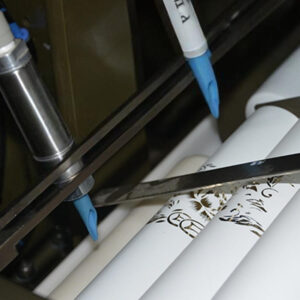
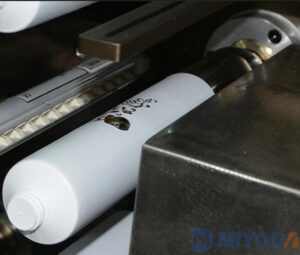
Premium tube packaging increasingly demands in-line embossing, hot-stamp decoration, or integrated label application at the filling stage. When a machine accommodates these finishing operations in-line, you eliminate a separate downstream process — reducing handling, contamination risk, and production floor footprint simultaneously.
Future-Proofing Against Market Changes
Technology upgrades without complete equipment replacement
The tube packaging market is evolving rapidly — bio-based PE substrates, post-consumer recycled (PCR) content requirements of 30–50%, compostable laminate formats. Each new material has slightly different sealing parameters. Bio-based PE, for example, requires jaw temperatures approximately 5–8°C lower than conventional PE to avoid thermal degradation of the bio-polymer chains.
A machine with independent per-recipe temperature fine-tuning capability handles these material transitions through parameter adjustment. A machine with a fixed or globally offset temperature control requires physical tooling modifications — or a new machine — to accommodate new substrates.
4. Ease of Operation and Maintenance: Your Daily Reality
User-Friendly Controls That Reduce Training Time
Why intuitive interfaces save you money on labor
Operator training for a semi-automatic tube filler requires 1–3 days to reach competent sustained production. Training for a fully automatic filling line — covering PLC alarm diagnosis, HMI recipe management, servo drive parameters, and changeover sequencing — requires 2–4 weeks to reach independent operation.
The gap between a well-designed HMI and a poorly designed one represents real money. A facility in Thailand documented 11 lost production days in a single quarter because their sole qualified operator was absent due to illness. Their machine was functional. Their qualified operator pool was not. Cross-training a minimum of two operators per machine is a production continuity requirement, not an optional investment — and it is only practical if the machine’s interface is genuinely learnable.
Key Term: PLC (Programmable Logic Controller) — the industrial computer that controls machine sequencing, safety interlocks, and alarm management. PLC-based machines store all operational parameters digitally, enabling recipe management, fault logging, and remote diagnostics unavailable on older relay-logic or mechanical-cam systems.
Touchscreen systems versus mechanical controls: What works best
Modern touchscreen HMI systems with graphical process visualization, alarm history logging, and stored format recipes outperform mechanical control panels in every dimension relevant to cosmetic and pharmaceutical production: changeover time, operator error rate, and fault diagnosis speed. The exceptions are in extremely dusty or high-humidity environments where touchscreens may require additional protection ratings (IP65 minimum for washdown environments).
Maintenance Demands That Won’t Drain Your Resources
Preventive maintenance schedules and their real costs
Critical wear components on tube filling machines include:
- Piston pump seals — replaced every 3–6 months on abrasive products (physical exfoliants, zinc oxide formulations)
- Sealing jaw heating elements — replaced every 12–18 months at sustained production
- Nozzle check valves — replaced every 6–12 months depending on product acidity and abrasiveness
- Conveyor drive belts — annual replacement at high-volume operations
Ask every supplier to provide a 3-year spare parts forecast with unit pricing at time of quotation — not a generic maintenance recommendation. Suppliers who cannot provide this data at the evaluation stage are giving you a reliable preview of the support experience you will have after purchase.
Downtime implications for your production schedule
Industry data shows that unplanned packaging line downtime costs cosmetic and pharmaceutical manufacturers between USD 10,000 and USD 100,000 per hour depending on product value and production scale. For a pharmaceutical contract manufacturer filling specialty ointments at USD 25/kg product cost, a 4-hour unplanned stoppage involving 8,000 tubes of 50g product represents USD 10,000 in direct product cost alone — before accounting for production rescheduling, rush overtime, and order delivery penalties.
The most cost-effective maintenance strategy is documented preventive maintenance executed on schedule — not reactive repair after failure. Ask suppliers for their recommended PM interval schedule and the average time required to complete each service event.
Technical Support and Spare Parts Availability
Why responsive manufacturer support protects your investment
When a sealing jaw fails mid-run on a 40,000-tube pharmaceutical batch, the relevant question is not when a technician might be available — it is what the contractual response time guarantee is and where the nearest stocked spare parts depot is located.
Before purchase, ask every supplier:
- What is your committed response time for critical production stoppages?
- Where is your nearest regional service center?
- Which critical spare parts are stocked within 48-hour shipping distance of my facility?
Suppliers who cannot answer these questions concretely during the sales process will not answer them more helpfully after the purchase order is signed.
Cleaning and Sanitation Protocols
For products subject to ISO 22716 Good Manufacturing Practice for cosmetics, CIP (Clean-in-Place) systems represent current best practice. CIP automates chemical flushing of product pathways without disassembly — reducing cleaning time from 2–3 hours of manual teardown to 30–45 minutes of documented automated cycling.
Key Term: CIP (Clean-in-Place) — an automated system for cleaning internal machine surfaces, product-contact pathways, and fill heads without requiring manual disassembly. CIP systems generate a cleaning cycle log that becomes part of your GMP documentation record.
For pharmaceutical operations, cleaning validation — documented proof that cleaning procedures consistently remove product residues and cleaning agents below established limits — is required before any new product is introduced on shared equipment. Machines with CIP systems reduce the time and cost of cleaning validation significantly by providing reproducible, documented cleaning cycles.
5. Reliability and Durability: Protecting Your Investment Long-Term

Build Quality That Justifies Your Investment
Materials and construction that withstand continuous operation
For pharmaceutical and regulated cosmetic applications, product-contact surfaces must be constructed from 316L stainless steel with a surface finish of Ra ≤ 0.8 µm — the electropolished standard that prevents bacterial adhesion and enables validated cleaning. Non-product-contact structural components should be 304 stainless steel minimum; painted mild steel is not acceptable in cleanroom environments.
Machine frames constructed from welded stainless steel profiles maintain dimensional stability across thermal cycling — a critical property for maintaining seal jaw alignment and fill accuracy at sustained production temperatures. Machines with painted powder-coat steel frames show dimensional drift under repeated thermal cycling that affects calibration stability over time.
Why cheap equipment costs more in the long run
A USD 12,000 entry-level semi-automatic filler with a 3-month spare parts lead time from the manufacturer’s home country is not a USD 12,000 machine. It is a machine whose first unplanned breakdown — statistically occurring within 18 months of heavy production use — can cost USD 15,000–40,000 in lost production, rush orders, and expedited repair service.
The total 3-year cost of ownership for that machine frequently exceeds the cost of a USD 28,000 machine from a supplier with a regional service network and 48-hour parts availability — making the “cheaper” machine the more expensive decision by a significant margin.
Uptime Rates That Keep Your Production On Schedule
What reliability percentages actually mean for your business
A machine with 95% uptime sounds excellent — until you calculate what 5% downtime costs across your production schedule. On a two-shift, 250-day operating calendar:
$$\text{Annual Downtime} = 250 \text{ days} \times 2 \text{ shifts} \times 8 \text{ hours} \times 5% = 200 \text{ hours}$$
At 80 TPM with a product value of USD 0.50/tube, 200 hours of annual downtime represents 160,000 tubes unproduced — USD 80,000 in revenue not generated. The difference between a 95% and a 99% uptime machine at this scale is 64,000 tubes, or USD 32,000 in annual revenue impact.
Redundancy features that prevent complete production halts
High-reliability tube filling machines incorporate redundancy features that allow continued — if reduced — operation during component failures: dual fill heads where one can operate independently, bypass circuits for non-critical vision inspection systems, and manual override modes for conveyor and indexing functions. These are not luxury features; they are production continuity tools that prevent a single component failure from stopping an entire production run.
Long-Term Value Beyond the Purchase Price
Total cost of ownership calculations that reveal true expenses
The purchase price of a tube filling machine represents only 30–40% of its total cost of ownership over a 10-year service life. The remaining 60–70% comprises operating labor, energy consumption, maintenance and spare parts, cleaning materials, and production losses from downtime and quality defects.
A USD 25,000 semi-automatic machine producing 2 million tubes per year with USD 45,000 in annual operating costs yields a 10-year TCO of USD 475,000 — a cost per tube of USD 0.024.
A USD 80,000 automatic machine producing 8 million tubes per year with USD 38,000 in annual operating costs yields a 10-year TCO of USD 460,000 — a cost per tube of USD 0.006 — 75% lower per unit despite a higher purchase price.
6. Regulatory Compliance and Certification Standards
Meeting Industry Requirements Without Guesswork
FDA compliance for pharmaceutical applications
In the United States, pharmaceutical tube filling must comply with FDA 21 CFR Part 211 — the Current Good Manufacturing Practice (cGMP) regulation for finished pharmaceuticals. Equipment-specific requirements include: construction from materials that do not contaminate product; documented cleaning validation procedures; electronic batch records generated for every production run; and calibration documented on a defined schedule.
Non-compliance has material consequences. Multiple cosmetic tube manufacturers have received FDA Warning Letters — with some facing facility-level remediation costs exceeding USD 500,000 — after failing to document GMP compliance during expansion into pharmaceutical contract filling.
CE marking and international standards compliance
For equipment sold or operated within the European Economic Area, CE marking under the EU Machinery Directive (2006/42/EC) is a legal requirement — not a quality indicator. It confirms the machine was assessed against essential health and safety requirements before being placed on the market. For cosmetic production in the EU, machine qualification documentation must align with ISO 22716 GMP requirements and is increasingly reviewed by major retail buyers as part of supplier audits.
How non-compliance creates costly recalls and legal issues
A contract pharmaceutical manufacturer in Brazil operated a domestically purchased filling machine correctly for four years. When a European distributor requested the machine qualification file before approving a supply contract, it did not exist. Remediation took seven months and approximately USD 38,000 in consulting work — before the first EU-bound shipment cleared. The opportunity cost of the delayed contract launch: conservatively USD 400,000 in deferred revenue.
Documentation and Validation Support
Key Term: IQ / OQ / PQ — the three-stage qualification framework required for pharmaceutical and regulated cosmetic production:
- IQ (Installation Qualification): Documents that the machine was installed per design specifications with correct utilities.
- OQ (Operational Qualification): Verifies the machine performs within specification at minimum, target, and maximum operating settings.
- PQ (Performance Qualification): Demonstrates consistent production of compliant product across three consecutive batches at production conditions.
A realistic IQ/OQ/PQ execution timeline for pharmaceutical equipment is 8–16 weeks after machine installation. Total cost — including protocol writing, test execution, documentation, and regulatory review — typically runs USD 20,000–100,000 depending on equipment complexity.
Suppliers who provide IQ/OQ/PQ template protocols as standard scope — not as a paid add-on — are signaling genuine experience in regulated market supply. This is a supplier selection criterion, not a nice-to-have feature.
Traceability and record-keeping capabilities
Modern pharmaceutical-grade filling machines generate electronic batch records automatically — linking each production run to machine settings, fill weights, sealing temperatures, operator IDs, and raw material lots. Pharmaceutical regulations require minimum 5-year data retention. Budget for a manufacturing execution system (MES) or ERP integration if your machine does not generate audit-ready batch records natively. This is not optional in regulated markets; it is a market access requirement.
7. Cost Structure and ROI: Making the Numbers Work
Understanding Total Cost of Ownership
Initial purchase price versus lifetime operating costs
| Cost Category | Typical Range (USD 80k automatic machine) |
|---|---|
| Equipment purchase price | 80,000 |
| Site preparation & utility upgrades | 5,000–15,000 |
| Installation & commissioning | 3,000–8,000 |
| Operator & maintenance training | 3,000–8,000 |
| IQ/OQ/PQ validation (pharmaceutical) | 20,000–60,000 |
| Spare parts initial inventory | 5,000–15,000 |
| Facility qualification (cleanroom/HVAC) | 5,000–30,000 |
| Total Project Cost | USD 121,000–216,000 |
Energy consumption and labor requirements
Modern servo-driven filling machines consume 30–40% less energy than pneumatic-actuator equivalents of comparable output. At sustained 2-shift operation, that energy saving — typically USD 3,000–8,000 annually at industrial electricity rates — compounds meaningfully across a 10-year service life.
Labor: a fully automatic line at 80 TPM requires 1 operator per shift. Three semi-automatic lines producing equivalent output require 3–4 operators per shift. At a blended labor rate of USD 22/hour across two shifts and 250 operating days:
$$\text{Annual Labor Saving} = 3 \text{ operators} \times 2 \text{ shifts} \times 8 \text{ hours} \times 250 \text{ days} \times $22 = $264,000$$
Return on Investment Timeline
How quickly the machine pays for itself
For a manufacturer producing 8 million tubes per year upgrading from semi-automatic to one fully automatic line, with a USD 120,000 total project cost (machine + ancillary), USD 264,000 in annual labor savings, and USD 45,000 in annual waste reduction:
$$\text{Payback Period} = \frac{$120,000}{$264,000 + $45,000} = \approx 4.7 \text{ months}$$
At high volume and moderate labor costs, automation payback can be remarkably fast. At lower volumes (2–3 million tubes per year), the same calculation typically shows a payback of 18–30 months — still a strong investment case when evaluated against a 10-year machine life.
For a detailed comparison of semi-automatic vs. fully automatic economics across different production scenarios, the Miyoda Packaging Machinery buyer’s guide for pharmaceutical and cosmetic tube filling provides scenario-by-scenario TCO analysis with documented production data.
Financing and Support Options
Lease versus purchase considerations for your cash flow
Buy if you will operate the equipment for more than 5 years, have capital available, and plan to build long-term production equity. Lease if you require technology flexibility, expect to upgrade in 3–4 years, or need to preserve working capital for market development activities. Leasing typically costs 30–50% more over a full 10-year equipment period — but preserves cash flow, which is a meaningful trade-off for brands in early rapid growth phases where capital deployed to distribution generates higher returns than equipment ownership.
Always evaluate lease offers against this benchmark: what is the total cost of the lease over your expected holding period, versus purchase price plus maintenance over the same period? The answer is not always obvious and varies significantly by lease structure and interest rate environment.
8. Safety Features and Operator Protection
Safeguarding Your Team
Emergency stop systems and safety interlocks
CE-marked machines comply with EU Machinery Directive requirements including emergency stop circuits accessible from all operator positions, guard-monitored safety interlocks that prevent machine cycling when access doors are open, and two-hand operation requirements for manual loading stations. These are legal baselines — not premium features.
For pharmaceutical production environments, OSHA 29 CFR 1910.147 lockout/tagout requirements mandate documented energy isolation procedures for all maintenance and cleaning activities. Machines with clearly labeled isolation points and stored lockout/tagout procedures in the operator documentation package reduce compliance burden and eliminate the most common category of serious manufacturing injury.
Noise levels and ergonomic considerations
High-speed automatic tube filling machines operate at 70–85 dB(A) at operator stations — below the 85 dB(A) threshold requiring mandatory hearing protection under EU and US regulations, but approaching it in high-speed configurations. Verify noise level data under full production conditions (not idle) from the supplier’s test documentation.
Ergonomic design of tube loading stations — specifically loading height, angle of approach, and repetitive motion requirements — affects operator fatigue rates, absenteeism, and long-term musculoskeletal injury risk. These factors have direct production continuity implications beyond their human cost.
Risk Mitigation and Liability
Insurance implications of equipment safety features
Facilities operating CE-marked, documented-safe machinery with current risk assessments and operator training records carry measurably lower product liability and equipment liability insurance premiums than facilities with non-documented equipment. Request current CE documentation, risk assessment, and declaration of conformity from every supplier as part of standard purchase due diligence.
Compliance with workplace safety regulations
Training records documenting operator qualification on specific machines are required in pharmaceutical GMP environments and strongly recommended for cosmetic production. In the event of a workplace incident, documented training records demonstrating operator competence are the difference between a manageable safety investigation and a protracted liability exposure.
Making Your Final Decision
Bringing It All Together
By this point in your evaluation, you have the framework to move beyond “this machine costs less” to a genuinely informed equipment decision. The five core criteria — production capacity, fill precision, flexibility, operational maintenance reality, and proven reliability — interact with each other in ways that brochure comparisons cannot reveal.
Here is a practical comparison matrix for your top equipment choices:
| Evaluation Criterion | Weight | Machine A Score (1–10) | Machine B Score (1–10) | Machine C Score (1–10) |
|---|---|---|---|---|
| Production capacity match | 20% | |||
| Fill precision / Cpk | 20% | |||
| Format flexibility | 15% | |||
| Maintenance accessibility | 15% | |||
| Regulatory documentation | 15% | |||
| Supplier support quality | 15% | |||
| Weighted Total | 100% |
Score each criterion independently for each machine under evaluation. The supplier with the highest weighted total — not the lowest price — is your starting negotiation point.
Red flags that should eliminate a machine from consideration
A machine should be removed from your evaluation shortlist if the supplier cannot provide: fill weight Cpk data from a documented production trial; IQ/OQ/PQ template protocols; a committed response time guarantee for technical support; a 3-year spare parts forecast with unit pricing; or references from existing customers in your product category and production scale.
Questions to ask manufacturers before signing contracts
Before committing to any purchase:
- Can I conduct a Factory Acceptance Test with my actual product formulation?
- What is your contractual response time for critical production stoppages?
- Which spare parts do you stock within 48-hour shipping range of my facility?
- What are the upgrade paths for speed and fill-head expansion on this platform?
- Can you provide references from customers producing the same product type at a similar scale?
- What does your warranty explicitly exclude, and can I see the warranty document now?
Your Next Steps
Timeline for evaluation and purchase
Allow 8–12 weeks for a thorough equipment evaluation, including supplier qualification, reference calls, FAT scheduling and execution, and contract review. Add 10–16 weeks lead time from order to delivery for standard configurations (16–24 weeks for custom pharmaceutical-grade systems), and 16–40 weeks from delivery to first validated commercial production batch depending on regulatory requirements.
Plan your product launch date around these timelines — not the other way around.
Getting references from other cosmetic manufacturers
Request a reference list of installed machines in your product category and your production scale. Contact those references directly — not through the supplier’s introduction. Ask specifically: what has been your actual fill weight Cpk in sustained production? What has been your average monthly unplanned downtime? How responsive is the supplier when you need technical support?
The answers will tell you more about the machine you are buying than any specification document.
📺 Watch: Tube Filling and Sealing Machine in Action
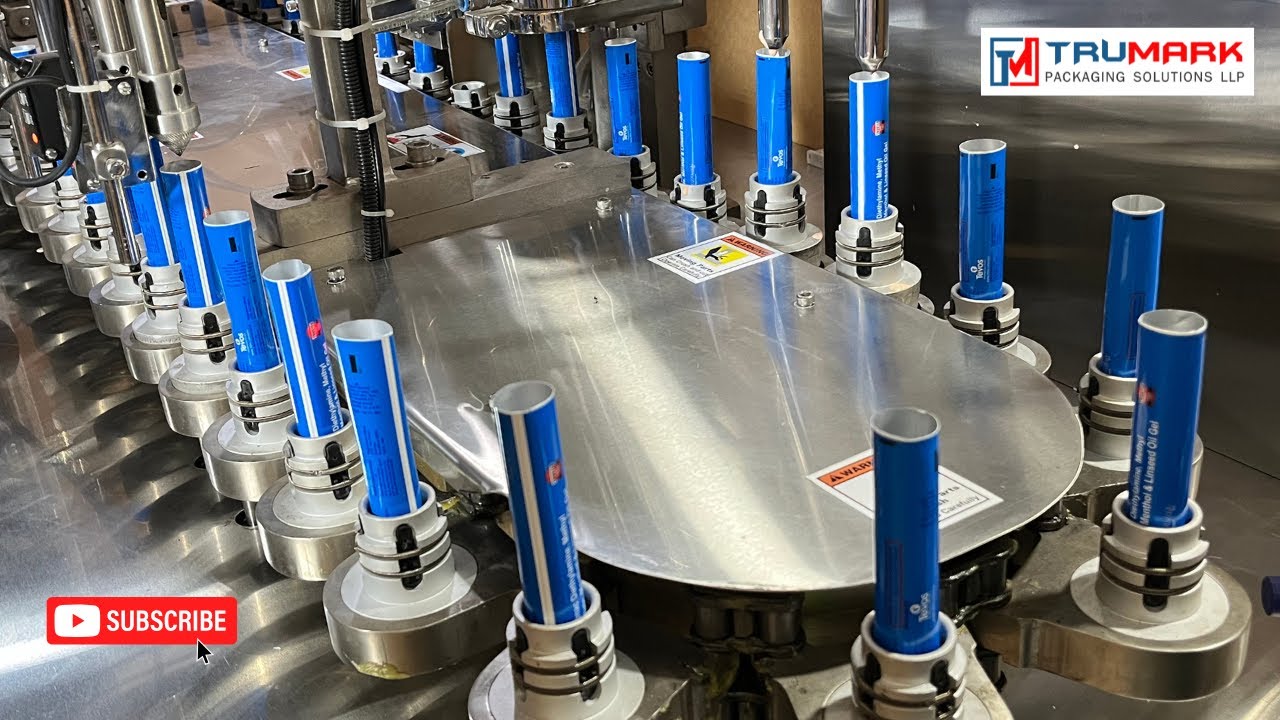
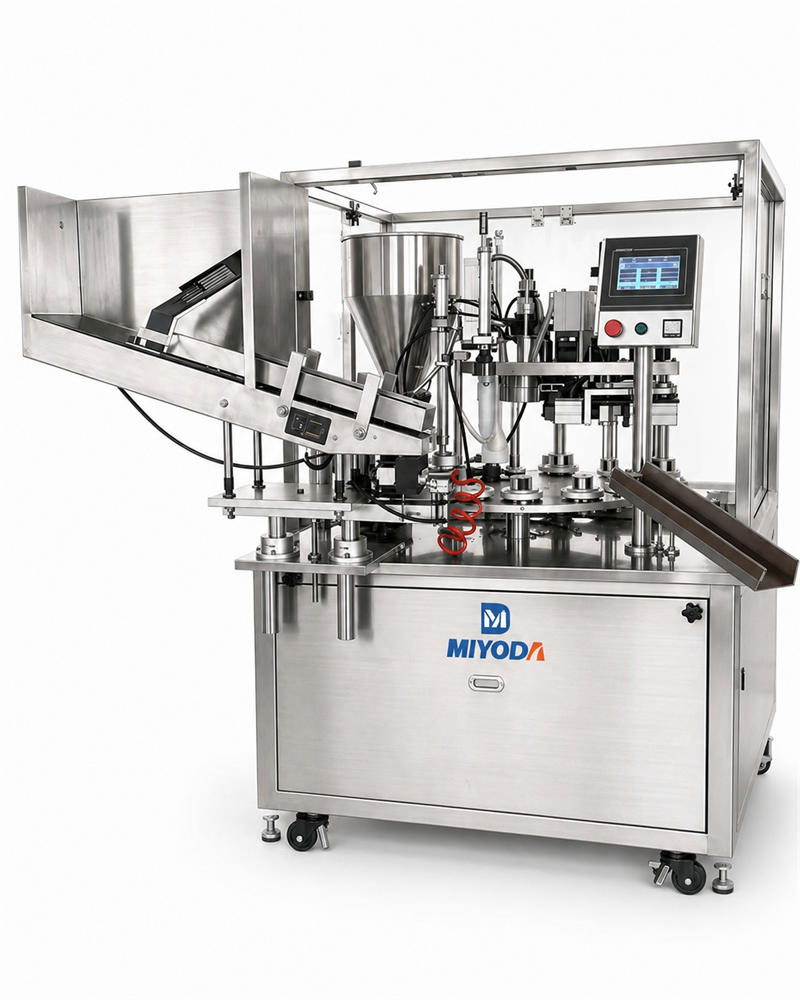
Watch: This video shows a high-speed automatic 2-head tube filling and sealing machine running at full production speed — observe the continuous rotary indexing, servo-driven fill stations, hot-air sealing jaws, and embossed batch coding in a single continuous cycle. If your target production volume is above 5 million tubes per year, this is the operational benchmark your equipment evaluation should be measured against.
Ready to Find the Perfect Tube Packaging Machine for Your Operation?

Choosing the right equipment is a decision that compounds over 10 years of production. Getting it right means lower cost per tube, faster regulatory approval, fewer production stoppages, and genuine scalability as your brand grows.
Miyoda Packaging Machinery specializes exclusively in automated tube production lines for cosmetic and pharmaceutical brands — covering everything from high-speed tube filling and closing machines to complete laminate tube production lines. Their equipment is engineered specifically for the material compatibility, fill precision, and regulatory documentation requirements of regulated cosmetic and pharmaceutical markets — not adapted from a generalist platform.
Download our free Tube Packaging Machine Buyer’s Checklist to evaluate equipment systematically across all five criteria — or schedule a consultation with our equipment specialists to discuss your specific production volume, tube format, and compliance requirements.
👉 Explore the Full Machine Range →
👉 Read the Complete Tube Filling Machine Buyer’s Guide →
Glossary of Key Terms
| Term | Definition |
|---|---|
| ABL | Aluminum Barrier Laminate — a multi-layer tube material containing an aluminum foil inner layer, providing near-complete oxygen and moisture barrier. |
| PBL | Plastic Barrier Laminate — a multi-layer tube using EVOH or nylon polymer barrier layers instead of aluminum foil. Fully recyclable, excellent printability. |
| TPM | Tubes Per Minute — standard production rate metric across the tube filling industry. |
| OEE | Overall Equipment Effectiveness — combined measure of availability, performance, and quality rate. World-class = 85–92%. |
| Cpk | Process Capability Index — measures how consistently fill weight stays within specification limits. Pharma requirement: Cpk ≥ 1.33. |
| IQ/OQ/PQ | Installation, Operational, and Performance Qualification — the three-stage framework required for pharmaceutical equipment validation. |
| FAT | Factory Acceptance Test — a formal production trial at the supplier’s facility before machine shipment. |
| CIP | Clean-in-Place — automated chemical cleaning of internal product pathways without machine disassembly. |
| HMI | Human-Machine Interface — the touchscreen or control panel through which operators interact with the machine. |
| PLC | Programmable Logic Controller — the industrial computer controlling machine sequencing, safety interlocks, and alarm management. |
| SPC | Statistical Process Control — statistical monitoring of production data in real time to detect process drift before defects occur. |
| TCO | Total Cost of Ownership — the complete cost of a machine across its service life, including purchase price, labor, maintenance, and production losses. |
| GMP | Good Manufacturing Practice — regulatory framework governing production quality, documentation, and equipment validation. |
Frequently Asked Questions
Q1: What production capacity do I actually need for my cosmetic business?
Size your machine to your current annual volume divided by available operating hours — then add 25–35% headroom for growth and seasonal peaks. A brand currently at 2 million tubes per year targeting 4 million in year three should not buy exactly to current volume; that forces a premature replacement decision that typically costs 60–80% of the original machine’s residual value plus full replacement cost. Calculate your minimum TPM requirement using the formula in Section 1, then specify equipment at 125–135% of that minimum.
Q2: How do I verify that a machine’s precision claims are real?
Request a Factory Acceptance Test (FAT) with your actual product formulation — not a demonstration with a substitute medium. A credible FAT includes a minimum 4-hour continuous run at target speed, fill weight data with mean and standard deviation across the run, seal peel strength measurements per ASTM F88, and print registration verification. Request the Cpk value from the FAT data — anything below Cpk 1.33 should prompt further investigation before purchase commitment.
Q3: Can one tube packaging machine handle multiple product types?
Yes, with important constraints. Quality machines handle different tube diameters (typically 13.5mm–50mm), lengths (50mm–220mm), and tube materials (plastic, ABL laminate, PBL laminate) through interchangeable tooling sets and stored HMI recipes. Viscosity differences, however, may require nozzle changes and fill pressure recalibration. Always confirm with the supplier that your complete formulation viscosity range — not just your primary SKU — is compatible with the machine’s fill system without significant reconfiguration.
Q4: What is the realistic downtime for maintenance and cleaning?
Preventive maintenance for standard semi-automatic machines requires 30–60 minutes per 500–1,000 production hours for scheduled servicing. Cleaning between product changeovers requires 30–45 minutes with CIP systems, or 2–3 hours with manual cleaning procedures. Unplanned breakdown frequency for well-maintained automatic machines averages 1–2 events per 2,000 production hours; average repair time for common failure events (seal jaw replacement, check valve swap, nozzle cleaning) is 45–90 minutes with readily available spare parts.
Q5: How important is manufacturer support and spare parts availability?
It is the second most important decision factor after machine specification — and the most commonly underweighted in price-driven procurement decisions. A machine with 8-week spare parts lead times is functionally unavailable for maintenance during that window. Before purchase, require the supplier to contractually commit to: critical spare parts availability within 48 hours of request; a documented regional service network; and a named technical support contact with committed response times. These commitments are as important as the machine’s fill accuracy specification.
Q6: What should I look for in warranty coverage?
A standard 12-month warranty covers manufacturing defects and component failures under normal use. What it typically excludes: wear items (seals, gaskets, check valves, heating elements), damage from incorrect operation or cleaning procedures, and calibration drift outside normal servicing intervals. Request the actual warranty document — not a verbal summary — before signing the purchase order. Pay particular attention to the definition of “normal use” and which components are classified as consumables excluded from coverage.
Q7: How do I calculate the true ROI of a tube packaging machine?
Use this framework:
$$\text{Annual Net Saving} = \text{Labor Saving} + \text{Waste Reduction} + \text{Quality Cost Reduction} – \text{Annual Operating Cost}$$
$$\text{Payback Period (months)} = \frac{\text{Total Project Cost}}{\text{Annual Net Saving}} \times 12$$
Factor in: purchase price, installation, training, energy consumption, maintenance, spare parts, labor savings, and waste reduction. For pharmaceutical applications, include IQ/OQ/PQ validation costs in your total project cost. Most well-specified automatic tube filling machines in high-volume cosmetic production achieve payback within 12–30 months.
Q8: What regulatory certifications must my tube packaging machine have?
CE marking (EU Machinery Directive) is required for equipment operated within the EEA. For pharmaceutical production in the US, equipment must be qualified per FDA 21 CFR Part 211 cGMP requirements — there is no “certification” per se, but the manufacturer must provide IQ/OQ/PQ qualification documentation. For cosmetic production in the EU under ISO 22716 GMP, machine qualification documentation demonstrating installation, operational, and performance qualification is required. For any pharmaceutical application, request the supplier’s validation master plan and IQ/OQ/PQ template protocols as part of your supplier qualification.
Q9: Is leasing or buying the better financial choice?
Buy if: production volume is stable and predictable, you will operate the machine for 5+ years, and capital is available without compromising growth investment. Lease if: you expect significant volume changes in the next 3 years, want technology flexibility, or need to preserve working capital. Calculate the total lease cost across your expected holding period and compare to purchase price plus maintenance — the difference often exceeds 30–50% over 10 years. Leasing is not inherently wrong; it is wrong when the premium paid for flexibility exceeds the value of that flexibility to your specific operation.
Q10: How much training do operators need to run a tube packaging machine?
Semi-automatic machines: 1–3 days to reach competent, sustained production. Fully automatic filling lines with PLC alarm management, HMI recipe management, servo drive diagnostics, and changeover sequencing: 2–4 weeks to reach independent operation. Factor the full training cost and production ramp-up time into your project budget. Suppliers who provide on-site training with operator qualification documentation and video-based remote support eliminate a critical dependency on locally available specialist technicians.
Q11: What’s the difference between semi-automatic and fully automatic machines?
Semi-automatic: the operator loads tubes manually; the machine fills, seals, and codes. Price range USD 8,000–35,000. Sustained production: 15–40 TPM. Best for annual volumes below 5 million tubes and high-SKU-count, small-batch operations. Fully automatic: tubes are loaded from a hopper or magazine, oriented, filled, sealed, coded, and discharged without manual intervention. Price range USD 60,000–250,000+. Sustained production: 60–200+ TPM. Best for annual volumes above 5 million tubes where labor cost savings justify the capital premium within a reasonable payback period.
Q12: How do I know if a machine will actually fit my production space?
Request detailed technical drawings, floor plans showing machine footprint plus maintenance clearance (minimum 1 meter on all sides requiring access), and utility specifications (electrical supply, compressed air, chilled water, drain connections). Account for material staging area near the loading station and finished goods staging near the discharge. Visit the manufacturer’s facility to see a comparable machine in operation and verify that the footprint matches what is shown on the drawing.
Q13: What happens if I outgrow my machine’s capacity?
On a modular platform (see Section 1 — Scalability), speed can be upgraded through additional fill heads or motor upgrades without replacing the base machine. On a fixed-capacity platform, outgrowing your machine means either running multiple shifts at maximum capacity (high maintenance risk, no peak demand buffer) or purchasing a second machine (full capital outlay, doubled maintenance burden, additional floor space). The answer to “what is the upgrade path when I need more capacity?” is one of the most important questions to ask before purchase.
Q14: How do I ensure the machine meets my cosmetic product’s specific requirements?
Conduct compatibility testing before finalizing your purchase commitment: run your actual formulation at target fill weight, target speed, and target sealing parameters during the FAT. Measure fill weight Cpk, seal peel strength, cap torque, and print registration. For sensitive formulations (high essential oil content, low-pH actives, alcohol-based products), conduct accelerated compatibility testing of the tube material in contact with the filled product at 40°C/75% RH for a minimum of 3 months before committing to production tooling.
Q15: What should I do before signing a purchase agreement?
Confirm in writing: equipment specifications and performance guarantees (fill weight Cpk, TPM, OEE target); warranty scope including explicit exclusions; training scope and operator qualification documentation; IQ/OQ/PQ protocol availability and included scope; spare parts availability commitments; installation timeline and commissioning milestones; and payment terms linked to delivery and FAT sign-off milestones. Have a legal review of any purchase agreement involving equipment valued above USD 50,000. Request references from at least three existing customers in your product category and contact them independently before signing.