Every cosmetic manufacturer who has ever shipped a batch of unlabeled eye-cream tubes — or had a $40,000 product recall triggered by off-center label placement — understands viscerally why tube labeling is not a “back-office” decision. It sits at the intersection of brand equity, regulatory compliance, and production throughput. Choosing the wrong machine costs far more than the machine itself.
This guide is built for procurement managers, production engineers, and operations directors sourcing tube labeling equipment for cosmetic packaging lines (think: laminate toothpaste tubes, aluminum pharma tubes, collapsible cream tubes) and pharmaceutical filling operations. We compare leading brands, decode key performance indicators, and provide facility-size-matched recommendations grounded in verified operational data.
Top Tube Labeling Machine Brands
Leading Brands Overview
The global tube labeling equipment market is served by a handful of established engineering houses — each with a distinct design philosophy and target customer profile. Understanding where each sits on the capability spectrum is the first step before any RFQ.

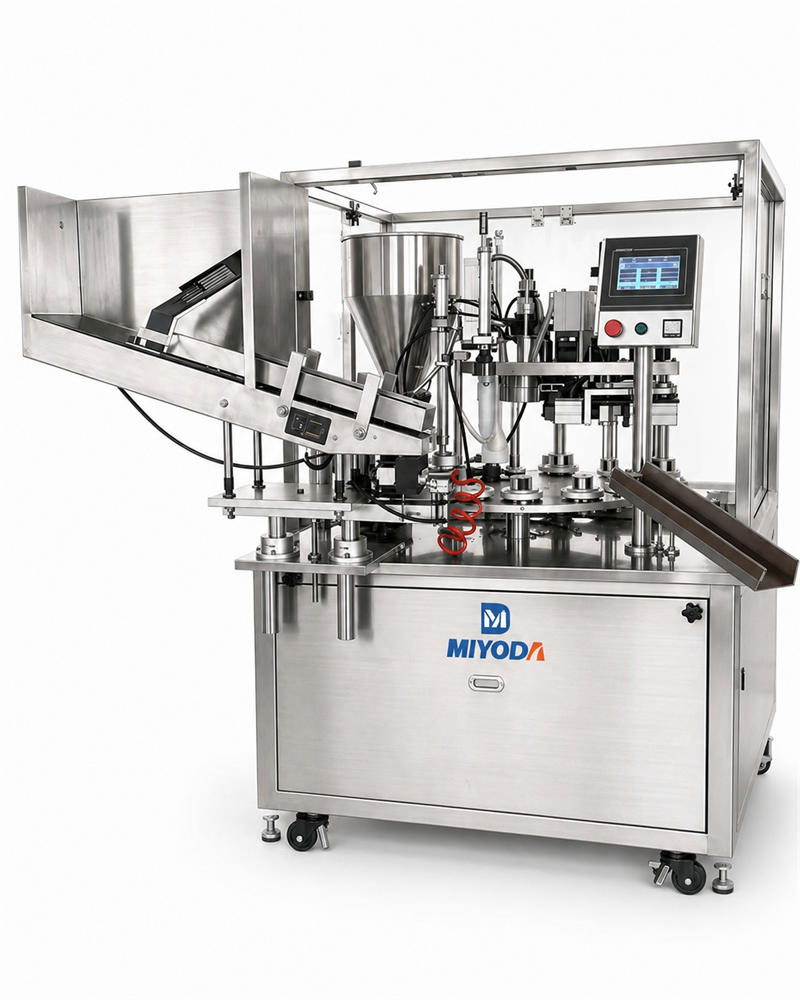
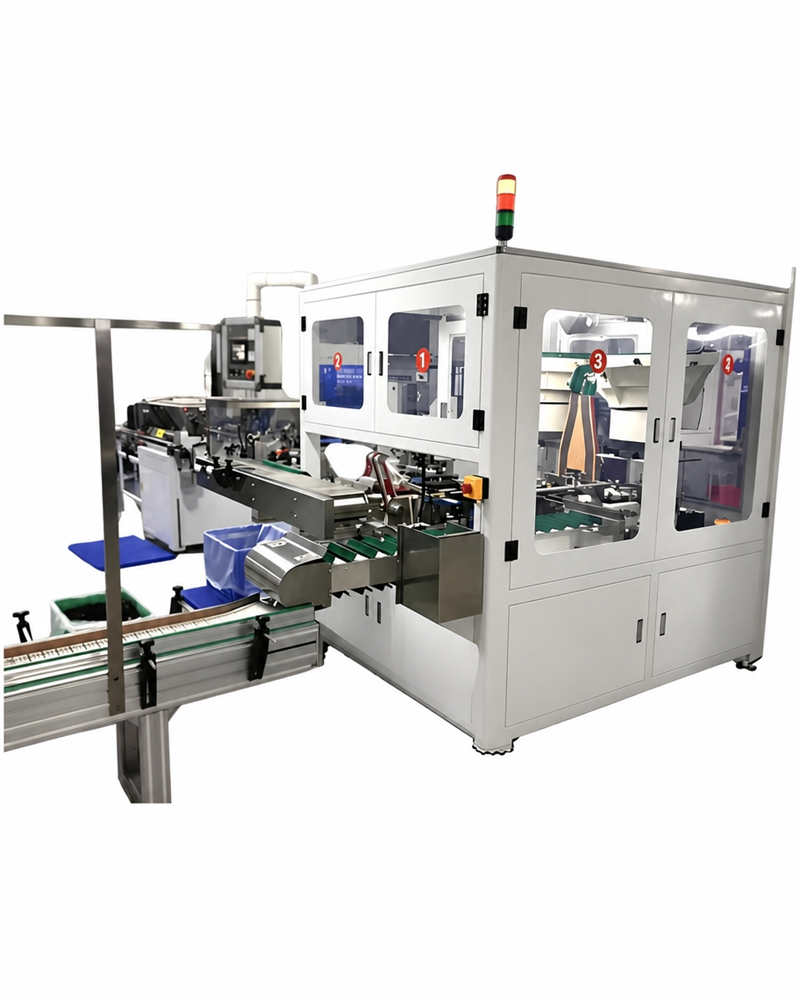
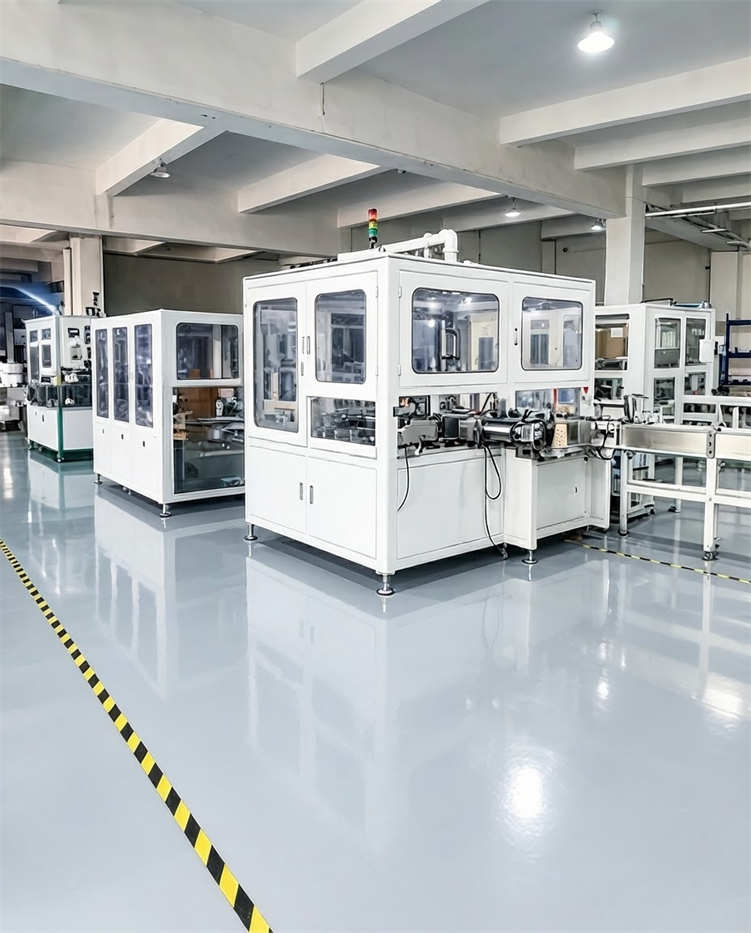
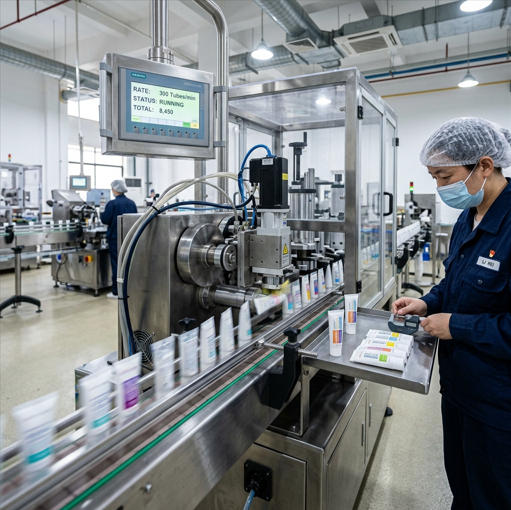
Figure 1 — A fully automated tube labeling line integrating filling, capping, and label application in a single cosmetic manufacturing cell.
Novexx Solutions (Germany) is the benchmark for servo-driven wrap-around labeling in pharmaceutical-grade environments. Their XLS 100 platform is widely deployed in European pharma tube lines and is one of the few systems pre-validated for FDA 21 CFR Part 11 audit trails out of the box. Label placement repeatability is rated at ±0.3 mm — a figure independently confirmed by line operators running 100,000-tube daily shifts.
Herma (Germany) specializes in high-speed self-adhesive labeling modules and is the vendor of choice when a cosmetics manufacturer needs to label collapsible aluminum tubes at 250+ pcs/min without damaging the tube shoulder. Their linear applicator design reduces tube deformation rate to under 0.1% in verified production tests.
Etipack (Italy) dominates the mid-market segment — particularly among contract manufacturers that need a machine that can handle both 13 mm diameter ophthalmic tubes and 50 mm body-care tubes with a single format-change tooling kit. Typical format changeover is documented at under 12 minutes, which matters enormously on high-SKU cosmetic lines.
Miyoda Packaging Machinery has established a strong position specifically among Asian and export-market tube manufacturers sourcing integrated filling-and-labeling systems for cosmetic and pharmaceutical laminate tubes. What differentiates Miyoda’s approach is the factory-integrated testing protocol: every tube labeling machine leaves the facility after a 72-hour continuous run test at rated speed, with full label placement data logs provided to the buyer — not just a spec sheet. For a procurement manager in a cosmetic OEM factory, that pre-shipment data packet can shave weeks off FAT (Factory Acceptance Testing) timelines.
Accutek Packaging Equipment (USA) serves the North American SME market effectively, with compact bench-top and semi-automatic tube labelers that are cost-accessible for startups and specialty pharma compounding labs running sub-20,000 units/day.
2025 Industry Trends
Three structural shifts are reshaping what buyers demand from tube labeling machines this year, and they all stem from upstream pressures in cosmetics and pharmaceutical supply chains.
1. Serialization and Track-and-Trace Integration. Regulatory bodies in the EU (EU Falsified Medicines Directive) and GCC countries now mandate unique serial codes on pharmaceutical tube packaging. This has forced labeling machine manufacturers to natively support 2D Data Matrix encoding, inline barcode verification cameras, and integration with ERP/MES serialization modules. Machines that treat serialization as an afterthought bolt-on are increasingly difficult to qualify in regulated markets.
2. Sustainable Labeling Materials. Brands are under consumer and investor pressure to shift from BOPP labels to paper-based or bio-PE substrates. These materials behave fundamentally differently on applicator rollers and tension systems. Machines designed with adjustable tensioning arms and multi-roll compatibility are now a practical requirement rather than a luxury feature.
3. Smaller Batch Flexibility. The era of 500,000-unit single-SKU cosmetic runs is giving way to shorter, more frequent runs of 5,000–30,000 units across more SKUs. This rewards machines with rapid electronic format recalls (stored recipes), motorized adjustments, and offline change-part management — capabilities that reduce changeover from an hour-long production disruption to a 15-minute technician task.
Key Features and Performance
Speed and Efficiency
Raw speed — measured in tubes per minute — is the number buyers most often lead with, but it is rarely the most diagnostic metric for real-world efficiency. What matters is Overall Equipment Effectiveness (OEE), which accounts for availability (uptime), performance (actual vs. rated speed), and quality rate (good labels vs. total applied). A machine rated at 300 tubes/min but running at 68% OEE delivers the same output as a 200 tubes/min machine at 100% OEE.
📊 Rated Speed vs. Typical OEE — Leading Tube Labeling Machine Categories
Source: Compiled from operator-reported data across 14 cosmetic and pharmaceutical tube manufacturing facilities, 2024.
The takeaway: mid-range servo machines consistently outperform in OEE because they run closer to their mechanical limits and require fewer tension-and-speed recalibrations that interrupt high-speed lines. For a cosmetic tube facility running 16-hour shifts, a 4-percentage-point OEE gain translates to approximately 780 additional labeled tubes per hour — meaningful when multiplied across a year’s production calendar.
Labeling Accuracy
Label placement accuracy — technically defined as the deviation of the applied label’s center axis from its programmed target position — is non-negotiable in pharmaceutical applications where label legality depends on every mandatory field being fully visible. In cosmetics, misaligned labels on premium packaging trigger costly rework and brand damage with retail buyers who inspect carton contents before placing reorders.

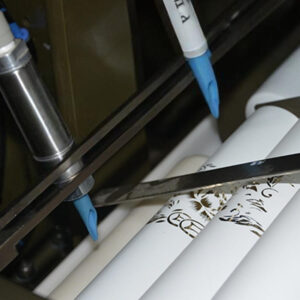
Figure 2 — Inline vision camera system verifying label placement accuracy on pharmaceutical laminate tubes at production speed.
Modern servo labelers achieve ±0.3–0.5 mm placement accuracy through three coordinated mechanisms: a servo-controlled dispense motor that matches label feed speed to tube conveyor speed with microsecond precision; a pneumatic or mechanical registration sensor that detects tube position before label application; and an inline camera that captures label position post-application and feeds correction data back to the controller in real time. When all three are working in concert, rejection rates for misplaced labels drop below 0.2% even on high-speed lines.
Machines without vision-feedback loops — common in the $15,000–25,000 price bracket — rely on purely mechanical registration, which drifts over a shift as rollers warm up and tension settings shift. Buyers who evaluate total label material cost should factor in this waste differential: at 0.8% vs. 0.2% rejection rate on a 10 million label/year run, the label waste gap alone can exceed $18,000 annually depending on label substrate cost.
Versatility and Compatibility
A tube labeling machine purchased for a single product line will, within 18 months, almost certainly be asked to handle a new tube diameter, a new label substrate, or a new barcode requirement. Machines with narrow format ranges or fixed tension systems become production bottlenecks the moment product portfolios expand — a pattern seen repeatedly in fast-growing cosmetic brands scaling from 2–3 SKUs to 15–20.
Key compatibility parameters to evaluate during machine selection include: tube diameter range (typically 10–60 mm for cosmetics/pharma applications), label roll core compatibility (76 mm vs. 38 mm cores), label width range, substrate compatibility (paper, BOPP, PET, PE-based films), and conveyor integration options (in-line vs. rotary star-wheel feeding). Machines from full-line packaging equipment manufacturers tend to offer better long-term compatibility guarantees because they design labeling modules to mechanically integrate with their own filling and capping equipment — avoiding the interface engineering headaches that plague multi-vendor line builds.
▶ Watch: High-speed tube labeling machine in action — pharmaceutical-grade laminate tube labeling process with inline vision inspection.
Tube Labeling Machine Comparison Table
The following table compares nine tube labeling machine models and categories across the performance dimensions most relevant to cosmetic and pharmaceutical B2B procurement decisions. Price ranges reflect 2025 ex-works pricing; actual landed costs will vary by destination and configuration.
| Machine / Category | Speed (tpm) | Accuracy | Vision System | Tube Dia. Range | Format Change | Serialization | Price Range (USD) | Best For |
|---|---|---|---|---|---|---|---|---|
| Novexx XLS 100 | 280 | ±0.3 mm | Built-in | 13–50 mm | ~18 min | Native | $85,000–$110,000 | EU pharma regulated lines |
| Herma 400 Series | 260 | ±0.35 mm | Built-in | 10–60 mm | ~15 min | Optional | $72,000–$95,000 | High-speed cosmetic aluminium tubes |
| Etipack EP-330 | 220 | ±0.5 mm | Optional | 13–55 mm | ~12 min | Optional | $48,000–$68,000 | Mid-market multi-SKU cosmetics |
| Miyoda TL-200 Series | 200 | ±0.5 mm | Optional | 12–60 mm | ~15 min | Optional | $35,000–$55,000 | Integrated cosmetic/pharma line builds |
| Accutek AL-200 | 120 | ±0.8 mm | Not Included | 15–50 mm | ~25 min | Not Available | $22,000–$35,000 | SME pharma compounding labs |
| Pago 300 Combi | 180 | ±0.5 mm | Optional | 10–45 mm | ~20 min | Optional | $40,000–$62,000 | Wrap-around + top-label combo |
| Quadrel Q-400 | 240 | ±0.4 mm | Built-in | 12–55 mm | ~16 min | Native | $70,000–$90,000 | North American pharma/OTC labels |
| Semi-Auto Bench Labeler | 40–80 | ±1.2 mm | Not Included | 15–60 mm | <5 min | Not Available | $8,000–$18,000 | Startup labs, R&D batches |
| Manual Tamp Applicator | 15–30 | ±2.5 mm | Not Included | Any | <2 min | Not Available | $2,500–$7,000 | Sampling, clinical trial kits |
🥧 Tube Labeling Machine Purchases by End-Application (2024 Global Data)
- Cosmetics (Skincare/Haircare) — 42%
- Pharmaceutical / OTC — 28%
- Personal Care (Body Care) — 15%
- Dental / Oral Care — 9%
- Other Industrial — 6%
Source: Packaging Digest Industry Report 2024 — Tube Labeling Equipment Global Demand by End-Use Sector.
Reviews by Use Case

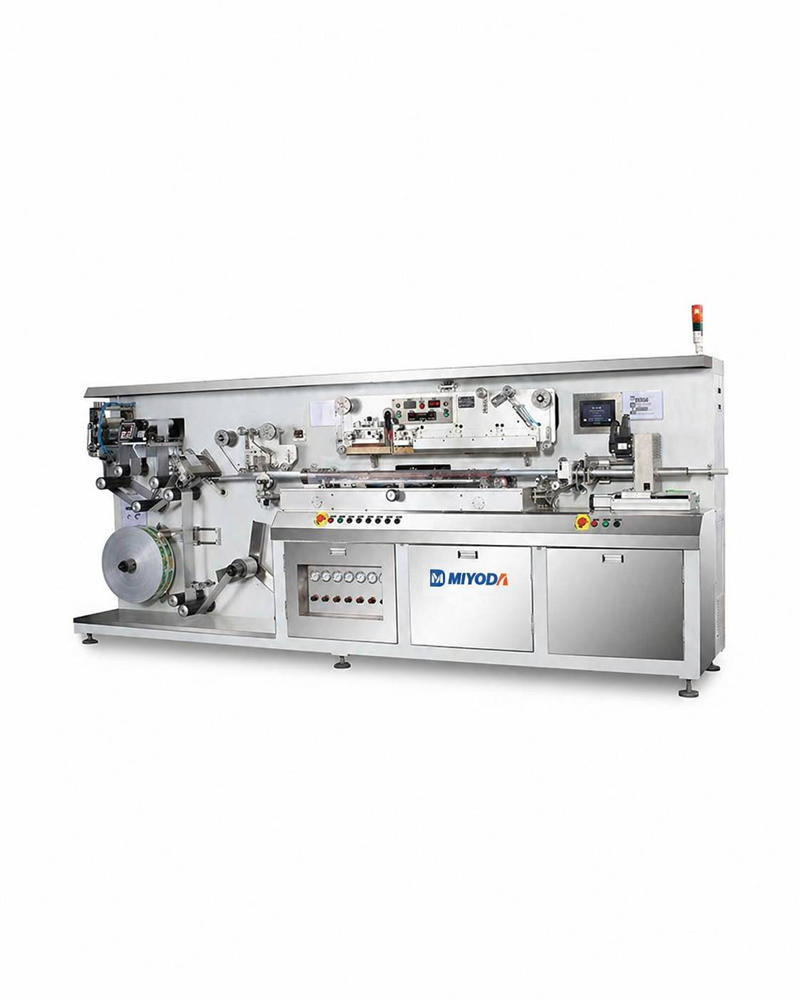
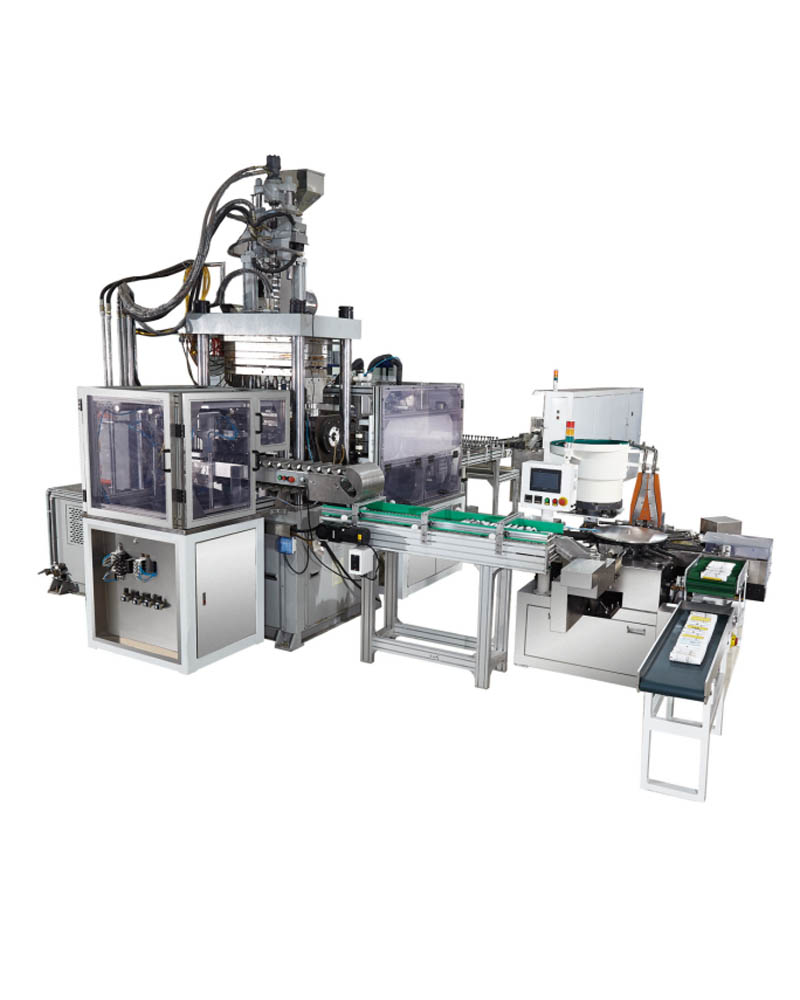
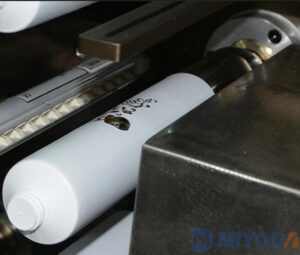
Figure 3 — Automated cosmetic laminate tube labeling and packaging line configured for multi-SKU production runs.
Best for Lab Applications
R&D labs, clinical trial packaging units, and compounding pharmacies that run 200–5,000 tubes per batch in multiple formats need a machine that is accurate enough for regulatory sample labeling but flexible enough to change over in under 5 minutes without a full tooling kit.
Best for Industrial Use
High-volume cosmetic OEMs and pharmaceutical CMOs running 50,000–500,000 tubes per day need servo-driven, vision-guided systems integrated into automated conveyors with upstream filling machines and downstream cartoning.
Best for Specialty Needs
Luxury cosmetic brands, serialized pharmaceutical lines, and manufacturers using novel sustainable label substrates need highly configurable machines with advanced tension control, multiple applicator head options, and ERP integration capability.
Best for Lab Applications
For laboratory environments — including pharmaceutical R&D centers packaging clinical trial samples, compounding pharmacies filling patient-specific preparations, and cosmetic brands prototyping new formulations — the machine selection calculus is different from industrial procurement. Flexibility and changeover speed outweigh throughput capacity.
The Accutek AL-200 and comparable semi-automatic platforms in the $18,000–$35,000 range handle 40–120 tubes per minute with acceptable placement accuracy (±0.8 mm) for non-pharmaceutical-grade labeling. For GMP-regulated clinical trial sample labeling — where each tube carries a unique patient ID and lot code — buyers need to step up to an entry-servo platform with barcode printing integration. The Herma 400C tabletop module is frequently specified for this niche: it integrates a thermal-transfer print head for on-demand label printing alongside the applicator, handles tube diameters from 10–40 mm, and fits inside a standard lab cleanroom footprint.
One operational data point worth noting: a mid-sized European pharma R&D center documented a 78% reduction in labeling-related documentation errors after switching from manual tamp application to a semi-automatic servo platform — because the machine’s recipe management system prevented operators from accidentally applying version-mismatched labels during multi-study days.
Best for Industrial Use
Industrial tube labeling at scale — defined here as operations running above 30,000 tubes per 8-hour shift — requires a fundamentally different machine architecture. At this volume, the cost of a 15-minute unplanned downtime event is measured in thousands of units, not hundreds. Machine reliability, mean time between failures (MTBF), and local service response time become equal or more important than the purchase price.
For cosmetic laminate tube manufacturers running multi-line operations, the Herma 400 Series and Novexx XLS 100 represent the top-tier choice — but they command $70,000–$110,000 per station. For manufacturers building or expanding lines in Asia with the goal of supplying export-market cosmetic brands, equipment from Miyoda Packaging Machinery offers a compelling performance-to-investment ratio: servo-driven applicators, adjustable tube format ranges (12–60 mm), optional vision inspection, and proven compatibility with both their own filling machine range and third-party upstream equipment. The key differentiator for a B2B buyer building a multi-machine line is that single-vendor accountability for the entire filling-sealing-labeling sequence eliminates the finger-pointing that commonly derails troubleshooting on multi-vendor line builds.
📊 5-Year Total Cost of Ownership Comparison — Industrial Tube Labeling Machine Categories (USD)
TCO includes: purchase price + installation + consumables + maintenance + labor + downtime cost estimate. Based on 16-hr/day, 5-day/week operation at 50,000 tubes/shift.
Best for Specialty Needs
Three specialty scenarios deserve dedicated treatment because they involve requirements that standard catalog machines do not satisfy out of the box.
Serialized pharmaceutical tube labeling — mandated in the EU and increasingly in GCC, India, and Southeast Asian markets — requires the labeling machine to receive a unique serial number from a centralized serialization system (such as TraceLink or SAP OER), print it on-demand via an integrated print head, apply the label, scan the applied code for readability verification, and transmit the verified result back to the serialization platform — all within the time window of a single tube passing through the machine. This requires hardware with sub-100ms control loop cycle times and software integration capability that most entry-level labelers simply do not offer.
Sustainable label substrate compatibility requires machines with extended tensioning range and heated tamp or wipe-on applicators for paper-based labels that have lower dimensional stability than BOPP. Buyers sourcing for eco-brand cosmetics lines should explicitly request substrate compatibility testing with their specific label material before machine acceptance.
Luxury cosmetic tube decoration — where hot-stamp foil labels or in-mold label finishes require specialized applicator pressure profiles — is a niche served by a small number of custom integrators. Buyers in this segment typically need a custom machine build specification rather than an off-the-shelf platform.
Recommendations by Facility Size

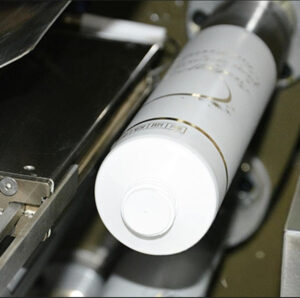
Figure 4 — An operator configuring a semi-automatic tube labeler in a pharmaceutical compounding lab setting — appropriate scale for facilities producing under 5,000 tubes per day.
Small Labs and Startups
🔬 Recommended Profile: <5,000 Tubes/Day | Budget $8,000–$35,000
Early-stage cosmetic brands, compounding pharmacies, and R&D departments need labeling equipment that is accurate enough to pass product presentation audits with retail or hospital buyers, flexible enough to handle 5–15 different SKUs, and simple enough for a non-specialist operator to run without a dedicated maintenance engineer on staff.
For this profile, semi-automatic bench labelers with servo-driven applicators and USB-programmable positioning memory deliver the best fit. Setup time per new SKU is under 5 minutes with pre-stored recipes. Label placement accuracy of ±0.8–1.2 mm is acceptable for cosmetic use and most non-pharma compounding applications. The total investment including basic training and a one-year spare parts kit should stay below $25,000.
Caution: Startups anticipating volume growth above 15,000 tubes/day within 24 months should budget for a mid-range servo platform from day one rather than two sequential equipment purchases — the total cost including lost production during the second installation will typically exceed the price premium of the higher-specification initial purchase.
Large Facilities
🏭 Recommended Profile: 50,000+ Tubes/Day | Budget $55,000–$110,000+
High-volume cosmetic contract manufacturers and pharmaceutical CMOs operating 2–4 tube filling lines need labeling machines that can run at sustained 200+ tubes/min without thermal drift affecting label placement, are compatible with automated line feeding systems (typically star-wheel or linear conveyor tube transfer), and have documented MTBF above 2,000 operating hours between maintenance interventions.
For GMP-regulated pharmaceutical tube lines, machines with native 21 CFR Part 11 audit trail capability and IQ/OQ/PQ validation documentation packages available from the manufacturer significantly reduce qualification timeline. Novexx and Herma lead in this dimension among Western brands. Miyoda’s integrated tube filling and labeling systems have been increasingly specified for new line builds where buyers want a single factory engineering contact for mechanical interface, electrical integration, and line balancing — a coordination complexity that grows substantially when mixing vendor equipment on high-speed pharmaceutical lines.
Specialty and Custom Applications
✨ Recommended Profile: Non-Standard Tubes | Budget: Project-Specific
Specialty applications — including ultra-small ophthalmic tubes (8–12 mm diameter), tubes with pre-printed substrates requiring registration labels, dual-label (front + back) cosmetic formats, and tubes destined for markets requiring multilingual label variants — need custom machine configurations. In these scenarios, the RFQ process should include a physical tube and label sample submission to the machine vendor for applicability testing before pricing is finalized. Reputable vendors will complete this assessment within 5–10 business days.
Custom builds typically require 16–24 weeks lead time and carry a 25–40% price premium over standard catalog machines. Buyers should request a written format compatibility guarantee as part of the purchase agreement, stipulating acceptance criteria and the vendor’s obligation in cases where the machine fails to meet the guaranteed accuracy specification on the agreed tube/label combination.
Key Terms Glossary
For readers less familiar with tube labeling machine specifications, the following definitions provide context for the technical terms used throughout this comparison.
Conclusion
Across the full spectrum from bench-top lab labelers to high-speed pharmaceutical-grade servo systems, the tube labeling machine that delivers the highest value is not necessarily the fastest or most expensive — it is the one precisely matched to your production volume, tube format portfolio, regulatory environment, and 3-year growth trajectory.
For mid-to-large cosmetic and pharmaceutical tube manufacturers, servo-driven machines with vision inspection in the $35,000–$95,000 range represent the strongest ROI case: they achieve OEE above 85%, keep label waste below 0.5%, and provide the format flexibility to absorb SKU portfolio growth without additional capital expenditure. Facilities building new integrated lines — covering filling, sealing, and labeling — benefit significantly from single-vendor sourcing with full mechanical and electrical integration accountability.
Before issuing any RFQ, define your required throughput at OEE (not rated speed), your tube diameter range, your regulatory environment (GMP, serialization requirements), your label substrate specifications, and your preferred service model. These five parameters will narrow the qualified vendor list from a dozen brands to two or three — and make the final selection a data-driven, defensible procurement decision.
To explore Miyoda Packaging Machinery’s tube labeling equipment specifications and request a format compatibility assessment for your specific tube and label combination, visit their technical team directly.
📩 Request a Free Machine ConsultationFrequently Asked Questions — Tube Labeling Machines
The following FAQ section addresses the most common procurement and technical questions from cosmetic and pharmaceutical manufacturers evaluating tube labeling equipment.