
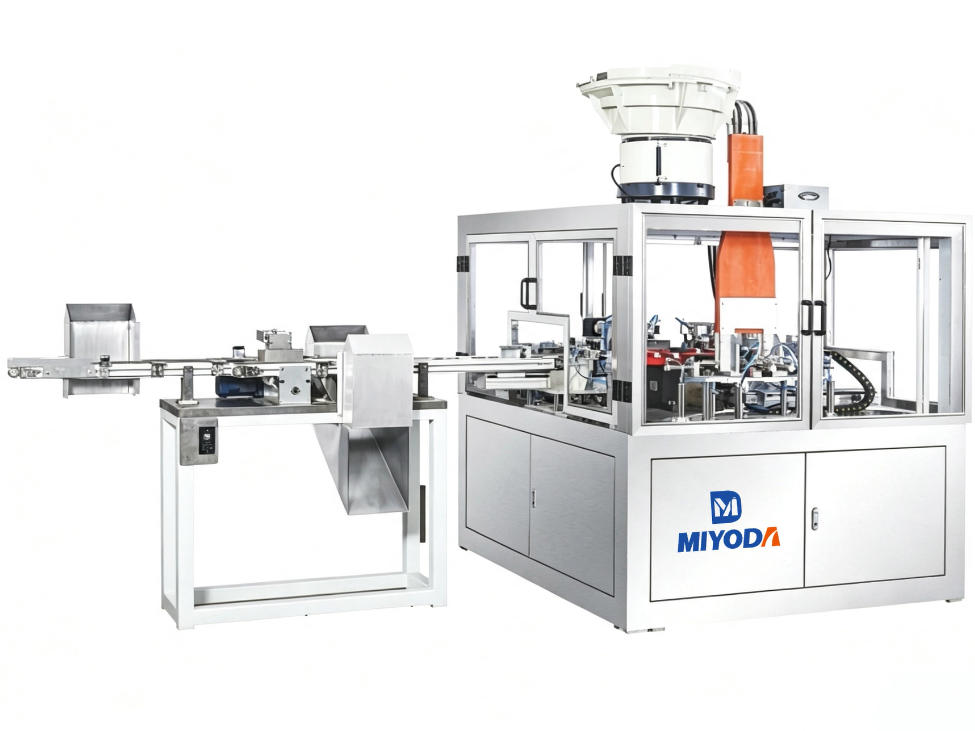
1. Executive Summary: Aligning Machine Investment with Your Production Goals
Buying an injection moulding machine for soft tube production is one of the biggest decisions a tube plant makes. It affects how fast you get your money back (ROI), whether your tubes pass customer audits, and whether you can say yes when a large brand calls with a bigger order.
The trouble is that most buyers compare machines on price and top speed. Those two numbers alone don’t tell you much. A cheap machine running at 85% yield can cost more per good tube than a machine that costs twice as much and runs at 98% yield.
Quick definition: Injection moulding (for tubes). Plastic pellets are melted and pushed under pressure into a closed steel mould. For soft tubes, this is usually how the tube shoulder is made. The shoulder is the neck, thread and orifice where the cap sits. It is often moulded directly onto the tube sleeve in the same step. Learn more about the general process on Wikipedia’s injection moulding overview.
This guide sorts machines into three tiers and helps you match one to your output, budget and growth plan:
| Tier | Typical Monthly Output | Automation Level | Ideal para |
|---|---|---|---|
| Entry-Level | Under 100,000 tubes | Manual / semi-automatic | Startups, pilot runs, niche brands |
| Mid-Range | 100,000 – 500,000 tubes | Semi-auto to fully automatic | Growing brands, regional OEMs |
| Premium | Over 500,000 tubes | Fully automatic, 24/7, data-connected | Contract manufacturers, global suppliers |
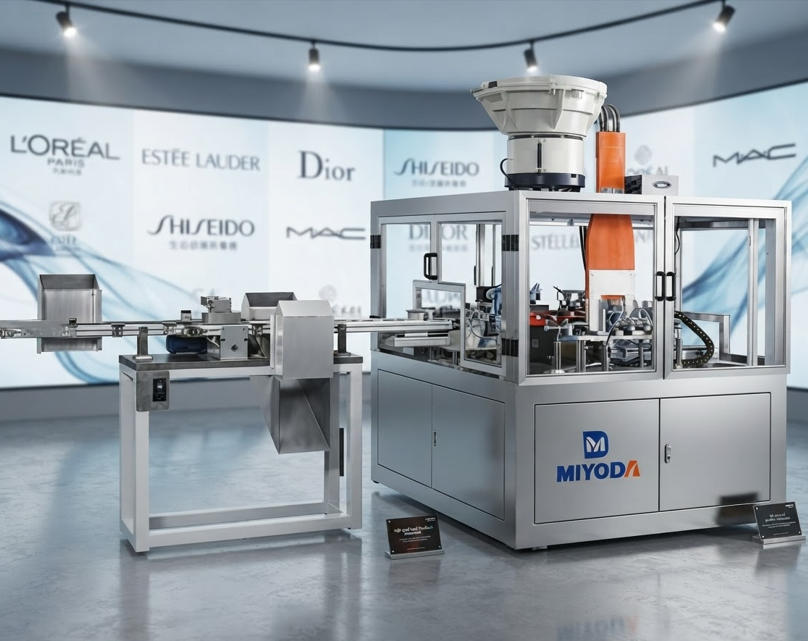
An automatic shoulder injection station. This is the part of the line where tube neck accuracy, cap fit and leak resistance are mostly decided.
2. Understanding Your Production Requirements: The First Step to Smart Investment
Before you ask for a quote, write down five numbers. Suppliers who get these up front can give you a real proposal. Without them, all you’ll get is a brochure.
Define Output, Material and Tube Specs
Output volume. Work out how many good tubes you need per month, not the machine’s rated speed. Add 15–20% on top for scrap, changeovers and planned maintenance.
Material type. Most cosmetic tube shoulders use polietileno de baja densidad (LDPE) or an LDPE/HDPE blend. Pharma tubes sometimes need PP or special barrier inserts. Each resin melts and shrinks differently, so the machine’s temperature control and screw design must suit it.
Tube specifications. List your diameters (for example 19, 25, 30, 35, 40 and 50 mm), wall thickness, and closure types (screw cap, flip-top, nozzle tip or membrane seal).
Perspectiva del sector: Buyers often forget that the shoulder has to match the cap supplier’s thread exactly. A 0.2 mm drift in the thread OD (outer diameter) can cause “cap spin” on the capping line. The cap then turns but never tightens. Share your cap drawings with the machine supplier early.
Assess Labor, Space and Automation Readiness
Ask yourself three honest questions:
How many skilled operators can you hire and keep? In regions with high labor turnover, a semi-automatic machine that needs constant attention becomes a quality risk.
How much floor space and power do you have? A fully automatic shoulder line with feeders and conveyors can need 3–4 times the space of a standalone vertical press.
Can your downstream equipment keep up? A fast shoulder machine feeding a slow capper just moves the bottleneck.
Identify Your Real Pain Points
Most tube makers who contact us describe the same three problems:
| Pain Point | What You See | Usual Root Cause |
|---|---|---|
| Inconsistent sealing | Leaks at the shoulder-to-sleeve joint | Unstable melt temperature or uneven mould cooling |
| High scrap rates | 5–10% of tubes rejected | Short shots, flash, off-center orifice |
| Slow cycle times | Line can’t meet peak orders | Manual loading, cold runners, poor cooling design |
Quick definition: Flash. A thin, unwanted film of plastic that leaks out where the two halves of the mould meet. On a premium cosmetic tube, visible flash is an instant rejection.
3. Entry-Level Machines: Cost-Effective Entry for Startups & Small Producers
Entry-level machines suit plants producing fewer than 100,000 tubes per month. They are usually vertical, semi-automatic presses. An operator loads the tube sleeve onto a mandrel, the machine injects the shoulder, and the operator unloads the finished part.
What You Gain
The upfront cost is low, the machine is simple to maintain, and your team can learn it quickly. For a new brand testing a market, this keeps capital free for moulds, printing and marketing.
A typical setup runs one or two cavities and produces roughly 15–30 tubes per minute. It depends heavily on operator speed.
The Trade-Offs
Higher labor dependency. Output depends on the operator’s speed. It usually drops 10–20% late in a shift as people tire.
Limited precision. Without closed-loop control, shoulder dimensions drift as the room warms up or the resin batch changes.
Longer changeovers. Switching from a 25 mm to a 35 mm tube can take 1–3 hours of manual bolting and parameter tuning.
When to Choose Entry-Level
It makes sense if you are testing demand for a new product line, running small batches for private-label clients, or working with limited capital. The key is to buy with an upgrade path in mind. Check that the moulds you order now will also fit a future automatic machine.
4. Mid-Range Machines: Balanced Performance for Growing Businesses
Mid-range machines cover 100,000 to 500,000 tubes per month. This is where most growing cosmetic brands and regional OEMs (Original Equipment Manufacturers, companies that produce under other brands’ names) end up.
What Changes at This Level
These machines range from advanced semi-automatic to fully automatic. They typically add servo-driven indexing, recipe storage on a touchscreen (HMI), and better temperature control across the barrel and mould.
Quick definition: Servo drive. An electric motor that knows its exact position at every moment. Unlike older hydraulic systems, it moves the same way every cycle. That is why shoulder dimensions stay consistent.
Quick definition: HMI (Human-Machine Interface). The touchscreen operators use to run the machine. A good HMI stores “recipes” for each tube size, so a changeover doesn’t mean re-entering 40 settings by hand.
Basic Automation Integration
Mid-range machines often connect to robotic pick-and-place units. These remove finished tubes and place them on a conveyor to the capper or printer, and they save one operator per shift.
A well-matched tube heading and shoulder machine at this tier also supports multiple diameters on the same frame. For a contract packer with 15+ SKUs, that flexibility is where the money is.
Why the Investment Pays Off
Moving from entry to mid-range typically cuts scrap from 6–8% down to 2–3%. Servo systems also use significantly less power than older hydraulic presses. The table below shows the difference at 300,000 tubes per month:
| Metric | Entry-Level | Mid-Range | Monthly Impact |
|---|---|---|---|
| Scrap rate | 7% | 2.5% | ~13,500 more good tubes |
| Operators per shift | 2 | 1 | 1 salary saved per shift |
| Changeover time | 2 hours | 30–45 minutes | More SKUs per week |
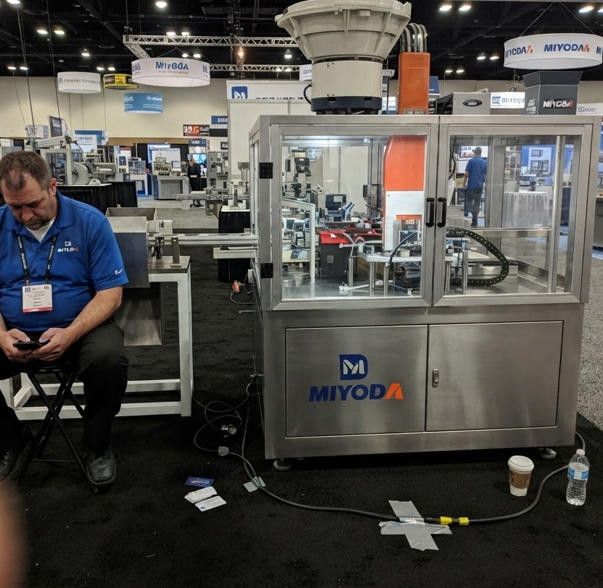
Mid-range shoulder machines handle both extruded PE sleeves and laminated (ABL/PBL) sleeves, so one plant can serve more product categories.
5. Premium Machines: High-Speed, Fully Automated Solutions for Large-Scale Demand
Premium machines are built for more than 500,000 tubes per month, running 24 hours a day, 7 days a week. Here, one hour of downtime costs thousands of dollars in lost output.
Advanced Features That Matter
Real-time monitoring. Every cycle’s temperature, pressure and time is logged. If a value drifts outside limits, the machine alerts staff before bad parts pile up.
Predictive maintenance. Sensors track motor current, vibration and heater health, and flag wear weeks before a breakdown.
IoT integration. Machine data flows to your factory software (MES or ERP), so managers can see output and efficiency live from any site.
Quick definition: Predictive maintenance. Fixing a part based on what sensor data says about its condition, rather than waiting for it to fail or replacing it on a fixed calendar.
Why Premium Lowers Your Cost per Tube
The purchase price is higher, but the cost per tube falls sharply at scale. One technician can supervise several machines. Scrap often stays below 1.5%. Hot runner moulds cut out runner waste completely.
Quick definition: Hot runner. A heated channel inside the mould that keeps plastic molten between shots. There is no solid “runner” to cut off and throw away, so all the resin becomes product.
Who Premium Is For
OEMs serving multinational beauty brands, pharma contract manufacturers, and suppliers exporting to regulated markets like the EU and US. For these buyers, audit-ready data logs matter as much as speed.
6. Decision Framework: Matching Machine Tier to Business Size & Goals
Use this simple guide to find your starting point:
Startup? Go entry-level, but insist on an upgrade path. Pick moulds and frames that can later accept auto-loading.
Scaling brand? Go mid-range and make sure it’s ready for automation. It should have robot interfaces, recipe storage and multi-diameter capability.
Global supplier? Go premium with Industry 4.0 capabilities, meaning full data logging, remote diagnostics and MES connectivity. (Industry 4.0 simply means connected, data-driven manufacturing. See the Fourth Industrial Revolution explainer.)
ROI Comparison Across Tiers
The figures below are indicative ranges from typical cosmetic tube projects. Your actual numbers depend on local labor cost, resin price and utilization.
| Factor | Entry-Level | Mid-Range | Premium |
|---|---|---|---|
| Typical payback period | 8–14 months | 12–20 months | 18–30 months |
| Annual maintenance cost (% of machine price) | 3–5% | 2–4% | 2–3% (with contract) |
| Typical uptime | 75–85% | 85–92% | 93–98% |
| Scrap rate | 5–8% | 2–3% | Under 1.5% |
| Operators per shift | 1–2 per machine | 1 per machine | 1 per 3–4 machines |
Perspectiva del sector: A premium machine’s payback looks slower on paper. But it’s the only tier where payback gets shorter as volume grows. Entry-level machines hit a ceiling. Once you need a second and third one, you’ve also hired more operators, taken more floor space and multiplied quality risk.
For a deeper side-by-side on specs, see this guide on choosing the right injection shoulder machine.
7. Critical Supplier Evaluation: 10 Must-Ask Questions Before Purchase
A machine’s brochure tells you its best day. These questions tell you about its normal day. Ask every supplier the same list and compare the answers side by side.
What is the machine’s actual cycle time for 30 mm diameter LDPE tubes? Ask for a video or trial report at your wall thickness, not the “maximum” speed with an empty mould.
Can it handle multi-cavity molds (8, 16, 32 cavities) with consistent fill balance? Fill balance means every cavity fills at the same speed and pressure. If it’s unbalanced, one cavity makes perfect shoulders while another makes short shots. Ask for weight data from every cavity.
What after-sales support do you offer in my region? Get names, locations and languages of real technicians, not just “global service.”
Do you provide mold changeover kits and training? A quick-change kit can cut changeovers from hours to under 30 minutes.
What is the average downtime and MTTR? Mean Time to Repair (MTTR) is the average time from breakdown to restart. Under 2 hours for common faults is a good benchmark.
Are spare parts readily available and priced transparently? Ask for a priced list of the top 10 wear parts, such as heater bands, nozzle tips, thermocouples and ejector pins.
Can the machine integrate with our existing labeling or filling lines? Check conveyor height, signal handshake and speed matching with your current máquina de llenado y cierre de tubos or capper.
Do you offer remote diagnostics and software updates? Remote access can fix 50–70% of software and parameter issues without a site visit.
What certifications do your machines have (CE, ISO, GMP compliance)? CE marking is required to sell machinery in Europe. See the European Commission’s CE marking guidance. Pharma buyers should also ask whether the supplier provides IQ/OQ/PQ validation documents.
Can I visit a reference site producing similar cosmetic/pharma tubes? A supplier confident in its machines will arrange a visit or a live video call with a current customer.
Quick definition: IQ/OQ/PQ. The three validation steps pharma plants use for new equipment. Installation Qualification checks it’s installed correctly. Operational Qualification checks it works across its full range. Performance Qualification proves it makes good parts consistently in real production.
For a broader vendor checklist, this guide on selecting a tube packaging machine vendor covers contract terms and red flags.
8. Hidden Costs to Anticipate: Beyond the Purchase Price
The machine price is often only 55–70% of what you actually spend in year one. Budget for these items up front, or they will come out of your margin later.
Mold Development and Compatibility
Moulds are often the biggest surprise. A high-precision multi-cavity shoulder mould with hot runners can cost a large share of the machine price itself. Check that the mould is designed for your specific machine’s clamp size, nozzle position and ejection stroke.
Choosing a supplier who builds both the machine and the precision tube shoulder injection mold removes the “machine vs. mould” blame game during commissioning.

Mould quality sets the limit on shoulder precision. Even the best machine can’t fix an unbalanced or poorly cooled mould.
Installation, Utilities and Facility Changes
Plan for three-phase power capacity, clean and dry compressed air, and chilled water for mould cooling. Some plants also need floor reinforcement or a small air-conditioned room for resin drying. These costs can add 5–15% to the project.
Training, Maintenance and Technicians
Operator training, a maintenance contract, and access to a trained local technician all cost money. Ask whether first-year training is included and what refresher courses cost.
Downtime During Changeovers and Troubleshooting
Every changeover hour is lost output. At a loaded machine rate of USD 100 per hour, a plant doing 6 changeovers a week at 2 hours each loses about USD 62,000 a year. A quick-change system can recover most of that.
| Hidden Cost | Typical Share of Year-1 Spend | How to Reduce It |
|---|---|---|
| Moulds and tooling | 15–30% | Buy machine + mould from one engineering team |
| Installation & utilities | 5–15% | Send your factory layout before ordering |
| Training & maintenance | 3–8% | Negotiate training into the purchase contract |
| Changeover & ramp-up losses | 5–10% | Quick-change moulds and HMI recipe storage |
9. Future-Proofing Your Investment: Scalability and Technology Readiness
A shoulder machine should serve you for 10–15 years. Your customers’ needs will change several times in that period. Here’s how to make sure your machine keeps up.
Choose a Modular Design
Modular machines let you add auto-loaders, robot unloaders, vision inspection or extra stations later, without replacing the base frame. Ask the supplier to show you which modules can be retrofitted, and at what cost.
Insist on Upgradable, Data-Ready Software
Your control system should export production data such as cycle count, rejects and alarms. It should also accept software updates. Pharma buyers in the US should confirm the machine supports audit trails in line with FDA 21 CFR Part 11 electronic records rules.
Plan for Sustainable Materials
Brands are moving fast toward bio-based PE (made from sugarcane), PCR resins (post-consumer recycled plastic) and mono-material tubes that are easier to recycle. These materials often have a narrower processing window, meaning they melt and flow within a smaller temperature range. Machines with precise, zone-by-zone temperature control handle them much better.
Perspectiva del sector: Several large beauty groups now ask tube suppliers for PCR content in new tenders. If your machine can’t run PCR resin consistently, you may be shut out of those bids, whatever your price.
Prepare for Product Diversification
Airless tubes, multi-layer barrier laminates, oval shoulders and nozzle tips for pharma ointments are all growing. Check whether your machine can accept new moulds for these formats. Also check that your upstream máquina de extrusión de tubos o máquina para fabricar tubos laminados can supply matching sleeves.
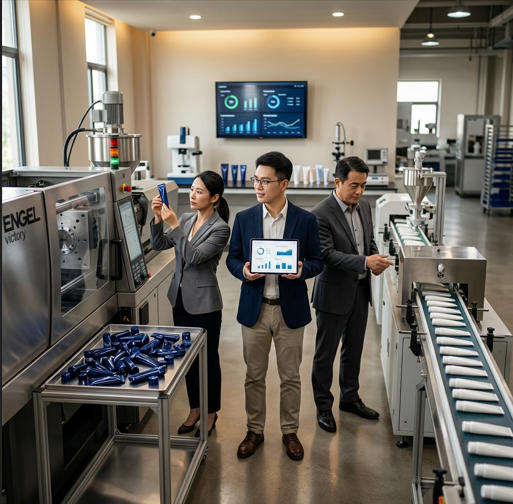
Extrusion makes the tube body. Injection moulding forms the shoulder. Future-proofing means planning both stages together.
Watch: Automatic Tube Shoulder Injection in Action
This video shows how an automatic shoulder injection machine loads sleeves, injects shoulders and discharges finished tube bodies in a continuous cycle. It’s useful for comparing with your current semi-automatic process.
https://www.youtube.com/watch?v=8EmFWeroUrQ
10. Case Study Snapshots: Real-World Success Across Tiers
These snapshots show how producers at different stages matched their machine tier to their goals.
Small Producer, Vietnam: From Entry-Level to Mid-Range in 12 Months
A private-label skincare tube maker started with one semi-automatic entry-level shoulder machine running 25 mm and 30 mm tubes for local brands. Demand from e-commerce clients doubled their output within 12 months.
Instead of buying a second manual machine and hiring two more operators, they upgraded to a mid-range machine with an auto loader. The result was the same headcount, twice the output, and a noticeable drop in off-center orifice complaints.
Mid-Sized OEM, Turkey: 40% Less Scrap with Closed-Loop Control
A cosmetic OEM serving European brands struggled with scrap, especially in summer when factory temperatures rose. After switching to a mid-range machine with closed-loop temperature and pressure control, they cut scrap by 40%.
Quick definition: Closed-loop control. The machine constantly measures what’s happening (temperature, pressure, position) and corrects itself automatically, like cruise control in a car.
Global Supplier, Germany: 98% Uptime with a Premium Fleet
A multinational tube supplier runs a fleet of premium shoulder machines for pharma and cosmetic clients. By combining predictive maintenance with central monitoring, they reached 98% uptime. Maintenance now happens during planned windows, not in the middle of urgent orders.
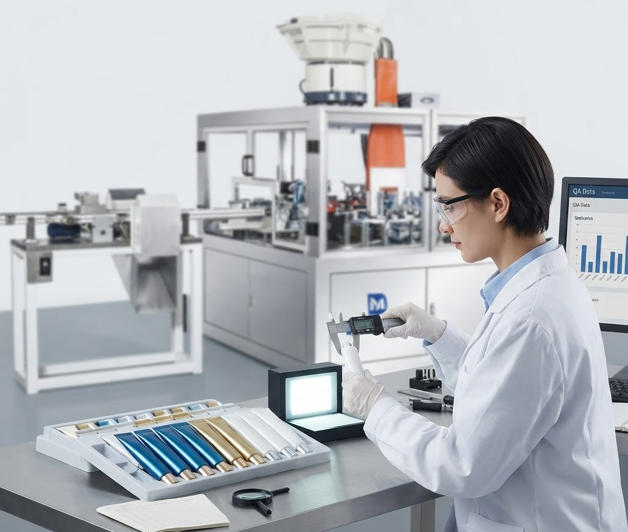
Across all three cases, the gains came from matching the machine tier to real demand, not from simply buying the fastest option.
At Miyoda Packaging Machinery, our engineers start every project by reviewing your tube drawings, resin and monthly targets. Before you commit, we produce samples for validation, typically within 7–15 days. Pairing the shoulder station with a matched automatic tube capping machine keeps the whole line in balance. For day-to-day tips once your machine is running, see our injection shoulder machine efficiency best practices. You can also read how an automatic injection shoulder machine streamlines production.
Glosario de términos clave
| Término | Plain-English Meaning | Example |
|---|---|---|
| Tube shoulder | The top of the tube: neck, thread and opening | The part a flip-top cap screws onto |
| Cavity | One “pocket” in a mould that forms one part | A 16-cavity mould makes 16 shoulders per shot |
| Cycle time | Time for one full mould open–inject–cool–eject sequence | 12 seconds per shot |
| Fill balance | Whether all cavities fill equally | All 16 shoulders weigh within ±0.05 g |
| Hot runner | Heated mould channels that leave no waste runner | Saves resin on every shot |
| Servo drive | Precise electric motor with position feedback | Same stroke every cycle |
| MTTR | Average time to fix a breakdown | 90 minutes |
| Uptime | Share of planned time the machine actually runs | 95% = about 1.2 hours down per day on a 24h plan |
| GMP | Good Manufacturing Practice rules for safe, consistent production | Required for pharma tube supply |
| PCR resin | Plastic made from recycled consumer packaging | 30% PCR tube for an eco-brand |
Preguntas frecuentes
How do I know if an entry-level machine will meet my quality standards for pharmaceutical tubes?
Check three things: dimensional accuracy (shoulder OD, orifice size, thread), sealing integrity (leak and burst testing), and whether the process can be documented to GMP requirements. Many entry-level machines can make acceptable parts but lack data logging for audits. Run a sample trial and measure at least 30 parts before deciding.
Can I start with a basic machine and upgrade later as my business grows?
Yes, if you choose a model with a modular automation path. Before you buy, confirm that auto-loaders, robot unloaders and your existing moulds can be reused on the next tier. This avoids scrapping tooling when you scale.
What cycle time should I expect when producing 40 mm diameter cosmetic tubes?
On multi-cavity moulds, a full shot cycle for 40 mm shoulders typically runs 12–18 seconds on mid-range to premium machines. The exact figure depends on wall thickness, resin and mould cooling design. Always ask for a trial at your actual specs.
How does machine precision affect tube weight consistency and material waste?
Higher-tier machines control shot size much more tightly, so each shoulder gets exactly the resin it needs. Plants moving from basic to precision machines commonly cut overfill and scrap enough to save up to 15% of raw material at the shoulder stage.
Are injection shoulder machines compatible with silicone-free mold release systems?
Well-designed moulds with good surface finish and proper ejection often need little or no release agent. For pharma tubes, avoiding silicone contamination matters, so ask your supplier about mould coatings and non-contaminating release options during mould design.
Do you provide support for mold design and validation?
Miyoda Packaging Machinery’s engineering team reviews your shoulder drawings, checks mould flow and fill balance, and runs sample validation before shipment. This first-article testing confirms the machine and mould work together on your specs.
What training is included to ensure my team runs the machine efficiently?
Training typically covers startup and shutdown, recipe management, quality checks, fault codes and basic mould care. Installation and on-site training are available for overseas clients. Most operators work independently within two to four weeks.
How quickly can technicians respond to breakdowns in Southeast Asia?
Response times vary by supplier and location, so get them in writing. Many issues can be solved within hours through remote diagnostics. For on-site visits, ask for a committed response time and confirm which critical spare parts are kept in stock for your machine model.
Can the machine handle both round and oval tube profiles without major retooling?
With quick-change mould systems and stored HMI recipes, switching between round and oval shoulders can take under 30 minutes. Oval profiles need their own mould and matching sleeve mandrels, so plan these at purchase.
Is energy consumption significantly lower in premium machines?
Yes. Servo-driven machines typically use 30–50% less energy than standard hydraulic systems, because the motor only draws significant power while it’s moving. On a 24/7 line, that saving adds up quickly.
What is the typical lifespan of a mid-range injection moulding machine in continuous operation?
With regular preventive maintenance, a quality mid-range machine usually lasts 10–15 years. Screws, barrels, heaters and seals are replaced along the way at predictable intervals.
Can I test my resin material before purchasing?
Yes. Send your drawings, sample tubes or resin, and we can run a trial and produce samples for your evaluation, typically within 7–15 days. It’s the most reliable way to confirm real-world performance.
Are financing or leasing options available for distributors and agents?
Payment terms are flexible, commonly a deposit on order with the balance before shipment. Distributors and agents should discuss terms, demo units and regional support arrangements directly with our sales team through the Miyoda contact page.














