
Maximizing Efficiency: How an Injection Shoulder Machine Can Streamline Your Soft Tube Production Process
The global cosmetic tube packaging market is on a steep growth curve — valued at USD 4.2 billion in 2025 and projected to reach USD 8.4 billion by 2035 at a CAGR of 7.2% (Future Market Insights, 2025). Add pharmaceutical tube demand to that figure, and the production pressure on soft tube manufacturers becomes even clearer: more volume, tighter quality thresholds, faster delivery windows, and an expanding list of compliance requirements from buyers and regulators.
The machines at the center of this pressure are injection shoulder machines — the equipment that forms the shoulder, neck, and closure interface of a plastic soft tube through injection moulding. This is where tube quality is largely determined, where production bottlenecks most commonly originate, and where the right technology investment creates compounding advantages across the entire downstream process.
This guide covers how modern injection shoulder machines address the core operational challenges facing cosmetic and pharmaceutical tube producers — with concrete data, real production scenarios, and the practical detail that buyers, distributors, and agents need to make informed decisions.

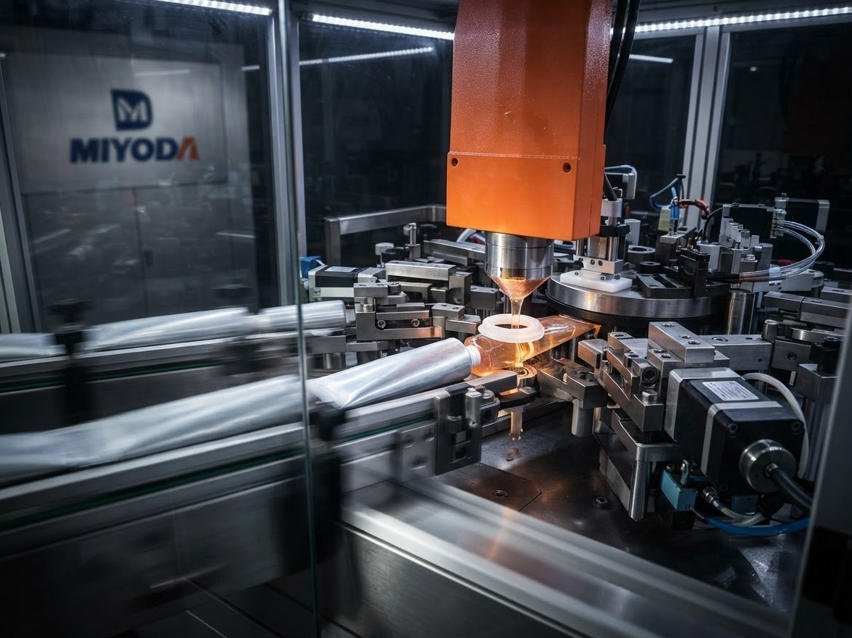
A modern automatic injection shoulder machine in operation — servo-driven, PLC-controlled, capable of producing consistent tube shoulders for cosmetic and pharmaceutical packaging at high speed. Source: Miyoda Packaging Machinery
1. The Growing Demand for High-Quality Soft Tubes
Soft tubes are the dominant packaging format for a wide range of cosmetic and pharmaceutical products — face creams, sun protection, toothpaste, medicated gels, ointments, and topical pharmaceuticals. Their flexibility, tamper-evidence, hygienic dispensing geometry, and efficient product evacuation make them the preferred choice for products where consumer convenience and formula integrity are both commercial priorities.
What Rising Demand Actually Means for Producers
The volume growth is real and measurable. But for tube manufacturers, growth in market volume is not automatically growth in margin. Three specific production challenges determine whether rising demand translates into profitable output or simply into higher operational stress:
Inconsistency is the most expensive problem most tube shoulder operations face without realising it. A shoulder that varies by 0.3 mm in outer diameter across a production run does not look like a problem on the production floor. On the filling line, where tube mandrels are sized to within 0.15 mm of the tube shoulder specification, that 0.3 mm variation causes tube feed jams, misaligned seals, and filling stoppages that cost thousands of dollars per hour to resolve.
Material waste accumulates invisibly. Traditional multi-step shoulder forming — where a separately extruded tube sleeve is headed in a separate station — generates flash, runner waste, and setup scrap at each step. At 5 million tubes per year and a resin cost of USD 2.80/kg, even a 3% material waste reduction is worth over USD 42,000 in recovered material cost annually.
Slow cycle times limit your capacity ceiling and inflate per-unit cost. Every second added to the shoulder forming cycle reduces the number of saleable shoulders produced per shift, increases machine depreciation cost per unit, and reduces your ability to meet peak demand without overtime or additional equipment.
The injection shoulder machine addresses all three of these problems — not one at a time, but simultaneously, by integrating precision, automation, and process control into a single forming station.
2. Understanding the Injection Shoulder Process: A Game-Changer in Tube Manufacturing
Before comparing technologies, it is worth being precise about what an injection shoulder machine actually does — because the process is fundamentally different from traditional shoulder forming, not just incrementally faster.
How Injection Shoulder Moulding Works
In injection shoulder moulding, molten resin is injected directly into a closed mold cavity positioned at the open end of the tube sleeve. The resin fills the cavity under controlled pressure, forming the shoulder geometry, neck taper, and orifice bore in a single, simultaneous operation. The mold cools, opens, and ejects a complete, dimensionally consistent shoulder — bonded to the tube sleeve in the same cycle.
Glossary — Injection Shoulder Moulding: A tube manufacturing process in which the tube shoulder (including the neck, nozzle tip, and shoulder curve) is formed by injecting molten plastic resin into a precision mold cavity at the open end of the tube sleeve. The bond between the shoulder and tube sleeve is created in the same step as the shoulder formation, eliminating a secondary joining operation.
The Traditional Multi-Step Process — and What It Costs
In traditional tube heading (compression or multi-step shoulder forming), the tube sleeve is produced on the extrusion line as a separate component. The shoulder or cap is formed in a separate moulding operation and then joined to the sleeve in a heading station through heat, pressure, or adhesive bonding — each step involving additional tooling, handling time, and a joint interface that carries structural risk.
This is not a theoretical cost difference. It is measurable:
| Process Parameter | Traditional Multi-Step | Injection Shoulder Moulding |
|---|---|---|
| Process steps to produce finished tube body | 3–4 (extrusion → shoulder moulding → joining → trimming) | 1–2 (extrusion → injection shoulder) |
| Shoulder joint structural integrity | Depends on bonding quality at junction | Monolithic — no joint interface |
| Dimensional repeatability | ±0.3–0.5 mm across high-volume runs | ±0.05–0.15 mm with servo control |
| Material at joint interface | Potential adhesive or heat bond variability | Homogeneous resin — no bond line |
| Setup waste per changeover | High (bonding station + moulding setup) | Single station — one recipe recall |
The elimination of a separate bonding step is not just a cycle time improvement — it removes an entire category of structural defects from the production process. Leaks at the shoulder-to-sleeve junction are a primary cause of soft tube product complaints; injection shoulder moulding eliminates the junction entirely.
3. Eliminating Production Bottlenecks: How Automation Drives Speed and Consistency
The production capacity of a soft tube line is not determined by the fastest station. It is determined by the slowest. In most traditional multi-step tube production lines, the shoulder forming and joining station is the limiting station — and it is the one where manual handling most commonly introduces variation, damage, and time loss.
How Automated Injection Shoulder Machines Eliminate Bottlenecks
Modern automatic injection shoulder machines remove manual handling from the critical path of tube shoulder production through servo-driven indexing, PLC-controlled process sequencing, and automatic part ejection and transfer to downstream stations. The result is a cycle time that is deterministic — it takes the same time every cycle, regardless of operator fatigue, attention, or experience.
On a line running 120 shoulder formations per minute, eliminating a 4-second manual handling step per tube (typical for semi-automatic heading operations) adds 480 additional tubes per shift to output without any change in equipment or staffing. At a finished tube value of USD 0.35 per unit, that is USD 168 per shift in recovered output value from a process change alone.
Glossary — Servo-Driven Indexing: A positioning system that uses servo motors — precisely controlled electric motors with position feedback — to move tube sleeves from station to station in exact, repeatable increments. Unlike pneumatic or cam-driven systems, servo indexing can be reprogrammed for different tube sizes without mechanical tooling changes, and its positioning accuracy is verifiable at every cycle.
Throughput Benchmarks: What Automated Systems Actually Deliver
Producers who have transitioned from semi-automatic or traditional multi-step shoulder forming to fully automatic injection shoulder machines report throughput improvements in a consistent range of 30–50% per shift at matched operating hours. The improvement comes from three compounding sources: faster cycle time, higher yield rate (fewer stoppages for manual defect correction), and longer productive runs per shift (automated systems maintain full speed from start to stop; manual-assisted systems slow as operators fatigue).
For a contract tube manufacturer running two shifts at 100 shoulders per minute on a semi-automatic line, a 35% throughput improvement from automation adds approximately 18,900 additional tubes per day — nearly 5 million additional tubes annually from the same facility footprint.
 The injection mold cavity is where dimensional consistency is determined — precision-machined to ±0.01–0.02 mm tolerance, the mold geometry defines shoulder OD, neck angle, and orifice bore across every cycle of a production run. Source: Miyoda Packaging Machinery
4. Reducing Material Waste and Lowering Operational Costs
Resin is the largest variable cost in tube shoulder production. The margin between a profitable production run and a break-even one is often determined by how efficiently your process converts raw resin into saleable finished shoulders — with minimal flash, minimal runner waste, and minimal setup scrap.
Where Material Waste Actually Originates
Traditional multi-step processes generate resin waste at multiple points: in the runner systems of the shoulder moulding operation, in the bonding stage where excess adhesive or heat-affected material is trimmed, and in the setup sequences where each station requires independent warming-up and qualification cycles before producing saleable product.
Injection shoulder moulding concentrates all of this into a single process with engineered waste minimisation:
Hot runner systems eliminate cold runners entirely — resin in the runner channels stays molten between shots and returns to the next shot, producing zero runner waste per cycle. In cold runner systems, runner weight per cycle on a four-cavity tube shoulder mold can be 0.8–1.5 g per shot. On a line running 6 million shoulders per year, eliminating runner waste at 1.2 g per shot saves approximately 7,200 kg of resin annually — or roughly USD 20,000 at standard cosmetic tube resin pricing.
Precise volumetric dosing through servo-controlled injection — metering exactly the required shot volume per cycle — eliminates the systematic overpacking that occurs when operators compensate for process uncertainty by running slightly higher than calculated shot sizes. Industry data indicates that traditional moulding methods can generate up to 30% raw material wastage due to inefficient runner systems and defective parts (LinkedIn Engineering Study, 2025); precision-dosed injection shoulder machines with hot runners reduce this to under 3% in documented production environments.
The Total Cost-Per-Unit Comparison
Here is a simplified comparison for a producer making 8 million tube shoulders per year:
| Catégorie de coûts | Traditional Process | Injection Shoulder Machine | Annual Saving |
|---|---|---|---|
| Resin waste (runners, flash, setup scrap) | 4.5% of material cost | <1.5% of material cost | ~USD 18,000 |
| Labour (operator headcount per shift) | 4 operators | 1–2 operators | USD 36,000–54,000 |
| Scrap rejection cost | 6–8% of output | 1.5–2% of output | USD 22,000–32,000 |
| Energy (servo vs. hydraulic) | Baseline | 60–80% reduction | USD 7,000–12,000 |
| Total annual saving | — | — | USD 83,000–116,000 |
At a machine investment of USD 120,000–180,000, these savings generate a payback period of 12–22 months — consistent with documented manufacturer experience across cosmetic and pharmaceutical tube production facilities.
5. Enhancing Product Quality and Brand Value
For cosmetic brands, the tube is the product — at least from the consumer’s first impression. A tube that feels structurally substantial, opens cleanly, dispenses consistently, and maintains its geometry through repeated use communicates product quality before the formula inside has made any impression.
The shoulder is the most structurally and aesthetically critical component of the tube. Its geometry determines cap fit, seal quality, shoulder curve aesthetics, and the mechanical feel of every opening and closing action the consumer makes for the life of the product.
How Shoulder Precision Affects Downstream Filling Performance
Inconsistent shoulder dimensions create problems that only manifest downstream — during filling and sealing. A shoulder OD that varies by 0.3 mm across a production run produces tubes that fit the filling mandrel inconsistently:
- Tubes undersized relative to the mandrel tolerance feed loosely, causing rotational drift during filling that misaligns the sealing jaw with the tube tail — producing off-centre seals that fail aesthetically or structurally
- Tubes oversized relative to the mandrel tolerance require forced loading, slowing the filling line cycle and increasing the risk of tube body damage during insertion
A documented analysis of cosmetic tube filling line stoppages found that shoulder and neck geometry inconsistency accounts for up to 35% of tube-related filling line rejects — defects that appear to be filling failures but are actually heading failures (CosmeticTubeWG, 2025). Resolving the heading process resolves the filling line problem.
Defect Rate Reduction: Real Data From Producers Who Have Made the Transition
A pharmaceutical contract manufacturer documented in their supplier qualification report that transitioning from a semi-automatic heading process to a fully automatic injection shoulder system reduced their tube shoulder scrap rate from 8.2% to 1.5% over a 6-month transition period. At 4 million shoulders per month and a production cost of USD 0.04 per shoulder at the heading stage, that 6.7 percentage point reduction represented USD 107,200 in recovered monthly output value — or USD 1.28 million annually.
The aesthetics improvement was equally significant. Injection shoulder moulding produces parting line flash within ±0.05 mm of the mold design specification, versus ±0.3–0.5 mm in manual compression heading. For luxury cosmetic brands whose premium positioning depends on packaging surfaces that are visibly free of moulding marks, this precision is not optional — it is the specification.
Glossary — Parting Line Flash: A thin film of excess resin that forms at the mold parting line interface (where the two mold halves meet) when mold clamping force is insufficient to prevent resin escape during injection. Flash on cosmetic tube shoulders is a visible surface defect that communicates poor manufacturing quality to consumers and causes rejection in premium retail audits.
6. Scalability and Flexibility for Diverse Product Lines
The commercial reality for most cosmetic and pharmaceutical tube producers — particularly contract manufacturers and distributors serving multiple brand clients — is that they do not run one shoulder design indefinitely. They run 10, 20, or 50 different shoulder designs across multiple tube diameters, with customer-driven changes in design frequency that has accelerated significantly with the growth of direct-to-consumer beauty brands.
Quick Mold Change Systems: The Technology That Makes Flexibility Real
The operational flexibility of an injection shoulder machine is only as good as its changeover time. A machine that takes 3 hours to change from a 25 mm to a 35 mm shoulder mold is not a flexible machine — it is a dedicated machine with nominally swappable tooling.
Modern injection shoulder machines designed for multi-SKU cosmetic and pharmaceutical production incorporate quick mold change systems that reduce physical tooling changeover from 2–3 hours to under 30 minutes in documented high-volume operations (EAS Change Systems, 2025), combined with HMI recipe recall that restores all process parameters for the new mold design in under 2 minutes.
Glossary — Quick Mold Change (QMC) System: A standardised mechanical interface between the injection machine’s platen and the mold body that allows the mold to be removed and replaced without re-torquing individual mounting bolts to precise specifications. QMC systems use magnetic clamps, hydraulic clamp locks, or standardised bayonet interfaces that release and engage the mold in minutes. Combined with HMI recipe recall, QMC reduces changeover time from hours to minutes — transforming a nominally multi-SKU machine into a genuinely flexible one.
Meeting the Needs of Contract Manufacturers
For contract tube manufacturers serving multiple cosmetic brand clients, production flexibility determines business model viability. A facility that can switch shoulder moulds in 25 minutes — versus a competitor who needs 3 hours — can profitably accept minimum order quantities that the competitor must decline as uneconomical.
At a loaded machine rate of USD 120 per hour, a 2.5-hour changeover advantage on every SKU switch is worth USD 300 per changeover. A contract manufacturer doing 8 shoulder design changes per week recovers USD 2,400 per week in machine time — approximately USD 120,000 annually — from a changeover time reduction that does not require purchasing any additional equipment.
Integration with Existing Production Lines
Injection shoulder machines from reputable manufacturers are designed with standard mechanical and electrical interfaces that allow integration into existing tube production lines without requiring a complete line rebuild. Standard conveyor height compatibility (typically 900–950 mm working height), digital I/O interfaces for upstream tube sleeve in-feed systems, and OPC-UA data output for MES/ERP integration allow the heading station to be upgraded without disrupting the rest of the production line.
For producers planning a complete line — from tube sleeve extrusion through heading, decoration, and filling — Miyoda Packaging Machinery’s complete tube extrusion production line covers the integration specifications for each station, providing a framework for line design that optimises workflow from the first equipment selection rather than retrofitting integration during installation.
Watch: Automatic Cosmetic Tube Making Machine — Full Production Sequence
Understanding what integrated injection shoulder production looks like at operational speed — from tube sleeve formation through shoulder injection and downstream handling — is the fastest way to identify where your current process has bottlenecks this technology eliminates. The video below shows a complete automatic cosmetic tube making machine sequence:
{% youtube 2rnZ1dqe7WA %}
How cosmetic tubes are manufactured — complete automatic process from tube extrusion through shoulder injection heading, printing, and finishing. The shoulder injection station (shown at approximately 2:10) demonstrates the continuous automatic cycle that replaces manual multi-step heading in high-volume production.
7. Minimizing Maintenance and Downtime with Smart Machine Design
A machine that runs at 95% OEE for 10 years contributes far more to your business than a machine that runs at 98% OEE for the first year and steadily degrades thereafter because its maintenance requirements were not accounted for in its design or in your production planning.
Engineering for Long-Term Reliability
The components that determine injection shoulder machine longevity in high-volume cosmetic and pharmaceutical production are the injection barrel and screw, the mold cooling system, the servo drive train, and the ejector system. Each has a predictable wear profile — and the most expensive maintenance interventions are the ones that were not anticipated in the maintenance schedule.
Barrel and screw service life in standard LDPE and HDPE tube shoulder production: 8,000–15,000 operating hours with correct processing temperatures and resin quality. Using excessively high barrel temperatures to compensate for a slow feed system degrades this to 4,000–6,000 hours. The cost of a barrel and screw replacement on a mid-size machine is USD 8,000–20,000 — entirely avoidable with correct operating parameters and scheduled dimensional inspection every 2,000 hours.
Mold cooling system maintenance is the most frequently deferred maintenance activity on injection shoulder machines — and the most consequential. Scale build-up in cooling channels reduces heat transfer efficiency, extending cooling time and increasing cycle time progressively. Quarterly descaling with appropriate cleaning solution restores cooling efficiency; annual full cooling channel flow testing verifies that the system is performing to specification.
IoT-Enabled Predictive Maintenance: What It Delivers in Practice
Modern injection shoulder machines equipped with IIoT sensors transmit real-time process data — barrel temperatures, clamp force, injection pressure, cycle time, motor current draw — to a monitoring system that can detect deviations from established control limits before they cause production failures. Research on IoT-based predictive maintenance in manufacturing documents 70–90% reduction in unplanned downtime compared to reactive maintenance schedules (Frontiers in Artificial Intelligence, 2020).
For a tube shoulder machine running at 120 parts per minute, avoiding a single 4-hour unplanned stoppage per month — conservative for a reactive maintenance operation — recovers 28,800 shoulders per event at full production speed. At USD 0.04 production cost per shoulder, that is USD 1,152 per avoided stoppage event, or over USD 13,800 per year from maintenance approach alone.
Glossary — OEE (Overall Equipment Effectiveness): OEE = Availability × Performance Rate × Quality Rate. A machine running 90% of scheduled time, at 95% of rated speed, with 97% of parts passing first-time quality inspection has an OEE of 83.1%. World-class injection moulding OEE benchmarks are 85–90%. The Quality component — the percentage of parts produced within specification — is where injection shoulder machine precision delivers its most measurable OEE advantage over traditional heading processes.
Real-time production monitoring on an IoT-connected injection shoulder machine — cycle time trend, clamp force, and OEE displayed on a live dashboard. These data streams are what enable predictive maintenance to prevent unplanned stoppages before they occur. Source: Miyoda Packaging Machinery
8. Meeting Regulatory and Hygiene Standards in Pharma and Cosmetics
The regulatory environment for pharmaceutical tube packaging has tightened substantially over the past decade. FDA CGMP regulations for pharmaceutical manufacturers require equipment constructed from materials that do not contaminate product, cleaning documentation for every production run, and batch records traceable to raw material lots and operating parameters. The EU equivalent — EU GMP Annex 1 for pharmaceutical packaging — adds requirements for cleanroom compatibility and environmental monitoring.
For cosmetic producers, ISO 22716:2007 increasingly functions as a de facto compliance requirement — not because it is legally mandated everywhere, but because major cosmetic retail buyers (particularly EU pharmacy chains and US mass-market retailers) require ISO 22716 certification as part of supplier qualification.
Cleanroom Compatibility: What It Actually Requires
Pharmaceutical tube shoulder production in a controlled environment is specified under ISO 14644 cleanroom classification — typically ISO Class 7 or 8 for packaging component production. This requires that the injection shoulder machine be constructed without particle-shedding surfaces, without open lubrication points that could contaminate the product environment, and with a footprint that can be wiped down and validated under the cleanroom’s environmental monitoring protocol.
Machines designed for GMP compatibility include: stainless steel or hard-coated exterior panels (no painted surfaces that chip), sealed lubrication systems with no external grease points in the product zone, and full machine documentation packages including IQ/OQ/PQ (Installation Qualification, Operational Qualification, and Performance Qualification) protocol templates that allow the customer’s validation team to execute qualification without developing protocols from scratch.
Glossary — IQ/OQ/PQ: The three-stage equipment validation protocol required for pharmaceutical-grade manufacturing equipment. IQ verifies the machine was installed per design specifications. OQ verifies it performs within specification across its full operating range. PQ demonstrates consistent production of compliant parts across three consecutive production batches at production conditions. Total validation time for an injection shoulder machine: typically 8–16 weeks from machine delivery.
Batch Record Capability and Data Integrity
For pharmaceutical tube producers, the machine’s data logging capability is as important as its mechanical performance. Regulators and pharmaceutical buyers expect batch records to document: mold identity, operator ID, process parameter set used, injection pressure range during the run, cycle count produced, and in-process quality check results — all linked to the batch number and traceable to the raw material lot.
Machines with 21 CFR Part 11-compatible electronic batch record generation eliminate the manual data entry process that introduces transcription errors, creates data integrity vulnerabilities during FDA inspections, and consumes technician time that adds cost without adding value.
9. Real Client Success Stories: Measurable Gains in Efficiency
Results from real production environments are more useful than specifications. The following cases document actual outcomes from cosmetic and pharmaceutical tube producers who transitioned to injection shoulder machines — with the specific numbers that make the business case concrete.
Case A: Cosmetic OEM Cuts Shoulder Forming Time by 40%
A cosmetic OEM in Southeast Asia producing approximately 6 million tubes per year across 22 active SKUs was running a semi-automatic multi-step heading process that required 3 operators per shift and produced a shoulder forming time of 6.8 seconds per tube at a yield rate of 91.5%.
Following the installation of a servo-driven injection shoulder machine with quick-change mold capability and HMI recipe management, they documented:
- Shoulder forming cycle time reduced from 6.8 to 4.1 seconds — a 40% reduction in forming time
- Yield rate improved from 91.5% to 97.2% — eliminating the majority of dimensional rejection and junction defect scrap
- Operator headcount at heading station reduced from 3 to 1 — two operators redeployed to downstream packaging functions
- Annual material saving from reduced scrap: USD 28,400 based on resin pricing at their production volume
- ROI achieved in 14 months from combined labour saving, scrap reduction, and increased saleable output
Case B: Pharmaceutical Packager Reduces Scrap Rate from 8% to 1.5%
A pharmaceutical contract manufacturer producing topical cream tubes for EU distribution was experiencing an 8% shoulder scrap rate using a legacy compression heading process — nearly all from dimensional inconsistency at the shoulder-to-sleeve junction and flash at the nozzle tip that exceeded the visual acceptance criteria in their EU GMP quality plan.
After transitioning to an automatic injection shoulder machine with hot runner tooling and cavity pressure monitoring:
- Scrap rate fell from 8.0% to 1.5% — a 6.5 percentage point reduction representing USD 156,000 in annual recovered material and production cost at their output volume
- Filling line stoppages related to shoulder dimension variation fell by 71% — the filling line supervisor confirmed this as the most significant operational improvement in their facility in three years
- EU GMP pre-supply audit passed with zero deficiency findings on the heading process — a direct result of the machine’s electronic batch record capability and documented process capability data (Cpk 1.68 on shoulder OD)
- Three additional pharmaceutical contracts awarded within 18 months — the GMP compliance documentation capability was cited by two new clients as the deciding factor in supplier selection
Case C: Contract Tube Manufacturer Scales Production Without Adding Headroom
A contract tube manufacturer in Eastern Europe was facing an order book 40% above their current production capacity during a peak retail season, with 16 weeks to fulfil a major cosmetic brand’s order or lose the contract.
They had the tube sleeves in inventory. Their heading station was the constraint — their legacy multi-step process could not reach the required volume without adding a second shift that would consume the entire margin of the contract.
Their injection shoulder machine — already in service for decoration line integration work — was reconfigured for full production of the new order’s shoulder specification. With quick-change molds installed in under 25 minutes and recipe parameters restored from HMI storage in 2 minutes, the machine ran at 115 parts per minute for 10 operating days.
- Output target met within 14 of the available 16 weeks with 2 weeks buffer remaining
- No additional headcount added — the automated system ran with one technician monitoring output
- Contract retained, and volume extended for the following season — the client cited production reliability as the basis for extending the contract
10. Your Path to Smarter Production: Choosing the Right Partner
Selecting an injection shoulder machine is a capital decision with a 10+ year operational horizon. The machine’s mechanical specification matters. But the supplier’s capability to support your operation — through installation, training, spare parts, and technical service — determines whether the machine performs to that specification for the duration of its service life.
What a Genuine Solutions Partner Looks Like
The distinction between a machine supplier and a solutions partner is straightforward: a machine supplier delivers equipment to your dock and provides a manual. A solutions partner delivers equipment, installs it with your line in mind, trains your team to operate it correctly from the first shift, guarantees that critical spare parts are available within your planning horizon, and provides technical support that resolves issues in hours rather than weeks.
Before signing any purchase agreement, require written commitments on:
- Remote diagnostic response time: Maximum time from a critical production stop to a live technical session. Target: 2–4 hours, not “next business day”
- Critical spare parts lead time: Committed delivery time for the top 5 wear items — nozzle tip, barrel screw seal, mold cooling O-rings, ejector pins, servo feedback cable — to your facility address
- IQ/OQ/PQ documentation scope: Is validation protocol template development included in the purchase price, or is it quoted separately after delivery?
- Backward compatibility commitment: Will this machine’s critical spares be available for a minimum of 10 years? Require this in the contract, not as a verbal assurance
The Investment That Compounds Over Time
A well-specified, well-supported injection shoulder machine does not just pay back its purchase price. It generates a compounding operational advantage — through lower per-unit cost, higher yield, faster changeover, and compliance capability — that widens the gap between your operation and competitors who are still running legacy heading processes.
$$\text{Annual Operating Advantage} = \text{Labour Saving} + \text{Scrap Reduction} + \text{Energy Saving} + \text{Revenue from GMP Contracts}$$
For a mid-size cosmetic tube manufacturer producing 8 million shoulders per year, this formula typically yields USD 80,000–130,000 per year in net operating advantage after the machine has paid back its initial cost — an advantage that continues for the remaining 7–9 years of the machine’s service life.
Miyoda Packaging Machinery engineers its tube heading and shoulder machine platform specifically for the cosmetic and pharmaceutical soft tube production environment — covering tube diameters from 16 mm to 60 mm, with automatic operation, multiple diameter capability, and high-speed production designed for integration into complete tube production lines. Their tube heading and shoulder machine product page outlines the technical specifications and capability range, and their engineering team provides application-specific guidance on mold specification, line integration, and validation support.
For producers evaluating the complete production chain — from extrusion through heading, printing, filling, and closing — the Miyoda complete tube production line portfolio covers each station in the sequence and the integration requirements between them, supporting informed decisions at every step of the specification process.

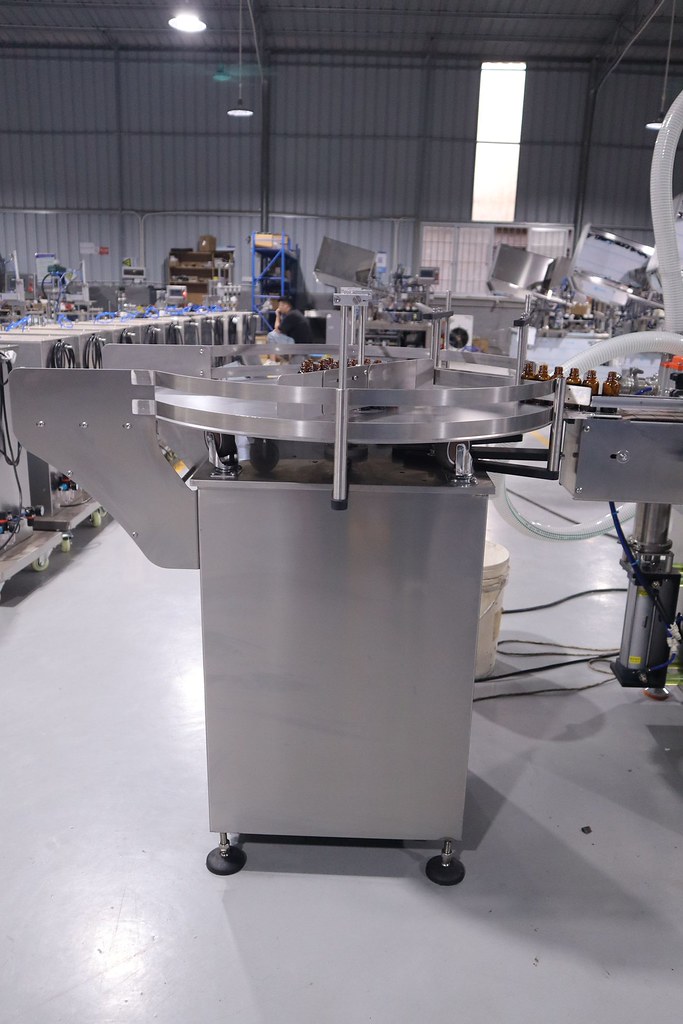
A complete soft tube production line — extrusion, injection shoulder heading, and downstream decoration and filling operating in an integrated sequence. The efficiency of each station is multiplied by the efficiency of the stations it feeds. Source: Miyoda Packaging Machinery
Glossaire des termes clés
| Term | Definition |
|---|---|
| Injection Shoulder Moulding | Process forming the tube shoulder and neck by injecting molten resin into a precision mold cavity at the tube sleeve’s open end, in a single step |
| Hot Runner System | A mold design in which resin in the runner channels stays molten between shots, eliminating solid runner waste and reducing material consumption per cycle |
| Flash | Excess resin escaping the mold cavity at the parting line; a visible surface defect that causes rejection in premium cosmetic and pharmaceutical tube production |
| Quick Mold Change (QMC) | Standardised mechanical interface enabling mold replacement in under 30 minutes, transforming a nominally multi-SKU machine into a genuinely flexible one |
| OEE (efficacité globale des équipements) | OEE = Availability × Performance × Quality; world-class injection moulding OEE benchmark is 85–90% |
| Cpk (indice de capacité du processus) | Statistical measure of process consistency within specification limits; Cpk ≥ 1.33 is the pharmaceutical production standard |
| Servo-Driven Indexing | Tube positioning system using servo motors with position feedback, enabling precise and reprogrammable movement between production stations |
| IQ/OQ/PQ | Installation Qualification, Operational Qualification, Performance Qualification — the three-stage validation protocol for pharmaceutical-grade production equipment |
| ISO 14644 | International standard classifying cleanroom environments by airborne particle concentration; ISO Class 7 or 8 typical for pharmaceutical tube packaging component production |
| IIoT (Industrial Internet of Things) | Network-connected sensors on manufacturing equipment transmitting real-time process data to monitoring systems for predictive maintenance and remote diagnostics |
| 21 CFR Part 11 | FDA regulation governing electronic records and electronic signatures; requires that electronic batch records meet data integrity, audit trail, and access control requirements |
| TCO (coût total de possession) | Complete cost of equipment over its operational life, including purchase price, installation, training, energy, maintenance, and downtime losses |
Questions fréquemment posées
1. What is an injection shoulder machine, and how does it differ from traditional tube manufacturing methods?
An injection shoulder machine forms the tube shoulder, neck, and orifice by injecting molten resin directly into a precision mold cavity at the open end of the tube sleeve — creating the shoulder in a single, simultaneous step that bonds it to the sleeve in the same cycle. Traditional multi-step heading processes form the shoulder separately (in a compression mould or by thermoforming) and then join it to the sleeve in a subsequent bonding station, creating an additional process step, an additional joint interface, and an additional potential defect category. Injection shoulder moulding eliminates the junction between shoulder and sleeve — producing a monolithic structure with no bond line and dimensional consistency of ±0.05–0.15 mm versus ±0.3–0.5 mm in manual compression heading.
2. Can this machine produce both cosmetic and pharmaceutical-grade tubes?
Yes — with appropriate configuration. The mechanical process is the same; the difference is in the compliance infrastructure surrounding it. Pharmaceutical tube shoulder production requires IQ/OQ/PQ validation documentation, GMP-compliant equipment design (no particle-shedding surfaces, sealed lubrication points, stainless steel panels), electronic batch record generation compliant with FDA 21 CFR Part 11 or EU GMP data integrity requirements, and cleaning validation SOPs. Cosmetic production has more flexibility, though ISO 22716 compliance is increasingly required by major retail buyers. Confirm at the specification stage which regulatory environment your product will be sold into, and verify that the machine and supplier can support the corresponding documentation requirements.
3. How much can I reduce material waste compared to extrusion-based processes?
At the heading stage, the combination of hot runner mold systems (eliminating runner waste per cycle) and servo-controlled shot dosing (eliminating systematic overpacking) typically reduces material waste from 4–8% of resin input to under 2% in documented production environments. Clients who have transitioned from cold-runner compression heading to injection shoulder moulding with hot runners report resin savings of 20–30% at the heading station — consistent with the LinkedIn engineering study finding that traditional moulding can generate up to 30% raw material wastage. At 5 million shoulders per year and a resin cost of USD 2.80/kg at an average shoulder weight of 3.5 g per part, a 25% waste reduction saves approximately USD 36,750 annually in recovered resin cost.
4. What is the typical return on investment for upgrading to an injection shoulder system?
ROI timeline depends on production volume, labour cost structure, current scrap rate, and the specific operational efficiency gap between the current process and the upgraded one. For mid-volume producers (4–10 million shoulders per year), documented payback periods typically fall in the 12–22 month range, driven primarily by labour saving from reduced operator headcount, scrap reduction, and recovered output from cycle time improvement. Pharmaceutical producers who gain access to compliant contracts through the machine’s GMP documentation capability often see effective ROI in under 12 months when the new contract revenue is included in the calculation. The ROI formula to apply to your specific numbers: Total Investment ÷ (Annual Labour Saving + Annual Scrap Reduction Value + Annual Energy Saving) = Payback Period in Years.
5. Can I switch between different tube sizes and designs quickly?
Yes — with quick mold change systems and HMI recipe management. Physical mold removal and replacement on a machine equipped with a QMC system takes under 30 minutes in documented operations; machines without QMC systems take 2–4 hours for the same change, which is the critical differentiator for multi-SKU contract manufacturers. HMI recipe recall restores all process parameters for the new mold design in 1–2 minutes, eliminating manual parameter re-entry errors. Confirm both capabilities — physical changeover system type and HMI recipe depth — with any supplier you are evaluating, and ask for a timed changeover demonstration on the actual machine before purchase.
6. Do I need to redesign my current tube packaging to use this technology?
Not necessarily. For most standard soft tube shoulder geometries — including flip-top closures, standard screw closures, oval shoulders, and round shoulders across diameters from 16 mm to 60 mm — injection shoulder machines can be tooled to produce existing designs without requiring packaging redesign. Complex shoulder geometries (multi-stage neck profiles, integral hinge features, or very tight nozzle bore tolerances below 1.0 mm ID) may benefit from design optimisation for moulding during the tooling development process. An experienced supplier will conduct a design for moulding (DFM) review of your existing shoulder design before quoting tooling, identifying any features that would be difficult to produce consistently at volume without modification.
7. Is operator training provided, and how complex is the machine to run?
Operator training for a fully automatic injection shoulder machine covers: machine startup and shutdown sequences, HMI recipe management and parameter adjustment, in-process quality check execution (dimensional measurement, visual inspection criteria), fault code interpretation and first-response troubleshooting, mold handling and basic inspection, and cleaning and lubrication procedures. Experienced operators reach independent competent operation in 2–4 weeks. The machine’s day-to-day operation is genuinely simpler than a multi-station semi-automatic process — one operator monitors output, calls up recipes, and responds to alarm conditions, rather than coordinating multiple stations manually. Confirm training scope, duration, and qualification documentation in the purchase agreement.
8. How does injection shoulder technology improve sealing and filling line performance?
The direct mechanism is dimensional consistency. A shoulder produced to ±0.05–0.15 mm OD tolerance across 10 million annual cycles fits filling line mandrels consistently — the same mandrel fit, every tube, every shift. This eliminates the feed variability, rotation drift, and forced loading that causes filling line stoppages on lines fed by inconsistent heading processes. Documented filling line performance improvements following heading process upgrades include: 35–71% reduction in tube-related line stoppages, elimination of seal misalignment defects traceable to shoulder dimension variation, and 15–25% reduction in filling line speed reduction events caused by tube loading problems. The improvement in the heading station is felt most clearly at the filling station, even though no changes are made to the filling equipment.
9. What maintenance is required, and what is the expected machine lifespan?
A preventive maintenance programme for an injection shoulder machine has four tiers: daily (10–15 minutes — visual mold inspection, ejector function check, barrel temperature verification, first-article dimensional check); weekly (lubrication of drive components, cooling circuit flow verification, mold parting line inspection); monthly (full mold strip and clean, servo encoder diagnostic, cooling channel descaling); quarterly (barrel dimensional inspection, screw tip assembly check, full mold dimensional verification against commissioning baseline). With consistent preventive maintenance, high-quality injection shoulder machines constructed from industrial-grade materials operate efficiently for 10–15 years — with planned component replacements (screw tip, ejector pins, mold sealing rings) at predictable cycle-count intervals rather than reactive failures.
10. Can the machine integrate with my existing filling and packaging lines?
Yes — machines designed for production line integration include standard conveyor interface heights (900–950 mm), digital I/O handshake signals for upstream and downstream equipment synchronisation, and OPC-UA data output for MES/ERP integration. Confirm the specific interface protocol with your machine supplier and your existing downstream equipment suppliers during specification — not during installation, when integration issues are expensive to resolve. The most common integration challenge is conveyor height mismatch between the heading machine’s discharge level and the downstream decoration or filling line’s infeed level; this is straightforward to design around if identified at specification stage and significant to resolve if discovered during installation.
11. Are spare parts readily available, and do you offer global service support?
Spare parts availability is a contractual commitment, not a sales assurance. Before purchasing, require a written spare parts availability guarantee specifying which critical components are stocked regionally and what the committed lead time is to your facility for each. Also confirm whether the spare parts commitment extends to the specific machine model for a minimum of 10 years from purchase — critical for operations planning equipment depreciation over a standard 10-year service life. Miyoda Packaging Machinery provides global after-sales support including remote technical assistance and documented spare parts guarantees for their tube production line clients.
12. Do you offer trial runs or sample production before purchase?
Yes — and this is one of the most important pre-purchase steps you can take for a heading machine investment. A sample production trial on your actual tube substrate, with your specific shoulder geometry, at production speed, produces dimensional data that tells you what the machine will actually deliver in your application — not what the specification sheet says it can deliver in ideal conditions. Request a witnessed Factory Acceptance Test (FAT) that includes: 500 consecutive production cycles at full production speed, dimensional measurement on 30 samples (OD, ID, height, wall thickness at three points), and seal strength testing of the shoulder-to-sleeve bond. The FAT data is your baseline — it is the reference against which any performance dispute during the machine’s service life will be resolved.















