
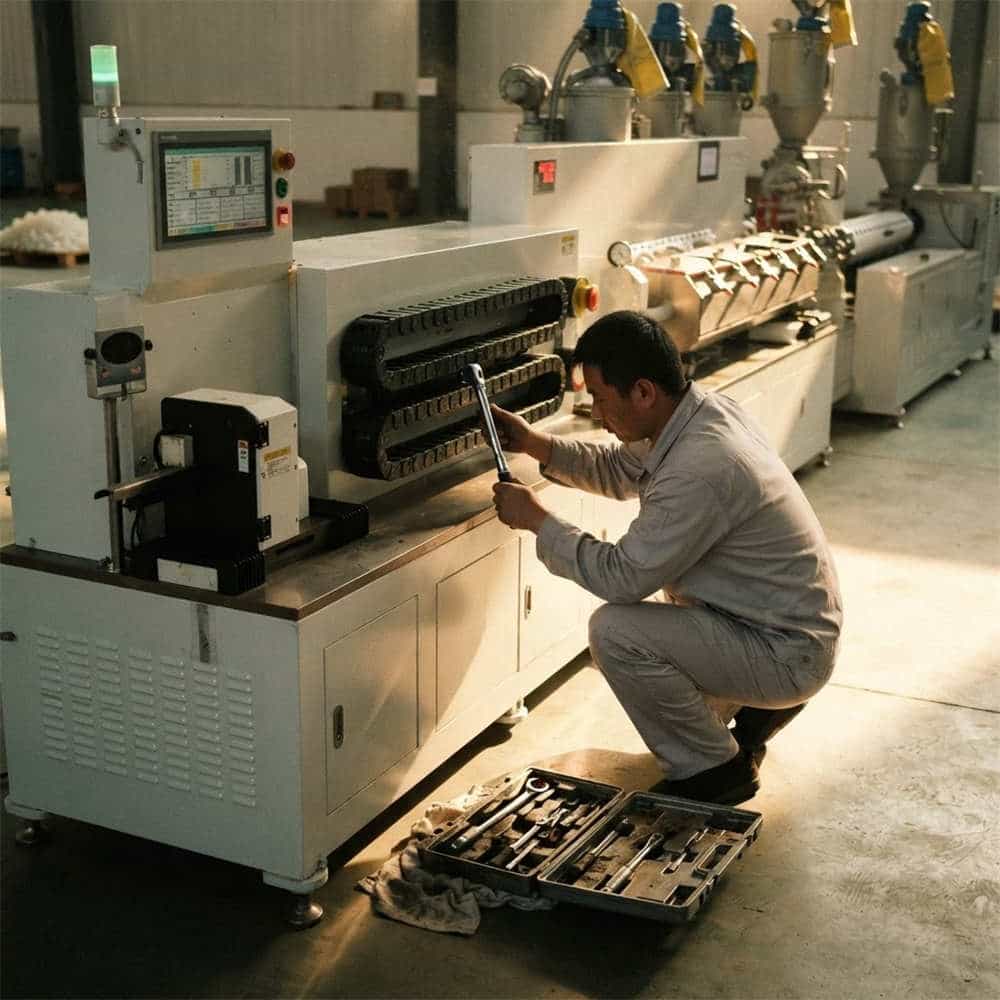
When Your Extruder Isn’t Performing, Your Whole Line Pays the Price
A plastic extruder running slightly out of spec doesn’t announce itself loudly. It shows up as tubes with inconsistent wall thickness that pass visual inspection but fail burst testing. It shows up as a subtle dimensional drift that ruins print registration three stations downstream. It shows up as black specks in pharmaceutical tubes that force a full batch rejection at your customer’s QC lab.
These aren’t catastrophic failures. They’re slow bleeders — and for cosmetic and pharmaceutical tube producers, they’re often more damaging than a full line stop, because they erode margin and customer confidence quietly over weeks before anyone identifies the root cause.
This guide addresses exactly those problems. It covers 10 structured troubleshooting areas across the full extrusion process — from pre-startup inspection through to data logging and remote support escalation — with practical diagnostics you can apply on your production floor today.

1. Comprehensive Pre-Startup Inspection Protocol
Most extrusion problems that appear in the first two hours of a production run were created before the machine was even switched on. A thorough pre-startup inspection isn’t a formality — it’s the single highest-return action you can take per shift.
Start with a full visual walk of the line: check for shipping or maintenance residue on guide surfaces, verify that all fasteners on the die head and barrel clamps are torqued to spec (finger-tight is not torqued), and confirm that pneumatic and hydraulic line fittings are fully seated with no visible weeping at the connections. A 1 bar pressure drop in a hydraulic circuit that holds die alignment will cause wall thickness variation within 30 minutes of startup — and it takes 10 seconds to check.
For GMP-compliant environments — particularly pharmaceutical tube producers — pre-startup documentation is not optional. Your inspection log should include machine serial number, shift date, operator ID, and a signed confirmation that all safety guards and interlocks have been verified functional. If your process is subject to FDA cGMP regulations under 21 CFR Part 211, that pre-startup record is a traceable quality document — treat it as one.
Common pre-startup failures that cause downstream problems: misaligned die-to-vacuum tank entry (causes ovality within the first meter); unverified thermocouple connections (causes temperature zone to run open-loop); and haul-off belt pressure set to the previous product’s spec (causes immediate diameter deviation on first tubes off the line).
2. Precise Temperature Zone Calibration
The temperature profile across your extruder barrel is not something to set once and forget. PID controllers (Proportional-Integral-Derivative — the algorithm that governs how the heater responds to the difference between setpoint and actual temperature) drift over time as thermocouple junctions age. On a machine running two shifts per day, a 6-month-old thermocouple may be reading 4–7°C lower than the actual barrel surface temperature — enough to cause degradation in the melt without triggering an alarm.
Use a calibrated external contact thermometer to spot-check each zone against the controller display at least monthly. For LDPE (Low-Density Polyethylene — the most common material for soft cosmetic tubes, valued for its flexibility and chemical resistance), the acceptable variance per zone is ±2°C. Wider deviation causes melt viscosity inconsistency that shows up as surface roughness or wall thickness variation that no downstream adjustment can fully correct.
Multi-layer co-extrusion structures add complexity: each extruder in a 3-layer or 5-layer system must hold its own thermal profile independently, and the interface temperature between layers affects adhesion strength. If you’re seeing inter-layer delamination during tube shoulder formation, check whether a temperature zone in the secondary extruder has drifted upward — overheated tie-layer material loses its adhesion window quickly.
“We were getting intermittent delamination on a 5-layer EVOH structure — only on some batches, not all. The root cause turned out to be a failed heater band in zone 3 of the secondary extruder, compensated for by adjacent zones but leaving a cold spot in the barrel. External thermocouple verification found it in under an hour.” — Process Engineer, Southeast Asian cosmetic tube manufacturer
Baseline documentation matters: record your validated temperature profile (the one that produces in-spec product) as a named recipe in your PLC. Every time you change material grade, tube diameter, or line speed, create a new documented profile — don’t overwrite the original.
3. Screw and Barrel Wear Assessment Schedule
Screw and barrel wear is gradual, invisible, and expensive to ignore. In a typical cosmetic tube extrusion environment running pigmented LDPE at 10–15 meters per minute, measurable wear on the screw flight OD (outer diameter) begins appearing between 4,000 and 6,000 operating hours — earlier if the line runs colored masterbatch with mineral-based pigments, which act as mild abrasives on the metal surface.
The practical signs of wear that production teams notice first: output rate drops at a fixed screw RPM (you need more speed to maintain the same throughput), melt temperature rises without a setpoint change (increased mechanical shear from wider screw-to-barrel clearance), and — the one that triggers quality rejections — black specks appearing intermittently in production. Those specks are degraded polymer that has been sitting in stagnant flow zones created by the increased clearance between the worn screw flight and barrel bore.
For pharmaceutical tube producers, black specks are not a cosmetic defect — they are a product contamination event. A single rejection at your customer’s incoming inspection can trigger an audit of your entire quality system.
Recommended assessment schedule: bore gauge the barrel and measure screw flight OD monthly on high-output lines. Replace or resurface when flight clearance exceeds 0.15mm for standard cosmetic grades, or 0.08mm for pharmaceutical-grade applications where homogeneity requirements are tighter. Keep a wear trend log — the slope of the wear curve tells you when to plan replacement, not just whether replacement is needed now.
Learn more about screw and barrel wear diagnostics in this technical deep-dive from Plastics Technology, which covers measurement methods and material-specific wear rates in detail.
4. Die Head Alignment and Lip Adjustment System
Die head alignment is the difference between a tube with consistent 0.4mm wall thickness all the way around and one with a 0.6mm wall on one side and 0.25mm on the other — a defect that causes uneven dispensing, failed crimping seals, and customer returns.
Concentricity (the degree to which the inner and outer surfaces of the extruded tube share the same center axis) is controlled by the position of the mandrel tip relative to the die lip. Adjustment is made via the centering bolts around the die head — typically four or six bolts in a cross pattern. The adjustment process requires a dial indicator or feeler gauge set and should be performed cold (before heatup) when the die is mechanically stable, then verified again at operating temperature since thermal expansion shifts the geometry.
Laser alignment tools are the current best practice for high-precision tube lines. A laser bore sight positioned at the die exit aligned to the vacuum sizing tank entry reduces the chance of the tube exiting the die at an angle that creates systematic wall variation — a problem that basic centering bolt adjustment cannot detect or correct.
Lip gap adjustment — the gap between the die tip and die ring that determines wall thickness — should be approached in small increments: no more than a quarter-turn of the adjustment bolt at a time, with a 3–5 minute stabilization period before measuring the effect. Aggressive lip adjustment causes more problems than it solves, particularly in multi-layer co-extrusion where disturbing one layer’s flow geometry affects adjacent layer interfaces.
| Defect Observed | Likely Die Issue | Corrective Action |
|---|---|---|
| Wall thick on one side only | Mandrel off-center | Adjust centering bolts; verify with dial indicator |
| Wall thin across full circumference | Lip gap too narrow | Open lip gap in ¼-turn increments; re-measure |
| Webbing / tube not closing fully | Die-to-tank misalignment | Laser-align die exit to vacuum tank entry |
| Surface roughness / sharkskin | Die land too short or overheated | Check zone temperature at die exit; adjust land length |
5. Vacuum Sizing and Cooling Tank Optimization
The vacuum sizing tank is where your extruded tube transitions from a soft, dimensionally unstable melt to a solid tube with its final OD (outer diameter). Get this station wrong, and everything downstream — printing registration, heading, filling, and crimping — will be fighting a dimensional problem that started here.
Vacuum pressure should be set to the minimum needed to hold the tube against the sizing sleeve, not the maximum available. Over-vacuuming a soft tube causes the tube to collapse slightly at the entry point, creating internal stress that leads to warping post-cut. The correct starting point is typically 0.3–0.5 bar below atmospheric for LDPE tubes, adjusted based on tube diameter and wall thickness. Measure the actual vacuum at the tank gauge — not at the pump — since line losses between the pump and tank can be significant.
Water flow distribution inside the cooling tank is equally critical. Spray bars should produce uniform coverage around the tube circumference. If the tube cools faster on the bottom (closest to the spray bars) than the top, it will ovalize — shrinking more on the cooled side. Ovality above 0.3mm in a 22mm tube is enough to cause jamming in heading machine mandrel chucks and inconsistent printing on flat-print decoration lines.
Check water temperature at the tank inlet and outlet: a delta-T (temperature difference) below 3°C suggests either insufficient flow rate or inadequate heat removal capacity for your production speed. Increase flow or reduce line speed in 5% increments until the delta-T reaches 5–8°C, which indicates effective heat extraction. For lines running above 12 meters per minute on larger diameters, a two-stage cooling tank may be required to achieve full solidification before the haul-off.

6. Haul-Off and Take-Up Tension Control
The haul-off unit (the set of rubber-belted or tracked grippers that pull the cooled tube away from the die at a controlled, constant speed) is the pacemaker of your entire extrusion line. If its speed isn’t precisely matched to the extrusion output rate, you get dimensional instability in one of two forms.
Slow haul-off relative to extrusion speed creates a pileup: the tube grows thicker than spec and may sag or buckle before entering the haul-off. Fast haul-off relative to extrusion speed causes draw-down — the tube is stretched longitudinally, thinning the wall in a pattern called “dog-boning” (thinner walls in the middle of the tube, thicker at the ends). For tamper-evident or child-resistant tube applications, dog-boning is a structural failure — the thin section becomes the point of unauthorized access.
Haul-off speed calibration should use a laser tachometer to measure actual belt speed rather than relying on the motor speed display, since rubber belt wear and slippage cause real surface speed to fall below the indicated value over time. Match this measurement to the extruder output rate (calculated from screw RPM, melt density, and die geometry) and verify with a direct tube weight-per-meter measurement on freshly extruded product.
Encoder feedback systems — sensors that read the actual haul-off belt speed and feed that data back to the PLC for closed-loop correction — are standard on modern lines and should be verified for response accuracy at least quarterly. An encoder with accumulated positional error of more than 0.5% will allow slow drift in tube diameter that only shows up when customer QC measures the finished product.
7. Downstream Equipment Synchronization
The extruder does not operate in isolation. On a complete soft tube extrusion production line, the main extruder PLC must communicate in real time with the cutting station, any inline printing unit, and the transfer conveyor feeding the heading machine. When these signals fall out of sync, the consequences are immediate and visible: cut tubes arriving at the heading station at irregular intervals cause mandrel jams; print registration shifts when the cutter fires 20ms late; and conveyor pileups create tube surface damage that QC catches as cosmetic rejects.
PLC communication between stations typically runs on Modbus RTU, Modbus TCP, or EtherNet/IP protocols. Before blaming the extruder for downstream problems, verify that the master clock signal from the extruder PLC is being received correctly at each slave station. A network switch with a faulty port can cause intermittent signal dropout that appears as random downstream errors with no obvious upstream cause.
For high-speed cosmetic lines running above 60 tubes per minute, synchronization timing tolerances are tight: the cutter trigger signal must arrive within ±5ms of target, and conveyor speed must track haul-off speed within ±1%. Any variance beyond this generates scrap bursts that look random but are actually periodic — they follow the timing cycle of the desynchronized station. Log tube rejection events by timestamp: if they cluster at regular intervals, you have a synchronization problem, not a random quality event.
8. Preventive Maintenance (PM) Checklist Integration
The difference between a line that achieves 85% OEE (Overall Equipment Effectiveness — the product of availability, performance, and quality rates, expressed as a percentage) and one that struggles at 65% is rarely the machine’s fundamental design. It’s almost always the discipline of preventive maintenance versus the habit of reactive repair.
A digital PM log — not a paper form — provides accountability and trend visibility that paper cannot. When a gearbox oil change is logged digitally, with date, technician ID, and oil grade recorded, you can run a report 18 months later and see exactly how many hours elapsed between services. Paper logs get lost, get wet, and get backdated.
Structured PM Schedule: Soft Tube Extrusion Line
| Fréquence | Tâche | Component |
|---|---|---|
| Quotidien | Inspect die face for melt buildup; clean cooling tank strainer | Die head, cooling system |
| Hebdomadaire | Check haul-off belt condition; verify all heater band connections | Haul-off, barrel heating |
| Mensuel | Lubricate gearbox and thrust bearing; bore-gauge screw clearance; verify encoder accuracy | Drive system, screw/barrel |
| Trimestriel | Change hydraulic filters; clean electrical panel with dry compressed air; full PLC parameter backup | Hydraulics, controls |
| Annuel | Full thermal imaging of electrical cabinet; replace thermocouple elements; screw measurement report | All critical systems |
For operations running 24/7, the annual audit interval should be reduced to every 6 months. Component fatigue accumulates in proportion to actual runtime hours — a machine running three shifts per day ages at three times the rate of a single-shift line.
9. Real-Time Process Monitoring and Data Logging
SCADA (Supervisory Control and Data Acquisition — software that monitors and records data from production equipment in real time) and MES (Manufacturing Execution System — software that connects machine-level data to production planning, quality, and compliance records) are increasingly standard requirements, not optional upgrades — especially for pharmaceutical tube producers subject to regulatory inspection.
In practical terms, a SCADA-connected extrusion line gives you a live trend of melt pressure, motor current draw, zone temperatures, and haul-off speed — displayed together so that correlations become visible. When melt pressure rises 8% over 20 minutes while motor current rises in parallel, you’re looking at a screen pack (the filter mesh between the barrel and the die head) approaching blockage. With SCADA, you see it building. Without it, you discover it when the line surges and your first 50 tubes of the new hour are out of spec.
For pharmaceutical compliance, data logging goes beyond operational visibility — it’s a regulatory requirement. Batch records for pharmaceutical-grade tube production must include time-stamped temperature logs, fill weight records, and material traceability data that links each tube batch to a specific resin lot. Systems supporting 21 CFR Part 211 cGMP requirements must produce records that are complete, accurate, and protected against retroactive modification — paper logs fundamentally cannot meet this standard at audit scale.
Miyoda Packaging Machinery’s extrusion systems are designed with PLC architectures compatible with OPC-UA and Modbus TCP gateway integration, allowing connection to customer-side SCADA or MES platforms without full machine replacement. See the full buyer’s guide for plastic tube extrusion machine selection to understand which data output configurations are available across different machine specifications.
Watch: 5-Layer & 3-Layer Cosmetic Seamless PE Tube Extrusion in Operation
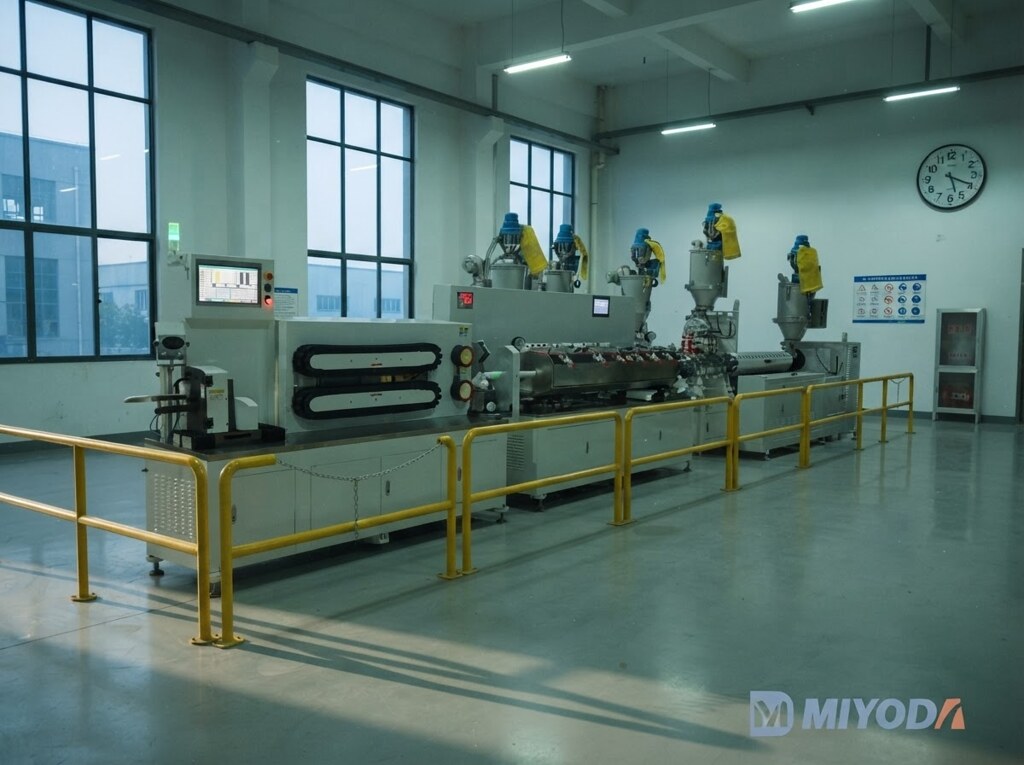
Seeing a correctly configured multi-layer extrusion line running at production speed makes several of the concepts above concrete — particularly the interaction between haul-off tension, cooling tank entry alignment, and downstream cut quality. The video below shows a 5-layer and 3-layer cosmetic seamless PE tube extrusion machine in full operation.
10. Direct Technical Support Escalation Pathway
There is a moment in every production crisis when the internal team has exhausted their diagnostic options and the right next step is escalation — but escalation done wrong wastes 45 minutes before any useful information is exchanged. The team member who calls technical support with “the machine is making bad tubes” gets a very different response than the one who calls with “we’re seeing 0.2mm ovality on 25mm OD LDPE tubes, vacuum is at 0.4 bar, water temp is 18°C in and 22°C out, and the deviation started at 14:32 after we changed the material lot.”
Before any escalation call, document and have ready: machine model and serial number, current parameter settings (a photo of the HMI screen is faster than reading values aloud), the specific defect with measurement data (not descriptions — numbers), and the timeline of when the problem first appeared and what changed before it appeared. This preparation compresses a typical 60-minute remote diagnostic session to under 20 minutes.
For distributors and agents managing multiple end-user sites, a standardized escalation form shared with all customers creates consistency: when a customer in Indonesia and a customer in Poland both call your technical team with the same format of information, your technicians can diagnose both faster and accumulate institutional knowledge about machine behavior across different climates, material grades, and operating practices.
Miyoda Packaging Machinery provides remote diagnostic support via secure VPN connection, WhatsApp video for visual confirmation of defects, and a network of trained regional agents for on-site escalation when remote support reaches its limits. Contact Miyoda’s technical support team to discuss setting up a dedicated support pathway for your facility or your distribution network.

Glossary of Key Extrusion Terms
- LDPE (polyéthylène basse densité)
- The most common base material for soft cosmetic squeeze tubes. Valued for its flexibility, chemical resistance, and compatibility with a wide range of cosmetic and personal care formulations. Requires precise temperature control in the 160–220°C range depending on grade.
- Co-extrusion
- The process of simultaneously extruding two or more layers of different materials through a single die head to form a composite tube wall. Common configurations include 3-layer (PE/EVOH/PE) and 5-layer (PE/TIE/EVOH/TIE/PE) structures for barrier performance.
- PID Controller
- Proportional-Integral-Derivative controller — the algorithm that governs how a heater responds to the gap between the setpoint temperature and the measured actual temperature. When PID parameters are correctly tuned, the zone reaches setpoint quickly and holds it stably. Poorly tuned PID causes temperature oscillation.
- Ovality
- A dimensional defect in which the cross-section of an extruded tube is elliptical rather than circular. Caused by uneven cooling, vacuum pressure issues, or die misalignment. Ovality above 0.3mm in a standard cosmetic tube creates downstream problems in heading, printing, and filling stations.
- Dog-Boning
- Wall thinning at the center of a tube caused by excessive haul-off speed relative to extrusion rate. The tube is stretched longitudinally during solidification, redistributing material mass toward the tube ends. Critical failure mode in structural or tamper-evident tube applications.
- Screen Pack
- A fine mesh filter positioned between the extruder barrel and the die adapter that catches unmelted particles and contaminants in the melt stream. Blockage causes rising melt pressure, surging output, and potential contamination if the pack ruptures. Replace before pressure rises more than 15% above baseline at constant output.
- OEE (efficacité globale des équipements)
- A composite metric calculated as Availability × Performance × Quality. A line running 20 hours per day (out of a planned 22), at 95% of rated speed, with 98% good product yield achieves approximately 83% OEE. World-class OEE for extrusion is typically 85%+.
Questions fréquemment posées
Why is my extruded tube showing inconsistent wall thickness?
The three most common causes are: die mandrel off-center (confirmed with a feeler gauge — wall will be consistently thicker on one side), fluctuating haul-off speed (confirmed by measuring tube weight-per-meter at intervals across a run), and uneven cooling in the vacuum sizing tank (confirmed by measuring tube OD at 90° intervals). Start with die alignment — it’s the most common root cause and the most controllable.
How often should I inspect the screw and barrel in cosmetic tube production?
Monthly bore gauging is the right frequency for lines running colored masterbatch or more than one shift per day. Every three months is acceptable for lines running natural (uncolored) LDPE on a single shift. Document measurements in a trend log — the rate of wear increase tells you more than any single measurement.
What temperature accuracy is required for LDPE soft tube extrusion?
Maintain ±2°C in each barrel zone, validated with an external contact thermometer rather than relying on the controller display alone. Thermocouple drift on machines running more than 8 hours per day can accumulate to 5–7°C error within 6 months, causing melt inconsistency that no downstream parameter adjustment can fully correct.
My extruder is showing high motor load — what should I check first?
Check in this sequence: screen pack condition (rising back-pressure increases load), feed throat for bridging (material packed above the screw entry point), material dryness (moisture-contaminated resin requires more mechanical energy to process), and screw flight clearance (worn clearance increases viscous drag). High motor load combined with output rate drop almost always points to screen pack blockage or feed throat issues.
How do I prevent black specks in pharmaceutical-grade tubes?
Black specks are degraded polymer — they come from stagnant flow zones in worn screw clearances, from die lip areas where material sits between runs, or from contaminated regrind in the material feed. Prevent them through: quarterly die head cleanout (disassemble, clean, and inspect all flow surfaces), use of purging compounds between material or color changes, and strict incoming material quality control with no regrind in pharma-grade runs.
Can I run multi-layer co-ex tubes on a standard single-layer extrusion line?
No — co-extrusion requires a multi-manifold die head, separate extruders for each layer, individual temperature control zones per extruder, and layer thickness monitoring. Converting a single-layer line to co-extrusion is a major capital upgrade, not a parameter adjustment. If you’re evaluating co-ex capability, review Miyoda’s complete tube extrusion production line configurations to understand what a properly specified co-ex system includes.
Why does my tube ovalize after exiting the cooling tank?
Ovality after the cooling tank almost always points to one of two causes: insufficient vacuum pressure (the tube isn’t being held firmly against the sizing sleeve while it solidifies), or uneven water spray distribution inside the tank (the tube cools faster on one side, shrinking asymmetrically). Start by measuring vacuum at the tank gauge (not the pump), then inspect spray bar nozzles for blockage or directional variation.
How do I calibrate the haul-off speed to match extrusion output?
Use a laser tachometer to measure actual belt surface speed — not the motor speed indicator, which doesn’t account for belt wear and slippage. Calculate your target haul-off speed from extruder output rate (screw RPM × output-per-revolution at current melt conditions) and cross-verify with direct tube weight-per-meter measurement. Fine-tune via PLC settings in 0.5% increments, checking tube diameter after each adjustment.
What maintenance is required for hydraulic systems in humid tropical environments?
In high-humidity environments, hydraulic reservoir breathers (the vented caps that allow the reservoir to breathe as fluid level changes) must be moisture-absorbing types — standard open breathers allow humid air into the reservoir, accelerating fluid degradation and corrosion of internal components. Change hydraulic filters quarterly regardless of indicator color, since humidity-degraded fluid damages filters faster than clean environments. Check fluid for milky appearance (water contamination) monthly.
How can I reduce startup waste during color or material changes?
The fastest method is a structured purge sequence using a commercial purging compound compatible with your resin system. Run the purge compound at 5–10°C above your previous material’s processing temperature, at moderate screw speed, until the extrudate is visually clean. For operations doing multiple color changes per shift, quick-disconnect die systems — where the die head can be swapped in under 15 minutes — reduce contamination-driven purge time significantly compared to barrel-only purging.
Is remote diagnostic support available for machines in remote or emerging-market locations?
Yes. Modern PLC systems with OPC-UA or cloud-gateway capability allow secure remote access to machine parameters, alarm histories, and trend data from any location with an internet connection. For sites in areas with unreliable internet, a local data logger that buffers up to 72 hours of production data and syncs when connectivity is available ensures that diagnostic information is never lost during outages.
What documentation is required for regulatory compliance in pharmaceutical tube production?
At minimum, pharmaceutical tube producers need time-stamped temperature logs for every production batch, material traceability records (resin lot number linked to tube batch number), calibration records for critical instruments (thermocouples, pressure transducers, encoders), maintenance logs, and deviation records for any out-of-specification event with documented corrective action. Electronic records must meet 21 CFR Part 11 or EU Annex 11 data integrity requirements — meaning records must be time-stamped, attributable to a specific operator, and protected from retroactive editing.
How do I train new operators effectively on Chinese-manufactured extruders?
Effective training on Chinese-manufactured extrusion equipment requires material in the operator’s working language — not just English manuals. Miyoda Packaging Machinery provides multilingual SOP packages, machine-specific video tutorials, and onsite training programs that can be customized for distributor networks managing operators across multiple countries. The most effective programs combine machine operation training with basic troubleshooting decision trees — so operators know how to respond to common alarm conditions without calling for engineering support.
Can I upgrade my existing extruder for higher output without replacing the entire machine?
In many cases, yes. Common upgrade pathways include screw geometry redesign for higher-shear or higher-throughput profiles, replacement of standard barrel heaters with ceramic band heaters for faster zone response, and controller upgrades from older relay-based systems to modern PLC with recipe management and remote monitoring capability. The feasibility depends on the base machine’s mechanical condition and electrical architecture — contact Miyoda’s engineering team for a specific assessment of your machine’s upgrade potential.
What signs clearly indicate it’s time to replace the extrusion screw?
Three definitive replacement indicators: reduced output rate at a fixed screw RPM that cannot be recovered by parameter adjustment (typically a 10–15% output drop from original baseline); visible corrosion, pitting, or metal loss in the feed or compression zones when the screw is pulled for inspection; and persistent melt homogeneity problems (black specks, gels, or unmelted particles) that continue after eliminating all other possible causes including screen packs, material contamination, and temperature zone accuracy.
Ready to Solve Your Extruder Problems — or Upgrade Your Line?
Whether you’re troubleshooting a specific extrusion defect, evaluating your PM program, or planning a line upgrade that needs to meet pharmaceutical compliance standards — the right conversation starts with knowing exactly what you’re working with.
Explore Miyoda Packaging Machinery’s tube extrusion machine specifications — covering mono-layer through 6-layer co-extrusion, LDPE, MDPE, EVOH barrier structures, and PCR-compatible configurations for sustainable packaging.















