
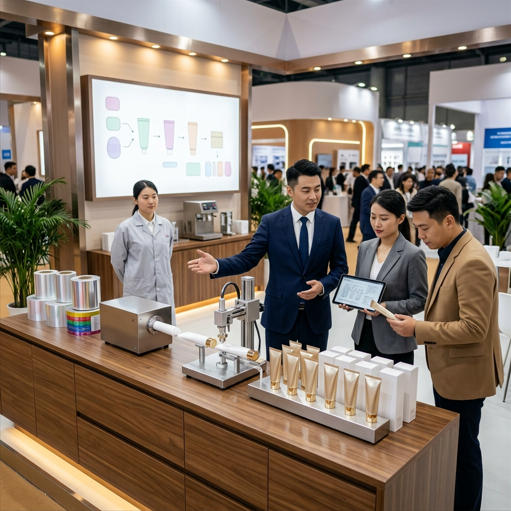
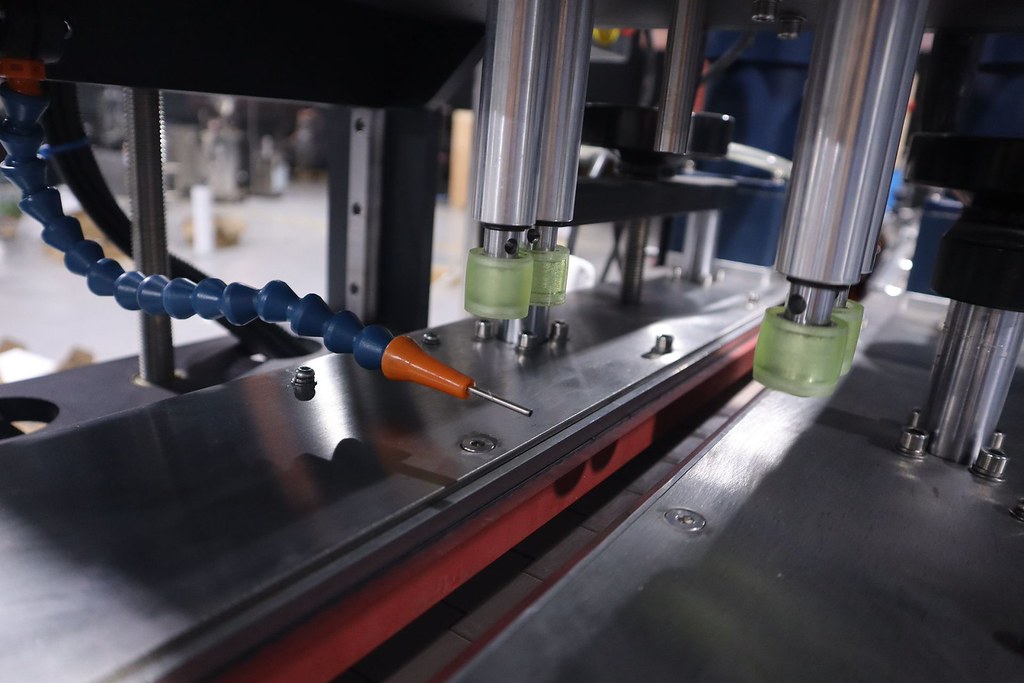
The machines you choose today determine your production ceiling for the next 8–12 years. Every feature on this list exists to solve a real problem — not to fill a spec sheet.
The Hidden Cost of “Good Enough” Machines
Most production problems in soft tube manufacturing don’t announce themselves. They accumulate quietly.
A tube loading station that requires two operators instead of one. A cutting system that drifts 0.3mm over a shift and causes 1.2% seal rejection. A changeover that takes 90 minutes when a competitor’s line does the same switch in 28 minutes. An energy bill that nobody questions because “that’s just what these machines cost to run.”
None of these problems trigger a crisis. They just erode margin, month after month, until your cost per thousand tubes is meaningfully higher than the industry benchmark — and you’re not sure exactly why.
The machines you specify today will run your cosmetic or pharmaceutical tube production for the next 8–12 years. The features you prioritize — or overlook — at the point of purchase are the features you’ll be living with through that entire period.
This guide was written specifically for buyers evaluating soft tube production equipment: manufacturers scaling up production, brand owners bringing tube production in-house, and distributors advising clients on machine specifications. It covers the ten features that consistently separate high-performing production lines from ones that fall short of their ROI potential.
Why Machine Selection Is a Strategic Business Decision
Purchasing a soft tube production machine is not a procurement exercise. It’s a business strategy decision with a 10-year time horizon.
That distinction changes what you should be evaluating. A procurement exercise optimizes for purchase price. A strategy decision optimizes for total cost of ownership — which includes purchase price, installation, training, energy, maintenance, downtime, labor, and the cost of quality failures — across the machine’s operating life.
Consider a straightforward comparison. Machine A costs $80,000 and runs at 65 tubes per minute with a 2.1% seal rejection rate. Machine B costs $110,000 and runs at 80 tubes per minute with a 0.4% rejection rate. Over a 10-year production life at 15 million tubes per year:
At $0.08 material cost per tube, that’s $20,400 vs. $4,800 per year in scrap material alone — a difference of $15,600 annually. Over 10 years, Machine B’s quality advantage alone covers $156,000 of its $30,000 purchase premium, while also producing 22.5 million more tubes at the same operating hours.
This is the calculation frame that matters. The innovative features in this guide are not premium extras. They are the specific engineering decisions that determine which side of this calculation your operation lands on.
💡 Industry Insight: For cosmetic and pharmaceutical tube markets, product quality is also a compliance requirement. FDA CGMP regulations (21 CFR Part 211) and ISO 22716 for cosmetics require documented process control, traceability, and quality assurance systems. Machines that support these requirements through built-in documentation, parameter logging, and process control are not a luxury for pharmaceutical clients — they’re a prerequisite for market access.
Automatic Tube Loading — Minimize Labor, Maximize Throughput

Automatic tube loading eliminates the single highest-frequency manual touch-point in soft tube production — and with it, the variation, fatigue, and stoppages that come with it.
What Manual Loading Actually Costs You
On a conventional soft tube production line, tube loading — the process of feeding empty tubes from storage into the machine’s conveying system — is typically performed by one to two operators per shift. It sounds simple. In practice, it’s one of the most disruptive points on the entire line.
Manual loading introduces variation in tube orientation, irregular feeding intervals that cause micro-stoppages downstream, and operator fatigue that compounds over a shift. A loader working at the beginning of a 10-hour shift performs differently than the same operator in hour eight. That inconsistency propagates through every station downstream.
An automatic tube loading system — using vibratory bowl feeders, belt conveyors, or robotic pick-and-place units — feeds tubes into the production line at a consistent rate and in precise orientation, regardless of shift timing, operator experience, or production volume.
Real-World Impact
Research from the tube packaging machinery sector shows automated loading systems reduce per-unit labor costs by 40–60% at volumes above 150,000 tubes per month, as confirmed by Miyoda Packaging Machinery’s production analysis data. Beyond the headline cost saving, automatic loading systems:
- Eliminate tube orientation errors that cause jams and require manual intervention
- Maintain consistent feed rate even during surge demand periods
- Free operators for quality monitoring tasks rather than repetitive physical feeding
- Enable genuine lights-out or reduced-crew production on night shifts
For clients in markets where skilled labor is expensive or supply-constrained — Western Europe, North America, and increasingly Southeast Asian manufacturing hubs — this feature alone can drive the purchase decision.
Precision Cutting Systems — Consistent Quality, Every Tube
The Tolerance That Protects Your Seal
In soft tube production, the cut that separates individual tube bodies from the extruded tube stock must be accurate to within ±0.1mm to guarantee consistent sealing performance downstream. That’s roughly the width of a human hair.
Here’s why that precision matters commercially: tube sealing machines apply heat and pressure to a specific length of tube tail to create the hermetic seal at the bottom of each filled tube. If the cut length varies — even by 0.3–0.5mm — the seal zone on some tubes falls outside the designed heating area. The result is an underseal: a tube that appears sealed visually but fails under light pressure, creating leak risk during distribution or at the consumer’s hands.
In pharmaceutical tube packaging, an underseal isn’t a cosmetic issue. It’s a sterility breach. A batch of medicated creams or ophthalmic ointments with inconsistent seal integrity creates a product recall scenario — one that costs multiples more than the machine upgrade that would have prevented it.
Servo-driven cutting systems — where the blade movement is controlled by a digital servo motor rather than a mechanical cam — deliver cutting precision of ±0.1mm shot-to-shot and maintain that tolerance consistently across an 8-hour production shift, regardless of thermal expansion or mechanical wear progression. Older cam-driven systems drift as mechanical components wear, requiring frequent manual adjustment to maintain acceptable tolerances.
💡 Glossary:
- Servo motor: An electric motor with a built-in feedback sensor that continuously compares actual position to the commanded position and corrects in real time. In cutting systems, this means the blade hits exactly the same position on every cycle.
- Hermetic seal: An airtight, tamper-evident seal with zero gas permeability — the standard requirement for pharmaceutical tube packaging.
Precision as a Material Efficiency Tool
Precise cutting also reduces material waste. On an extrusion line producing 35mm-diameter tubes at 12 meters per minute, a ±0.1mm cut length tolerance wastes approximately 0.3mm of tube material per cycle in over-cut trim. A ±0.5mm system wastes 1.5mm per cycle — five times more material, on every tube, every minute of every shift.
Digital Control Panels with HMI — Real-Time Monitoring and Control
Moving Beyond the Button Panel
An HMI (Human-Machine Interface) is the touchscreen control panel that allows operators to interact with the production machine — setting parameters, monitoring performance, receiving alerts, and diagnosing problems — without needing specialized engineering knowledge.
First-generation tube production machines used fixed button panels and analog gauges. A parameter change required a maintenance engineer with a wiring diagram. A fault condition required manual diagnosis. Recipe changes between tube sizes meant reconfiguring mechanical stops and re-running test tubes until the setup was confirmed.
Modern HMI systems — found on current-generation soft tube production lines — change this entirely.
What a Good HMI Delivers in Practice
An intuitive, well-designed HMI panel on a soft tube production machine enables:
Stored production recipes: Every tube SKU — size, material type, fill volume, seal temperature, cut length — is saved as a named recipe in the machine’s memory. Switching from a 35mm cosmetic cream tube to a 25mm pharmaceutical ointment tube means selecting the new recipe on the touchscreen, not manually adjusting 12 mechanical parameters. Changeover time drops from 90+ minutes to 22–30 minutes.
Real-time process monitoring: Temperature profiles at every heating station, seal pressure, cut length, fill volume, and line speed are displayed continuously. An operator can see a seal temperature drifting toward its lower limit and correct it before the first underseal tube is produced — rather than discovering the problem during end-of-shift quality sampling.
Fault logging and production records: Every parameter value, every alarm event, and every operator intervention is time-stamped and logged. For pharmaceutical clients, this creates the batch production records required by GMP regulations without additional manual documentation effort.
Remote diagnostics: With a secure network connection, the machine manufacturer’s technical team can view live machine data, review fault logs, and in many cases resolve operational issues remotely — without waiting for an on-site service visit. Manufacturing Tomorrow’s analysis of industrial HMIs confirms that remote diagnostic capability reduces average fault resolution time from days to hours for connected production facilities.
Integrated Leak Detection — Guaranteeing Product Integrity
The Seal Failure You Can’t See
Visual inspection catches obvious tube defects — visible delamination, gross seal failures, obvious contamination. It does not catch micro-leaks: pinhole-sized perforations or incomplete seal bonds that allow product to slowly migrate through the tube wall or seal zone under the pressure of normal handling.
For a cosmetic manufacturer, a micro-leaking tube that reaches retail causes product contamination, packaging failure, and a customer complaint that takes its story to social media. For a pharmaceutical manufacturer, the same failure is a sterility breach with regulatory and liability implications that far exceed the value of the batch.
Integrated leak detection — built into the tube production line as an inline quality check — identifies these failures before tubes leave the production station, without opening, puncturing, or destroying the tube being tested. This approach is called non-destructive testing (NDT).
How It Works: Pressure Decay Testing
The most widely used inline NDT method for soft tube seals is pressure decay testing: a small pneumatic fixture grips the sealed tube, applies a calibrated internal air pressure, and then monitors pressure over a defined time window (typically 0.5–2 seconds at production line speed). A tube with a micro-leak shows a measurable pressure drop. A tube with an intact seal holds pressure within the instrument’s tolerance band.
PTI’s pharmaceutical container closure integrity guidance establishes that pressure decay and vacuum decay methods are the accepted deterministic testing approaches for pharmaceutical packaging — deterministic meaning they produce a quantitative pass/fail result, not a probabilistic one.
At a production speed of 80 tubes per minute, an integrated pressure decay system tests every tube — not a statistical sample — with a test cycle of under one second per tube. Rejected tubes are automatically diverted to a reject bin, with each rejection logged by timestamp and position in the production sequence.
The outcome: A customer complaint rate from seal failures that measures in parts per million rather than percentage points, and documented rejection data that satisfies pharmaceutical quality audit requirements.
Quick Changeover Systems — Adaptability Without Lost Production

In a multi-SKU cosmetic tube production environment, changeover time is a direct measure of production flexibility — and a direct competitor in your cost structure.
The Real Cost of Long Changeovers
Every minute your production line is stopped for a changeover is a minute of zero output. On a line producing 80 tubes per minute with a $0.15 contribution margin per tube, every minute of changeover costs $12 in foregone contribution. A 90-minute changeover costs $1,080. Two changeovers per day, five days per week: $10,800 per week in lost contribution margin.
This is not a hypothetical. It’s the production economics of any manufacturer serving multiple cosmetic or pharmaceutical brands with varying tube formats — which describes the majority of contract tube manufacturers and brand owners managing 8–20 active tube SKUs.
Quick changeover systems — designed around the principles of SMED (Single-Minute Exchange of Die), a lean manufacturing methodology that converts internal changeover steps (machine stopped) to external steps (preparable while machine runs) — compress changeover time by 40–60% through a combination of engineering and procedure design.
What “Quick Changeover Ready” Means in Hardware
On a soft tube production machine, quick changeover capability is implemented through:
Modular tooling: Forming mandrels, seal jaws, and cut dies are engineered with standardized mounting interfaces that allow removal and replacement with hand tools in under 5 minutes per station, rather than requiring specialized tools and mechanical adjustment.
Pre-set tooling carts: Changeover tooling for the next scheduled SKU is staged, pre-adjusted, and physically transported to the machine before the current run ends. The changeover begins the moment the last tube of the previous batch exits — not when a technician goes to find the tooling in the storage room.
Recipe-driven parameter switching: As covered in Part 4, stored HMI recipes eliminate the parameter-by-parameter manual reconfiguration that accounts for 35–50% of conventional changeover time. When the tooling is swapped, the control system loads the new recipe and the first test tubes can be run within minutes.
According to Lean Production’s SMED methodology guide, well-implemented changeover reduction programs consistently achieve 50–75% reduction in changeover time — moving a 90-minute changeover to 22–45 minutes. On a production line running two changeovers per day, that recovery is worth $5,400–$7,560 per week in restored contribution margin.
Energy-Efficient Design — Lower Operating Costs and Credible Sustainability
Where Tube Production Machines Consume Energy
The major energy consumers on a soft tube production machine are the heating systems (for tube forming and sealing), the drive motors controlling conveying, cutting, and loading, and the pneumatic systems powering actuators and test fixtures.
In a conventional machine design, these systems run at fixed power levels regardless of production rate. Heating elements hold temperature continuously. Fixed-speed drive motors run at full power even when the line is jogging at reduced speed. Pneumatic compressors cycle continuously to maintain system pressure.
In an energy-efficient machine design, every one of these systems is engineered for demand-responsive operation:
Servo drives on all motion axes: Servo motors draw power in proportion to the torque demand of the motion they’re performing. A servo-driven conveying axis consumes 35–50% less energy than a fixed-speed induction motor running the same conveying function, because the servo is not maintaining speed against a fixed load — it’s providing exactly the torque required for the actual load at each moment. Zone Fuma Machinery’s energy efficiency analysis confirms energy consumption reductions of 30% or more when servo-driven technology replaces conventional fixed-speed drives in packaging machinery.
Intelligent heating zone management: Modern seal heating systems use PID (Proportional-Integral-Derivative) controllers that modulate heating element power output to maintain target temperature within ±1°C, rather than cycling full-power heating on and off. This approach reduces heating system energy consumption by 15–25% while also improving seal temperature consistency — directly benefiting seal quality.
Auto-standby and power-down protocols: During planned production pauses (material changeovers, operator breaks, end-of-shift cleaning), energy-efficient machines automatically reduce heating elements to standby temperature, park servo drives to sleep mode, and depressurize pneumatic circuits — resuming to full production readiness in under 3 minutes when production restarts.
The ESG Case
For manufacturers supplying major cosmetic and personal care brands — Unilever, L’Oréal, Estée Lauder, Henkel — energy consumption data is increasingly requested as part of supplier qualification and annual ESG (Environmental, Social, and Governance) reporting. Suppliers who can document per-unit energy consumption and year-on-year improvement are positioned as preferred vendors. Suppliers who cannot are increasingly at risk of being displaced by competitors who can.
An energy-efficient tube production machine is not just a cost reduction tool. It’s a supplier qualification asset.
Data Integration and Industry 4.0 Readiness
The Gap Between Running and Optimizing
There’s a meaningful difference between a production line that is running and one that is optimized. A running line produces output. An optimized line produces output at its maximum sustainable efficiency, with full visibility into where losses occur and why.
The gap between the two is often larger than manufacturers realize. Symestic’s OEE benchmark analysis shows that the average OEE (Overall Equipment Effectiveness — a composite measure of availability, performance, and quality) for packaging lines is approximately 65%. World-class performance is 85%. That 20-percentage-point gap represents 20% of available production capacity that is being consumed by unplanned downtime, speed loss, or quality rejects — without clear visibility into the root causes.
Industry 4.0 connectivity — the ability of a machine to share real-time production data with plant-level SCADA (Supervisory Control and Data Acquisition) systems, MES (Manufacturing Execution Systems), and ERP (Enterprise Resource Planning) platforms — is what turns a running line into an optimized one.
💡 Glossary:
- OEE (efficacité globale des équipements) : A metric calculated as: Availability × Performance × Quality. An OEE of 100% means perfect production — running at rated speed, with no unplanned stops, and zero defective output.
- SCADA: Software that collects data from production machines in real time and displays it to operators and managers for monitoring and control.
- OPC-UA: An industry-standard communication protocol that allows machines from different manufacturers to share data with higher-level systems using a common language.
What Connectivity Delivers in Practice
A soft tube production machine with OPC-UA connectivity and a standard data output interface enables:
Real-time OEE dashboards: Production managers can see current line speed, uptime, and rejection rate from any device — at the machine, in the office, or remotely. Drops in OEE are visible within seconds, not discovered during end-of-shift reporting.
Predictive maintenance triggers: Vibration sensors, motor current monitors, and temperature sensors on key machine components generate trend data over time. Anomalies — a bearing running 3°C hotter than its baseline over 14 days, for example — trigger a maintenance alert before the bearing fails, not after it causes a 4-hour unplanned downtime event.
Batch traceability records: Every production parameter for every batch — fill volume, seal temperature, cut length, rejection count, operator ID — is automatically recorded against the batch number. For pharmaceutical clients, this data fulfills the batch record requirements of FDA 21 CFR, partie 211 without manual documentation effort.
For a deeper look at how AI and IoT are reshaping connected tube production lines, the Miyoda Packaging Machinery guide to AI and IoT in tube filling provides a practical roadmap for manufacturers evaluating smart factory readiness.
After-Sales Support and Global Service Network
 A machine’s long-term performance is inseparable from the quality of support behind it. The right supplier relationship reduces downtime, lowers training costs, and protects your production investment.
The Support Gap That Costs More Than the Machine
Here is a scenario that plays out regularly across cosmetic and pharmaceutical tube manufacturing facilities: a production machine fails at 11pm on a Tuesday. The failure is a sensor fault that a remote technician could diagnose in 20 minutes with access to the machine’s live data. But the machine supplier’s support line connects to a regional sales office that opens at 9am, in a different time zone. Production is down for 10 hours.
At a production rate of 80 tubes per minute and a margin of $0.15 per tube, that 10-hour downtime event costs:
No maintenance program covers that cost. The only way to avoid it is to not have the 10-hour downtime in the first place — which requires a supplier whose support infrastructure matches the production environment’s operating hours and technical demands.
What Genuine After-Sales Support Looks Like
Response time commitments — in writing: A supplier who commits to a 4-hour response for critical production stoppages and backs that commitment with a service level agreement is a different category of partner than one whose brochure mentions “24/7 support” without defining what that means.
Spare parts availability: Critical wear parts — seal jaws, cutting blades, filling nozzles, O-rings, sensors — should be available from stock within 48–72 hours. A spare parts starter kit covering 12–18 months of normal consumables should be included in the machine purchase package, not quoted separately as an afterthought.
On-site commissioning training: Factory acceptance testing (FAT) confirms the machine works. On-site installation and commissioning training — conducted at your facility, with your materials, running your tube SKUs — confirms your team can operate and maintain it. These are not the same thing, and a supplier who treats them as equivalent is setting you up for a difficult first six months.
Remote diagnostic infrastructure: Machines equipped with secure remote access capability allow the supplier’s engineers to view live machine data, review alarm histories, and in many cases adjust parameters remotely — resolving the majority of operational issues in minutes rather than days. Cannon S.p.A.’s after-sales model demonstrates what a global industrial machinery support network looks like in practice, including remote diagnostics integrated with on-site response.
Le Miyoda Packaging Machinery tube filling machine buyer’s guide covers the full scope of what to evaluate in a machinery supplier relationship, including support infrastructure, warranty terms, and spare parts strategy.
Watch: Innovative Soft Tube Production Lines in Action
Seeing the features described in this guide operating on a real production line gives context that spec sheets can’t provide. This video shows a fully automated cosmetic and pharmaceutical tube production line — including automatic loading, servo-driven processing, and high-speed filling and sealing:
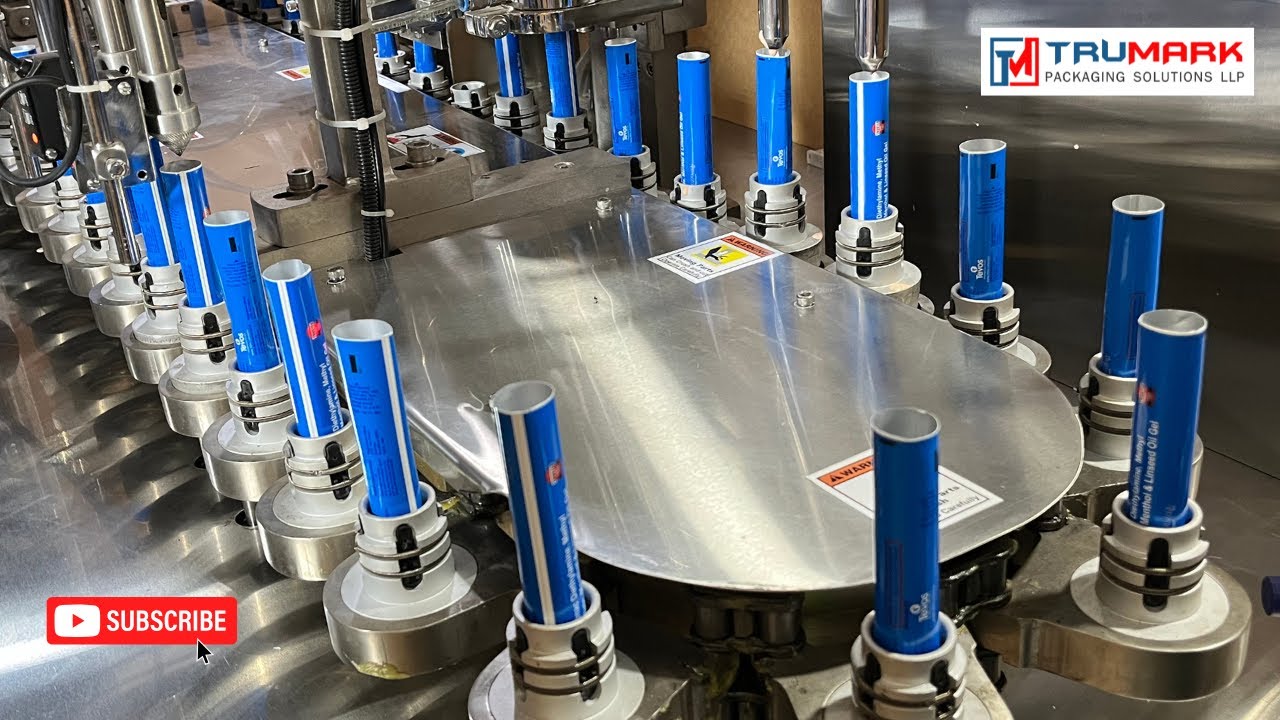 ▶ Watch: Automatic Tube Filling and Sealing Machine — High-Speed Production Line for Cosmetic and Pharmaceutical Packaging
Pay particular attention to the loading station, the seal formation speed, and the operator interface — these are the elements that define sustained production efficiency on an 8-hour shift.
Feature Comparison: Standard vs. Innovative Machine Specifications
| Fonctionnalité | Standard Configuration | Innovative Configuration | Production Impact |
|---|---|---|---|
| Tube loading | Manual (1–2 operators) | Automatic vibratory / robotic | –40–60% labor cost |
| Cutting system | Cam-driven, ±0.5mm tolerance | Servo-driven, ±0.1mm tolerance | –1.5% reject rate |
| Control panel | Fixed button panel | Touchscreen HMI with recipe storage | –50% changeover time |
| Leak detection | End-of-line sample testing | Inline 100% pressure decay NDT | Near-zero field leak escapes |
| Changeover | Manual re-setup, 60–90 min | Modular tooling + recipe recall, 20–30 min | +20–35% effective uptime |
| Drive systems | Fixed-speed induction motors | Servo drives with energy management | –30–40% energy consumption |
| Data output | None / manual logs | OPC-UA, SCADA-ready, batch records | Full production visibility |
| Remote support | Phone + site visit | Secure remote diagnostics | Fault resolution in hours, not days |
ROI Framework: What Innovative Features Return Over 5 Years
For a mid-volume soft tube producer running 15 million tubes per year on a single production line, the incremental value of moving from a standard to an innovative machine configuration typically looks like this:
| Feature Upgrade | Économies annuelles | 5-Year Value |
|---|---|---|
| Auto loading (–1.5 operators/shift, 2 shifts) | $45,000–$90,000 | $225,000–$450,000 |
| Precision cutting (–1.7% reject rate) | $15,000–$25,000 | $75,000–$125,000 |
| Quick changeover (–60 min × 2/day × 250 days) | $36,000–$54,000 | $180,000–$270,000 |
| Servo energy reduction (30% of $40k/yr energy) | $10,000–$15,000 | $50,000–$75,000 |
| Inline leak detection (–field complaints, recalls) | $20,000–$50,000 | $100,000–$250,000 |
| Total estimated 5-year incremental value | $630,000–$1,170,000 |
The purchase price premium of an innovative-feature machine over a standard configuration is typically $40,000–$80,000. Against a 5-year value creation range of $630,000–$1,170,000, the case for that investment is not a close call.
For a detailed ROI calculation tool specific to tube production machinery investment, Miyoda’s tube mill ROI calculator provides a structured framework with real cost data from the cosmetic and pharmaceutical tube manufacturing sector.
Frequently Asked Questions (FAQs)
1. How do automatic tube loading systems reduce production costs?
Automatic tube loading systems replace manual tube feeding — typically requiring one to two operators per shift — with a vibratory bowl, belt conveyor, or robotic pick-and-place system that feeds tubes continuously and in precise orientation without operator intervention. The direct labor saving is 40–60% of loading-related headcount costs. Beyond that, automatic systems eliminate orientation errors (which cause jams and micro-stoppages downstream), maintain consistent feed rates throughout the shift regardless of operator fatigue, and enable reduced-crew or lights-out production during night shifts. For manufacturers in high-labor-cost regions, automatic loading typically delivers full payback within 12–18 months on labor savings alone.
2. Can precision cutting improve my product’s shelf life?
Yes — directly. Consistent tube body cut length within ±0.1mm ensures that the seal zone on every tube is within the designed heating area of the sealing station. Tubes with inconsistent cut lengths produce seals where some portions of the seal interface receive insufficient heat, creating an underseal — a partial bond that allows slow product migration through the seal zone over time. This accelerates product oxidation, contamination risk, and shelf-life degradation even before the tube is opened. Servo-driven cutting that eliminates this variation produces hermetically consistent seals that maintain product integrity through the full intended shelf life.
3. Are digital control panels easy to use for operators with limited technical training?
Modern HMI systems on soft tube production machines are designed specifically for operators without engineering backgrounds. Large touchscreens with graphical displays show the machine’s current state visually rather than through numerical codes. Alarm messages appear in plain language (e.g., “Seal jaw temperature below setpoint — check heater cartridge”) rather than error codes requiring a manual lookup. Multilingual interfaces support teams with diverse language backgrounds. And pre-stored production recipes mean that changing between tube formats doesn’t require understanding what each parameter does — the operator selects the product name and the machine loads the correct settings automatically. Most manufacturers report that new operators reach full independent operation within 2–4 days on a well-designed HMI system, versus 2–4 weeks on older fixed-panel machines.
4. How does integrated leak detection work, and is it mandatory for pharmaceutical tubes?
Integrated inline leak detection on tube production lines most commonly uses pressure decay testing: a pneumatic test fixture grips each sealed tube, briefly pressurizes it to a calibrated level (typically 0.5–2 bar depending on tube material and wall thickness), and monitors pressure over a defined window (0.5–2 seconds). A tube with any form of seal breach — micro-perforation, incomplete seal bond, or junction box pinhole — shows a measurable pressure drop against the tolerance band and is automatically rejected. While the specific regulatory requirement varies by product and market, USP <1207> guidance on container closure integrity testing strongly recommends deterministic, non-destructive testing methods for sterile pharmaceutical packaging. For cosmetic tubes containing water-based formulations prone to microbial contamination, it’s a best-practice quality standard that reduces customer complaint rates and protects brand reputation.
5. What is the average time saved with quick changeover systems?
In the soft tube production industry, conventional changeovers between tube SKUs (size, material, or format changes) typically take 60–120 minutes on machines without quick changeover design. Machines built with modular tooling, standardized mounting interfaces, and HMI recipe storage consistently achieve changeovers in 20–35 minutes — a 40–60% time reduction consistent with SMED methodology benchmarks from Lean Production. On a production line running two changeovers per shift day at 80 tubes per minute and a $0.15 contribution margin per tube, recovering 45 minutes of changeover time twice daily represents $162,000 in restored annual contribution margin. This is among the highest-return features available in modern soft tube production machine design.
6. Do energy-efficient machines compromise on performance?
No — the engineering approach is additive, not substitutive. Energy-efficient servo drives provide better motion control precision than the fixed-speed induction motors they replace, not equivalent precision at lower power. Intelligent PID-controlled heating systems maintain tighter temperature control than on/off cycling systems, improving seal quality while consuming less energy. The energy savings come from eliminating waste — power drawn when no useful work is being performed — not from reducing the power available when production demands it. Independent analysis confirms packaging machines with servo-drive architecture and demand-responsive heating systems achieve 30–40% energy reduction with no throughput or quality trade-off.
7. Can these machines handle both laminated and PE tubes?
Yes — most modern soft tube production machines are configurable for polyethylene (PE) extruded tubes, aluminum-plastic laminate (ABL) tubes, and plastic-plastic laminate (PBL) tubes. The key configuration differences are in the seal jaw geometry and temperature profiles (laminate tubes require different heat sealing parameters than pure PE tubes) and in the tube handling system (laminate tubes are stiffer and require different conveying guidance than flexible PE tubes). These configurations are managed through the HMI recipe system — switching between PE and laminate tube formats is a recipe change, not a mechanical conversion, on well-designed machines. For a detailed guide to the differences between laminate and extruded tube production, Miyoda Packaging Machinery’s tube extrusion machine overview covers the technical considerations for each material type.
8. How does Industry 4.0 integration benefit small to mid-sized manufacturers?
The perception that Industry 4.0 connectivity is only for large-volume manufacturers is a common and expensive misconception. For small to mid-sized tube producers, real-time OEE data delivers proportionally higher value because management resources are tighter — a production manager overseeing three lines cannot physically monitor all three simultaneously, but a connected dashboard shows all three lines’ performance simultaneously on a single screen. Downtime events that would take hours to diagnose through manual investigation can be resolved in minutes when the machine’s data log is accessible remotely. And batch traceability records that would require dedicated quality documentation staff are generated automatically. The cost of OPC-UA connectivity on a new machine is marginal ($2,000–$5,000 as a feature add). The value of a single prevented 4-hour unplanned downtime event typically exceeds that cost.
9. Is remote diagnostics secure and reliable?
Industrial-grade remote diagnostic systems use encrypted VPN (Virtual Private Network) connections and role-based access controls that limit what the connected technician can view or modify. Machine data is read-only unless the operator on-site grants explicit write permission for a specific adjustment. Major machine manufacturers’ remote access platforms comply with IEC 62443 industrial cybersecurity standards. The practical reliability depends on internet connection quality at the manufacturing facility — a 10 Mbps minimum connection supports full remote diagnostic capability including live video, machine data streams, and PLC program review. On the supplier side, Festo’s packaging machine sustainability and remote service capabilities demonstrate the engineering standard for secure industrial remote access in packaging machine applications.
10. What kind of training is provided for new machine operators?
Best-in-class suppliers provide training in two distinct phases: pre-shipment factory training at the manufacturer’s facility (typically 3–5 days, covering machine operation, HMI navigation, routine maintenance, and fault diagnosis) and on-site commissioning training at your facility during machine installation (1–3 days, covering the same topics but using your actual tube materials, your product recipes, and your facility’s specific operating procedures). The commissioning training phase is more valuable than factory training alone because it deals with real production conditions rather than ideal demonstration conditions. Beyond initial training, leading suppliers provide online documentation libraries, operator training videos accessible from the HMI, and refresher training programs for new staff joining an established production team.
11. How do I know if a machine is compliant with GMP or ISO standards?
Ask for documented evidence — not a statement. For pharmaceutical market applications, request: a declaration of conformity to 21 CFR Part 211 equipment design requirements (or EU GMP Annex 15 equivalent), material certificates for all product-contact surfaces (confirming food-grade or pharmaceutical-grade stainless steel, compliant elastomers, and non-contaminating lubricants), and an IQ/OQ (Installation Qualification / Operational Qualification) protocol package that the supplier will execute during commissioning. For cosmetic market applications, ISO 22716 (Good Manufacturing Practice for cosmetics) establishes equipment design and documentation requirements. A reputable supplier maintains this documentation as a standard part of their technical package. A supplier who responds to these requests with “our machines are designed to GMP standards” without documentation is not meeting the evidentiary standard your clients and regulators require.
12. Can I integrate this machine into my existing production line?
Integration with existing upstream and downstream equipment depends on two factors: physical compatibility (conveying heights, tube format, transfer speed) and data compatibility (communication protocols). For physical integration, most modern machines offer adjustable conveying heights and transfer point geometry to match existing line configurations. For data integration, machines with OPC-UA or Modbus TCP output can connect to most current SCADA and MES platforms through standard interfaces. Older equipment without network capability can still be physically connected but won’t contribute to a connected data architecture. When evaluating integration feasibility, provide your machine supplier with the technical specifications of your existing upstream (tube body supply or extrusion line) and downstream (filling, printing, capping) equipment — a qualified supplier will map the interface requirements before quoting.
13. What maintenance is required for digital control systems?
The HMI panel itself — touchscreen, processor, and display — requires minimal maintenance: periodic cleaning of the touchscreen surface with approved non-abrasive cleaners, annual verification that all cable connections are secure, and software updates when the machine manufacturer releases firmware improvements (typically 1–2 times per year). The PLC (Programmable Logic Controller) underlying the HMI has no user-serviceable parts and typically runs for 10–15 years without hardware intervention in a stable production environment. Battery backup for the PLC’s memory — maintaining stored recipes and parameters during power outages — should be checked annually and replaced every 3–5 years. Total annual maintenance time for the digital control system on a typical tube production machine is 2–4 hours.
14. Do you offer customization for specific tube sizes or production volumes?
Leading soft tube production machine suppliers — including Miyoda Packaging Machinery — design machines around a configurable platform that accommodates a defined range of tube diameters (typically Φ13mm–Φ60mm), tube lengths (60–220mm), and production speeds (40–200 tubes per minute depending on configuration). Within that platform range, tooling sets for specific tube dimensions are quoted separately and can be ordered simultaneously with the machine or added later as new tube formats are introduced. For production volumes outside the standard platform range — very high volumes requiring multi-machine configurations, or very small specialty volumes requiring batch-mode production — custom engineering solutions are available, typically with a 8–16 week additional lead time for design and tooling manufacture. Provide your current and projected tube format range and annual volume targets to your machine supplier at the earliest stage of the evaluation process.
15. How do innovative features impact return on investment (ROI)?
The ROI impact of innovative machine features operates across four independent value streams, each contributing to accelerated payback. Labor savings from automation (automatic loading, recipe-driven changeovers) typically represent the largest single component — $45,000–$90,000 annually for a 2-shift operation. Quality improvement from precision cutting and inline leak detection reduces reject and rework costs and eliminates the tail risk of field failures and recalls. Uptime improvement from quick changeover systems and predictive maintenance capability recovers contribution margin that conventional machines leave on the table every shift. Energy reduction from servo drives and intelligent heating management directly reduces utility costs with no operational trade-off. Combined, these streams deliver ROI on the feature premium in 12–18 months for mid-volume producers — and create a compounding cost advantage over a 10-year machine life that significantly exceeds the initial investment differential.















